Colored BIPV Procurement: How to Evaluate Suppliers Before a Solar Facade Project
Colored BIPV Procurement Is Not Standard Solar Module Purchasing
Buying standard solar modules is already a technical procurement process, but the logic is relatively mature. A buyer compares module power, efficiency, cell technology, degradation rate, warranty, certifications, bankability, price per watt, shipping schedule and supplier reputation. The product is usually installed on a roof, ground structure or solar farm where appearance is secondary to performance and cost.
Colored BIPV procurement is different because the product is not only a solar module. It is also a visible architectural material. It may become part of a facade, curtain wall, rainscreen cladding system, canopy, skylight, balcony railing, roof-integrated surface or public-facing solar wall. If the supplier fails, the problem is not only lower energy output. The building may look wrong, the facade may fail approval, replacement panels may not match, construction may be delayed, and the owner may lose confidence in the entire project.
This is why solar facade procurement must be handled with a broader mindset. The buyer is not simply purchasing watts. The buyer is purchasing a combination of energy performance, facade appearance, building-envelope compatibility, color stability, documentation, engineering coordination, warranty clarity, logistics discipline and long-term serviceability.
A standard PV module can often be replaced with another module of similar size and power. A custom colored BIPV panel cannot always be replaced so easily. Its color, finish, glass structure, junction box position, mounting interface and facade role may be project-specific. A missing or mismatched replacement panel can become visible on the building for years.
For this reason, the central question in BIPV supplier evaluation is not “Who offers the lowest price?” The better question is “Which supplier can reduce project risk from design approval to long-term operation?”
A good supplier does not only sell panels. A good architectural solar supplier helps the buyer translate building requirements into a reliable photovoltaic facade system.
Start With the Project Type Before Shortlisting Suppliers

Many buyers begin by asking suppliers for a quotation too early. They send a rendering, a panel size, a color preference and an estimated area. Then they compare prices. This approach may work for simple product categories, but it is risky for BIPV.
Before selecting a colored solar panel supplier, the buyer should first define the project type clearly. Is the project a new facade, a retrofit facade, a heritage roof, a solar canopy, a curtain wall, a decorative solar wall, a public building, a commercial office tower, a hotel, a residential development or a transport facility? Each type has different requirements.
A curtain wall project may require glass safety, strict facade engineering and hidden electrical routing. A retrofit project may require phased installation, compatibility with an existing structure and active-passive panel matching. A public building may require visible sustainability messaging and strong documentation. A heritage project may require roof-matching colors and approval support. A solar mural may require custom patterns and detailed panel mapping.
This means supplier capability must match project complexity. A supplier that can produce colored modules for a simple roof application may not be suitable for a high-rise facade. A supplier that can make beautiful samples may not be able to support facade drawings, cable routing, replacement strategy or construction documentation. A supplier with good standard modules may not understand custom BIPV project delivery.
A strong custom BIPV sourcing process begins with a project brief. The brief should describe application, building type, visible surfaces, color intent, active area, passive panel needs, local codes, expected output, facade system, installation method, sample approval process and project schedule.
Without this brief, suppliers may quote different assumptions. The buyer may think the prices are comparable, but they are not. One quote may include engineering support, passive panels and color control. Another may include only active modules. One may assume standard glass. Another may assume safety laminated glass. One may include documentation. Another may not.
In colored BIPV procurement, unclear scope creates false savings.
Color Samples Are Not Marketing Materials; They Are Procurement Evidence
Color is one of the biggest risk points in BIPV. A supplier may show attractive product photos, renderings or small samples, but the real question is whether the color can be repeated at building scale and remain stable over time.
For solar facade procurement, color samples should be treated as formal procurement evidence. They should not be reviewed casually. The buyer should request physical samples for each proposed color and finish. These samples should be viewed outdoors, under different light conditions, and next to adjacent building materials such as glass, aluminum, stone, brick, ceramic panels or passive cladding.
Small samples are useful for early selection, but larger mockups are needed before final procurement. A color that looks acceptable on a small piece may appear too strong, too dull, too reflective or too inconsistent across a large facade. Viewing angle also matters. Some colored PV technologies shift appearance depending on angle, sunlight and sky condition.
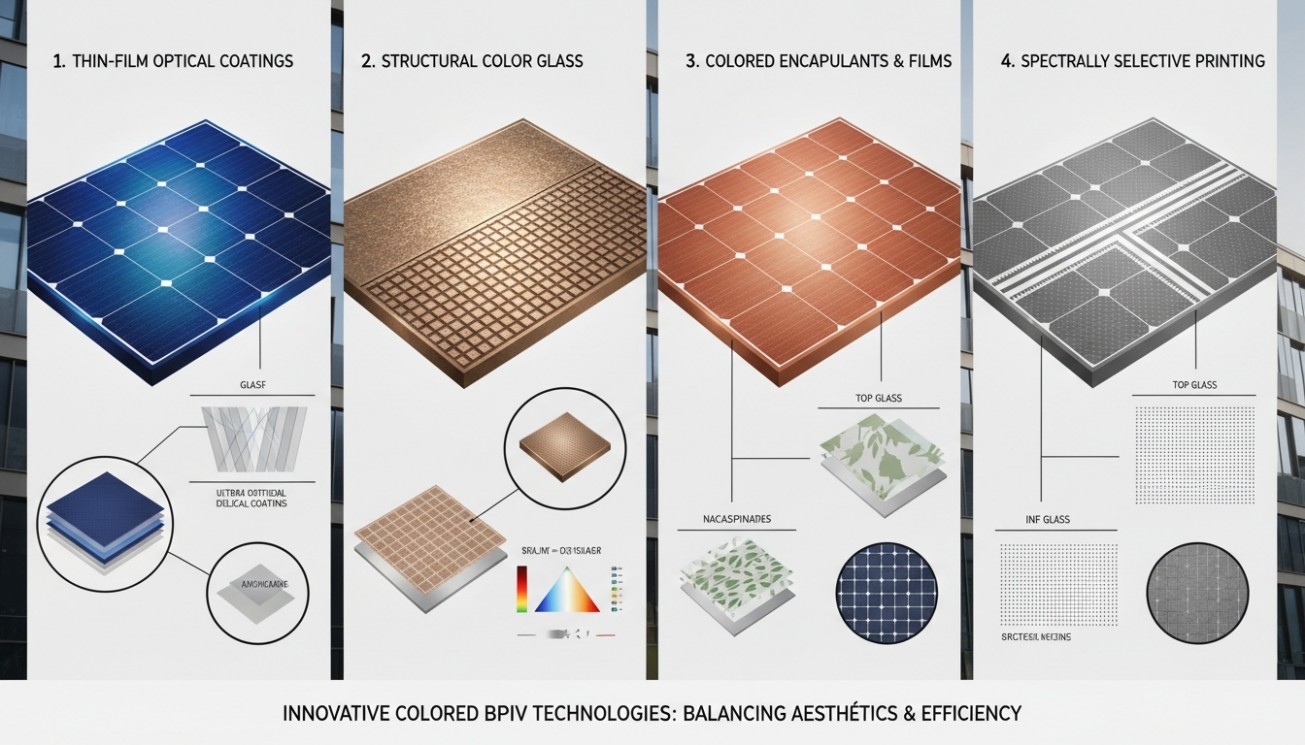
The buyer should ask the colored solar panel supplier how color is created. Is it coating, ceramic printing, colored interlayer, film, structural color or another method? How does the method affect output? How is color tolerance controlled? Can the supplier provide active and passive panels with matching appearance? Can replacement panels match future batches?
This is where BIPV quality control begins. If color is not controlled, the facade can become visually defective even if the electrical system works. The supplier should be able to define color tolerance, production batch control, sample approval procedure and replacement color strategy.
A serious buyer should keep approved color records. These records should include sample codes, production references, photos under controlled conditions, color tolerance information and supplier confirmation. This documentation may become important years later if panels need replacement.
In colored BIPV, the sample is not a sales tool. It is part of the contract risk.
Performance Data Must Be Color-Specific
A common procurement mistake is accepting generic module performance data. A supplier may provide a standard datasheet showing power output, efficiency and warranty. But if the project uses colored panels, the buyer must ask whether the data applies to that exact color, technology and glass structure.
Colored BIPV procurement requires color-specific performance data. Different colors can have different output levels because they reflect, absorb or transmit light differently. A blue panel, terracotta panel, grey panel, bronze panel and white panel may not perform the same. A custom pattern may perform differently from a solid color. A semi-transparent panel may perform differently from an opaque panel.
The buyer should request output per square meter for each color option. In facade projects, Wp/m² is often more useful than panel wattage because building surfaces are constrained by area, grid and facade rhythm. Annual yield modeling should also be requested, especially for large projects. The model should include orientation, shading, local irradiance, vertical installation, color-related loss, temperature behavior, inverter strategy and active panel area.
This does not mean the highest-output color is always the best choice. A lower-output color may be more acceptable architecturally and may allow a larger active area. But the trade-off must be known before procurement.
A reliable architectural solar supplier should be honest about performance differences between colors. Vague claims such as “high efficiency” or “similar to standard modules” are not enough. The buyer should ask for test data, measurement conditions and whether the figures are based on samples, mass production or estimated calculations.
For solar facade risk management, transparency is better than optimism. A realistic performance model helps the owner, architect, EPC and investor understand what the project can actually deliver.
Quality Control Must Cover Both Solar and Facade Requirements
Standard solar quality control focuses on electrical performance, cell quality, lamination, insulation, mechanical load, degradation, microcracks, hot spots and environmental testing. BIPV must include those checks, but it also needs facade-level quality control.
BIPV quality control should include color consistency, glass dimensions, edge quality, thickness tolerance, visual defects, coating uniformity, print alignment, active-passive matching, junction box placement, cable exit position, mounting interface, packaging protection and documentation accuracy.
This is especially important when a project uses custom BIPV panels. Custom dimensions and colors increase the risk of production variation. A standard module production line is optimized for repeatability. A custom BIPV project may involve smaller batches, multiple panel types and special handling. Without strong quality control, errors can appear during installation.
The buyer should ask whether the supplier provides a project-specific quality plan. This plan should define inspection steps, acceptance criteria, factory testing, sample approval, production batch tracking, packing inspection and pre-shipment documentation. For large facade projects, third-party inspection may be useful.
The buyer should also ask how panels are labeled. If active and passive panels look similar, each panel must be clearly identified. If different colors or patterns are used, panel location codes must be accurate. A wrong panel installed in the wrong location can damage both appearance and electrical grouping.
For BIPV project delivery, quality control is not only about avoiding defective products. It is about making sure the right panel reaches the right place, in the right sequence, with the right documentation.
Warranty Must Be Divided Into Clear Layers
Buyers often ask about warranty as if it were one simple number. In BIPV, warranty is more complex. A colored PV module warranty may involve several layers: product warranty, power output warranty, color stability warranty, glass warranty, coating or printing warranty, water tightness responsibility, facade system warranty, installation warranty and electrical system warranty.
These layers may be provided by different parties. The module manufacturer may cover product defects and power degradation. The facade contractor may cover installation and weatherproofing. The electrical contractor may cover wiring and inverters. The coating or glass processor may have separate material terms. If responsibilities are unclear, the owner may face disputes later.
A serious solar facade procurement process should define warranty boundaries before signing. The buyer should ask:
What does the product warranty cover?
What does the power warranty cover?
Does the warranty apply to the selected color?
Is color fading or color shift covered?
Are coatings, films or printed layers included?
What happens if active panels and passive panels age differently?
Who is responsible for water leakage?
Who is responsible for glass breakage?
Who is responsible for installation defects?
What conditions void the warranty?
How are replacement panels supplied?
Can replacement color be guaranteed?
This is critical for solar facade risk management. A warranty that looks strong on paper may be weak if it excludes the actual risks of colored BIPV. For example, a power warranty may not help if the facade becomes visually mismatched. A product warranty may not cover installation water leakage. A color claim may be useless without measurable tolerance.
The buyer should not accept vague warranty language. Colored BIPV is a long-term building material, and warranty language must reflect that reality.
Active and Passive Panels Change Procurement Scope
Many colored BIPV facades use both active and passive panels. Active panels generate electricity. Passive panels do not generate power but are used to complete the facade appearance, fill shaded zones, cover non-electrical areas or match the visual rhythm of the building.
This has major implications for colored BIPV procurement. If the buyer only requests active panels, the facade may later require separate passive cladding from another supplier. Matching may become difficult. If passive panels are not included in the original scope, the final building may look inconsistent.
A professional BIPV supplier evaluation should therefore ask whether the supplier can provide active and passive panels as a coordinated system. The passive panels should match color, gloss, surface finish, joint rhythm and durability as closely as possible. They should also fit the same mounting logic if required.
The buyer should ask for an active-passive panel map. This map should identify which panels generate power, which are passive, how they are grouped, and how they are installed. It should be included in design documents, production schedules and as-built records.
Active-passive coordination also affects cost comparison. A low quote for active panels may not include passive panels. A higher quote may include a full facade package. These prices are not directly comparable.
For custom BIPV sourcing, the buyer should evaluate the entire facade surface, not only the active solar area. The building owner cares about how the whole facade looks and performs. Procurement should reflect that.
Delivery Risk Is Higher Than Most Buyers Expect
BIPV panels are often project-specific, fragile, heavy, visually sensitive and sequence-dependent. This makes logistics important.
In standard PV projects, modules are usually delivered in large batches and installed in repeated layouts. In BIPV facade projects, panels may have different sizes, colors, functions and positions. Some panels may belong to a specific floor, elevation or facade zone. If panels are delivered out of sequence, damaged in transit or mislabeled, installation delays can occur.
BIPV project delivery should therefore include a logistics plan. The buyer should ask how panels will be packed, labeled, protected, shipped, unloaded, stored and distributed on site. Packaging should protect not only the electrical module but also the visible surface. Scratches, edge damage or coating marks may be unacceptable on a facade panel.
For international projects, shipping risk can be significant. Glass-based BIPV may require special crates, moisture protection, shock monitoring and careful unloading. Customs documentation, insurance, lead time and replacement strategy should be considered.
The buyer should also ask about spare panels. For custom colored projects, it may be wise to order spare active and passive panels from the same production batch. Future replacement panels may be difficult to match exactly. Spare panels create upfront cost but reduce long-term risk.
In solar facade procurement, delivery is not a minor operational detail. It is part of the project’s success.
Engineering Support Is Often More Valuable Than a Lower Unit Price

A supplier may offer a low module price but little technical support. Another supplier may be more expensive but provide drawings, sample coordination, facade interface advice, electrical layout support, documentation and replacement planning. For BIPV, the second supplier may be the safer choice.
An architectural solar supplier should be able to communicate with architects, facade consultants, EPC contractors, electrical engineers and developers. The supplier should understand drawings, module grids, cable exits, glass build-ups, color approval, facade substructures and construction sequencing.
The buyer should ask what engineering support is included. Does the supplier provide shop drawings? Can they advise on mounting interfaces? Can they coordinate cable exit positions? Can they provide BIM objects or panel schedules? Can they support mockups? Can they join technical meetings? Can they provide installation guidance? Can they prepare documentation for approval?
If a project is simple, limited support may be acceptable. If the project is a visible facade, high-rise, retrofit, heritage building or custom pattern, engineering support becomes essential.
This is one of the most important points in BIPV supplier evaluation: the cheapest product may not be the lowest-risk solution. In BIPV, design errors, approval delays, color mismatch, delivery mistakes and installation conflicts can cost far more than the difference between two module prices.
Price Should Be Evaluated Against Facade Value, Not Only PV Value

Many buyers compare colored BIPV with standard PV and conclude that it is expensive. That may be true if the comparison is only price per watt. But colored BIPV procurement should be evaluated against both energy value and facade value.
If BIPV replaces passive cladding, part of the cost belongs to the building envelope. If it supports green certification, part of the value belongs to sustainability strategy. If it improves building image, part of the value belongs to asset positioning. If it enables solar on a visible surface that standard modules could not occupy, part of the value belongs to project feasibility.
This does not mean colored BIPV is always financially justified. Some projects are too shaded, too complex or too expensive. But the evaluation should use the right comparison.
A buyer should compare:
Passive facade material plus separate PV.
Standard rooftop PV only.
Standard dark BIPV panels.
Colored BIPV with active and passive panels.
Colored BIPV as part of a full facade renovation.
Colored BIPV with branding, ESG and tenant value included.
The right model depends on project goals. A warehouse roof may not need colored BIPV. A public-facing office facade may justify it. A heritage building may need it for approval. A corporate headquarters may value the visible sustainability message. A retrofit project may combine cladding replacement and energy generation.
In solar facade risk management, price is only one part of value. The real question is whether the product reduces or increases total project risk.
Red Flags in Colored BIPV Supplier Evaluation

Buyers should watch for warning signs during BIPV supplier evaluation.
One red flag is a supplier that talks only about color availability but cannot explain how color affects performance.
Another red flag is a supplier that provides standard PV datasheets without color-specific data.
Another is a lack of physical samples or reluctance to provide outdoor mockups.
Another is vague warranty language, especially around color stability, coating durability and replacement panels.
Another is no clear active-passive panel strategy.
Another is no project-specific quality control plan.
Another is inability to support facade drawings or cable routing coordination.
Another is unclear fire, glass or building-envelope documentation.
Another is overpromising that any color, size or pattern can be made without trade-offs.
Another is quoting only active panels when the facade clearly requires passive matching panels.
Another is poor logistics planning for custom glass modules.
Another is no evidence of completed BIPV projects or no willingness to discuss project limitations.
A good supplier does not need to have every answer immediately, but they should understand the questions. If a supplier treats colored BIPV like ordinary panel trading, the buyer should be cautious.
A Practical Procurement Workflow for Colored BIPV Buyers

A structured colored BIPV procurement workflow can reduce mistakes.
Define the Building and Application
Clarify whether the project is facade, roof, canopy, curtain wall, retrofit, heritage, public art or cladding replacement. Define the project role before contacting suppliers.
Prepare a Technical Brief
Include location, orientation, area, facade drawings, desired colors, active-passive needs, expected output, application type, local requirements and schedule.
Shortlist Suppliers by Capability
Do not shortlist only by price. Evaluate experience, technology, customization ability, documentation, engineering support and project references.
Request Samples and Color Data
Ask for physical samples, color-specific output data, durability information and active-passive matching options.
Compare Scope Carefully
Check whether quotations include active panels, passive panels, mounting interfaces, packaging, engineering support, testing, documentation, spare panels and warranty terms.
Review Technical Risks
Assess fire, glass safety, waterproofing, structural load, cable routing, color consistency, replacement strategy and installation method.
Build a Mockup
Use mockups to confirm color, reflection, cell visibility, joint rhythm, active-passive matching and facade details.
Finalize Contract and Quality Plan
Define approved samples, inspection criteria, production records, delivery sequence, warranty layers and replacement obligations.
Manage Delivery and Installation
Track panel labels, packaging, site storage, installation sequence, damage control and as-built documentation.
Plan Long-Term Operation
Keep color records, spare panels, maintenance manuals, monitoring data, warranty contacts and replacement procedures.
This workflow turns custom BIPV sourcing from a risky product search into a controlled project process.
Focused FAQ
What is colored BIPV procurement?
Colored BIPV procurement is the process of sourcing colored building-integrated photovoltaic products for facades, roofs, canopies or cladding systems while evaluating color, performance, safety, facade compatibility, delivery, warranty and supplier support.
How is BIPV supplier evaluation different from normal PV supplier evaluation?
BIPV supplier evaluation must consider architectural appearance, glass structure, active-passive panels, color consistency, facade engineering, cable routing, safety documentation and long-term replacement, not only module wattage and price.
What should buyers ask a colored solar panel supplier?
Buyers should ask a colored solar panel supplier about color technology, output per color, sample approval, color tolerance, active-passive matching, certifications, warranty, quality control, delivery protection and engineering support.
Why is solar facade procurement complex?
Solar facade procurement is complex because the product must work as both a photovoltaic system and a building envelope material. It affects appearance, energy generation, safety, waterproofing, structure, maintenance and long-term asset value.
What does BIPV quality control include?
BIPV quality control includes electrical testing, color consistency, glass dimensions, coating or print quality, junction box placement, cable exit accuracy, panel labeling, packaging inspection and project-specific production records.
What should a colored PV module warranty cover?
A colored PV module warranty should clarify product defects, power output, color stability, coating or film durability, replacement panels, exclusions, installation responsibilities and whether the selected color is covered by the warranty.
Why is architectural solar supplier support important?
An architectural solar supplier should support drawings, samples, mockups, facade coordination, electrical interface discussions, quality documents and replacement planning. This support can reduce project risk more than a low unit price.
How can buyers reduce solar facade risk?
Buyers can improve solar facade risk management by preparing a clear project brief, requesting color-specific data, using physical mockups, defining active-passive panels, checking warranty layers, requiring quality control plans and documenting replacement procedures.
Conclusion
Colored BIPV can create powerful value for buildings, but only when it is procured correctly. It is not a commodity solar purchase. It is a project-specific combination of photovoltaic performance, architectural material, facade system, visual identity and long-term asset responsibility.
A strong colored BIPV procurement process begins with project clarity. The buyer must define the application, building role, color intent, active area, passive panel needs, facade system and performance expectations before comparing suppliers. A strong BIPV supplier evaluation then looks beyond price. It checks color technology, output data, quality control, warranty layers, engineering support, logistics discipline and project references.
The best colored solar panel supplier is not always the cheapest. It is the supplier that can reduce uncertainty across design, approval, production, delivery, installation and operation. In BIPV, the cost of mistakes can appear on the building’s face.
For developers, solar facade procurement should be evaluated against facade value as well as energy value. For architects, supplier selection must protect design intent. For EPCs and contractors, documentation and logistics are essential. For building owners, warranties, replacement panels and maintenance records determine long-term confidence.
Colored BIPV succeeds when procurement understands the full system. The product must generate power, fit the building, survive weather, satisfy codes, arrive safely, install correctly, age predictably and remain serviceable for decades.
That is the real difference between buying panels and delivering a solar facade.