Colored BIPV for Historic Buildings: Can Solar Energy Fit Heritage Architecture?
Historic Buildings Need Solar, But They Cannot Be Treated Like Ordinary Roofs
Historic buildings are often discussed as if they belong only to the past. Their stone walls, brick facades, timber structures, clay roofs, decorative cornices, arched windows, and traditional streetscapes are protected because they hold cultural, architectural, and urban value. But these buildings also exist in the present. They consume energy, require maintenance, face rising operating costs, and sit inside cities that are trying to reduce carbon emissions.
This creates a difficult question: how can historic buildings participate in the energy transition without losing the visual and cultural qualities that make them worth preserving?
The answer is not as simple as installing standard black solar panels on every available roof. In many heritage districts, ordinary PV modules may be rejected because they interrupt rooflines, contrast with clay tiles, disturb historic facades, or create a technical appearance that does not belong to the architectural context. The issue is not only engineering. It is identity.
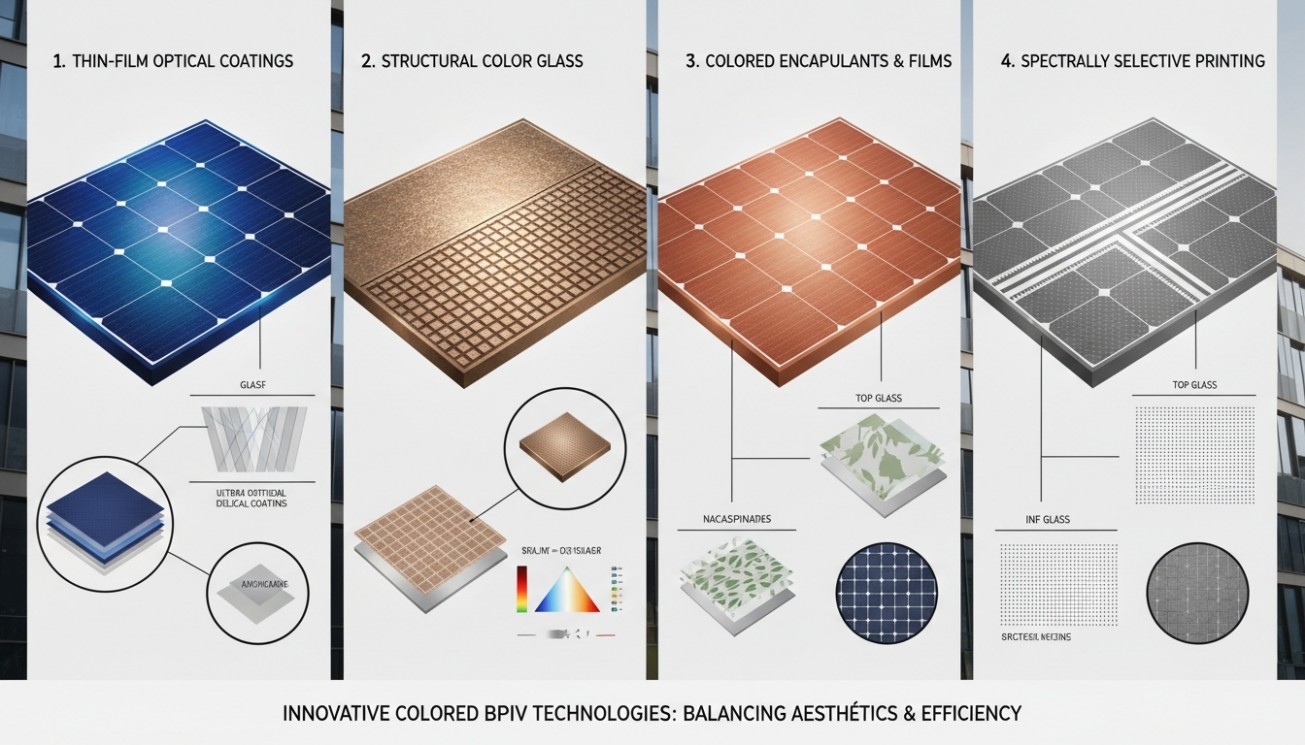
This is where colored BIPV for historic buildings becomes important. Instead of asking heritage architecture to accept the appearance of conventional solar equipment, colored building-integrated photovoltaics ask solar technology to adapt to the visual language of the building. This is a major shift. It changes solar from a visible attachment into a potential restoration-compatible material.
The goal of heritage solar panels is not to hide sustainability. The goal is to make renewable energy compatible with preservation. A historic building does not need to become visually modern to become energy-efficient. It needs solar solutions that respect scale, color, texture, roof geometry, facade rhythm, and public perception.
In this context, BIPV is not just a technical product category. It becomes a negotiation between climate responsibility and cultural continuity.
Why Conventional Solar Panels Often Fail in Heritage Contexts

Standard solar panels are designed for energy performance, manufacturing efficiency, and installation scale. They are excellent for many rooftops, industrial buildings, commercial roofs, and utility projects. But they often fail visually in historic environments.
The first problem is color contrast. Many historic roofs use terracotta, red clay, slate, copper, weathered metal, or muted earth tones. A blue-black module can look like a foreign object on these surfaces. Even when the installation is technically clean, it may appear visually disruptive.
The second problem is geometry. Historic roofs may have dormers, chimneys, irregular slopes, ridges, towers, skylights, and decorative roof details. Standard rectangular modules do not always fit these patterns. Poorly arranged modules can break the visual rhythm of the roof.
The third problem is visibility. In some modern commercial settings, rooftop equipment is barely seen from street level. In historic districts, roofscapes are often part of the public view. A church roof, town hall roof, old school roof, railway station canopy, or historic market hall may be visible from streets, plazas, hills, bridges, or neighboring buildings.
The fourth problem is approval. Heritage authorities, planning boards, local communities, and building owners may require that any intervention preserve the character of the structure. If solar is presented only as a functional add-on, it may face resistance.
The fifth problem is reversibility. Some heritage projects require that new systems can be removed in the future without damaging the original building. This affects mounting methods, roof penetration, cable routing, waterproofing, and maintenance access.
These challenges explain why solar panels for old buildings cannot be selected only by wattage and price. They must be evaluated through visual impact, installation method, preservation rules, and long-term building behavior.
Colored BIPV Changes the Conversation From Conflict to Compatibility
The most important value of colored BIPV for historic buildings is that it changes the project conversation. Instead of asking whether solar panels will damage the appearance of the building, the project team can ask how photovoltaic materials can be designed to fit the building.
This does not mean every historic building is suitable for BIPV. Some buildings may be too sensitive, too shaded, structurally limited, or visually protected. But colored BIPV gives designers more options than conventional PV.
A roof with red clay tiles may be able to use terracotta solar modules that reduce contrast. A slate roof may be able to use dark grey or matte black modules with less visual disturbance. A brick facade may be able to integrate warm-toned photovoltaic cladding in less sensitive areas. A historic industrial building may be able to use solar facade retrofit strategies on rear elevations, courtyard walls, or newer additions. A public heritage building may use solar canopies or outbuildings instead of the most protected roof surface.
The point is not to force solar everywhere. The point is to expand the design toolkit.
In heritage projects, compatibility is more important than novelty. Solar products must avoid looking like a last-minute technical layer. Roof-matching solar panels can support this goal because they reduce the visual distance between photovoltaic function and traditional material appearance.
When solar becomes visually compatible, social acceptance improves. Local stakeholders are more likely to support a project if it appears respectful rather than invasive. This is why color is not a superficial feature in heritage solar. It can influence whether the project is allowed to happen.
Terracotta Solar Modules and the Importance of Roofscape Continuity

Among all colored BIPV options, terracotta solar modules are especially relevant for historic buildings. Terracotta roofs are common in many regions, including parts of Europe, the Mediterranean, Latin America, and older urban districts worldwide. Their warm red-orange tones are strongly associated with traditional architecture, civic identity, and roofscape continuity.
A standard dark module placed on a terracotta roof can disrupt this continuity. The roof may suddenly appear patched, divided, or visually dominated by modern equipment. In heritage areas, that visual break can be unacceptable.
Terracotta solar modules offer a different approach. They aim to preserve the overall warmth of the roof while adding photovoltaic function. The modules may not disappear completely, and they should not be marketed as magic invisible solar. But they can reduce contrast enough to make the installation more acceptable.
The success of terracotta BIPV depends on several details. The color should not be selected from a screen rendering alone. Terracotta varies widely. Some roofs are bright orange, some are muted red, some are brownish clay, and some are aged with weathering and surface variation. A new solar module that is too uniform may still stand out against an old roof. A slightly textured or muted finish may integrate better than a flat bright color.
The module layout also matters. A small patch of photovoltaic panels may look more disruptive than a carefully planned roof zone. In some cases, replacing an entire roof plane with roof-matching solar panels can look more coherent than placing a few modules in the center. In other cases, the best solution may be to use solar only on less visible roof slopes.
Performance must also be discussed honestly. A terracotta appearance may involve optical trade-offs. The project team should evaluate output per square meter, expected annual yield, color stability, and maintenance strategy. The value of terracotta solar modules lies in enabling solar adoption where standard modules may not be accepted.
Heritage Solar Panels Must Respect the Building’s Hierarchy
Not every surface on a historic building has the same importance. A main street-facing roof may be highly sensitive. A rear roof slope may be less visible. A decorative facade may be protected. A later extension may have more flexibility. A courtyard elevation may be suitable for intervention. A service building or annex may offer solar potential without touching the most significant historic fabric.
This is why heritage solar panels should be planned through a hierarchy of sensitivity.
The first step is to identify the building’s most important visual and cultural elements. These may include the principal facade, roofline, entrance axis, historic masonry, ornament, public view corridors, tower elements, or original materials. These areas require the greatest caution.
The second step is to identify less sensitive zones. These may include rear elevations, flat roof sections, modern additions, internal courtyards, service buildings, replacement roofs, parking canopies, or new landscape structures. These areas may provide better opportunities for solar integration.
The third step is to compare solar potential with heritage sensitivity. A surface with excellent sun exposure may still be unsuitable if it damages the building’s character. A surface with moderate yield may be more appropriate if it has lower visual impact. In architectural heritage solar, the best solution is not always the highest-yield surface. It is the surface where energy value and preservation value can coexist.
This hierarchy prevents solar design from becoming a purely technical exercise. It also helps explain the project to heritage authorities. Instead of saying “we want to install panels,” the project team can show that it has studied visibility, significance, reversibility, material compatibility, and energy contribution.
That level of thinking is essential for serious BIPV renovation.
Solar Panels for Old Buildings Require More Than Visual Matching
Color matching is important, but solar panels for old buildings must solve more than appearance. Historic buildings often have complex structural, material, and maintenance conditions.
Older roofs may have limited load capacity. Timber structures, old rafters, fragile tiles, uneven surfaces, and aging waterproofing can make installation difficult. Before selecting a photovoltaic product, the project team must understand whether the roof can support the added load and whether the mounting method is appropriate.
Waterproofing is another major issue. Historic roofs may not tolerate unnecessary penetrations. Poor installation can create leaks, moisture damage, or deterioration of original materials. A solar project that saves energy but damages the building is not a successful project.
Electrical routing also requires sensitivity. Cables, conduits, junction boxes, inverters, and monitoring systems should be placed without harming protected elements or creating visual clutter. In some buildings, interior routes may be limited by historic finishes. Exterior cable runs may be visually unacceptable. This means electrical design must be planned early.
Fire safety must be reviewed carefully. Historic buildings may contain timber structures, limited compartmentation, old materials, or difficult access for emergency response. The PV system should be designed with appropriate isolation, fire considerations, maintenance access, and documentation.
Maintenance is also critical. A solar system on an old building should be serviceable without repeated damage to historic fabric. If cleaning, replacement, or inspection requires risky access, the long-term project may become difficult.
For these reasons, colored PV modules alone do not guarantee a good heritage solar solution. The module must be part of a complete preservation-aware system.
BIPV Renovation Is Different From New-Build BIPV

A new building can be designed around BIPV from the beginning. The architect can set the facade grid, roof pitch, structure, cable paths, inverter rooms, fire zones, and maintenance access with photovoltaic integration in mind. Heritage projects are different. The building already exists. Its form, materials, constraints, and cultural significance are already established.
This makes BIPV renovation more complex than new-build BIPV.
In renovation, the solar system must adapt to the building rather than the building adapting to the solar system. Roof geometry may be irregular. Facade dimensions may not match standard module sizes. Structural upgrades may be limited. Original materials may need to remain visible. Planning approval may require careful documentation. Construction work may need to avoid damage to historic fabric.
At the same time, renovation can create opportunities. If a roof is already due for repair, building-integrated solar renovation may be considered as part of the replacement strategy. If an old facade needs energy upgrading, solar cladding may be evaluated on less sensitive elevations. If a public building is being modernized, a carefully designed BIPV system can support both energy targets and educational value.
The key is timing. Solar should be considered early in the renovation planning process, not after the conservation scope is already fixed. If the project team waits too long, the most compatible integration opportunities may be lost.
A strong BIPV renovation strategy connects roof repair, facade maintenance, energy performance, heritage approval, and long-term operation into one decision process.
Building-Integrated Solar Renovation Should Not Erase Historic Character
The phrase building-integrated solar renovation can sound technical, but in heritage architecture it must be handled with cultural care. Integration does not mean covering the building with new technology until the original identity disappears. True integration means adding energy function while preserving the readable character of the building.
This requires restraint. Some surfaces should remain untouched. Some interventions should be placed in secondary zones. Some products should be color-matched. Some modern additions can carry the solar load so that historic fabric is protected. Some projects may use nearby structures, canopies, or new extensions instead of placing PV on the most sensitive roof.
The best heritage solar projects are not always the most visually invisible. They are the most respectful. In some cases, a carefully expressed solar element may be acceptable if it is clearly contemporary but well proportioned. In other cases, near-invisibility is required. The correct approach depends on the building’s significance and the local preservation philosophy.
This is why architectural heritage solar requires collaboration. Solar engineers, architects, conservation specialists, facade consultants, structural engineers, local authorities, and building owners must work together. If one discipline dominates, the project may become unbalanced. A purely technical approach may harm heritage value. A purely preservationist approach may block necessary decarbonization. A purely visual approach may ignore safety and performance.
The goal is not compromise in the weak sense. The goal is synthesis: energy improvement that strengthens the building’s future without weakening its past.
Roof-Matching Solar Panels and the Psychology of Acceptance
Public acceptance plays a major role in heritage solar. People may support renewable energy in general but object when they believe solar panels damage a beloved building or historic streetscape. This is not always irrational. Buildings carry emotional and cultural meaning. A technical installation can feel like a loss if it changes the character of a place.
Roof-matching solar panels address this psychological barrier. By reducing contrast, they make solar feel less intrusive. They help people see the project as an energy upgrade rather than a visual disruption.
This does not mean everyone will accept the project. Some stakeholders may oppose any visible intervention. Others may question performance, cost, authenticity, or long-term maintenance. But color matching gives the project team a stronger starting point. It shows that the design respects the building.
The psychology of acceptance also depends on communication. A project team should explain why solar is needed, why the selected surface is appropriate, how the color was chosen, what alternatives were considered, how the installation protects historic materials, and what energy benefits the system will provide.
For public buildings, transparency is especially important. A school, library, museum, or municipal building using heritage solar panels can become a demonstration of how older architecture can participate in climate action. The story should not be “we added panels.” The story should be “we found a way for a historic building to remain useful, responsible, and relevant.”
Solar Facade Retrofit in Heritage Settings
Most heritage solar discussions focus on roofs, but facades can also be relevant in some projects. A solar facade retrofit may be possible on less sensitive elevations, newer additions, industrial heritage buildings, courtyard walls, or replacement facade zones.
Historic industrial buildings are especially interesting. Warehouses, factories, railway buildings, mills, and older commercial structures often have large surfaces and may be undergoing adaptive reuse. Some may have brick facades that should remain visible, but others include later additions or blank walls where carefully selected photovoltaic cladding could be appropriate.
A solar facade retrofit can also work when the project includes a new extension. Instead of placing solar directly on the original building, the new volume can carry the photovoltaic surface. This allows the project to meet energy goals while preserving the historic structure.
Facade retrofit requires careful material coordination. A colored photovoltaic facade should not mimic historic materials in a cheap or false way. It should either complement the old building respectfully or clearly distinguish new from old while maintaining visual harmony. Terracotta, bronze, grey, and muted tones can all be useful depending on context.
In some cases, the facade system may combine active and passive panels. Active panels generate electricity in suitable zones, while passive panels maintain visual continuity in shaded or non-electrical areas. This approach is common in professional BIPV thinking and can be useful in heritage-adjacent projects.
A good solar facade retrofit is not about covering old architecture. It is about identifying where the building can accept new energy function without losing its integrity.
Colored PV Modules Must Be Evaluated by Lifecycle, Not Only Installation Day
A heritage solar project may take months or years to approve, design, install, and commission. But the building may stand for decades or centuries. This is why colored PV modules should be evaluated through lifecycle thinking.
Color stability matters. If a terracotta module fades differently from surrounding roof materials, the system may become more visible over time. If replacement modules do not match the original batch, repairs may create patchwork. If the color layer degrades, the project may lose both energy and architectural value.
Maintenance matters. Can panels be cleaned without damaging old roof tiles? Can a module be replaced without removing large sections of roof? Can maintenance workers access the system safely? Are the electrical components documented clearly for future building managers?
Reversibility matters. If preservation rules require that the installation can be removed in the future, the mounting system should minimize permanent damage. Cable routes, fixings, and roof interfaces should be documented.
Documentation matters. Historic buildings often change ownership, management teams, and maintenance contractors. The project should include clear records of module type, color specification, layout, electrical design, structural assumptions, warranties, replacement procedures, and heritage approvals.
In ordinary solar projects, these details are already important. In architectural heritage solar, they are even more important because the cost of mistakes is not only financial. It can include damage to cultural value.
How to Build a Decision Framework for Heritage Solar Projects

A practical framework for colored BIPV for historic buildings should begin with six questions.
What Is the Heritage Value?
The team should identify why the building matters. Is the roof historically significant? Is the facade protected? Is the streetscape important? Are there specific materials that must remain visible? Understanding heritage value prevents inappropriate solar placement.
Where Is Solar Least Disruptive?
The team should map roof slopes, facade areas, courtyards, annexes, canopies, modern additions, and service structures. The best solar location may not be the most obvious one.
Which Color Strategy Fits the Building?
The project may need terracotta solar modules, slate-like modules, muted grey panels, bronze-toned facade glass, or other roof-matching solar panels. Color should respond to the building, not just supplier availability.
What Is the Energy Contribution?
Even if heritage constraints reduce installable area, the project should still model expected output. The goal is to understand the real contribution of solar panels for old buildings in the specific context.
How Will the System Be Installed and Maintained?
Mounting, waterproofing, cable routing, fire safety, access, cleaning, and replacement must be reviewed before installation begins.
How Will the Project Be Explained?
The project should communicate preservation logic and energy value. This is especially important for public buildings, heritage boards, local communities, and funding bodies.
This framework helps move the project away from yes-or-no conflict. It creates a structured conversation about compatibility.
What Buyers Should Ask Suppliers
Choosing a supplier for heritage solar panels is not the same as buying standard modules for a warehouse roof. Buyers should ask more specific questions.
Can the supplier provide colored PV modules in colors suitable for historic materials?
Can physical samples be reviewed under outdoor light?
Can the color be matched to terracotta, slate, brick, stone, or aged roof materials?
What is the output per square meter for each color?
How does the color technology affect performance?
Can the supplier support custom dimensions or project-specific layouts?
Is the product suitable for roof integration, facade integration, or only surface mounting?
Can the mounting system reduce visual impact and protect existing materials?
How are replacement modules handled in the future?
Can the supplier provide documentation for heritage approval, safety review, and maintenance planning?
These questions reveal whether the supplier understands BIPV renovation or only sells solar products. In heritage projects, supplier maturity matters because the project risk is high. A low-price module with poor color control, weak documentation, or limited engineering support can create approval delays and long-term problems.
The best supplier is not necessarily the one with the widest color catalog. It is the one that can help the project team balance color, performance, safety, installation, and preservation requirements.
When Colored BIPV Is Not the Right Solution
A serious article about colored BIPV for historic buildings should also recognize limits. Colored BIPV is not suitable for every heritage project.
It may not be appropriate if the building is too visually sensitive, if the roof structure cannot support the system, if the site is heavily shaded, if maintenance access is impossible, if fire risk cannot be managed, if the product cannot meet local building codes, or if the color match is poor.
In some cases, off-site solar procurement, nearby solar canopies, ground-mounted systems, energy efficiency upgrades, heat pumps, insulation improvements, or district renewable energy may be better options. The goal is decarbonization, not forcing PV onto every historic roof.
This honesty strengthens the credibility of the topic. Building-integrated solar renovation should be used where it improves the building’s future without harming its value. When it cannot do that, other energy strategies should be considered.
The maturity of the industry will be measured not only by what it can install, but by what it chooses not to install.
Focused FAQ
Can historic buildings use solar panels?
Yes, but solar panels for old buildings require careful planning. The project must consider roof structure, visual impact, heritage rules, waterproofing, cable routing, maintenance access, and long-term preservation. Standard black modules may not be acceptable in sensitive locations.
What is colored BIPV for historic buildings?
Colored BIPV for historic buildings refers to photovoltaic products designed to match or complement historic roofs, facades, and materials. These systems can generate electricity while reducing visual conflict with heritage architecture.
Why are terracotta solar modules important?
Terracotta solar modules are important because many historic roofs use clay tiles or warm red-orange materials. Terracotta-colored PV can reduce contrast and make solar energy more acceptable in traditional roofscapes.
Are heritage solar panels less efficient?
Heritage solar panels may have different performance depending on color, technology, orientation, and installation method. Some color treatments can reduce output compared with standard dark modules. However, they may enable installations that conventional panels could not achieve.
What are roof-matching solar panels?
Roof-matching solar panels are photovoltaic products designed to visually align with existing roof materials such as terracotta tiles, slate, dark roofing, or muted historic surfaces. Their purpose is to reduce visual disruption.
Is BIPV renovation better than adding normal panels?
BIPV renovation can be better when visual integration, material replacement, and heritage approval are important. Normal panels may be suitable for hidden or less sensitive areas, but BIPV can provide a more integrated solution for visible surfaces.
Can colored PV modules be used on facades?
Yes. Colored PV modules can be used in facade applications, especially on less sensitive elevations, modern additions, industrial heritage buildings, or renovation zones where a solar facade retrofit is appropriate.
What should building owners ask before choosing architectural heritage solar?
Owners should ask about heritage impact, color matching, structural load, waterproofing, fire safety, installation reversibility, maintenance access, energy yield, supplier documentation, and long-term replacement strategy. Architectural heritage solar requires both technical and preservation expertise.
Conclusion
Historic buildings should not be excluded from the energy transition, but they also should not be treated like ordinary solar platforms. Their roofs, facades, materials, and public meaning require a more careful approach. This is why colored BIPV for historic buildings is becoming an important topic in architectural solar design.
The value of heritage solar panels lies in compatibility. They help solar energy enter sensitive buildings by reducing visual conflict, matching traditional materials, and supporting preservation-aware renovation. Terracotta solar modules, roof-matching solar panels, muted colored PV modules, and carefully planned solar facade retrofit strategies can all help bridge the gap between renewable energy and heritage architecture.
However, success depends on more than color. A good heritage solar project must address structure, waterproofing, fire safety, reversibility, maintenance, lifecycle performance, and approval strategy. It must be designed by people who understand both energy systems and historic buildings.
The deeper purpose of building-integrated solar renovation is not to make old buildings look new. It is to help them remain useful, responsible, and relevant in a low-carbon future. Historic architecture has survived because societies found reasons to keep it. Today, one of those reasons must be its ability to adapt.
Solar energy can fit heritage architecture, but only when solar technology respects architecture first.