Colored BIPV Is Redefining Solar Panels for Architecture, Not Just Adding Color
Colored BIPV Begins Where Conventional Solar Panels Stop Fitting the Building
For many years, solar power was mainly discussed as an engineering question. How many watts can a module produce? How much roof area is available? What is the payback period? How efficient is the cell technology? These questions still matter, but they do not fully explain why Colored BIPV has become an important topic in the building and renewable energy sectors.
The reason is simple: buildings are not only platforms for energy equipment. Buildings are also visual objects, public assets, architectural statements, real estate investments, and long-term urban infrastructure. A solar solution that works technically may still fail architecturally if it looks like an afterthought. This is especially true for commercial facades, cultural buildings, public facilities, hotels, high-end residential projects, urban renovation projects, and buildings located in historically sensitive districts.
Traditional black or blue-black modules are effective for many rooftops. They are mature, cost-efficient, widely available, and easy to specify in standard solar projects. But when solar power moves from the roof to the facade, from utility logic to architectural logic, and from invisible equipment to visible building skin, the rules change. This is the space where Colored BIPV becomes important.
Instead of treating solar panels as separate objects mounted onto a building, building integrated photovoltaics treat the photovoltaic layer as part of the building envelope. The module may replace or combine with facade panels, roof tiles, glazing, shading elements, canopies, balcony rails, curtain walls, or decorative cladding. When color enters this system, the photovoltaic product becomes more than an energy device. It becomes a design material.
That is why Colored BIPV should not be understood as ordinary colored solar panels with better appearance. It should be understood as a new category of architectural energy material. Its value is not only measured by peak wattage. Its value is also measured by whether it can help a building accept solar power without losing visual coherence, design quality, user confidence, and project approval.
The Real Problem Is Not Solar Efficiency, But Architectural Acceptance
In a standard solar project, a black module on a roof may be acceptable because the roof is often not the primary visual surface of the building. On many industrial roofs, warehouses, farm buildings, and utility-scale structures, appearance is secondary. The project decision is mostly driven by capacity, cost, installation speed, inverter matching, warranty, and yield.
A facade is different.
The facade is the face of the building. It influences brand image, real estate value, neighborhood acceptance, planning approval, tenant perception, and the emotional response of people who see the building every day. A facade material cannot be selected only because it performs a technical function. It must also match the architectural language of the project.
This is why architectural solar panels exist as a different market from conventional PV modules. Architects, developers, facade engineers, urban planners, and building owners often ask questions that ordinary solar product pages do not answer:
Can the solar surface match the surrounding materials?
Will the building still look intentional after installation?
Can the color remain stable over time?
Will the panels create unwanted glare?
Can the system fit the facade grid?
Can the electrical components be hidden?
Can the product pass building safety requirements?
Can the project be explained as architecture, not just as equipment?
These questions define the real market for Colored BIPV. The challenge is not only whether the module can generate electricity. The deeper challenge is whether the solar product can become acceptable to the people who design, approve, finance, occupy, and maintain the building.
This is also why the phrase aesthetic solar panels should not be treated as a shallow marketing label. In BIPV, aesthetics can influence whether a project happens at all. If a solar system is visually rejected by architects, building owners, or local authorities, its technical efficiency becomes irrelevant. A lower-visibility, color-matched, facade-integrated solution may produce less power per square meter than a standard module, but it may unlock an installation area that would otherwise remain unused.
In that sense, color is not decoration. Color is a project-enabling feature.
Colored BIPV Changes the Role of the Solar Module
A conventional PV module is usually selected as a standardized product. Buyers compare wattage, efficiency, dimensions, frame type, glass type, degradation rate, warranty, packaging, and price. The module is then mounted onto a structure designed to hold it.
A Colored BIPV module follows a different logic. It may need to work as a facade material, a glazing element, a roof-integrated tile, or a piece of solar cladding. This means it must satisfy two worlds at the same time: the solar energy world and the construction material world.
From the solar side, it must generate electricity safely and reliably. It must connect to a system, tolerate outdoor exposure, resist electrical failure, and maintain performance over time.
From the construction side, it must fit architectural dimensions, meet safety requirements, respect the facade system, handle wind load, coordinate with waterproofing, support maintenance access, and satisfy the visual intent of the building.
This dual identity is what makes building integrated photovoltaics more complex than ordinary rooftop PV. It is also what makes the category more valuable. If a product can replace a passive facade material while also generating energy, the building is no longer simply consuming space. It is turning its surface into an active asset.
For this reason, a serious BIPV facade project should not be evaluated only by the price per watt. That metric is useful in conventional solar procurement, but it can be misleading in architectural solar. A facade-integrated photovoltaic product may have a higher upfront cost than a standard module, but it may also reduce the need for separate cladding, create a stronger sustainability story, improve building identity, contribute to green building targets, and use vertical surfaces that standard rooftop solar cannot access effectively.
The better question is not “Is Colored BIPV cheaper than standard solar panels?” The better question is “What role is this material playing in the building?”
If it is only being treated as an energy device, it may look expensive. If it is treated as a building envelope material that also generates power, the value equation becomes more complete.
Why Color Matters More on Facades Than on Roofs

Color plays a different role depending on where the solar product is installed. On many roofs, especially flat commercial roofs, visual matching may not be critical. On facades, color becomes central because the photovoltaic surface is visible from the street, neighboring buildings, public spaces, and interior viewpoints.
A BIPV facade must relate to the architectural composition around it. A dark black facade may work well for some modern buildings, but it may look too heavy for others. A blue-black module may be visually acceptable on a technical building, but unsuitable for a hotel, school, cultural center, office headquarters, retail complex, or residential tower where the facade is part of the design value.
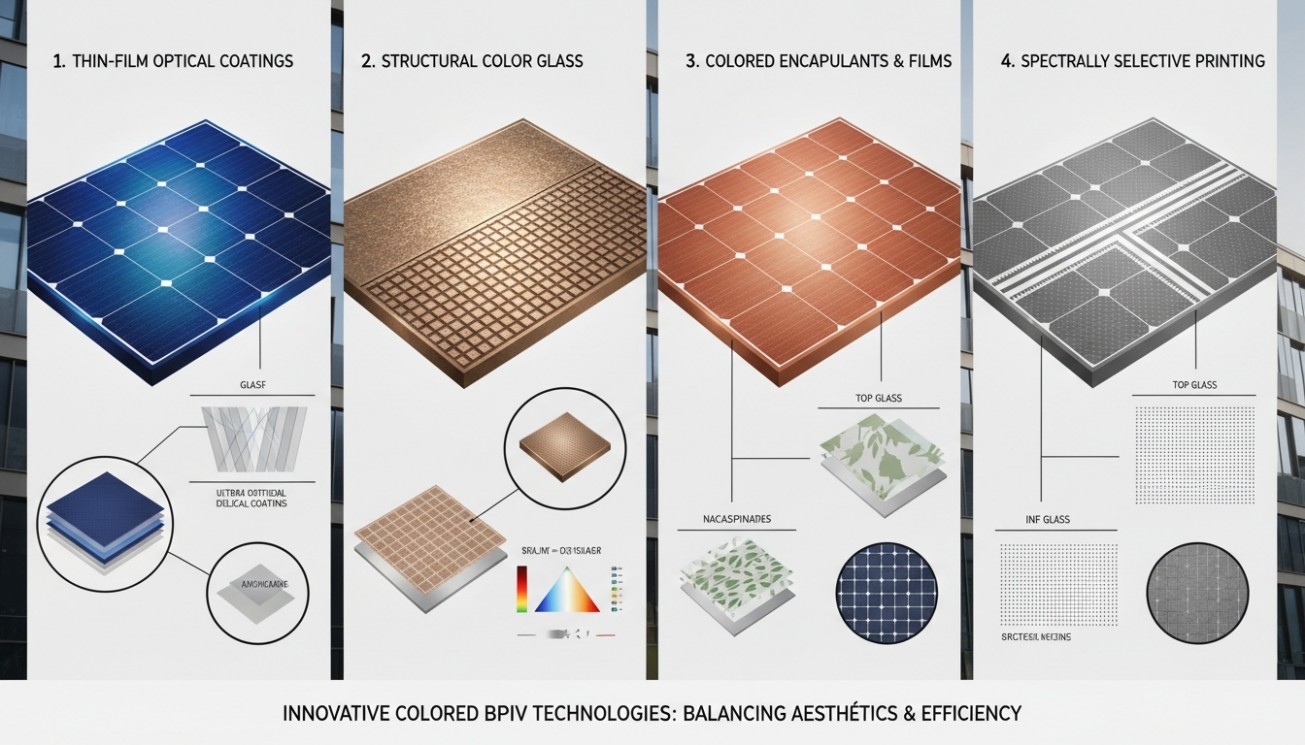
This is where colored photovoltaic glass and colored module technologies create new design possibilities. Terracotta tones can help solar surfaces relate to brick, clay tile, or historic roofscapes. Bronze and champagne tones can match commercial curtain walls and metal cladding. Grey tones can integrate with stone, concrete, aluminum, and modern minimalist facades. Blue-green tones can connect with glass-heavy architecture. Custom patterns can make the solar surface appear more like a deliberate facade material than a repeated technical panel.
Color also affects how people emotionally interpret solar technology. A standard black solar panel may communicate efficiency, but it may also communicate industrial equipment. A well-integrated colored facade can communicate sustainability without visual disruption. For public buildings and real estate projects, that difference matters.
The success of Colored BIPV is therefore not only technical. It is psychological and architectural. It helps solar power become part of the building’s identity instead of sitting outside the design language.
From Product Appearance to Urban Integration

The rise of Colored BIPV also reflects a larger urban question: how can cities generate more renewable energy without turning every building into an obvious technical installation?
Urban buildings often have limited roof area compared with their energy demand. High-rise buildings, commercial blocks, apartment towers, public institutions, and mixed-use developments may not have enough roof space for conventional solar to make a meaningful contribution. Their facades, however, represent a much larger surface area.
But urban facades are highly visible. They shape the character of streets, skylines, districts, and public spaces. If solar facades are visually poor, they may face resistance. If they are visually integrated, they may become part of the city’s energy transition.
This is why solar facade system development is important. A solar facade system is not only a group of panels attached to a wall. It is a coordinated solution involving module design, mounting method, cable routing, inverter strategy, fire safety, ventilation, waterproofing, replacement logic, and architectural detailing. Color gives this system a better chance of being adopted in real buildings.
In urban renovation, the role becomes even more interesting. Many existing buildings already need facade upgrades because of aging cladding, poor insulation, outdated appearance, or new energy performance requirements. If a building owner must invest in facade renovation anyway, solar cladding can transform the project from a passive repair into an energy-generating upgrade.
This does not mean every facade should become solar. Orientation, shading, local climate, building height, maintenance access, and financial conditions all matter. But it does mean that facade surfaces should no longer be ignored in energy planning. Colored BIPV makes these surfaces more usable because it addresses one of the biggest barriers: appearance.
Colored Photovoltaic Glass Is Not Only a Solar Product

One of the most important materials in this category is colored photovoltaic glass. Unlike standard framed modules, photovoltaic glass can be designed as part of the building envelope. It may be laminated, semi-transparent, opaque, patterned, tinted, or customized to meet project-specific visual and structural needs.
A PV glass facade can perform several roles at once. It can generate electricity, protect the building from weather, contribute to shading, shape the appearance of the exterior, and support the building’s sustainability strategy. In some projects, the glass may be used in curtain walls. In others, it may be used for skylights, canopies, atriums, railings, sunshades, or decorative facade zones.
This multi-functionality is what separates colored photovoltaic glass from a simple solar panel. The product has to be discussed with architects, facade consultants, electrical designers, structural engineers, and project owners. Its specification may involve glass thickness, lamination structure, color consistency, visible light transmission, fire behavior, mechanical load, cell spacing, junction box placement, cable management, and maintenance planning.
For B2B buyers, this means supplier evaluation must go beyond module price. A supplier of Colored BIPV must be able to support customization, documentation, sample approval, performance data, project coordination, and engineering communication. In many cases, the ability to respond to architectural requirements is as important as the ability to produce a module.
This is why PV glass facade projects often require a longer decision cycle than standard solar installations. The product is not purchased as an isolated component. It is approved as part of a building system.
Why “Beautiful Solar” Is Still Not Enough

Although appearance is central to Colored BIPV, beauty alone is not enough. A colored module that looks attractive in a brochure may fail in a real project if it cannot meet energy, durability, safety, and installation requirements.
There are several practical risks.
First, color may reduce power output. Some colors reflect or filter light that would otherwise reach the cells. The impact depends on the color technology, material structure, optical behavior, cell layout, and module design. A serious buyer should not accept vague statements such as “high efficiency” without understanding the actual output per square meter.
Second, color consistency matters. A facade is viewed as a large surface. Small color differences between batches may become obvious when panels are installed side by side. For architectural projects, sample approval and batch control are essential.
Third, facade integration affects thermal behavior. Vertical modules may experience different airflow, shading, temperature, and irradiance patterns than rooftop modules. The system should be evaluated in the context of the actual building.
Fourth, maintenance and replacement must be planned. If one module is damaged after several years, can the replacement match the original color? Can the panel be accessed safely? Are cable connections serviceable? Does the facade system allow selective replacement?
Fifth, local building codes may influence material choice. Fire safety, wind load, glass safety, waterproofing, electrical isolation, and facade system certification can all affect whether a product is suitable.
This is why the market should not treat aesthetic solar panels as purely decorative. The more visible and integrated the solar product becomes, the more professional the specification process must be.
The Difference Between Colored Solar Panels and Colored BIPV

The terms colored solar panels and Colored BIPV are sometimes used together, but they should not be confused.
Colored solar panels can refer to any PV module designed with a non-standard visual appearance. These may be used on roofs, facades, small structures, decorative installations, or custom projects. They may still function as mounted equipment.
Colored BIPV, however, implies a deeper level of building integration. The photovoltaic element is not merely placed on the building; it becomes part of the building’s material system. It may replace cladding, glazing, roofing, shading, or facade elements. The design must consider both energy generation and construction performance.
This distinction matters for content, product positioning, and buyer education. A homeowner searching for colored solar panels may care about roof appearance. A developer evaluating Colored BIPV may care about facade design, building code, carbon targets, tenant value, public image, and long-term maintenance.
For a professional blog or industry platform, the stronger angle is to explain how these layers connect. The market does not need another shallow article saying colored panels look better. It needs content that explains when color is useful, when it is not, what performance trade-offs exist, and how BIPV changes the procurement logic.
A Strong BIPV Facade Is Designed Early, Not Added Late
One of the most common mistakes in solar facade projects is treating BIPV as a late-stage add-on. In conventional rooftop solar, it may be possible to design the building first and add PV later. In a BIPV facade, this approach is risky.
Facade-integrated solar should be considered early because it affects module size, grid rhythm, structural support, cable routing, inverter zoning, access strategy, waterproofing, color approval, and visual composition. If the building design is already fixed, the solar system may be forced into awkward module sizes, inefficient layouts, visible cable paths, or compromised facade details.
Early planning also allows the design team to decide where Colored BIPV makes the most sense. Not every surface should be active. Some facade zones may be shaded for most of the day. Some zones may be too fragmented. Some areas may be visually important but electrically inefficient. Other areas may offer a good balance between exposure, visibility, and design integration.
A professional solar facade system should therefore begin with project mapping:
Which facade orientations receive meaningful sunlight?
Which surfaces are most visible?
Which colors are acceptable to the design concept?
Which module sizes fit the facade grid?
Where can cables be hidden?
Where can inverters and electrical rooms be located?
How will maintenance be performed?
What part of the facade should remain passive?
This early-stage thinking is what separates a strong architectural solar project from a superficial green feature.
How Colored BIPV Supports ESG and Building Value
For developers and building owners, Colored BIPV can also contribute to ESG communication and building differentiation. Many real estate projects now need to show credible sustainability strategies. Rooftop solar may be useful, but it is often invisible to the public. A colored solar facade can make sustainability visible without making the building look like a technical installation.
This visibility has value. A corporate headquarters can use a BIPV facade to express innovation and environmental responsibility. A school or university can use architectural solar panels as an educational element. A public building can show that renewable energy is part of civic infrastructure. A hotel or retail project can communicate green identity through its exterior design.
However, the message must be honest. The best ESG value comes when the solar facade is technically meaningful and architecturally integrated. If the system produces only symbolic output, the project may be criticized as cosmetic. If the design is poor, it may hurt the building’s image. If performance data is unclear, it may weaken the credibility of the sustainability claim.
A strong Colored BIPV project should therefore connect visual value with real function. It should explain what the system replaces, how it generates power, how it contributes to the building strategy, and how it will perform over time.
What Buyers Should Understand Before Choosing Colored BIPV
A buyer evaluating Colored BIPV should start with project logic, not product appearance. The first question should not be “Which color is available?” The first question should be “What is the building trying to achieve?”
For a heritage renovation, the priority may be visual compatibility and low disruption. Terracotta, brick-like, stone-like, or roof-matching solutions may be relevant. For a commercial office facade, the priority may be a clean modern appearance, brand image, and predictable system integration. Bronze, grey, black, or glass-like finishes may be more suitable. For a public building, the priority may be visibility, education, and design symbolism. A more expressive colored or patterned facade may be appropriate.
After the project goal is clear, the buyer should evaluate technical fit. This includes output per square meter, module dimensions, weight, glass structure, mounting method, fire and safety performance, wind load, electrical design, warranty, color durability, and replacement strategy.
The buyer should also ask whether the supplier can support the project beyond product delivery. In BIPV, documentation, engineering communication, sample development, facade coordination, and installation guidance can determine success. A supplier that only sells modules may not be enough for a complex PV glass facade or solar cladding project.
In short, Colored BIPV buying decisions should be made by combining architectural intent, energy modeling, facade engineering, and long-term operation. It is a cross-disciplinary decision, not a catalog purchase.
Why Colored BIPV Will Not Replace Standard Solar Panels
It is important to be realistic. Colored BIPV will not replace standard solar panels in every market. Standard modules will remain dominant in utility-scale solar, industrial rooftops, many residential roofs, and cost-sensitive projects where appearance is not the primary barrier.
The strength of Colored BIPV is not universal price competitiveness. Its strength is unlocking surfaces and projects where standard modules are visually unacceptable, architecturally unsuitable, or commercially insufficient. It serves a different layer of the solar market.
This distinction is important for industry positioning. If colored products are compared only with standard modules on cost per watt, they may seem weak. If they are compared with premium facade materials, green building systems, energy-generating cladding, and urban renovation solutions, their value becomes clearer.
The future solar market will not be one product type. It will include standard rooftop PV, commercial solar, residential solar, floating PV, agrivoltaics, vehicle-integrated PV, and multiple forms of building integrated photovoltaics. Colored BIPV belongs to the part of the market where design quality and energy generation must coexist.
The Strategic Meaning of Colored BIPV for the Solar Industry

The solar industry has already proven that it can scale technology, reduce cost, improve efficiency, and standardize manufacturing. The next challenge is integration. Solar power must enter more surfaces, more building types, more cities, and more design contexts. This requires products that speak the language of architecture as well as the language of energy.
Colored BIPV is important because it helps bridge that gap. It allows photovoltaic materials to become more acceptable to architects, developers, building owners, and urban communities. It expands the conversation from “Where can we install panels?” to “How can buildings themselves become power-generating assets?”
This does not make color a superficial feature. It makes color part of market access. A module that cannot fit the building may never be installed. A solar facade that can match the building may create new project opportunities.
For manufacturers, this means success will depend on more than cell efficiency. It will depend on customization capability, color technology, facade knowledge, project support, documentation, and the ability to communicate with non-solar decision makers.
For buyers, this means Colored BIPV should be evaluated as a design-integrated energy material. It requires a broader view than standard PV purchasing.
For architects, it means solar no longer has to be hidden. It can be shaped, coordinated, and expressed.
For cities, it means renewable energy can become part of the built environment without sacrificing visual quality.
Focused FAQ
What is Colored BIPV?
Colored BIPV refers to building-integrated photovoltaic products designed with specific colors, finishes, patterns, or visual effects so they can become part of roofs, facades, glazing, cladding, or architectural surfaces while generating electricity.
Is Colored BIPV the same as colored solar panels?
Not exactly. Colored solar panels may simply refer to PV modules with a colored appearance. Colored BIPV usually means the photovoltaic product is integrated into the building envelope, such as a BIPV facade, roof tile, curtain wall, canopy, or solar cladding system.
Does Colored BIPV reduce efficiency?
Color can affect output because it changes how light reaches the solar cells. The actual impact depends on the color, material, coating method, module design, and optical technology. Buyers should compare performance by project-specific yield, not only by peak wattage.
Where is Colored BIPV most useful?
Colored BIPV is most useful in buildings where appearance matters, such as commercial facades, public buildings, hotels, residential towers, cultural buildings, heritage renovations, schools, urban retrofit projects, and high-visibility developments.
Why do architects care about Colored BIPV?
Architects care because architectural solar panels can help renewable energy fit the building’s design language. Color, texture, size, transparency, and facade rhythm all influence whether solar can be accepted as part of the architecture.
What is colored photovoltaic glass?
Colored photovoltaic glass is glass-based solar material that can generate electricity while serving as part of a building surface. It may be used in facades, skylights, canopies, curtain walls, railings, or other architectural applications.
Is Colored BIPV suitable for old buildings?
It can be suitable when visual matching is important. Color-matched solar materials may help solar power fit historic roofs, brick facades, terracotta surfaces, or renovation projects where standard black modules would be visually unacceptable.
How should buyers evaluate a Colored BIPV supplier?
Buyers should evaluate color options, output per square meter, glass structure, safety documentation, customization ability, facade integration support, project references, color durability, warranty, and engineering communication. A strong solar facade system requires more than module production.
Conclusion
Colored BIPV is not simply a cosmetic upgrade to solar panels. It represents a shift in how the solar industry enters architecture. As buildings become more important in energy strategy, photovoltaic products must do more than generate electricity. They must fit facades, respect design intent, support renovation, satisfy building requirements, and create value for owners, architects, developers, and cities.
The real meaning of Colored BIPV is integration. It integrates power generation with building appearance. It integrates solar technology with facade materials. It integrates sustainability goals with architectural identity. It integrates renewable energy with urban acceptance.
Standard solar panels will continue to serve many markets well. But for visible buildings, sensitive sites, premium projects, and urban facades, standard appearance is often not enough. These projects need solar materials that can speak the language of architecture.
That is why Colored BIPV, colored photovoltaic glass, architectural solar panels, solar cladding, and PV glass facade systems are becoming important topics in the next stage of solar development. They do not replace ordinary PV. They expand where PV can go.
The future of solar buildings will not be defined only by how much electricity a module can produce. It will also be defined by how intelligently that module becomes part of the building itself.