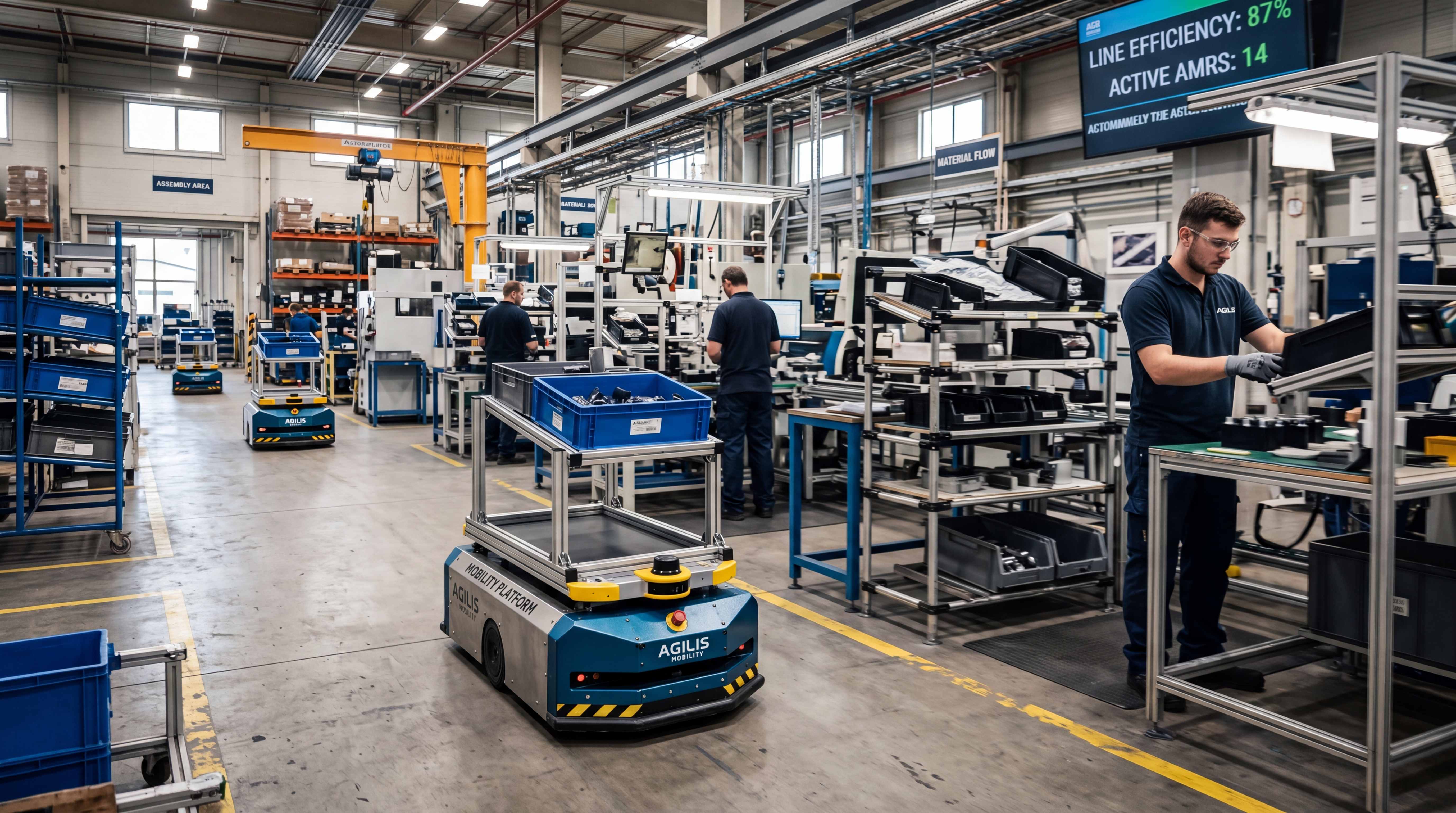
How to Choose the Right AMR/AGV Mobile Base: Why Payload Alone Is Not a Real Selection Method
The Load Number That Misleads So Many Projects
In the early stage of an automation project, selection often begins with a number that looks reassuringly objective.
How much does the load weigh?
The question sounds reasonable. It feels technical. It creates the impression that the project is already moving toward an engineering decision rather than a vague commercial conversation. Once the answer is given, buyers and suppliers often begin to narrow the field quickly. A load of 300 kilograms suggests one class of vehicle. A load of 800 kilograms suggests another. A load of 1,500 kilograms seems to point immediately toward a heavier industrial mobile robot base.
This is where many teams believe they are becoming more professional.
In reality, this is where many teams begin to make the wrong decision with high confidence.
Payload is important. No serious mobile base selection process can ignore it. But payload alone is not a selection method. At best, it is a filter. At worst, it is a misleading shortcut that causes buyers to choose a platform that looks sufficient on paper yet fails when the project meets the complexity of real operations.
A transport task is never defined by weight alone. It is defined by how that weight moves, where it moves, how often it moves, how precisely it must stop, what happens around it, what must be integrated with it, and how the task may change over time. A 500-kilogram load in one factory can be a simple repetitive transport mission. The same 500-kilogram load in another environment can require a very different AMR mobile base or AGV mobile base because the real difficulty is not the mass itself. The real difficulty lies in the operating profile.
This distinction matters more than many buyers realize.
A mobile robot that can carry the required weight but struggles with turning radius, docking repeatability, floor transitions, shift-level traffic, top-module stability, or fleet orchestration is not the right solution. It is simply a robot with the right brochure number.
And brochure numbers do not run factories.
When companies reduce the conversation to mobile robot payload, they often end up buying transport capacity without buying transport suitability. The result is predictable. The project starts with optimism, enters commissioning with compromise, and reaches live operation with a growing list of workarounds.
That is why the smarter question is never just, “How much weight do we need to move?”
The smarter question is, “What kind of transport task are we truly asking this mobile base to perform?”
Only when that question is answered properly does payload find its rightful place inside a larger decision framework.

Why Payload Feels Like a Safe Starting Point
Teams do not focus on payload because they are careless. They focus on payload because it appears measurable, comparable, and easy to defend internally.
A purchasing manager can explain a load number. A project engineer can write it into a requirement sheet. A supplier can respond to it with a model category. Everyone involved feels like progress is being made.
There is comfort in numbers that look definitive.
But the problem is that payload is one of the few variables in the transport equation that remains simple even when the project itself is not. It gives the illusion of clarity precisely because it leaves so many other variables unresolved.
A mobile robot carrying 600 kilograms across a short, clear, flat, highly repeatable route is doing a completely different job from a mobile robot carrying 600 kilograms through mixed traffic, across floor joints, with variable pick-up orientation, multiple handoff stations, and changing shift priorities. The load may be identical. The task is not.
This is why payload alone cannot tell you whether you need a more rigid AGV mobile base, a more adaptive autonomous mobile robot platform, a lower-profile chassis for tight turning, a platform optimized for dock repeatability, or a vehicle architecture designed for long-term robot fleet scalability.
It can only tell you that some solutions are definitely too small.
That is useful, but it is not enough.
The real risk appears when teams confuse “not too small” with “correctly chosen.”
The Difference Between Load Capacity and Task Capacity
The industry often talks about load capacity as if it were the central measure of mobile robot capability. In reality, task capacity is the more meaningful concept.
Load capacity answers one question: can the platform physically support the payload?
Task capacity answers the more important question: can the platform execute the job reliably, repeatedly, safely, and economically in the real environment where it must operate?
A platform may have sufficient load capacity but insufficient task capacity. This happens more often than buyers expect.
A vehicle may support the weight, but the center of gravity may shift unfavorably when a cart is loaded unevenly. The turning behavior may become unstable in tight aisles. The braking response may change on polished concrete. The docking performance may degrade when the top module introduces vibration or structural flex. The navigation performance may become less reliable if the environment is crowded or visually inconsistent. The battery strategy may not support the actual frequency of missions. The system may work as a single robot but not as a fleet.
None of these issues are captured by payload alone.
This is the central mistake in underdeveloped selection logic: it treats the robot as a weight carrier rather than a task executor.
A strong mobile base selection process must therefore shift from asking “what can this base carry?” to asking “what can this base sustain under real operating conditions?”
That shift is what separates entry-level automation planning from mature industrial thinking.
A Better Starting Point: Build the Task Profile First

If payload is not the right center of the conversation, what is?
The answer is the task profile.
Before selecting an AMR mobile base or AGV mobile base, a company should define the job not as a load category but as a transport profile. That profile should describe the actual nature of the movement the robot must perform.
A good task profile does not begin with the robot. It begins with the workflow.
What object is moving?
How is it loaded?
How often does it move?
Where does it start and stop?
How precise must handoff be?
How stable is the environment?
How much traffic exists around the route?
How likely is layout change?
How many vehicles may eventually share the system?
What must the mobile base integrate with upstream or downstream?
These questions do far more to determine the right industrial mobile robot base than weight alone ever will.
Because when the task profile is clear, payload becomes contextualized. It no longer acts as a misleading headline number. It becomes one part of a system-level decision.
The First Layer of the Task Profile: What Is Actually Being Moved?

The phrase “600-kilogram load” sounds specific, but it often hides more than it reveals.
Is the load a pallet? A wheeled cart? A shelving rack? A machine fixture? A custom frame? A tote assembly? A delicate electronics rack? A mixed-load trolley?
The geometry of the transported object changes the selection logic dramatically.
Weight Distribution Matters More Than Buyers Expect
Not all 600-kilogram loads behave like the same 600-kilogram load.
A compact, low-center, evenly distributed payload places very different demands on the base than a tall rack with a high center of gravity. A platform that looks perfectly suitable on a capacity chart may become far less suitable when the real load is long, narrow, vibration-sensitive, or structurally unstable.
An AMR mobile base carrying a tall cart is not only dealing with weight. It is dealing with dynamic motion behavior. Acceleration, deceleration, cornering, floor irregularities, and emergency stops all interact with the structure of the payload.
This is why the correct question is not just “how heavy is it?”
It is “how does the load behave when the robot moves?”
Contact Logic Also Changes the Decision
A pallet on forks, a cart on wheels, a rack on support legs, and a top-mounted conveyor module all create different interface conditions.
Some tasks require the mobile base to lift. Some require it to tow. Some require it to position underneath an object. Some require fixed top mounting. Some demand millimeter-level repeatability because downstream transfer systems depend on reliable alignment. Others are more tolerant.
These differences directly influence the choice between a more route-disciplined AGV mobile base and a more flexible autonomous mobile robot platform, but even within those broad categories, they reshape the selection of chassis architecture, suspension behavior, docking design, and control logic.
A base is never chosen correctly until the payload interface is understood.
The Second Layer: How the Task Behaves Over Time
Many selection errors happen because teams describe the load but fail to describe the rhythm of the work.
A transport system is not judged only by what it carries. It is judged by how the demand behaves across a shift, a day, a season, and a production cycle.
Repetitive Tasks and Variable Tasks Are Not the Same Project
A transport task that repeats every six minutes between two fixed points creates a very different design problem from a task that triggers unpredictably across multiple zones.
If the workflow is repetitive, stable, and highly structured, an AGV mobile base can be extremely effective because it reinforces process regularity. If the workflow is variable, event-driven, or frequently reprioritized, an AMR mobile base often becomes more suitable because adaptability creates real operational value.
The error is to assume that the same payload requirement implies the same vehicle logic.
It does not.
A factory may have a 400-kilogram transport requirement in both its feeding loop and its rework area. The feeding loop is repetitive, route-stable, and predictable. The rework area is exception-heavy, people-dense, and constantly changing. The right selection method cannot treat these as the same task simply because the load number matches.
Peak Intensity Changes Everything
Transport systems often look fine when evaluated at average demand. But live operations rarely fail at average demand. They fail at peaks.
A proper mobile base selection process must ask not only how much is moved, but how intensely it must be moved during the busiest periods. Shift changeovers, production surges, urgent dispatches, replenishment windows, and temporary disruptions create stress conditions that expose weak assumptions.
A platform that seems sufficient under average conditions may underperform badly when mission frequency rises. This can affect charging strategy, traffic density, task queue management, and response time. At this point, the conversation moves beyond single-robot suitability and into robot fleet scalability.
If the future system must absorb peaks without turning operators into manual traffic managers, then the base must be chosen with system behavior in mind, not just individual payload capability.
The Third Layer: Route Stability vs Route Volatility

One of the most decisive variables in selecting an AMR mobile base or AGV mobile base is route behavior.
Not all routes are merely paths between two points. Some are stable process corridors. Others are operationally fluid spaces.
That distinction changes the entire selection logic.
Stable Routes Favor Discipline
If the route is highly predictable, physically protected, and unlikely to change, then a more structured AGV mobile base approach often makes sense. In these cases, the transport environment is already designed for repeatability. Constraint becomes an advantage because it reinforces reliability.
The base does not need to reinterpret the world constantly. It needs to execute the route consistently.
Volatile Routes Favor Adaptation
If the route passes through mixed traffic, variable staging zones, temporary storage areas, shared aisles, or spaces that evolve over time, then route volatility becomes a core issue. In that environment, an AMR mobile base can reduce the cost of change because the transport layer does not depend as heavily on fixed path assumptions.
This is where many buyers realize that factory intralogistics is not only about moving material efficiently. It is about designing a movement system that remains useful when the factory changes.
A robot chosen only for payload may look acceptable during the pilot phase, when the route is carefully managed. Later, when real life returns to the floor, the same robot may prove mismatched to the transport reality.
The Fourth Layer: Docking, Transfer, and Handoff Precision

This is one of the most underestimated parts of the selection process.
Many teams focus intensely on getting from A to B and think much less about what happens at A and B.
But in most industrial environments, the real value of a mobile robot does not come from movement alone. It comes from successful transfer.
The Stop Is Often Harder Than the Journey
A base may navigate well and still fail the task if it cannot stop in the right way, at the right angle, with the right repeatability.
If the mobile base must align with conveyors, machine loading points, lift stations, rack interfaces, roller tables, or transfer docks, then precision is no longer a secondary feature. It becomes central to system reliability.
This is why a light-to-medium AMR mobile base in a transfer-heavy process may require more careful selection than a heavier base operating in a less precise application. The apparent simplicity of the payload can be misleading if the handoff tolerance is tight.
Docking Logic Should Be Defined Early
A mature mobile robot integration process should define transfer logic before the vehicle is chosen, not after.
Will the robot need passive alignment or active alignment?
Will it hand off to a fixed station or a movable cart?
Does the workflow tolerate centimeters of variation or require tighter repeatability?
Will the payload module shift over time?
Does the base need lift functionality?
Does the robot approach straight-on or from multiple directions?
These questions often determine the right chassis architecture more strongly than payload class.
Yet many teams leave them undefined until late in the project, when changing the vehicle choice becomes expensive.
The Fifth Layer: Floor Reality and Environmental Conditions

Factories are often described on paper as clean, flat, structured spaces. Real production environments are rarely that simple.
Floor joints, surface wear, ramps, embedded rails, drainage slopes, painted zones, cable crossings, debris, moisture, threshold transitions, and mixed-use traffic all shape how an industrial mobile robot base behaves in practice.
Floor Conditions Change More Than Comfort
Poor floor conditions do not only affect ride quality. They affect traction, stability, sensor confidence, repeatability, and the motion behavior of the payload itself.
A base carrying a tall rack across an uneven transition is dealing with more than a minor bump. It is dealing with structural sway, potential localization disturbance, and docking risk further downstream.
When buyers reduce selection to mobile robot payload, they usually fail to capture these dynamic effects.
A transport system that works beautifully on a polished demo floor may behave very differently on a live factory floor with wear patterns, shared traffic, and imperfect transitions.
Environment Should Be Treated as a Design Variable
Temperature shifts, dust, reflective surfaces, lighting inconsistency, aisle congestion, and forklift coexistence all shape the suitability of a mobile base. This is particularly important in material handling automation, where perceived robot capability can be heavily influenced by the discipline or disorder of the environment around it.
A proper selection method must therefore evaluate the environment not as background, but as part of the system.
The Sixth Layer: Human Interaction and Traffic Culture

A transport robot does not operate in engineering abstraction. It operates in a workplace culture.
This is especially true in shared industrial environments, where human habits, forklift behavior, local shortcuts, and informal movement patterns often matter as much as formal layout drawings.
The Same Robot Behaves Differently in Different Cultures
A well-marked plant with disciplined traffic rules creates one kind of operating condition. A busy workshop where carts, forklifts, technicians, pallets, and temporary storage frequently spill into shared aisles creates another.
The same AMR mobile base may look efficient in one and frustratingly conservative in the other. The same AGV mobile base may appear perfectly stable in one and overly rigid in the other.
This is why buyers should not ask only whether the robot is capable. They should ask whether the site is behaviorally compatible with the robot logic being considered.
Safety Performance Is Shaped by Interaction Design
A base selected for technical capacity but deployed into unmanaged shared traffic can create hidden inefficiency. The robot may stop too often, reroute too frequently, or require operators to adapt in ways the site was not prepared to support.
In these cases, the failure is not always the vehicle. The failure is the mismatch between system logic and local traffic reality.
Smart mobile base selection is therefore partly about engineering and partly about operational anthropology. The best choice is often the one that matches how the site actually behaves, not how the site wishes to describe itself.
The Seventh Layer: Integration Is Not a Late-Stage Detail

One of the most expensive misconceptions in mobile robotics is the belief that the base can be chosen first and integration can be figured out later.
In simple demonstration scenarios, that illusion can survive for quite a while. In real industrial deployment, it rarely does.
The Mobile Base Lives Inside a Larger Automation Logic
A robot does not create value in isolation. It interacts with call systems, line-side requests, warehouse logic, machine states, elevator interfaces, access control, charging behavior, traffic zoning, and reporting systems.
This means the right AMR mobile base or AGV mobile base is also the one that fits the digital and control architecture of the site.
Does the system need ERP-triggered missions?
Does it need MES awareness?
Will missions be called manually, automatically, or both?
Does the project require fleet-level prioritization?
Will downstream systems need status feedback?
Will the site expand into multi-zone or multi-building transport later?
These are not software questions that can be postponed. They are selection questions.
Because the wrong base can create the wrong integration burden.
Integration Determines Long-Term Economics
A vehicle that looks cheaper at acquisition may become more expensive if it creates more custom engineering, more exception handling, or more operational friction later. A vehicle that seems over-capable at first may become the more honest investment if it reduces the cost of future scaling and system connection.
This is especially important in factory intralogistics, where transport automation increasingly shifts from isolated pilot projects toward infrastructure-like operational layers.
The buyer is no longer choosing a machine. The buyer is choosing how the movement layer of the site will connect to everything else.
The Eighth Layer: Future Expansion and Fleet Logic
A robot chosen for today’s route may become tomorrow’s bottleneck.
That is why robot fleet scalability must be part of selection from the beginning, even when the first phase includes only one or two units.
A Single Robot Is Not the Same as a Scalable System
Many projects begin with a single base, a single task, and a single zone. This is a reasonable way to reduce risk. But the selection should still reflect the possible future state.
Will the site add more routes?
Will more departments request automation after the first success?
Will the same platform need to support multiple payload modules?
Will traffic coordination become more important later?
Will the system eventually need centralized orchestration?
If the answer to any of these is yes, the base should not be chosen purely as a standalone vehicle. It should be chosen as part of a scalable transport strategy.
Growth Exposes Weak Assumptions
A base that seems perfectly fine in a one-robot deployment may reveal limitations later in fleet communication, charging management, traffic logic, or integration flexibility. When growth comes, the site discovers that it did not really choose a transport system. It chose a local fix.
That is why a mature autonomous mobile robot platform strategy includes not just chassis capability, but orchestration logic, deployment philosophy, and future adaptability.
Why “Payload Plus Margin” Is Still Not Enough
Some teams recognize that payload alone is too simple, so they add a safety margin and believe the problem is solved.
If the load is 500 kilograms, they select a 700-kilogram-capacity base. This feels prudent. It is better than matching the minimum exactly. But it is still not enough if the rest of the task profile remains undefined.
A margin on payload does not correct for poor docking fit, unstable load geometry, inappropriate traffic logic, weak integration planning, or route volatility. It simply creates more headroom on one variable.
That is useful engineering. It is not complete selection logic.
A base with extra capacity can still be the wrong base.
What Mature Buyers Do Differently
The strongest buyers do not start by asking for a model recommendation. They start by constructing a transport truth.
They document the task.
They classify the environment.
They define the transfer logic.
They map route stability.
They examine peak intensity.
They understand human interaction.
They anticipate integration.
They consider future scaling.
Only then do they ask which AMR mobile base or AGV mobile base fits the mission.
This sequence matters because it prevents the project from being captured too early by a misleading simplification.
When the workflow is properly profiled, the right payload category becomes clearer, the right chassis form becomes clearer, the right navigation logic becomes clearer, and the right integration architecture becomes clearer.
In other words, the task reveals the robot, not the other way around.
A Practical Selection Mindset for Real Projects
If there is one principle worth remembering, it is this:
A mobile base should be selected according to the complexity of the task, not just the mass of the load.
That means every serious mobile base selection process should evaluate at least the following realities:
The physical behavior of the load.
The rhythm and variability of missions.
The stability or volatility of routes.
The precision of docking and transfer.
The quality of the floor and surrounding environment.
The nature of human and forklift interaction.
The depth of required mobile robot integration.
The long-term need for robot fleet scalability.
Once these are understood, payload becomes meaningful rather than misleading.
Final Perspective
The reason payload is such a persistent selection trap is simple: it is easy to see, easy to compare, and easy to defend. But industrial automation is not won by choosing the easiest variable. It is won by identifying the variables that actually decide operational success.
An AMR mobile base or AGV mobile base does not succeed because it can carry a number on a specification sheet. It succeeds because it fits the task profile of the site in the real world of movement, transfer, variability, integration, and scale.
That is the difference between buying a platform and buying a solution.
A platform carries weight.
A solution carries workflow.
And in modern material handling automation, the companies that move faster are not always the ones with the biggest robots or the highest payload charts. They are the ones that understand the task deeply enough to choose a base that truly belongs inside their operation.
So the next time a project begins with the question, “How much weight do we need to move?”, the wiser response is not to reject the question. The wiser response is to finish it.
How much weight do we need to move, under what conditions, through what workflow, with what precision, in what kind of environment, and toward what future operating model?
That is where real selection begins.
#AMRMobileBase
#AGVMobileBase
#MobileRobotPayload
#MobileBaseSelection
#MaterialHandlingAutomation
#FactoryIntralogistics
#AutonomousMobileRobotPlatform
#IndustrialMobileRobotBase
#RobotFleetScalability
#MobileRobotIntegration
#SmartFactory
#IndustrialAutomation