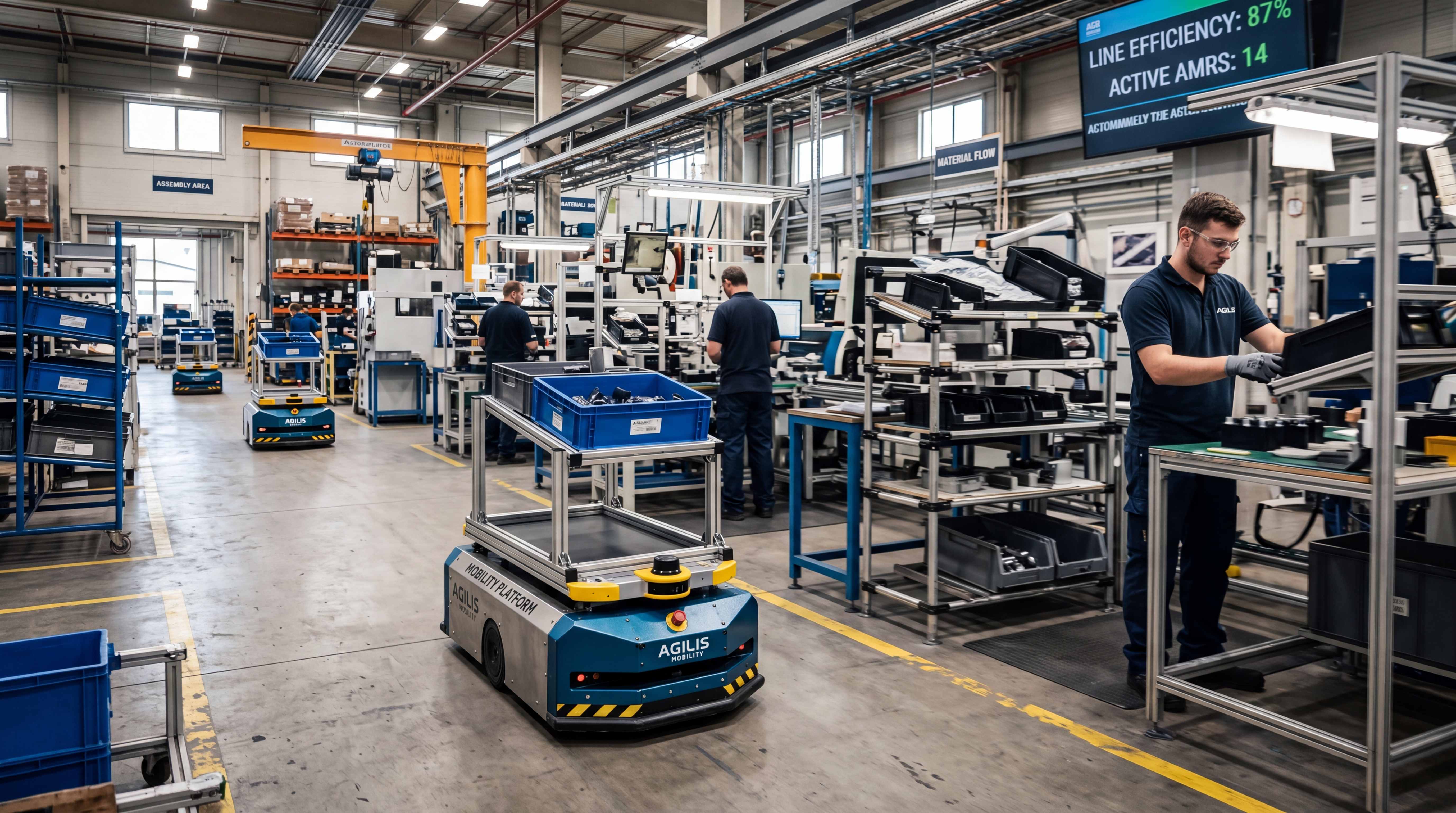
There Is No Universally Best Navigation for an AMR/AGV Mobile Base—Only the Best Fit for the Site
The Day the “Most Advanced” Option Became the Wrong Option
In automation planning, few words create more excitement than the word navigation.
It sounds intelligent. It sounds futuristic. It sounds like the part of the system that separates a basic machine from a truly capable one. That is why many early project conversations become centered around one seemingly simple question: which navigation technology should we choose for our AMR mobile base or AGV mobile base?
At first, this feels like the right question. It sounds technical enough to be serious. It sounds precise enough to guide procurement. It sounds advanced enough to promise future readiness. And because the market is full of labels—magnetic tape, QR code, reflector, laser navigation, SLAM, visual navigation, natural feature navigation, hybrid guidance—the topic quickly becomes crowded with claims.
One supplier emphasizes flexibility. Another emphasizes repeatability. One says fixed guidance is outdated. Another says full autonomy is unnecessary complexity. One sells changeability. Another sells discipline. The buyer stands in the middle of this debate believing that the goal is to identify the most advanced technology and avoid the one that sounds older.
That is where the conversation often goes wrong.
The best mobile robot navigation strategy is almost never the one with the most fashionable name. It is the one that best matches the site’s operating truth. It is the one that fits the movement logic, the traffic behavior, the docking needs, the layout stability, the maintenance culture, and the future change profile of the environment in which the robot must work.
In other words, navigation is not a beauty contest between technologies. It is a contract between a robot and a site.
A navigation method that performs brilliantly in a structured electronics plant may be the wrong choice in a mixed-traffic machining workshop. A route-based AGV guidance system that seems conservative on paper may be the most rational option in a stable production corridor. A highly adaptive AMR navigation system that looks like the obvious future may underperform if the customer expects docking behavior that the environment itself does not support. A flexible system may reduce the cost of layout change while increasing the burden of map governance, traffic policy, and behavioral tuning. A fixed system may reduce ambiguity while increasing the cost of every route modification.
This is why navigation should never be discussed in isolation.
If buyers want to make strong decisions for factory intralogistics, they must stop asking which navigation technology sounds best in theory and start asking which navigation logic belongs inside their actual site. That change in mindset is more important than any sensor specification.
Because in real deployments, navigation is not about how a robot sees the world. It is about whether the robot and the world have been matched honestly.

Navigation Is Not a Feature Layer. It Is an Operating Philosophy
One of the reasons navigation is often misunderstood is that it is presented as a technical feature rather than an operational model.
Buyers are shown hardware diagrams, maps, sensors, route overlays, and software interfaces. They are taught to compare technologies according to how a vehicle locates itself or follows a path. These comparisons are useful, but they only describe the mechanism. They do not describe the consequences.
What really matters is not just how the robot navigates. What matters is what that navigation method assumes about the site.
A route-based AGV mobile base assumes that transport discipline creates value. It assumes the environment can be stabilized enough that fixed movement logic becomes an advantage. It assumes repeatability matters more than adaptation in the target area. It often works best where path structure is not a burden, but a reinforcement of operational order.
A more flexible AMR mobile base assumes that change is frequent enough, or costly enough, that the transport layer must absorb variation rather than resist it. It assumes the site cannot or should not lock all movement into fixed guidance logic. It assumes dynamic rerouting, layout flexibility, and evolving traffic conditions are not exceptions—they are part of normal operations.
This difference is profound.
The choice between navigation methods is therefore not just a technical selection. It is a decision about how a company wants movement to behave under real conditions. It is a decision about whether the business wants to engineer stability into the floor or intelligence into the mobile system. It is a decision about where operational complexity should live.
Should complexity be embedded into infrastructure, route definition, and physical path management?
Or should complexity be embedded into sensing, software, map governance, and autonomous behavior?
Neither answer is universally right. But each answer implies a different kind of organization, a different type of maintenance burden, and a different relationship between the robot and the changing reality of the plant.
That is why the navigation discussion must move beyond phrases like “more advanced,” “more modern,” or “more flexible.” These terms are too shallow to support industrial decisions.
A navigation method becomes valuable only when its assumptions fit the operating reality.
The First Question Is Not “Which Navigation?” but “What Kind of Site?”
When buyers begin evaluating an industrial mobile robot, they often start with product catalogs, vendor comparisons, or demo videos. This approach is understandable, but it places the technology before the environment.
A stronger process begins in the opposite direction.
The first question should not be: what navigation technologies are available?
The first question should be: what kind of site are we trying to automate?
This sounds basic, but it changes the entire decision path.
A highly standardized plant with stable transport lanes, controlled crossings, predictable pickup points, and long-term layout discipline is fundamentally different from a plant where staging areas shift, temporary carts appear, forklifts improvise, people take shortcuts, and work cells evolve every quarter. Both sites may want a mobile base. Both may move similar payloads. Both may even use similar process language. But their navigation needs are not the same.
The right AMR navigation system or AGV guidance system emerges only after the site has been classified honestly.
Stable Sites Reward Route Certainty
In a stable site, navigation does not need to solve constant ambiguity. It needs to execute a transport contract with consistency.
If the movement path is known, the zones are controlled, and the transfer points remain highly repeatable, then a more deterministic AGV mobile base strategy can be extremely effective. In these conditions, fixed guidance is not primitive. It is efficient. The vehicle behaves inside a protected logic that the operation already supports.
A plant that values stable takt, clean route discipline, and low behavioral variation often benefits from navigation methods that reinforce those strengths rather than reinterpret them.
Dynamic Sites Reward Adaptive Behavior
In a dynamic site, navigation must do more than follow instructions. It must survive changing conditions without constant system redesign.
If traffic changes daily, if aisles are sometimes clear and sometimes blocked, if production support areas expand and contract, if workstations move, if mixed traffic makes fixed assumptions fragile, then an AMR mobile base with a more adaptive mobile robot navigation approach often becomes the more honest choice.
In these sites, the operational value of navigation lies less in route certainty and more in the reduced cost of change.
That is why the question is not “Which navigation is best?”
It is “What kind of site is asking the question?”
Why Fixed Guidance Is Still More Relevant Than Many People Admit
The market likes to speak as if route-based guidance belongs to the past and autonomous navigation belongs to the future. This story is appealing, but it oversimplifies industrial reality.
Fixed guidance remains highly relevant because many factories still derive real value from route certainty.
A magnetic, optical, or otherwise predefined AGV guidance system is not automatically inferior simply because it depends on a structured path. In the right context, its discipline is exactly what makes it attractive. It reduces ambiguity. It simplifies validation. It reinforces repeatability. It lowers behavioral variation. It helps define where robot movement belongs and where it does not.
This matters greatly in operations where process order is already one of the plant’s strongest assets.
The Hidden Strength of Predictability
In automation, predictability is underrated because it does not sound innovative.
But predictable movement can be powerful. Operators learn where the robot will go. Supervisors can protect crossings more effectively. Handoff points become easier to standardize. Maintenance teams face fewer unknown behaviors. Line-side interactions become simpler to plan.
In these environments, a route-dependent AGV mobile base may produce not only better transport consistency, but also lower organizational strain.
The plant is not asking the robot to negotiate uncertainty. It is asking the robot to reinforce a process that has already been disciplined.
The Cost of Change Is the Real Trade-Off
The limitation of fixed guidance is not that it works poorly. The limitation is that it can make change expensive.
When routes move, process flows change, stations relocate, or temporary flexibility becomes permanent, the originally elegant structure can turn into a redesign burden. At that point, what once looked efficient may become restrictive.
This does not make the original decision wrong. It simply means the economic balance between discipline and flexibility has shifted.
That is why fixed guidance should be judged not by age, but by fit. A stable process may benefit from it for many years. A volatile process may outgrow it quickly.
The real issue is not whether the technology is old.
The real issue is whether the site is likely to stay still.
Why Flexible Navigation Is Powerful—and Also Frequently Romanticized
If route-based guidance is often underestimated, autonomous navigation is often romanticized.
Many buyers encounter an AMR mobile base in a controlled demonstration and come away believing that dynamic navigation solves complexity by itself. The robot moves around obstacles, remaps zones, handles mixed paths, and seems liberated from the constraints of fixed routes. This is genuinely impressive. But it can also lead to a dangerous misunderstanding.
Flexible navigation does not eliminate complexity. It relocates complexity.
When a company adopts a more adaptive AMR navigation system, it is accepting a different operational burden. Instead of managing route infrastructure to the same extent, it must manage map quality, behavior tuning, traffic policies, exception logic, digital governance, and the interaction between autonomous movement and local workplace culture.
This is not a reason to avoid autonomy. It is a reason to understand it properly.
Flexibility Is Valuable Only When Change Is Real
A highly adaptive autonomous mobile robot platform creates value when the site genuinely needs changeability. If the plant reconfigures workflows, runs mixed traffic, experiences variable congestion, or expects routes to evolve, then dynamic navigation can reduce the lifecycle cost of movement. It can make the system more resilient. It can shorten redeployment time. It can protect the business from being trapped by yesterday’s route logic.
But if the environment is already stable and likely to remain so, then flexibility may be a benefit the site pays for without fully using.
This is a subtle but important point. Not every plant that can buy autonomy actually needs the full economic promise of autonomy.
Adaptation Requires Governance
Many organizations choose an AMR mobile base because they want to reduce operational rigidity. That goal is valid. But flexibility without governance is not maturity. It is drift.
Dynamic routing requires clear rules. Mixed traffic requires well-designed behavior policies. Free movement still requires boundaries. The more autonomy a site adopts, the more seriously it must think about digital order.
This is one of the biggest gaps between successful AMR deployments and disappointing ones. The technology may be similar. The difference often lies in whether the user understood that adaptive navigation is not a substitute for system thinking. It is a demand for better system thinking.
The Navigation Method Must Match the Nature of the Route

If a site wants to make a practical decision instead of a symbolic one, it should classify its routes before classifying technologies.
Not every transport path within a plant behaves the same way. Even within one facility, some routes are highly stable while others are chaotic. Some areas are architecturally clean but behaviorally messy. Some zones are predictable at the floor level but volatile at the workflow level.
This means a single building can contain multiple navigation realities.
Long, Protected, Repetitive Corridors
A route that runs between fixed process points, with strong lane control and little variation, usually benefits from navigation simplicity and repeatability. In such corridors, the value of fixed guidance or highly constrained movement logic is often high. The task is not to improvise. The task is to deliver disciplined transport.
Mixed-Use Production Areas
A route that crosses shared aisles, passes around temporary staging, and must coexist with manual activity often benefits from a more adaptive AMR mobile base. Here, the transport system is exposed to conditions that fixed assumptions cannot fully absorb. The robot must respond to changing circumstances without turning every exception into a system failure.
Rework, Exception, and Support Zones
Some areas do not behave like mainline production at all. Rework cells, temporary support zones, engineering areas, and variable logistics pockets can demand movement that is irregular, event-driven, and only partially standardized. This is where dynamic routing becomes especially valuable. The navigation system is no longer serving a repetitive loop. It is supporting an operationally unstable zone.
Once routes are viewed this way, the navigation conversation becomes more concrete. Buyers stop comparing technologies in general and start matching movement logic to route character.
That is exactly where good decisions begin.
Docking Precision Can Overrule the Navigation Hype
In many projects, the debate around navigation becomes so intense that teams forget the most important operational truth: a robot that moves elegantly but docks poorly is not a successful transport solution.
This is especially true for factory intralogistics applications involving transfer stations, machine loading, conveyor alignment, shelf interfaces, or lift-and-place handoff conditions.
Movement Is Only Half the Job
A mobile base creates value when it arrives in the right condition for the next process step.
If the system must align with a conveyor, position a cart under a frame, present a pallet to a machine, or deliver material into a transfer fixture, the navigation choice must be evaluated not only according to route behavior but according to terminal precision. A technology that supports highly flexible movement may still require stronger environmental control at the docking moment. A route-based system may deliver better repeatability in a tightly structured handoff process.
This is why robot docking precision should never be treated as a secondary detail.
In fact, there are situations where the docking requirement is so critical that it should shape the navigation choice more strongly than route flexibility does.
Precision Depends on the Whole System
Buyers often speak as if docking precision comes directly from the robot alone. In reality, it is shaped by multiple layers: localization quality, floor condition, load stability, approach geometry, environmental order, mechanical alignment strategy, and downstream transfer tolerance.
The right mobile robot navigation method is therefore the one that can support the required docking logic under the real conditions of the site—not under ideal demo conditions.
This is one of the most important reasons why “most advanced” is such a weak decision criterion. A site does not need the most fashionable navigation. It needs the navigation that can repeatedly deliver usable arrivals.
Floor Conditions Are Part of Navigation, Not Background Noise
A plant drawing is flat. A factory floor rarely is.
This matters more than many buyers realize because navigation performance is inseparable from motion quality. A robot that localizes well in theory may still experience degraded behavior if the floor environment constantly disturbs its movement, load stability, or path consistency.
Floor joints, ramps, patch repairs, embedded rails, uneven transitions, oil residue, reflective zones, and changing surface textures all influence how a robot behaves. They also affect how the payload behaves, how sensors interpret the environment, and how consistent the final docking event can be.
The Floor Can Change the Meaning of a Navigation Method
A guidance system that performs predictably in a clean structured area may become operationally fragile in a workshop with damaged transitions and traffic-worn surfaces. An AMR mobile base that looks smooth in a demo corridor may show very different behavior when carrying a tall rack across floor inconsistencies. A route-based system may maintain discipline well, but only if the physical lane assumptions remain protected.
This is why floor assessment is not a maintenance detail. It is part of navigation strategy.
If the site ignores floor reality, it may misread the true suitability of an AGV guidance system or AMR navigation system and blame the robot later for a mismatch that was visible during evaluation.
Navigation Begins at Ground Level
It is tempting to think of navigation as something abstract—maps, algorithms, sensors, control logic. But every navigation system becomes real at the level of wheels, surfaces, load movement, and approach behavior.
A smart buyer therefore asks not only how a robot navigates, but how it navigates on this floor, in this traffic, with this payload, at this level of environmental wear.
That question is far more useful than asking which technology category sounds most modern.
Human Traffic Tells the Truth That Layout Drawings Often Hide
One of the most underestimated differences between sites lies not in their infrastructure, but in their human behavior.
Two factories may look similar on paper. Both may have marked lanes, defined work cells, and similar transport distances. Yet one may operate with disciplined pedestrian behavior, predictable forklift movement, and strong respect for controlled zones, while the other behaves more informally, with shortcuts, temporary blockages, hand-carried parts, parked carts, and unplanned crossings.
The navigation choice must account for this difference.
The Same Technology Behaves Differently in Different Cultures
A highly adaptive AMR mobile base may perform very well in a site where human variability exists but remains bounded by reasonable traffic discipline. In a site where unpredictable behavior is constant, the same robot may spend too much time slowing, stopping, rerouting, or waiting. What looks flexible can become operationally conservative.
Similarly, a route-based AGV mobile base may work efficiently in a culture that respects protected lanes, but become frustrating in a workplace where those lanes are treated as temporary storage zones or informal walkways.
The challenge is not just navigation technology. The challenge is the relationship between navigation logic and traffic culture.
Real Suitability Depends on Behavioral Compatibility
This is why site visits matter so much. Not because buyers need prettier demos, but because they need to see how the place actually behaves. The best industrial mobile robot is not necessarily the one with the strongest isolated capability. It is the one whose behavior model matches the workplace behavior surrounding it.
A good navigation strategy is therefore partly an engineering decision and partly a human-systems decision.
The plant is not buying a robot for a diagram. It is buying a robot for a lived environment.
The Future Layout Matters More Than the Current Layout

Many navigation decisions fail not because they misunderstand the present, but because they ignore the future.
When companies evaluate a mobile base project, they often examine the layout as it exists today. This is sensible, but incomplete. A navigation method that fits the current plant may be the wrong investment if the plant is already on a path toward structural change.
That is why a serious evaluation of an AMR mobile base or AGV mobile base must include not only current route behavior, but expected layout evolution.
Stable Today Does Not Always Mean Stable Tomorrow
Some factories appear stable simply because they have not yet started the next improvement cycle. Others look orderly because temporary variation has been suppressed during project evaluation. Some sites are about to add new lines, move storage zones, reassign routes, or change product mix. If these changes are likely, then navigation should be chosen with lifecycle economics in mind, not just launch conditions.
A route-dependent strategy may work very well for the current state while becoming increasingly expensive under future change. A more adaptive autonomous mobile robot platform may seem more complex at the beginning while proving more economical once layout volatility becomes normal.
Navigation Choice Is a Statement About Change Tolerance
In this sense, choosing navigation is also choosing how much future change the company wants the transport system to tolerate.
Some businesses value locked-in repeatability and are willing to pay the price of physical redesign later. Others expect ongoing change and want the transport layer to absorb that evolution digitally rather than physically.
Neither approach is automatically superior. But they reflect different assumptions about how the business expects to operate.
The right navigation strategy is the one whose tolerance for change matches the organization’s actual future.
Integration Changes What “Good Navigation” Really Means
Navigation is often discussed as if it were a self-contained capability. In practice, it lives inside a larger automation architecture.
A mobile base does not simply move through space. It responds to tasks, waits for permissions, coordinates with stations, interacts with conveyors, shares status data, and increasingly becomes part of a connected logistics layer. This changes how navigation should be judged.
A Good Navigation Method Must Also Fit the Control Strategy
A robot’s movement logic must align with the system logic around it.
If the project demands complex station calls, multi-zone task allocation, queue management, priority changes, and cross-process coordination, then the navigation method must support not only route execution but also clean integration into the broader operating model.
A highly structured AGV guidance system may integrate beautifully into a repetitive fixed-route application with mature station logic. A flexible AMR navigation system may create more value where mission logic is dynamic and route governance needs to adapt with the workflow.
In both cases, navigation should be evaluated as part of the total solution—not as an isolated piece of technical identity.
The More Connected the System, the More Honest the Navigation Decision Must Be
As companies mature in factory intralogistics, they increasingly discover that transport automation is not just about vehicle behavior. It is about orchestration. The mobile base becomes one part of a digital movement layer that includes dispatch logic, production timing, handoff readiness, charging strategy, and exception handling.
Once this happens, “best navigation” becomes a very different question. It no longer means the most visually impressive motion. It means the movement model that integrates most honestly with the business process.
That is a much harder question—and a much more valuable one.
Why the Best Sites Do Not Worship Technology Categories
The most experienced automation teams tend to speak less about whether a navigation method is advanced and more about whether it is appropriate.
That is not because they lack ambition. It is because they have seen enough deployments to know that success depends less on category prestige and more on operational fit.
They know that a fixed path can be brilliant in the right corridor.
They know that autonomous rerouting can be transformative in the right mixed-use area.
They know that a plant can contain both realities at once.
They know that navigation is not about what looks impressive in a presentation.
It is about what continues to work after six months of real production pressure.
This is a level of industrial maturity that many buyers only reach after making costly assumptions.
A site that adopts this mindset earlier will make better decisions sooner.
A Smarter Framework for Navigation Selection
If a company wants to choose navigation well, it should stop asking for a universal ranking and instead build a site-fit framework.
That framework should ask:
How stable are the routes?
How often will layout or process change affect the path?
How structured are the handoff points?
How tight is the docking requirement?
How disciplined is the traffic culture?
How rough or variable is the floor reality?
How much mixed use exists around the route?
How much digital governance can the organization realistically maintain?
How important is future change tolerance?
How deeply must the mobile base integrate with surrounding systems?
Once these questions are answered honestly, the navigation choice becomes much clearer.
It may still be technically complex. But it will no longer be conceptually confused.
And that is the true goal. Not to make the decision simple, but to make it real.
Final Perspective
There is no universally best navigation for an AMR mobile base or AGV mobile base because no navigation technology exists outside the reality of the site.
A fixed guidance strategy can be the most intelligent choice in a disciplined environment where route certainty creates value. A flexible AMR navigation system can be the most intelligent choice in a changing environment where the cost of rigidity would otherwise grow year after year. A plant with mixed route character may even require different navigation logics in different zones, or at least a more nuanced view of what movement discipline should look like across the operation.
The mistake is to assume that navigation categories carry their own value automatically.
They do not.
Their value emerges only when matched to route behavior, floor condition, docking precision, traffic culture, layout volatility, integration depth, and future operational intent.
That is why the most important question is not whether a navigation technology is advanced.
The most important question is whether it belongs.
Does it belong in this building?
Does it belong in this workflow?
Does it belong in this traffic culture?
Does it belong in this company’s future?
When buyers learn to ask those questions first, the navigation decision stops being a debate about labels and becomes what it should have been all along: a serious industrial judgment about fit.
And in the long run, fit always outperforms hype.
#AGVMobileBase
#MobileRobotNavigation
#AMRNavigationSystem
#AGVGuidanceSystem
#FactoryIntralogistics
#IndustrialMobileRobot
#DynamicRouting
#RobotDockingPrecision
#AutonomousMobileRobotPlatform
#SmartFactory
#MaterialHandlingAutomation