How to Size a Trailer Winch Correctly: Why Load Weight Alone Is Not Enough
Choosing the right trailer winch capacity is one of the most misunderstood decisions in trailer equipment selection. Many buyers still ask a simple question: “How much does the load weigh?” That question matters, but by itself it is not enough to determine how to size a trailer winch correctly.
In real trailer applications, the winch is not lifting a load vertically in a controlled lab environment. It is pulling a load through friction, across an angle, over bunks or rollers, up a ramp, or onto a trailer deck with changing resistance. That means the actual force demand depends on much more than total weight alone.

A more professional trailer winch capacity guide must account for how the load moves, what kind of trailer is involved, what surface conditions exist, and how much operating margin is needed for safe and repeatable pulling. This is where many underperforming winch installations begin: not with bad products, but with bad sizing logic.
Why Load Weight Alone Creates Sizing Mistakes
A buyer may know the boat weight, vehicle weight, or cargo weight and assume that number is the main basis for choosing a winch. In practice, that approach often leads to either undersizing or unnecessary oversizing.
The reason is simple. A trailer winch does not fight weight only. It fights resistance.
For a boat trailer winch, resistance depends on hull position, bunk friction, roller condition, launch depth, and ramp geometry. A heavier boat on a well-set trailer may pull more smoothly than a lighter boat on dry bunks with poor alignment.
For a car hauler winch, the situation changes again. A running vehicle with inflated tires and good alignment behaves very differently from a dead vehicle with locked brakes, flat tires, or poor ramp entry angle. Two vehicles with the same curb weight may create completely different winching demands.
For a utility trailer, the pull may be intermittent and unpredictable. The issue is not always weight, but how the load is introduced onto the deck and whether the surface allows efficient movement.
That is why the first principle of how much winch do I need for my trailer is this: the winch must be sized for resistance under real operating conditions, not only for the number printed on the trailer load sheet.
A Trailer Winch Should Be Sized for the Job, Not for the Label

The most common sizing mistake happens when buyers choose a winch based on a category label such as “boat trailer winch” or “car hauler winch” without asking what the actual working condition looks like.
A better winch sizing guide starts by asking five questions.
What Type of Load Is Being Pulled
A floating or partially supported boat behaves differently from a wheeled vehicle. A palletized cargo load behaves differently from equipment being dragged or rolled. The winch must be sized according to how the load resists movement.
What Type of Trailer System Is Involved
Bunk trailers, roller trailers, tilt decks, fixed-angle decks, and utility trailers all create different force requirements. The trailer itself is part of the winching system.
What Is the Loading Geometry
Ramp angle, trailer deck height, launch depth, and pull path all influence how much effort is required. A change in geometry can change force demand more than many buyers expect.
What Is the Operating Frequency
An electric trailer winch capacity decision should account for repeated use, not just maximum pull. A winch used every week or every day must deliver stable performance across cycles, not just survive a single heavy pull.
How Much Safety Margin Is Needed
Real environments are rarely ideal. Slippery ramps, poor alignment, unexpected drag, weather exposure, and one-person operation all increase the value of a properly sized safety margin.
The Most Important Variables in Trailer Winch Sizing
When professionals size a manual trailer winch or electric trailer winch, they do not look at load weight in isolation. They assess the full resistance picture.
Ramp Angle Changes More Than Most Buyers Realize
A steeper ramp increases the amount of force required to move the load in a controlled way. This applies to both marine and land-based trailer systems.
On a boat trailer winch, ramp angle affects how the boat approaches the trailer, how much self-centering support the trailer provides, and how much pull is required to seat the boat correctly at the bow stop.
On a car hauler winch size decision, ramp angle directly influences rolling resistance and the effort needed to move a disabled vehicle onto the deck. A low deck with a shallow approach angle may require far less winch effort than a taller trailer with a sharp loading angle.
Because of this, two operators loading the same boat or vehicle in different locations may report very different winching experiences with the same equipment.
Why This Matters
If the winch is sized only to nominal load weight, the buyer may overlook the extra effort created by poor approach geometry. This often leads to complaints that the winch feels weak, when the real issue is that the system was sized without considering loading angle.
Friction Is Often the Hidden Force Multiplier
Friction is one of the most underestimated factors in trailer winch selection.
For boats, friction may come from dry bunks, hull material, poor trailer immersion depth, or misalignment during recovery. In these cases, even a properly rated boat trailer winch capacity may feel inadequate because the system is working against unnecessary drag.
For vehicle trailers, friction may come from tire condition, wheel drag, seized brakes, uneven deck surfaces, or poor ramp contact. A dead vehicle with compromised rolling condition can require dramatically more pull than a functioning vehicle of similar weight.
For utility trailers, friction depends on whether the load is rolling, sliding, supported, or partially snagging during movement.
What Professionals Do Differently
Professionals do not ask only how heavy the load is. They ask how easily the load moves when winching begins. That single distinction separates consumer-level buying from application-based sizing.
First-Layer Pull Is Not the Same as Real-World Pull
Another common mistake in trailer winch capacity guide discussions is assuming that the published rating applies equally in all operating conditions.
In real use, pulling force changes as line builds up on the drum. The rated pull is typically strongest on the first layer. As more line wraps around the drum, effective pulling force decreases. That means the same winch may feel noticeably stronger at one part of the pull and weaker at another.
For buyers, this matters because a winch that looks sufficient on paper may operate much closer to its limit in the real world than expected. This is especially important when the pull is long, the trailer is steep, or the load becomes harder to move near the final seating position.
Why Margin Matters
A correctly sized electric trailer winch capacity decision should leave room for force loss across drum layers, shifting drag conditions, and imperfect alignment. A winch sized too close to minimum theoretical demand may work occasionally but deliver poor consistency.
Boat Trailer Winch Capacity Requires Marine-Specific Thinking

A proper boat trailer winch capacity calculation should never copy the logic used for vehicles or general cargo.
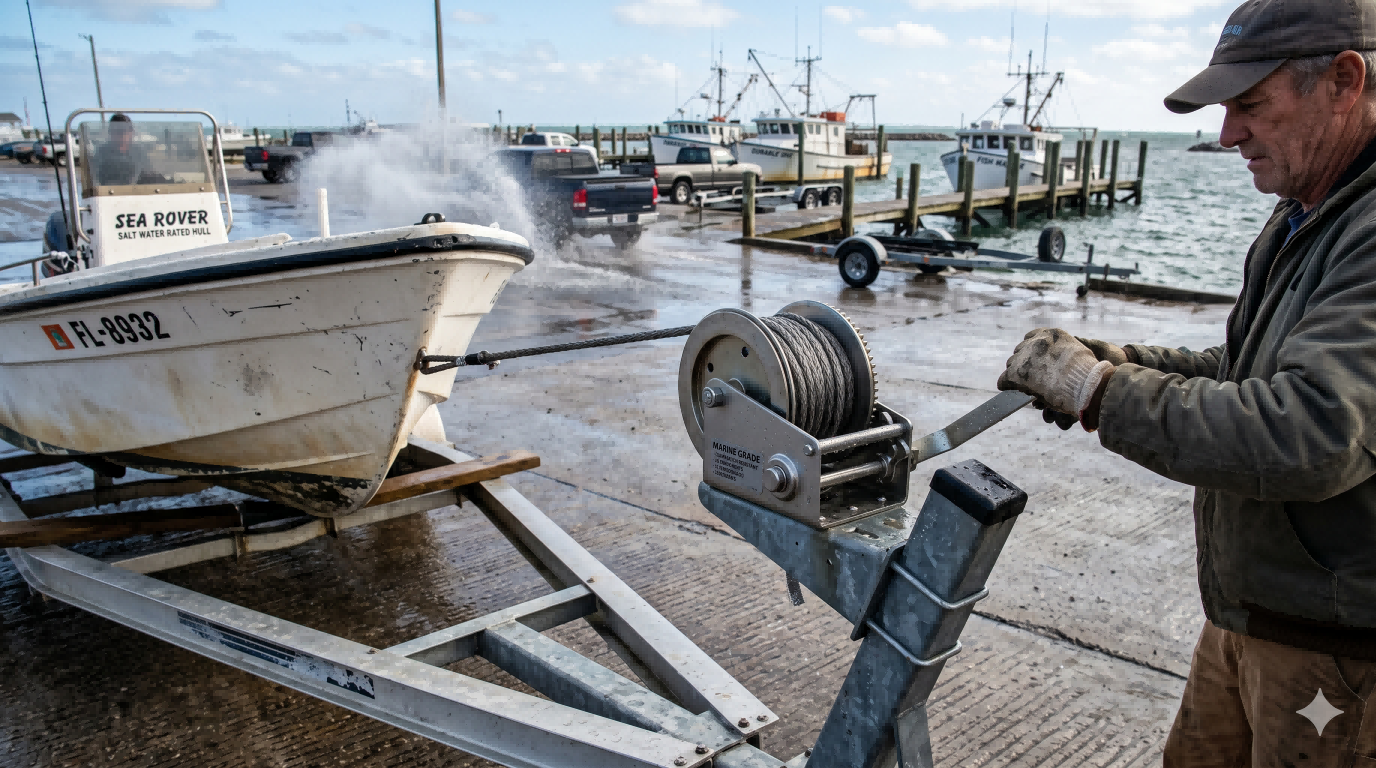
Boats are affected by trailer immersion depth, hull shape, bunk material, roller setup, and ramp condition. In many cases, the hardest part of the pull is not the beginning, but the final positioning of the boat onto the trailer. At that moment, friction and alignment can increase sharply.
Saltwater and wet environments also influence how the winch should be sized. Marine exposure increases the importance of corrosion resistance, sealed components, and dependable performance after repeated environmental exposure.
Key Questions for Boat Trailer Applications
When sizing a boat trailer winch, ask:
- Is the trailer using bunks or rollers?
- How steep is the launch ramp?
- Is the boat centered consistently during retrieval?
- Does the operator typically work alone?
- Is the trailer used in freshwater or saltwater?
- Does the load need smooth control near the final bow stop position?
A marine application is rarely just about pull rating. It is about controlled recovery under varying environmental conditions.
Car Hauler Winch Size Depends on Rolling Condition, Not Just Vehicle Weight

A car hauler winch size decision can become misleading very quickly if the buyer looks only at curb weight.
A functioning vehicle with free-rolling tires is one scenario. A non-running vehicle with damaged tires, steering issues, or brake drag is a completely different one. The winch must often compensate for uncertainty, not only for mass.
The deck height and ramp configuration also matter. A longer, lower approach can reduce force demand. A shorter, steeper setup can increase it significantly. That is why the same trailer winch may work well for one transport operator and feel undersized for another.
Common Mistakes in Car Hauler Sizing
Buyers often underestimate force when:
- the vehicle does not roll freely
- the deck angle is steep
- the pull is long
- the trailer surface is uneven
- the operator expects repeated recovery work rather than occasional loading
In these cases, the best answer is not always the biggest winch available, but a winch sized with proper operational margin.
Utility Trailer Winch Sizing Should Prioritize Versatility

A utility trailer winch sizing decision is often less predictable because utility trailers serve many different tasks.
Some loads roll easily. Others shift, drag, or resist movement unpredictably. Some users need the winch only a few times each season. Others depend on it whenever a difficult load appears. Because of that, utility applications often benefit from a balanced approach between rated pull, installation practicality, maintenance ease, and flexibility.
What Matters Most in Utility Use
For utility trailer applications, the best sizing logic usually considers:
- the widest likely range of loads
- how unpredictable the loading condition may be
- whether electric power is available
- how easy the system is to inspect and maintain
- whether the user values simplicity or higher pulling consistency
This is where a thoughtful trailer winch selection process creates better long-term results than chasing the highest number in the catalog.
Manual vs. Electric Sizing Is Not the Same Conversation

Many buyers assume that manual trailer winch size and electric trailer winch capacity should be evaluated the same way. They should not.
A manual system depends more heavily on human effort, gearing, and acceptable operator fatigue. Even if a manual winch can technically move the load, that does not mean it is the right solution if the pull is frequent, long, or physically demanding.
An electric system changes the workflow. It may justify a different sizing logic because it supports repeated operation, one-person loading, and more stable force delivery when the electrical system is designed correctly.
The Better Way to Compare
A manual trailer winch should be evaluated by:
- acceptable effort
- gearing behavior
- control at low speed
- expected usage frequency
- maintenance simplicity
An electric trailer winch should be evaluated by:
- real operating demand
- battery and wiring support
- cycle frequency
- thermal and duty considerations
- desired consistency of pull
So even when both systems can move the same load, they may not be equally suitable.
The Right Safety Margin Is a Business Decision, Not Just a Technical One

Safety margin is often treated as a generic recommendation, but in real applications it is a strategic decision.
A casual user with ideal loading conditions may accept a narrower margin. A dealer, fleet user, marina operator, or recovery-focused buyer usually needs more reserve because the operating environment is less predictable and downtime is more expensive.
Sizing a trailer winch too close to theoretical demand creates more than performance risk. It can create slower work, higher operator strain, inconsistent loading, and more troubleshooting in the field.
What Margin Protects Against
A well-chosen margin helps account for:
- unexpected drag
- poor alignment
- wet or dirty loading surfaces
- line pull reduction across drum layers
- variable operator experience
- inconsistent trailer setup
- non-ideal vehicle or boat condition
This is why real sizing decisions should be made with operating uncertainty in mind.
How Professional Buyers Approach Trailer Winch Sizing
Professional buyers rarely ask only, “What is the load weight?” They usually ask a more useful sequence of questions.
They define the application first. Then they review the trailer system, loading geometry, frequency of use, operating environment, and likely resistance variables. Only after that do they choose the winch capacity.
That process produces better results because it treats the winch as part of a system, not as a standalone accessory.
A Better Decision Framework
A professional how to size a trailer winch process looks like this:
Identify the Real Application
Boat trailer, car hauler, utility trailer, or mixed-use application.
Evaluate Movement Resistance
Rolling, sliding, bunk friction, brake drag, launch angle, and alignment behavior.
Review Operating Conditions
Occasional use, repeated use, marine exposure, solo operation, or commercial workload.
Add Practical Margin
Account for real-world inefficiencies instead of sizing to minimum theory.
Match the Winch to the System
Select a solution that supports the trailer, the workflow, and the environment.
This is the difference between sizing for specification sheets and sizing for actual field performance.
Final Thoughts
A serious trailer winch capacity guide should never reduce the decision to load weight alone. The right winch size depends on how the load moves, how the trailer is configured, how often the system is used, and how much uncertainty the buyer must manage.
For a boat trailer winch, marine friction, ramp angle, and final alignment matter. For a car hauler winch size decision, rolling condition, deck angle, and recovery uncertainty matter. For utility trailer winch sizing, flexibility and unpredictability matter.
That is why the best answer to how to size a trailer winch is not a single number. It is a system-level judgment.
When buyers understand that, they stop choosing winches by label and start selecting them by real application logic. That is where better performance, better safety, and better long-term value begin.
Trailer Winch Capacity #Trailer Winch Sizing #Boat Trailer Winch #Car Hauler Winch #Utility Trailer Winch #Electric Trailer Winch #Manual Trailer Winch #Trailer Loading Systems #Towing Equipment #Winch Selection Guide