Split Solar Water Heater vs Integrated Solar Water Heater: Which System Fits Your Project?
Why This Comparison Matters Before Choosing a Solar Water Heater
Choosing between a split solar water heater and an integrated solar water heater is not only a product comparison. It is a decision about building structure, water pressure, installation method, user comfort, maintenance access, and long-term project value. Many buyers first compare price, tank capacity, or collector size, but these numbers alone do not explain whether the system will fit the building properly.
A solar water heater is not installed in an empty showroom. It must work on a real roof, with real plumbing, real users, real weather, and real maintenance conditions. This is why the comparison between a split solar water heater and an integrated solar water heater should start from application logic rather than from appearance.
An integrated solar water heater usually combines the collector and water tank into one unit. It is often installed directly on the roof. This structure is simple, easy to understand, and commonly used in residential markets where installation cost and basic hot water demand are the main concerns.
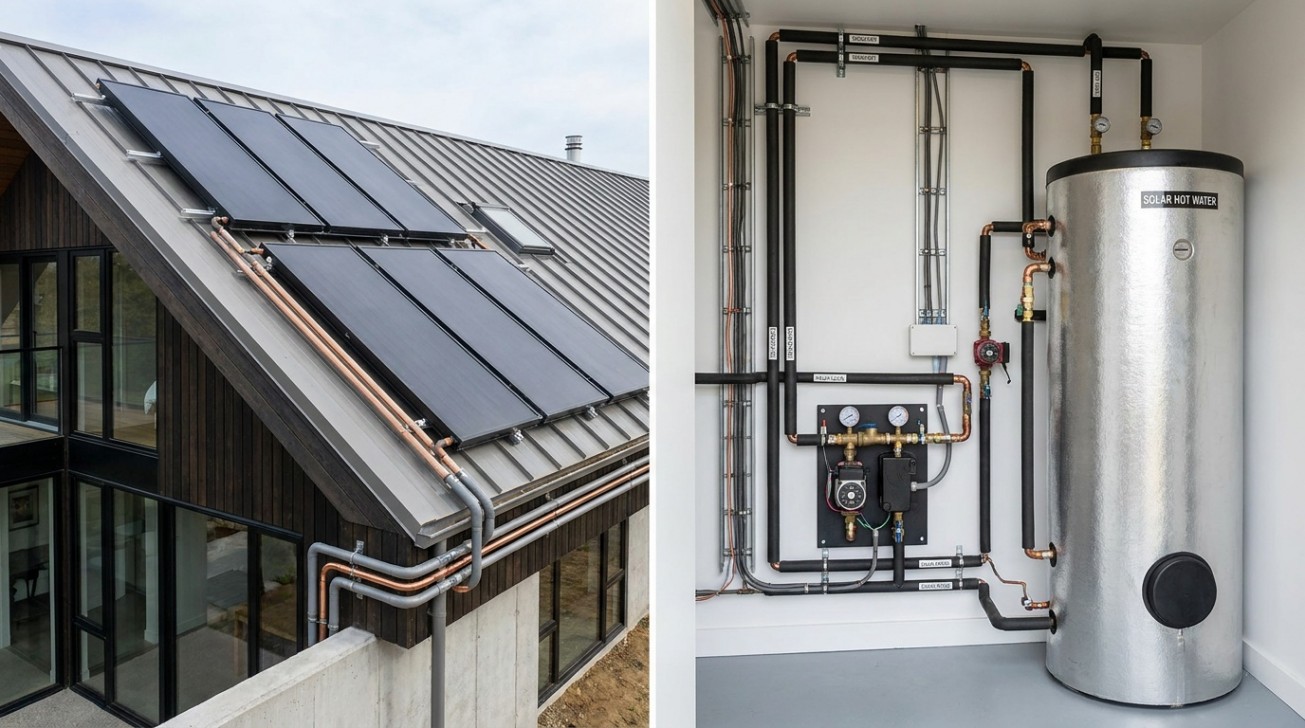
A split solar water heating system, by contrast, separates the solar collector from the storage tank. The collector can be installed on the roof, while the tank can be placed indoors, in a utility room, in a mechanical room, or in another protected location. This design is more flexible, but it also requires a more complete system configuration, including pumps, controllers, insulated piping, valves, and sometimes heat exchangers.
The question is not which one is universally better. The real question is: which system matches the project?
For a small house in a warm region, a simple compact solar water heater may be enough. For a villa, hotel, apartment, school, hospital, or commercial building, a split solar water heater may provide better pressure performance, cleaner building appearance, and more professional system integration.
The Basic Structural Difference

The most visible difference is where the tank is installed.
In an integrated solar water heater, the collector and tank are mounted together. The tank is usually above or behind the collector, forming a complete rooftop unit. This is why many people also call it a rooftop solar water heater. The system is easy to recognize because the storage tank is visible on the roof.
In a split solar water heater, the collector and tank are separated. The collector is still placed in a sunny location, usually on the roof or on a frame, but the tank is installed elsewhere. The tank may be inside the building, on a balcony, in a basement, in a plant room, or in a dedicated equipment space.
This structural difference changes almost everything that follows.
It changes how the system is installed.
It changes how the system handles pressure.
It changes how the roof load is distributed.
It changes how the building looks.
It changes how easy it is to maintain the tank and control components.
It changes how suitable the system is for larger projects.
A simple product photo may not show these differences clearly. Two solar water heaters may both provide hot water, but the system behind them can be very different.
An integrated solar water heater is closer to a packaged product. A split solar water heating system is closer to an engineered solution.
That is the first key point for buyers.
How an Integrated Solar Water Heater Works

An integrated solar water heater uses a compact structure. The collector absorbs solar radiation and transfers heat to the water stored in the attached tank. In many basic models, heat transfer may rely on natural circulation. Hot water rises, cooler water moves down, and the system circulates without needing a pump.
This is one reason integrated systems are popular. Fewer components mean easier installation and lower technical requirements. There may be no separate pump station, no complicated controller, and no long insulated pipe run between the collector and tank.
For many households, this simplicity is attractive. The user wants hot water, not a mechanical system. The installer wants a product that can be mounted quickly. The distributor wants a model that is easy to explain and easy to sell.
However, simplicity also creates limitations.
Because the tank is installed on the roof, the roof must support the system weight. A full water tank can be heavy. The visual impact can also be obvious, especially on modern villas, hotels, or buildings with strict appearance requirements. In some regions, rooftop tanks may not match local architectural standards.
Another limitation is pressure. Some integrated systems are non-pressurized or depend on gravity water supply. That may be acceptable in some markets, but it may not meet the expectations of users who want strong shower pressure and stable hot water delivery. Pressurized integrated models exist, but the combined rooftop structure still limits layout flexibility.
An integrated solar water heater is therefore best understood as a practical and economical solution for straightforward hot water demand. It can work well when the climate is suitable, the roof structure is strong enough, the appearance requirement is not strict, and the user does not need a complex centralized system.
How a Split Solar Water Heater Works

A split solar water heater works with a more system-based design. The collector absorbs solar heat, and a circulation loop transfers that heat to a storage tank installed separately from the collector. In many designs, this circulation is managed by a pump and a controller, making the system an active solar water heating system.
The controller monitors temperature differences between the collector and the tank. When the collector is hotter than the tank by a useful margin, the pump starts. Heat is transferred into the tank. When the temperature difference becomes too small, the pump stops to avoid unnecessary heat loss.
This control logic gives the split solar water heating system more flexibility. The tank does not need to be on the roof. It can be placed in a protected location. The system can be connected with electric backup, gas boiler backup, heat pump backup, or building hot water distribution.
This is why split systems are often used in higher-value applications. They are not only designed to produce hot water. They are designed to become part of the building’s hot water infrastructure.
A split solar water heater may use a flat plate collector or a heat pipe evacuated tube collector. It may be direct or indirect. It may be residential or commercial. It may be a small villa system or a larger centralized system. The system can be configured according to climate, roof space, daily water demand, pressure requirement, and project budget.
The advantage is flexibility. The challenge is design quality.
A split solar water heater needs correct collector sizing, tank sizing, pump selection, pipe insulation, controller setting, safety valve configuration, and installation practice. When these details are handled well, the system can provide strong long-term value. When they are ignored, the system may become more expensive without delivering better performance.
Installation Difference: Simple Mounting vs System Engineering
Installation is one of the biggest differences in this solar water heater comparison.
An integrated solar water heater is usually easier to install. The product arrives as a more complete unit. The installer places it on the roof, connects water lines, checks the support frame, and prepares the system for use. This makes it attractive for small residential projects and markets where installation labor must stay simple.
A compact solar water heater can reduce installation complexity because the collector and tank are already combined. Fewer components mean fewer connection points. Fewer connection points can mean fewer installation mistakes. This is one of the strongest advantages of integrated systems.
A split solar water heater, however, requires more planning. The installer must decide where the collector goes, where the tank goes, how pipes will run, where the pump station will be installed, where sensors should be placed, how the system will be insulated, and how backup heating will connect.
This does not mean a split system is difficult in a negative way. It means the system must be engineered properly. For professional installers, this is normal. For untrained installers, it may create risk.
In B2B projects, installation planning is often more important than the product itself. A hotel, apartment, or school cannot rely on casual installation. The system must match the building’s hot water load and maintenance routine. This is where a split solar water heating system becomes more suitable than a simple rooftop unit.
If the buyer’s priority is fast installation and low upfront complexity, an integrated solar water heater has an advantage. If the buyer’s priority is building integration, pressure performance, and long-term system design, a split solar water heater is usually stronger.
Roof Load and Building Appearance

Roof load is not always discussed early enough, but it can become a major issue.
An integrated solar water heater places the water tank on the roof. When the tank is full, the system weight increases significantly. For small houses with suitable roof structures, this may not be a problem. But for lightweight roofs, old buildings, modern architectural roofs, or commercial buildings with strict structural requirements, rooftop tank weight must be evaluated carefully.
A split solar water heater reduces this concern because the water tank can be placed indoors or in a mechanical area. The roof mainly carries the collector array and support frame, not the full storage volume. This can make the system easier to adapt to buildings where rooftop weight is limited.
Building appearance is another important factor.
A rooftop solar water heater with a visible tank may look acceptable in some residential markets. In other markets, especially for villas, resorts, hotels, and modern communities, a large rooftop tank may be considered unattractive. Architects may prefer low-profile collectors that blend with the roof surface.
A split solar water heating system supports cleaner visual design. Flat plate collectors or evacuated tube collectors can be arranged more neatly, while the tank stays hidden. For high-end residential and commercial buildings, this can be a decisive advantage.
This is not only about aesthetics. Building appearance affects property value, customer perception, and project acceptance. A hotel may not want visible rooftop tanks above guest areas. A villa owner may care about exterior design. A real estate developer may want a renewable energy system that does not damage the building’s visual identity.
In these cases, a split solar water heater can offer better architectural compatibility.
Water Pressure and User Comfort

Water pressure is one of the most practical user experience differences.
Many integrated systems, especially traditional non-pressure models, depend on gravity or basic water supply arrangements. This can work, but the outlet pressure may not feel the same as a modern pressurized plumbing system. In some homes, users may notice weaker shower pressure or inconsistent flow.
A pressurized solar water heater is designed to work with pressurized water supply. This is important for modern bathrooms, multiple outlets, hotel rooms, apartments, and commercial kitchens. Users expect hot water to behave like conventional hot water: stable, comfortable, and available under pressure.
A split solar water heater is often designed as a pressurized solar water heater, especially in mid-to-high-end markets. The storage tank can be built for pressure operation, and the system can connect more naturally with existing plumbing.
For B2B projects, pressure is not a small detail. A hotel guest does not care whether the system is solar or electric. The guest cares whether the shower is comfortable. A school or dormitory needs stable water delivery during peak usage. A commercial kitchen needs predictable hot water flow.
This is where a split solar water heating system can provide a better user experience. It can support stronger integration with pressurized building systems and backup heating equipment.
However, buyers should not assume that every split system is automatically pressurized. They should check tank pressure rating, safety valve configuration, heat exchanger design, plumbing compatibility, and local installation standards. A professional solar hot water system should be verified through specifications, not only through product names.
Climate Suitability and Freeze Protection
Climate can change the correct choice between integrated and split systems.
In warm regions with stable sunshine and little freezing risk, an integrated solar water heater can perform well. The simple structure matches the climate. There may be less need for complex freeze protection, indirect heat exchange, or advanced control logic.
In cold regions, the decision becomes more technical. Freezing risk can damage pipes, collectors, valves, and water circuits. A split solar water heater can be designed with indirect circulation, antifreeze fluid, heat exchanger protection, controller-based freeze protection, and indoor tank placement. These features can make the system more suitable for cold climates.
An active solar water heating system can also respond more intelligently to temperature differences. The controller can stop or start circulation according to system conditions. In some designs, it can support freeze protection logic and overheating management.
This does not mean every split system is automatically safe for freezing climates. Poor design can still fail. The system must use the right fluid, insulation, pipe routing, expansion vessel, safety devices, and maintenance plan. But the split structure gives engineers more room to design for difficult climates.
In very hot climates, overheating is another issue. If hot water demand is low and solar radiation is strong, collectors may produce more heat than the tank can store. Split systems often provide more options for managing this risk, especially when they include controllers, expansion vessels, heat dump strategies, or larger storage designs.
So climate suitability depends on system design. A simple compact solar water heater may be excellent in one region and unsuitable in another. A split solar water heating system may require more design effort, but it can be adapted to more climate conditions.
Maintenance Access and Service Logic
Maintenance is often ignored during purchase, but it becomes important after installation.
An integrated solar water heater keeps the tank and collector on the roof. If the system needs inspection, cleaning, valve replacement, or tank service, technicians may need to work on the roof. This can be inconvenient or unsafe depending on roof height, angle, weather, and access conditions.
A split solar water heater usually places the tank, pump station, controller, valves, and backup heater in a more accessible location. This makes routine inspection easier. Technicians can check pressure, sensors, pump operation, controller status, and tank condition without always accessing the roof.
For commercial projects, service access is a major advantage. A hotel or school cannot afford long downtime. Maintenance teams need equipment that can be inspected quickly. A hidden roof tank may be harder to manage than an indoor mechanical room.
A solar hot water system should not only be judged by how it works on day one. It should also be judged by how it can be maintained after five or ten years. Components such as pumps, controllers, sensors, valves, anodes, and insulation may need inspection or replacement.
The split design supports professional service routines. This is one reason it fits larger buildings better.
However, the split system also has more components. More components mean more points that require correct installation and maintenance. This is why supplier quality matters. A good supplier should provide system diagrams, installation manuals, control settings, spare parts guidance, and troubleshooting support.
Cost Difference: Initial Price vs Long-Term Value
Cost comparison is not as simple as saying one system is cheaper.
An integrated solar water heater usually has a lower initial cost. It has fewer components and simpler installation. For budget-sensitive residential buyers, this can be the deciding factor. If the application is simple, paying more for a complex system may not be necessary.
A split solar water heater usually costs more at the beginning. It may require a separate tank, pump station, controller, expansion vessel, more piping, better insulation, and more professional installation. The product cost and labor cost can both be higher.
But long-term value may be different.
A split solar water heating system can offer better pressure comfort, better appearance, easier maintenance access, better building integration, and greater scalability. For hotels, apartments, villas, and commercial projects, these benefits may justify the higher initial investment.
The right way to compare cost is total cost of ownership. Buyers should consider product cost, installation cost, maintenance cost, energy saving potential, service life, user comfort, building value, and system reliability.
For example, a low-cost rooftop solar water heater may save money at purchase but may not meet the design expectations of a premium villa. A simple integrated unit may work for a small home but may not satisfy a hotel’s centralized hot water demand. A more expensive split solar water heater may reduce future modification cost if it integrates better with the building.
Cost should be judged by application value, not only by quotation price.
Residential Use: Which One Makes More Sense?
For ordinary residential use, both systems can be reasonable.
An integrated solar water heater may be better for small homes where the roof is strong, appearance is not a major concern, the climate is warm, and the user wants an economical solution. It is practical, simple, and easy to explain.
A compact solar water heater is especially suitable when the household wants basic hot water without complex plumbing. In many markets, this type of system has become popular because it solves a direct need at an acceptable cost.
A split solar water heater may be better for modern homes, villas, or houses with higher comfort expectations. If the user wants indoor tank placement, stable pressure, backup heating integration, cleaner roof appearance, or better control, the split system becomes more attractive.
For residential buyers, the decision should consider lifestyle. A family that simply wants affordable hot water may not need a split system. A homeowner building a high-end house may prefer a hidden tank, clean roof layout, and pressure-compatible hot water.
The solar water heater comparison should therefore begin with the home’s actual expectation.
Does the user care more about low cost or comfort?
Is the tank allowed to be visible on the roof?
Is the roof strong enough for a full tank?
Does the home require stable pressure?
Is freezing a real risk?
Is there a mechanical room or indoor space for the tank?
The answers will usually point to the right system.
Commercial and Project Use: Why Split Systems Often Win
For commercial and project applications, a split solar water heater is often more suitable.
Hotels, apartments, schools, dormitories, hospitals, gyms, and factories usually require larger hot water capacity. They may also need centralized storage, backup heating, pressurized distribution, and maintenance access. A simple integrated rooftop unit may not provide enough flexibility.
A split solar water heating system can be designed in modules. Multiple collectors can connect to one or more storage tanks. The tank room can be arranged near existing boilers or mechanical equipment. The system can work as a solar preheating system rather than the only heat source.
This design logic is important. In commercial projects, solar thermal does not always need to cover 100% of hot water demand. It may reduce the energy load before the water reaches a boiler or heat pump. This makes the solar thermal water heater part of a larger energy-saving system.
For example, a hotel may use solar energy to preheat water during the day, while a gas boiler provides final temperature control during peak demand. A school may use solar hot water for dormitories and kitchens, while electric backup handles cloudy weather. A factory may use solar preheating to reduce fuel use in process water applications.
This is where the split system shows its industry value. It can connect with real building systems.
An integrated solar water heater is a product. A split solar water heater can be a project solution.
Distributor and Installer Perspective
From a distributor’s point of view, the two systems also create different business models.
An integrated solar water heater is easier to sell in volume. The product is simple, the customer understands it quickly, and installation is relatively standardized. It fits retail channels, local residential installers, and price-sensitive markets.
A split solar water heater requires more technical selling. The distributor must explain system layout, pressure design, control logic, tank placement, and long-term value. The installer must be trained. The quotation may need customization. The sales cycle may be longer.
But the split system also creates higher-value opportunities. It allows distributors and installers to serve villas, hotels, public buildings, and commercial projects. These customers may care less about the lowest price and more about system reliability, service capability, and professional design.
For suppliers, this means the marketing strategy should be different.
A compact solar water heater can be promoted with simple benefits: affordable, easy to install, suitable for homes.
A split solar water heating system should be promoted with system value: pressure comfort, architectural integration, indoor tank protection, flexible design, scalable capacity, and project-level reliability.
This difference matters for website content. A split product page should not only show photos and tank sizes. It should explain applications, components, design options, installation logic, maintenance access, and buyer evaluation criteria.
Typical Buyer Mistakes in This Comparison

Many buyers make mistakes when comparing these systems.
The first mistake is comparing only tank capacity. A 200L integrated system and a 200L split system may not deliver the same experience. Pressure, insulation, backup heating, control logic, and heat transfer design can all differ.
The second mistake is comparing only collector area. A larger collector does not automatically mean a better solar hot water system. The collector must match tank capacity, climate, usage pattern, and installation angle.
The third mistake is ignoring roof structure. A rooftop tank adds weight. Before choosing an integrated solar water heater, the roof must be evaluated.
The fourth mistake is ignoring water pressure. A low-cost system may provide hot water but fail to deliver comfortable shower pressure. This matters especially in modern homes and commercial buildings.
The fifth mistake is underestimating installation quality. A split solar water heater can perform poorly if pipes are not insulated, sensors are installed incorrectly, or the pump is mismatched.
The sixth mistake is treating solar water heating as a standalone product. In many projects, the system must work with existing plumbing, backup heating, and maintenance routines.
The seventh mistake is choosing the cheapest supplier without checking technical support. A supplier should provide system drawings, specifications, manuals, installation guidance, and spare parts support.
Avoiding these mistakes can save more money than negotiating a slightly lower purchase price.
A Practical Selection Framework

The best system can be selected by asking a few practical questions.
If the project is a small home, the climate is warm, the roof can support the tank, the user accepts visible rooftop equipment, and the budget is limited, an integrated solar water heater may be the right choice.
If the project requires indoor tank placement, better appearance, stronger pressure compatibility, larger capacity, backup heating integration, or commercial-level maintenance access, a split solar water heater is usually more suitable.
If the buyer needs stable water pressure, a pressurized solar water heater should be considered carefully. This is especially important for villas, hotels, apartments, and buildings with multiple hot water outlets.
If the region has freezing risk, the buyer should pay attention to indirect circulation, antifreeze protection, pipe insulation, and controller functions. A split design may provide more options for this.
If the project involves multiple users and peak demand, a solar thermal water heater should be sized according to actual hot water load rather than standard catalog assumptions.
If the building appearance matters, a split solar water heating system usually offers more design freedom because the tank can be hidden.
If the buyer wants the simplest possible installation, an integrated solar water heater may still be attractive.
The correct decision is therefore not based on one advantage. It is based on fit.
Split vs Integrated: Decision Summary
A split solar water heater is best for projects that need flexibility, pressure comfort, clean building appearance, indoor tank placement, professional control, and system scalability. It is especially suitable for villas, hotels, apartments, public buildings, and commercial hot water projects.
An integrated solar water heater is best for simple residential applications where low cost, easy installation, and basic hot water supply are the main goals. It works well when the roof can support the tank and the climate is suitable.
A compact solar water heater should not be seen as outdated. It remains useful in the right market. But it should not be forced into projects that require more advanced system design.
A split solar water heating system should not be seen only as a more expensive version. Its value is not just higher price or more components. Its value lies in better adaptability to real buildings and more professional hot water demand.
For B2B buyers, the split system usually offers more room for project differentiation. For retail residential buyers, the integrated system may offer faster purchase decisions. For suppliers and distributors, both categories can coexist if they are positioned correctly.
The important thing is to explain them clearly.
Focused FAQ
What is the main difference between a split solar water heater and an integrated solar water heater?
The main difference is the tank position. A split solar water heater separates the collector and storage tank, while an integrated solar water heater combines them into one rooftop unit. This difference affects installation, pressure performance, appearance, maintenance, and project suitability.
Is a split solar water heater better than an integrated solar water heater?
Not always. A split solar water heater is better for projects that need flexible installation, indoor tank placement, pressurized water supply, and professional system integration. An integrated solar water heater may be better for simple residential use with lower budget and easier installation requirements.
Which system is easier to install?
An integrated solar water heater is usually easier to install because the tank and collector are combined. A split solar water heating system requires more planning, including pump station location, pipe routing, controller setup, and tank installation.
Which system provides better water pressure?
A split solar water heater is often more suitable for pressurized applications, especially when designed as a pressurized solar water heater. Some integrated systems can also be pressurized, but buyers should check tank pressure rating and plumbing compatibility.
Which system is better for hotels or commercial buildings?
A split solar water heating system is usually better for hotels, apartments, schools, hospitals, and commercial buildings because it supports larger capacity, centralized storage, backup heating integration, and easier maintenance access.
Is an integrated solar water heater still a good choice?
Yes. An integrated solar water heater can be a good choice for small homes, warm climates, simple hot water demand, and budget-sensitive users. It remains practical when the application does not require complex system design.
Can both systems use solar thermal collectors?
Yes. Both systems are types of solar thermal water heater solutions. Depending on the design, they may use flat plate collectors, evacuated tube collectors, or other solar collector technologies.
Which system is better for modern buildings?
A split solar water heater is usually better for modern buildings because the tank can be hidden indoors, while collectors can be arranged more cleanly on the roof. This helps improve architectural appearance and system integration.
Conclusion
The choice between a split solar water heater and an integrated solar water heater should be based on project requirements, not only product price. An integrated system is simple, economical, and suitable for many basic residential applications. A split system is more flexible, more professional, and more suitable for buildings that require pressure comfort, better appearance, larger capacity, and long-term service access.
For small homes in warm climates, a compact solar water heater or rooftop solar water heater may deliver enough value. For villas, hotels, apartments, schools, hospitals, and commercial facilities, a split solar water heating system often provides stronger project adaptability.
A good solar water heater comparison should look beyond the catalog. It should evaluate roof load, water pressure, climate, maintenance, building appearance, backup heating, installation quality, and total cost of ownership.
In the end, the best solar hot water system is not the one with the largest tank or the lowest price. It is the one that fits the building, serves the users, reduces energy demand, and remains reliable throughout its service life.
#SplitSolarWaterHeater #IntegratedSolarWaterHeater #SolarWaterHeaterComparison #SolarHotWaterSystem #SplitSolarWaterHeatingSystem #CompactSolarWaterHeater #RooftopSolarWaterHeater #PressurizedSolarWaterHeater #ActiveSolarWaterHeatingSystem #SolarThermalWaterHeater