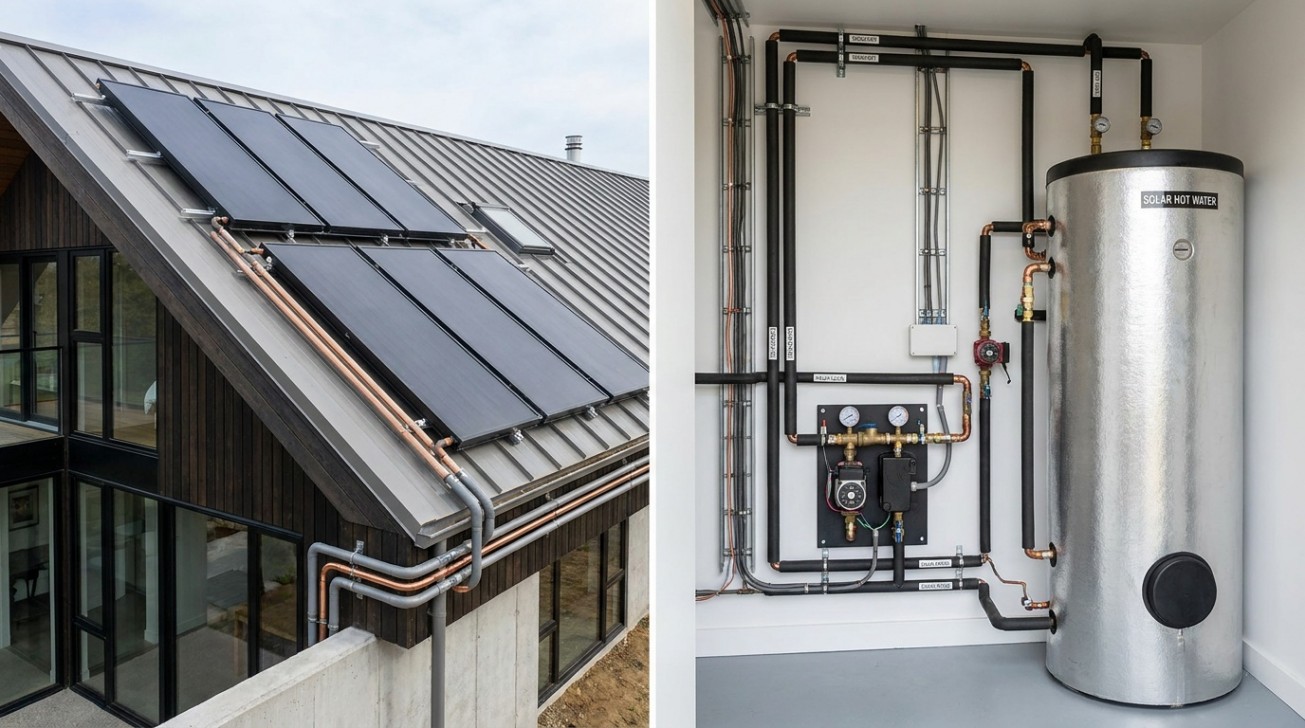
How to Maintain and Troubleshoot a Split Solar Water Heating System
Maintenance Is Not Repair — It Is Performance Protection
A split solar water heater maintenance plan should not begin only after the system fails. In a professional solar thermal project, maintenance is not the same as emergency repair. Maintenance is the planned work that protects performance, reduces downtime, extends component life, and helps the buyer understand whether the system is still operating as designed.
A split solar water heating system is a connected thermal system. The collector captures heat, the pipe loop moves heat, the pump station controls circulation, the controller decides when to run, the heat exchanger transfers energy, the tank stores hot water, and the backup heater protects supply when sunlight is not enough. If one part becomes weak, the user may only see one simple symptom: the water is not hot enough. But the real cause may be collector shading, poor insulation, trapped air, pump failure, controller error, glycol degradation, scaling inside the heat exchanger, tank heat loss, or incorrect backup heating logic.
This is why solar water heating maintenance must be systematic. A technician should not replace parts randomly. A distributor should not blame the collector before checking flow. A homeowner should not assume the system is broken because backup heating starts during several cloudy days. A B2B project buyer should not treat maintenance as a small after-sales detail. Maintenance is part of lifecycle value.
For residential users, good maintenance means stable comfort and lower energy bills. For hotels, apartments, schools, hospitals, gyms, resorts, and commercial kitchens, maintenance means service continuity. In commercial projects, hot water failure can create guest complaints, hygiene risks, operational disruption, and higher maintenance cost. A system that is easy to maintain is more valuable than a system that only looks impressive at installation.
The goal of this guide is to explain how to maintain and troubleshoot a split solar water heating system from a practical, industry-level perspective. The focus is not only what can go wrong, but how to identify problems logically and how to prevent them before they become expensive failures.
Build a Maintenance Baseline Before Problems Appear
The most important maintenance document is the baseline record created after commissioning. Without baseline data, troubleshooting becomes guesswork.
A professional solar thermal system service record should include system type, collector area, collector model, tank capacity, heat exchanger type, pump model, controller model, expansion vessel size, safety valve rating, normal operating pressure, normal flow range, controller settings, sensor locations, backup heating logic, antifreeze fluid type if used, and commissioning date.
This baseline gives technicians something to compare against. If the system pressure was 2.5 bar at commissioning and later drops to 1.2 bar, there may be leakage, air release, expansion vessel issues, or fluid loss. If the pump flow was originally stable but later becomes weak, there may be air, blockage, pump wear, filter contamination, or valve position problems. If the tank used to reach target temperature on sunny days but no longer does, the technician can check collector surface, shading, pump operation, heat exchanger transfer, and tank insulation.
For B2B distributors, baseline records are also useful for warranty discussions. If there is no record of pressure test, flow rate, glycol concentration, controller settings, or handover instructions, it becomes difficult to determine whether the issue is product-related, installation-related, usage-related, or maintenance-related.
A strong split solar water heater maintenance program starts with documentation. Maintenance is not only physical inspection; it is controlled comparison over time.
Daily and Weekly User-Level Checks
Not every maintenance action requires a professional technician. Users and building managers can perform simple checks that help detect problems early.
For residential systems, the user can check whether hot water availability is normal, whether the controller display looks normal, whether any alarm icon appears, whether the backup heater is running more often than usual, and whether there are visible leaks near the tank or pump station.
For commercial systems, maintenance staff can record tank temperature, solar loop pressure, pump operation status, controller alarms, and backup heating status. These checks do not require deep technical work, but they create useful operating history.
In a solar hot water troubleshooting process, operating history is very important. A one-day low-temperature event after heavy rain may be normal. A gradual temperature decline over several weeks may indicate dirt on collectors, pump flow reduction, scaling, sensor drift, or fluid degradation. A sudden pressure drop may indicate leakage. Frequent pressure relief discharge may indicate expansion vessel or overheating issues.
Simple user-level checks should not involve opening electrical panels, changing controller settings randomly, or releasing system pressure. Those tasks should be done by trained technicians. But users should know what normal operation looks like.
A good supplier should provide a simple user checklist during handover. For B2B projects, this checklist should be translated into the local language and included with maintenance training.
Solar Collector Maintenance: Keep Heat Collection Stable

The collector is the first point of heat input. If heat collection declines, every downstream component receives less useful energy. Good solar collector maintenance focuses on cleanliness, shading, mounting condition, glass integrity, connection condition, and physical damage.
Collector glass should be inspected for dirt, dust, bird droppings, leaves, snow, cracks, or surface damage. In dusty areas, cleaning may be required more frequently. In coastal or industrial areas, salt, pollution, or airborne particles may reduce transparency over time. A dirty collector does not always fail visibly; it simply produces less heat.
Shading should also be checked periodically. Trees grow. New buildings may appear nearby. Roof equipment may be added after installation. A collector location that was shade-free at commissioning may become partially shaded later. Partial shading can reduce useful output, especially during morning and afternoon periods.
Mounting structures should be inspected for loosened bolts, corrosion, roof leakage, frame deformation, and wind damage. In windy regions, mounting integrity is not optional. In snowy regions, snow load and collector angle should be considered. A weak mounting structure can become a safety risk as well as a performance problem.
For evacuated tube or heat pipe collectors, broken tubes, vacuum loss, manifold condition, and tube seating should be checked. For flat plate collectors, glass, frame seal, absorber condition, and moisture inside the panel may be relevant indicators. The maintenance method depends on collector type.
Good solar collector maintenance protects the entire system. If the collector cannot capture heat efficiently, the pump station, controller, tank, and backup heater cannot compensate without higher energy use.
Pump Station Maintenance: The Circulation Checkpoint
The pump station is one of the most important service points in a split solar system. Solar pump station maintenance should include checking pressure, flow, pump operation, valves, gauges, air separator, filling and draining points, leaks, noise, and temperature difference.
A pump may appear to run but still fail to circulate properly. This is why the technician should check flow, not only sound or electrical power. If the pump is running and the collector temperature is high but tank temperature is not rising, circulation may be weak or blocked.
Pressure gauges should be read and compared with baseline values. A pressure that is too low can indicate leakage, air release, insufficient fluid, or expansion vessel problems. A pressure that rises too high during operation may indicate overheating, expansion vessel failure, closed valves, or incorrect filling pressure.
Flow meters, if installed, are valuable. They help determine whether the system is moving enough heat-transfer fluid through the collector loop. Low flow can reduce heat transfer and increase collector temperature. Excessive flow may waste electricity and reduce temperature gain per pass.
Valves should be inspected for correct position. It is surprisingly common for service valves to be left partially closed after maintenance. Check valves should prevent reverse flow. Safety valves should not leak under normal conditions. Filling and draining valves should be closed securely after commissioning or service.
Solar pump station maintenance also includes listening. Unusual pump noise may indicate trapped air, cavitation, bearing wear, blockage, or incorrect pressure. Noise should not be ignored, especially in commercial systems where pump failure can quickly reduce hot water performance.
Controller Troubleshooting: Do Not Blame Hardware Before Reading the Logic

The controller is the decision maker. Many system problems are actually control problems. Solar controller troubleshooting should begin with reading sensor values, operating mode, alarm codes, pump output, backup heating status, and temperature settings.
A typical controller compares collector temperature and tank temperature. If the collector is sufficiently hotter than the tank, the pump starts. If the temperature difference becomes too small, the pump stops. If sensor readings are wrong, the controller may make wrong decisions.
Sensor problems are common. A loose collector sensor may read lower than actual collector temperature, causing delayed pump operation. A poorly inserted tank sensor may read incorrect water temperature, causing the pump or backup heater to operate improperly. A damaged sensor cable may trigger fault alarms. A sensor placed in the wrong tank position may cause unstable control.
Controller settings can also create issues. If the pump-on temperature difference is set too high, the system may miss useful solar heat. If the pump-off setting is wrong, the pump may run when little heat is available. If maximum tank temperature is too low, solar contribution may be limited. If backup heating is set too aggressively, solar savings may be reduced.
In solar hot water troubleshooting, always check controller logic before replacing expensive components. A system may have good collectors, good pump, and good tank, but poor settings can make it underperform.
For B2B projects, controller settings should be locked or documented after commissioning. Unauthorized changes can create long-term confusion. Maintenance teams should know which settings are user-adjustable and which should only be changed by trained technicians.
Glycol and Antifreeze Loop Maintenance

Indirect split solar systems often use antifreeze fluid in the collector loop. Solar water heater glycol maintenance is essential in cold climates and closed-loop systems.
Glycol protects the collector loop from freezing, but it does not last forever. High temperatures, stagnation, oxygen exposure, poor fluid quality, and long service intervals can degrade glycol. Degraded glycol may become acidic, lose freeze protection, reduce corrosion resistance, or form deposits. This can damage pumps, valves, heat exchangers, and collector loop components.
A technician should check glycol concentration, freeze protection level, pH, color, smell, and clarity. Dark, acidic, burnt, or contaminated fluid may need replacement. The service interval depends on system temperature, fluid type, climate, and operating conditions.
The loop pressure should also be checked. A closed-loop system must maintain pressure within the correct range. If pressure drops repeatedly, there may be a leak, air release, or expansion vessel problem. Simply adding more fluid without finding the cause may hide the real issue.
Solar water heater glycol maintenance should also include checking the expansion vessel. If the expansion vessel is not functioning properly, pressure may rise during heating and drop after cooling. This pressure instability can stress system components and cause safety valve discharge.
For B2B buyers, glycol maintenance should be explained before purchase. A closed-loop antifreeze system offers strong freeze protection, but it requires proper service. A supplier who sells an antifreeze system without explaining fluid maintenance is creating future after-sales risk.
Storage Tank Maintenance: Where Performance Becomes Usable Hot Water

The storage tank is where collected heat becomes available for use. Solar storage tank maintenance focuses on insulation, temperature performance, pressure safety, corrosion protection, anode condition, sediment, heat exchanger condition, and backup heating elements.
A tank with poor insulation loses heat faster. Users may notice that hot water cools overnight or backup heating runs more often. Insulation damage may not be obvious from the outside, but surface temperature, energy use, and tank temperature trends can reveal problems.
For pressurized tanks, safety valves and pressure relief devices must be inspected. A leaking relief valve may indicate high pressure, thermal expansion issues, valve wear, or incorrect installation. It should not simply be ignored.
If the tank uses a magnesium anode, the anode should be checked and replaced according to water quality and supplier recommendations. In hard or aggressive water conditions, corrosion protection is especially important. A tank failure is usually much more expensive than routine anode maintenance.
Sediment can accumulate in tanks, especially in areas with mineral-heavy water. Sediment reduces heat transfer, creates noise, affects water quality, and may shorten tank life. Flushing or cleaning may be required depending on design and local water conditions.
In systems with internal coils or heat exchangers, transfer performance should be monitored. If collector loop temperature is high but tank water heats slowly, the heat exchanger may be undersized, scaled, air-bound, or poorly circulated.
Good solar storage tank maintenance protects comfort, efficiency, and system life. The tank is not only a container; it is the thermal battery of the system.
Scaling and Water Quality: The Silent Efficiency Loss

Solar water heater scaling is one of the most common long-term problems in hard-water regions. Scaling occurs when minerals precipitate from heated water and form deposits on heat transfer surfaces, pipes, valves, and tank components.
Scale reduces heat transfer. It acts like insulation where heat should pass through metal. In a heat exchanger, scale can make collector energy transfer less effectively into domestic water. In pipes or valves, scale can restrict flow. In tanks, sediment and mineral deposits can reduce usable volume and increase backup heating demand.
Symptoms of solar water heater scaling may include slower heating, lower hot water temperature, increased backup heating use, reduced flow, pump stress, heat exchanger temperature imbalance, or noise from the tank.
Direct systems are more exposed to scaling in collector channels because domestic water circulates through the collector. Indirect systems protect the collector loop better, but the domestic water side, tank, and heat exchanger can still experience scaling.
Maintenance actions may include water treatment, descaling procedures, flushing, heat exchanger cleaning, filter inspection, and material selection. For severe hard-water markets, system design should consider serviceable heat exchangers and accessible tank inspection points.
For B2B distributors, water quality should be part of market evaluation. A system that works well in soft-water regions may create after-sales problems in hard-water markets if scaling is not addressed.
Troubleshooting Low Hot Water Temperature
Low hot water temperature is the most common user complaint. But the cause can vary widely. A logical solar hot water troubleshooting process should begin with conditions.
First, check weather and demand. Was the previous day cloudy? Was hot water demand unusually high? Is it winter? Was backup heating disabled? These conditions may explain temporary low temperature.
Second, check controller readings. What is collector temperature? What is tank temperature? Is the pump running when expected? Are there sensor errors? Is backup heating active?
Third, check pump station. Is pressure normal? Is flow present? Are valves open? Is the pump noisy? Is there air in the loop?
Fourth, check collector condition. Is the collector clean? Is it shaded? Is any tube broken? Is the collector orientation correct?
Fifth, check heat transfer. Is the collector loop hot but tank not heating? The issue may be heat exchanger scaling, air, low flow, or incorrect pump operation.
Sixth, check tank and backup. Is the tank losing heat quickly? Is the backup heater working? Is the thermostat set correctly? Is the mixing valve limiting outlet temperature?
A low-temperature complaint should not lead immediately to replacing the collector or pump. Good troubleshooting follows the heat path: collect heat, move heat, transfer heat, store heat, deliver heat.
Troubleshooting High Pressure, Low Pressure, and Fluid Loss
Pressure problems require careful attention because they may involve safety.
Low pressure in a closed-loop system may indicate leakage, air release, insufficient filling, expansion vessel issues, or safety valve discharge. If low pressure happens once after commissioning, it may be due to air removal. If it happens repeatedly, the system needs inspection.
High pressure may occur when fluid expands during heating and the expansion vessel cannot absorb the volume change. Causes may include incorrect pre-charge, undersized expansion vessel, blocked connection, overfilling, overheating, or failed vessel membrane.
Fluid loss may be visible near valves, fittings, collectors, pump station, or safety valve discharge. Sometimes leaks are small and only appear during heating. Thermal cycling can open weak joints that look dry when cold.
A professional technician should not simply refill the system repeatedly. Repeated refill without diagnosis can dilute glycol, introduce oxygen, hide leakage, and create corrosion risk.
Pressure problems are an important part of solar thermal system service because they affect safety, pump operation, freeze protection, and long-term reliability.
Troubleshooting Pump Noise, No Flow, and Air Problems
Pump noise is often a sign that the hydraulic loop needs attention. Possible causes include trapped air, low pressure, cavitation, blocked strainer, incorrect valve position, worn pump bearings, or unsuitable pump speed.
No flow can occur even when the pump has power. A valve may be closed. Air may block the loop. The pump impeller may be stuck. The controller may not be activating the pump. The pump may be undersized for the actual pipe resistance. The heat exchanger may be blocked.
Air problems can be difficult because they may appear intermittently. Air may collect in high points, causing unstable circulation. The system may work for a while, then lose performance as air moves through the loop.
Good solar pump station maintenance includes proper filling, purging, pressure setting, and air separator inspection. In commercial arrays, air removal points should be planned in the design stage. If the system has no proper venting strategy, service becomes harder.
Pump and air problems should be diagnosed with pressure readings, flow readings, controller output, sound, temperature difference, and valve inspection. Guessing usually leads to unnecessary part replacement.
Troubleshooting Controller Alarms and Sensor Faults
Controller alarms should be taken seriously but interpreted correctly. Many alarms do not mean the entire system has failed. They may indicate sensor disconnection, abnormal temperature, pump fault, overheating risk, freeze protection activation, or communication problems.
In solar controller troubleshooting, the first step is to identify the alarm code or message. Then compare sensor readings with real conditions. If the collector sensor reads extremely high or extremely low when conditions do not match, the sensor or cable may be faulty. If tank temperature reading is unrealistic, the tank sensor may be loose or damaged.
Sensor cables should be checked for cuts, loose terminals, moisture, rodent damage, or incorrect connection. Sensors should be placed in correct sensor wells and thermally connected. A sensor hanging in air near the tank is not measuring tank water temperature accurately.
Controller power supply should also be checked. Loose wiring, unstable voltage, or poor grounding may create intermittent operation.
For larger systems with monitoring, communication issues should be separated from thermal issues. A remote monitoring alarm may be caused by network failure, not heating failure.
Controller problems can be simple, but they can also mislead technicians. Always verify actual temperatures, pump operation, and wiring before replacing components.
Seasonal Maintenance: Spring, Summer, Autumn, and Winter

A split solar system experiences different risks in different seasons.
Before high-sun seasons, check collector cleanliness, pump operation, controller settings, expansion vessel, and overheating protection. Summer may bring strong solar input and low demand in some buildings, increasing overheating risk.
Before winter, check freeze protection, glycol concentration, pipe insulation, exposed outdoor pipe sections, controller freeze settings, and backup heating readiness. For cold regions, winter preparation is critical.
After storms, inspect collector mounting, glass, pipe supports, roof penetrations, and visible leaks. Wind and hail can damage collector fields or loosen mounting components.
In autumn, leaves and debris may collect around roof equipment. Cleaning and shading checks may be needed.
Seasonal solar water heating maintenance is especially important for commercial projects because system failure during peak occupancy or cold weather can be costly. The maintenance calendar should match local climate and project usage.
B2B After-Sales Strategy: Maintenance as a Sales Advantage

For B2B suppliers and distributors, maintenance support can become a competitive advantage. Many buyers compare equipment price, but serious project buyers care about long-term service.
A professional supplier should provide maintenance manuals, troubleshooting flowcharts, spare parts lists, controller settings, service videos, glycol service procedures, tank inspection guidance, and recommended inspection intervals. This support helps distributors train local installers and reduce after-sales disputes.
For export projects, language and clarity matter. A maintenance guide written only for engineers may not help property managers. A checklist written only for homeowners may not be enough for commercial service teams. Good documentation should match the user.
Spare parts planning is also important. Pumps, controllers, sensors, valves, seals, anodes, tubes, and gauges should be available. A system that performs well but cannot be serviced locally may become a problem after the warranty period.
A strong solar thermal system service package shows that the supplier understands lifecycle value. It also helps buyers trust the system for hotels, apartments, schools, hospitals, and other commercial projects.
Focused FAQ
How often should a split solar water heating system be maintained?
A split solar water heater maintenance schedule usually includes simple user checks monthly, visual inspections seasonally, and professional service annually. The exact interval depends on climate, water quality, system type, glycol use, and project scale.
What are the most common split solar water heater problems?
Common problems include low hot water temperature, weak pump circulation, trapped air, controller sensor faults, pressure loss, glycol degradation, collector shading, poor pipe insulation, tank heat loss, and solar water heater scaling.
Why is my solar hot water not hot enough?
Low temperature may be caused by cloudy weather, high demand, collector dirt, shading, pump failure, air in the loop, poor flow, controller error, heat exchanger scaling, tank heat loss, or backup heater issues. A proper solar hot water troubleshooting process should follow the heat path from collector to outlet.
What does solar collector maintenance include?
Solar collector maintenance includes checking glass cleanliness, shading, broken tubes, panel damage, mounting structure, corrosion, roof leaks, pipe connections, and collector orientation.
What should be checked in solar pump station maintenance?
Solar pump station maintenance should check pressure, flow rate, pump operation, valve positions, safety valve condition, air separator, leaks, gauges, noise, and controller activation.
How do I know if the solar controller has a problem?
Solar controller troubleshooting should check alarm codes, sensor readings, pump output, backup heater logic, temperature settings, wiring, and whether sensor readings match real conditions.
Why is glycol maintenance important in solar water heaters?
Solar water heater glycol maintenance is important because degraded glycol can lose freeze protection, become acidic, reduce corrosion resistance, and damage closed-loop components.
What causes scaling in solar water heaters?
Solar water heater scaling is caused by minerals in hard water forming deposits when heated. Scaling can reduce heat transfer, restrict flow, increase backup heating use, and shorten component life.
Conclusion
A split solar water heating system is not a one-time installation product. It is a working thermal system that needs inspection, records, maintenance, and logical troubleshooting. The best maintenance strategy is not to wait for failure, but to protect system performance before the user notices a problem.
Professional split solar water heater maintenance begins with baseline commissioning records. It continues with user-level checks, seasonal inspections, collector cleaning, pump station inspection, controller verification, glycol testing, tank maintenance, scaling control, and backup heating checks. When problems appear, solar hot water troubleshooting should follow the heat path: collect heat, move heat, transfer heat, store heat, and deliver heat.
For residential systems, good solar water heating maintenance protects comfort and energy savings. For hotels, apartments, schools, hospitals, gyms, resorts, and commercial kitchens, good maintenance protects service reliability and reduces operating risk. For B2B suppliers and distributors, service documentation, spare parts, and technician training are not extra details. They are part of product value.
A well-maintained split solar water heating system can provide stable hot water support, lower energy consumption, and long-term value. A poorly maintained system may lose performance quietly until users complain. The difference is not only equipment quality. It is whether the system has been managed as a complete solar thermal solution throughout its working life.
#SplitSolarWaterHeaterMaintenance #SolarWaterHeatingMaintenance #SolarHotWaterTroubleshooting #SolarCollectorMaintenance #SolarPumpStationMaintenance #SolarControllerTroubleshooting #SolarWaterHeaterGlycolMaintenance #SolarStorageTankMaintenance #SolarWaterHeaterScaling #SolarThermalSystemService