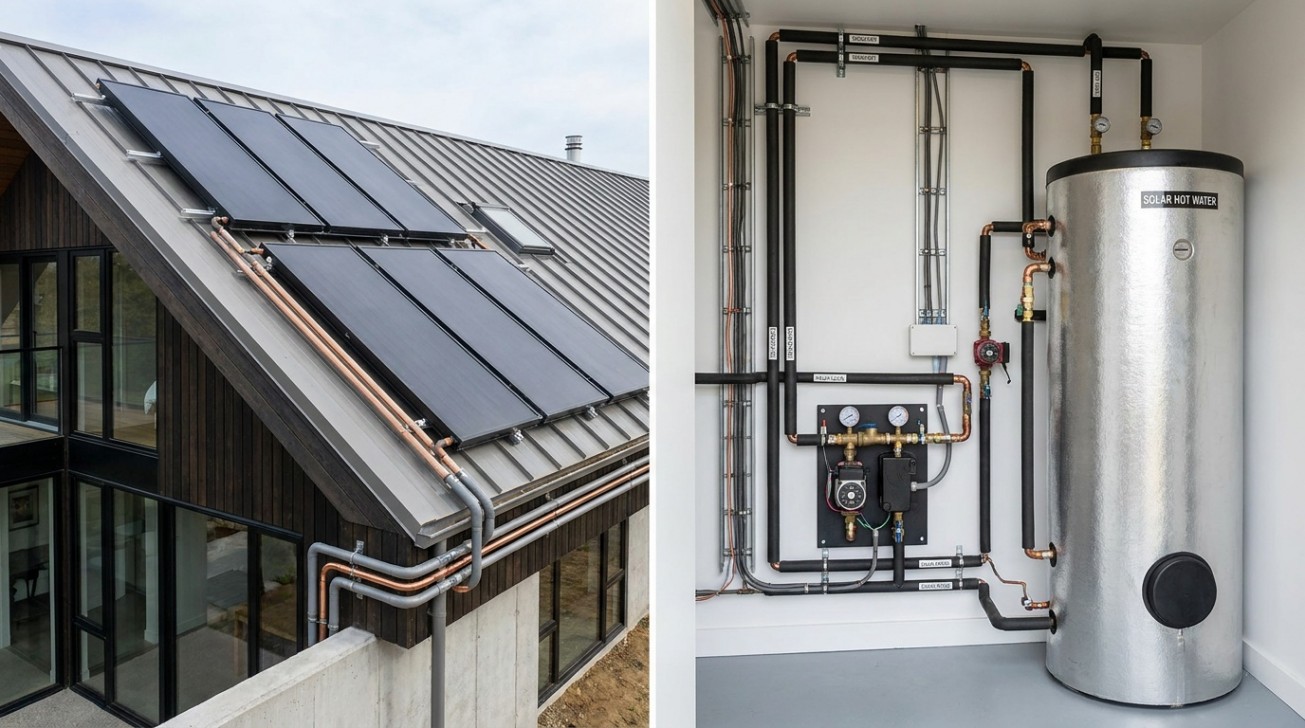
What Is a Split Solar Water Heating System?
What a Split Solar Water Heating System Really Means

A split solar water heating system is a solar hot water solution in which the solar collector and the water storage tank are installed separately. Instead of placing the tank and the collector together on the roof as one integrated unit, a split system allows the collector to be installed where sunlight exposure is best, while the storage tank can be installed indoors, in a mechanical room, on a balcony, in a utility area, or in another protected location.
This separated structure is the main reason the word “split” matters. It does not only describe the physical distance between the collector and the tank. It also reflects a different design logic. A split solar water heater is usually a system-based solution. It relies on circulation, temperature control, heat transfer, pressure management, and safety protection. In many applications, it is not just a product that is placed on the roof. It is a designed hot water system.
For buyers who are familiar with compact rooftop solar water heaters, this difference is important. A compact system usually puts the collector and the tank together. That design is simple and often cost-effective, especially for small homes in warm climates. But when the project requires better building appearance, higher water pressure, indoor tank protection, larger storage volume, or more flexible installation, a split solar water heating system becomes more suitable.
In international markets, this type of solution may be described in different ways. Some suppliers call it a split solar water heater. Some call it a split pressurized solar water heater. Others describe it as an active solar water heating system, especially when the system uses a pump and controller to move heat-transfer fluid between the collector and the tank. These names may look different, but they often point to the same basic idea: solar energy is collected in one place, stored in another place, and managed through a controlled circulation loop.
That is why the split system should not be understood as a single component. It is better understood as a complete solar water heating solution. The collector, tank, pump station, controller, expansion vessel, valves, piping, insulation, and backup heater all affect the final performance.
Why Split Design Exists in Solar Water Heating
The split design was developed because real buildings are not always suitable for simple rooftop tank systems. In many homes, hotels, apartments, schools, hospitals, and commercial facilities, the best location for solar collection is not the best location for water storage.
A roof may have good sunlight, but it may not be ideal for placing a heavy water tank. The building owner may not want the tank to be visible from the street. A hotel may need a large indoor storage tank that connects with an existing boiler room. A villa may require a clean roof appearance. A cold-climate project may need to protect the storage tank and hydraulic components from freezing weather. These are typical situations where a split solar water heating system becomes valuable.
The first advantage is layout flexibility. The solar collector system can be placed on the roof, terrace, ground frame, or another sunny area, while the tank can remain in a more convenient service location. This gives designers more freedom.
The second advantage is better pressure compatibility. Many split systems are designed as pressurized solar water heater solutions, which means they can work more naturally with modern plumbing systems. In many markets, users expect stable water pressure at showers, faucets, hotel rooms, and commercial outlets. A properly designed split pressurized solar water heater can support this expectation better than many simple non-pressure rooftop systems.
The third advantage is system scalability. A small home may use one collector field and one storage tank. A hotel or dormitory may use multiple collector arrays and a larger storage system. A factory may connect solar preheating to an existing boiler. Because the system is modular, the design can be adapted to different hot water loads.
The fourth advantage is protection and maintenance. When the tank, pump station, and controller are installed indoors or in a protected area, they are easier to inspect, repair, and protect from harsh outdoor conditions. This is one of the reasons split systems are common in higher-value projects.
How a Split Solar Water Heating System Works

A split solar water heating system works by collecting solar heat through a collector, transferring that heat through a circulation loop, and storing it in a water tank for later use. The basic logic is simple, but the system design must be correct.
When sunlight reaches the collector, the absorber inside the collector converts solar radiation into heat. Depending on the collector type, this may happen inside a flat plate collector or an evacuated tube collector. The heat is then transferred to water or to a special heat-transfer fluid. A pump moves the heated fluid between the collector and the storage tank. Inside the tank, the heat is transferred to domestic hot water directly or indirectly through a heat exchanger.
The controller is the brain of the active solar water heating system. It compares the temperature of the collector with the temperature of the water tank. When the collector is hot enough to provide useful heat, the controller activates the pump. When the temperature difference is too small, the controller stops the pump to prevent heat loss. This simple control logic is one of the most important differences between a split system and a passive system.
In a direct system, household water may circulate through the collector. This design is simpler and can be efficient in warm regions where freezing is not a serious risk. In an indirect system, a separate heat-transfer fluid circulates through the collector loop. This fluid passes through a heat exchanger and transfers heat to the domestic water in the tank. This design is usually more suitable for areas where freezing protection, water quality control, or system durability is important.
A split solar thermal system may also include an electric heater, gas boiler, heat pump, or other backup source. This does not mean the solar system is weak. It means the system is designed to provide reliable hot water even during cloudy days, rainy seasons, or high-demand periods. In many real projects, solar energy reduces the energy load, while the backup system ensures comfort and continuity.
Main Components of a Split Solar Water Heater

A complete split solar water heater is made of several coordinated components. Each part has a function, and poor selection of one part can reduce the performance of the whole system.
Solar Collector
The collector is the part that captures solar heat. In split systems, the collector may be a flat plate collector or an evacuated tube collector. A flat plate collector is often selected for stable climates, simple roof integration, and large-area installations. An evacuated tube collector, especially a heat pipe type, may be selected when higher thermal insulation, cold-weather performance, or faster heat response is required.
The collector should not be chosen only by appearance or price. The correct choice depends on climate, roof space, wind conditions, installation angle, water temperature requirement, and project budget. A good solar collector system should match the actual hot water demand rather than simply look impressive on paper.
Storage Tank
The storage tank stores heated water for use at different times of the day. In a split pressurized solar water heater, the tank is usually designed to handle pressure and connect with household or commercial water supply systems. The tank may include one or two coils, an electric heating element, a magnesium anode, insulation layers, temperature sensors, and safety valves.
Tank sizing is critical. If the tank is too small, the user may run out of hot water during peak demand. If the tank is too large, the system may heat water inefficiently and increase cost. For homes, the tank is usually selected based on the number of users and daily hot water habits. For hotels, schools, and apartments, the design should consider peak-hour usage, occupancy rate, and backup heating strategy.
Pump Station
The pump station drives circulation between the collector and the tank. It may include a circulation pump, flow meter, pressure gauge, check valve, safety valve, filling valve, and other hydraulic components. In a high-quality active solar water heating system, the pump station is not an optional accessory. It is part of the system’s operating stability.
A good pump station helps maintain correct flow rate. If the flow is too low, heat transfer may be insufficient. If the flow is too high, the pump may waste electricity and reduce heat exchange efficiency. For larger projects, pump selection should be calculated according to pipe length, height difference, collector area, and pressure loss.
Controller
The controller manages pump operation, temperature monitoring, overheating protection, antifreeze logic, and sometimes backup heating. In a solar hot water system, the controller helps prevent unnecessary circulation. Without proper control, the system may circulate fluid when there is not enough heat, which can move heat out of the tank instead of into it.
Some controllers are simple, while others support multiple sensors, holiday mode, anti-freeze protection, overheating protection, and system error alarms. For B2B projects, controller reliability is especially important because maintenance teams need clear system status and fault indication.
Heat Exchanger
In an indirect solar water heater system, the heat exchanger transfers heat from the collector loop to domestic water. It may be located inside the tank as a coil or outside the tank as a plate heat exchanger. The purpose is to separate the heat-transfer fluid from potable water.
This separation is useful in cold climates and areas with hard water. It can reduce freezing risk in the collector loop and prevent poor water quality from damaging collector channels. However, it also requires good design. If the heat exchanger is too small, heat transfer becomes limited. If the fluid is not maintained, system efficiency may decline over time.
Expansion Vessel and Safety Valves
Solar thermal systems operate under changing temperatures. As fluid heats up, it expands. The expansion vessel absorbs this expansion and helps maintain stable pressure. Safety valves protect the system when pressure becomes too high.
These parts may look small compared with collectors and tanks, but they are essential for safe operation. A split solar water heating system without proper pressure management may face leakage, pump problems, or premature component failure.
Piping and Insulation
Piping connects the collector and the tank. In split systems, pipe length can vary greatly from one project to another. Longer pipe runs increase heat loss and pressure loss. Therefore, pipe diameter, route, insulation thickness, and outdoor weather protection must be considered carefully.
Poor insulation can waste a large amount of collected heat. This is especially true in cold or windy environments. A well-designed solar water heating solution should protect not only the collector but also the entire heat transfer path.
Split System vs Integrated Solar Water Heater
The difference between a split system and an integrated system is one of the most important buying decisions in solar water heating.
An integrated solar water heater combines the collector and tank into one rooftop unit. This design is simple, easy to understand, and often suitable for small residential buildings in warm climates. The system usually has fewer components, lower installation complexity, and lower initial cost. For many basic hot water needs, it can be a practical choice.
A split solar water heating system, however, separates the collector from the tank. This makes the system more flexible but also more complex. The user gains better layout options, better building appearance, better pressure compatibility, and better system scalability. But the project also needs correct installation, pump control, hydraulic design, and maintenance planning.
The split system is usually more suitable when the user wants indoor tank placement, stable pressure, architectural integration, larger storage capacity, or project-level design. This makes it attractive for villas, hotels, apartment buildings, hospitals, dormitories, schools, gyms, resorts, and commercial kitchens.
The key point is not that one system is always better than the other. The key point is matching the system to the application. For a small house in a warm region with simple hot water needs, an integrated unit may be enough. For a larger building or a project with higher expectations, a split solar water heater may provide better long-term value.
Is a Split Solar Water Heating System Always Pressurized?
Many split systems are pressurized, but not every split system must be pressurized. This is an important distinction.
The word “split” describes the separated installation of collector and tank. The word “pressurized” describes how the water side of the system handles water pressure. A split pressurized solar water heater is a split system designed to work with pressurized water supply. It is often used when users expect strong shower pressure, stable outlet pressure, or compatibility with modern plumbing.
In many export markets, pressurized systems are more attractive for mid-to-high-end residential projects and commercial buildings. Users do not want hot water pressure to depend only on gravity. They expect the solar system to work like a conventional water heater.
However, some split systems may still be designed with non-pressure tanks or special hydraulic arrangements depending on local market habits and project requirements. Therefore, when comparing suppliers, buyers should not only ask whether the product is “split.” They should ask whether the tank is pressurized, what pressure rating it supports, what safety valves are included, and whether the system matches the local plumbing standard.
This is where B2B buyers must be careful. Two suppliers may both offer a split solar water heater, but the internal tank structure, coil design, pressure rating, insulation quality, pump station configuration, and controller functions may be very different.
Where Split Solar Water Heating Systems Are Most Suitable

A split solar water heating system is most valuable when the project needs flexibility, comfort, and long-term system performance.
Residential Villas and Modern Homes
For villas and modern houses, split systems are often chosen because they provide better appearance and comfort. The collector can be installed on the roof, while the tank can be hidden inside a utility room. This keeps the building exterior cleaner and reduces visible rooftop weight.
A pressurized solar water heater is also more aligned with modern home expectations. Users want stable water pressure in bathrooms, kitchens, and laundry areas. They may also want backup electric heating, smart control, and quiet operation.
Hotels and Resorts
Hotels need stable hot water throughout the day. Guest demand may rise sharply in the morning and evening. A properly designed solar hot water system can preheat a large volume of water and reduce energy consumption from boilers or electric heaters.
For hotels, split systems are especially useful because storage tanks and pump rooms can be arranged in service areas. Multiple collectors can be connected into arrays. The system can also be designed with backup heating to ensure guest comfort during bad weather.
Apartment Buildings and Dormitories
Apartment buildings and dormitories need centralized hot water solutions with reliable storage and distribution. A split solar thermal system can be designed as a preheating system that reduces the load on conventional heating equipment.
In these projects, the main value is not only energy saving. It is also system integration. The solar system must work with existing tanks, pumps, pipes, control systems, and maintenance routines. This is why split systems are often more suitable than simple rooftop units.
Schools, Hospitals, and Public Buildings
Public buildings often have predictable hot water demand. Schools may need hot water for dormitories, kitchens, or cleaning. Hospitals may require more stable supply and higher hygiene standards. A solar water heater system for these applications must be designed with safety, backup capacity, and maintenance access in mind.
Split systems allow equipment rooms to be organized more professionally. Tanks, pumps, controllers, and valves can be placed where technicians can inspect them easily.
Industrial and Commercial Preheating
Some commercial and industrial facilities do not need solar energy to provide all final hot water. Instead, they use solar energy for preheating. The water enters the conventional heating system at a higher temperature, reducing fuel or electricity consumption.
This application is a strong example of a system-level solar water heating solution. The solar system works as part of a larger energy chain. It may not replace the boiler, but it reduces the boiler’s workload.
Climate and Regional Considerations

Climate has a major influence on split system design. The same product configuration may not be suitable for every region.
In warm climates where freezing is rare, a direct circulation system may be simpler. Water can circulate through the collector and return to the tank. This approach can be efficient and easier to maintain when water quality is good and freeze protection is not a major issue.
In cold climates, an indirect system is usually more appropriate. The collector loop uses a heat-transfer fluid that can resist freezing. Heat is transferred to domestic water through a heat exchanger. This design adds complexity but improves protection.
In hot climates, overheating control becomes important. When solar radiation is strong and hot water demand is low, the collector may produce more heat than the tank can absorb. A good active solar water heating system should include temperature control, expansion capacity, and safety protection.
In areas with hard water, scaling should be considered. If hard water flows directly through collector channels, mineral deposits may reduce performance. An indirect system can help separate domestic water from the collector loop. However, the heat exchanger and storage tank still require proper maintenance.
In coastal regions, corrosion resistance matters. Outdoor collectors, frames, fasteners, and piping insulation may face salt air, humidity, and wind. A low-cost system with poor materials may look acceptable at first but fail earlier in harsh environments.
Therefore, the correct question is not only “What is the price of a split solar water heater?” The better question is “Is this system configuration suitable for the climate, water quality, building structure, and hot water demand of the project?”
How Buyers Should Evaluate a Split Solar Water Heating System

A buyer should evaluate a split solar water heating system as a complete system, not as separate parts.
The first factor is hot water demand. How many people use hot water? What is the daily water volume? What is the required outlet temperature? Is the demand stable or concentrated during peak hours? Without demand analysis, collector size and tank size can easily be wrong.
The second factor is collector selection. A flat plate collector and an evacuated tube collector may both work, but they are not identical. The best choice depends on climate, required temperature, available roof area, wind load, installation angle, and budget.
The third factor is tank design. For a split pressurized solar water heater, tank pressure rating, inner tank material, coil area, insulation thickness, electric backup, magnesium anode, and safety accessories should be checked carefully.
The fourth factor is control logic. The controller should support stable pump operation and necessary protection functions. For project-level systems, fault display and sensor reliability are also important.
The fifth factor is installation quality. Even a good product can perform poorly if pipes are too long, insulation is weak, sensors are placed incorrectly, or the pump is not matched with the system resistance.
The sixth factor is serviceability. Can the pump station be accessed easily? Can the tank be inspected? Can sensors be replaced? Are spare parts available? Can the supplier provide installation guidance and technical documents?
The seventh factor is total cost of ownership. A cheaper product may have higher installation risk, lower insulation quality, weaker control, or shorter service life. A better solar water heating solution should reduce long-term energy cost while keeping maintenance predictable.
Common Misunderstandings About Split Solar Water Heaters
Many buyers misunderstand split systems because suppliers sometimes explain them too simply.
One misunderstanding is that a split system is automatically better than an integrated system. This is not always true. If the project is small, the climate is warm, and the budget is limited, an integrated system may be more practical. Split systems create more value when flexibility, pressure, appearance, capacity, or system integration matters.
Another misunderstanding is that the collector alone determines performance. In reality, the solar collector system is only one part of the solution. Tank insulation, pump control, heat exchanger size, pipe insulation, installation angle, and backup heating also affect performance.
A third misunderstanding is that more collector area always means better performance. Oversizing the collector can increase overheating risk and waste budget. The collector area should match tank capacity and actual hot water demand.
A fourth misunderstanding is that solar hot water can completely remove the need for backup heating. In some sunny climates and low-demand applications, solar coverage may be high. But in most real projects, backup heating is still necessary for cloudy weather, seasonal variation, and peak usage.
A fifth misunderstanding is that all split systems are the same. In fact, two systems with similar photos may have very different materials, pressure ratings, control functions, heat exchange capacity, and installation requirements.
These misunderstandings are why a professional split solar water heating system should be explained through system design, not just product images.
Why Split Solar Water Heating Still Matters in the Renewable Energy Market

In recent years, many people have paid more attention to photovoltaic power, batteries, and heat pumps. However, solar thermal water heating still has a clear role in the renewable energy market because hot water is a direct thermal demand.
When a building needs hot water every day, using sunlight to produce heat directly can be efficient. A solar hot water system does not need to convert sunlight into electricity first and then convert electricity into heat. It captures thermal energy directly and stores it in water.
This does not mean solar thermal must compete against every other technology. In many projects, the better approach is integration. A split solar thermal system can work with electric heaters, gas boilers, heat pumps, or other heating equipment. Solar energy reduces the base energy load, while backup systems provide reliability.
For hotels, schools, apartments, and public buildings, this hybrid thinking is often more realistic than promising 100% solar coverage. The goal is not to create a perfect solar-only system. The goal is to reduce operating cost, improve energy structure, and maintain hot water reliability.
This is why the split system remains important. It is flexible enough to connect with different building systems. It can be scaled. It can be designed for different climates. It can use different collector types. It can be adapted for residential, commercial, and project applications.
What Makes a Good Split Solar Water Heating Supplier

A good supplier should not only sell a split solar water heater. The supplier should understand system design.
For B2B buyers, the supplier’s value appears in several areas. First, the supplier should provide clear product specifications, including collector area, tank capacity, pressure rating, insulation data, heat exchanger structure, pump station configuration, controller functions, and recommended installation conditions.
Second, the supplier should help match the system to the application. A villa, hotel, dormitory, and factory should not be treated as the same project. The hot water profile, installation environment, and backup heating method may be completely different.
Third, the supplier should provide installation guidance. Split systems require correct pipe connection, sensor placement, pressure testing, insulation, and controller setup. Without technical support, installers may make small mistakes that reduce performance.
Fourth, the supplier should offer spare parts and maintenance guidance. Pumps, sensors, valves, anodes, and controllers may need replacement during the system life. A reliable supplier should make this process predictable.
Fifth, the supplier should avoid exaggerated claims. A professional supplier does not promise that one system fits every climate or every building. Instead, the supplier explains design conditions clearly and helps the buyer choose the right solar water heating solution.
A Practical Way to Understand Split Solar Water Heating
The easiest way to understand a split solar water heating system is to see it as a bridge between solar energy and building hot water demand.
The collector captures heat.
The circulation loop moves heat.
The heat exchanger transfers heat.
The tank stores heat.
The controller manages heat.
The backup heater guarantees hot water.
The user receives stable hot water.
Every part matters. If the collector is good but the tank is poorly insulated, energy is wasted. If the tank is good but the pump control is wrong, heat transfer becomes unstable. If the system is well designed but installed without proper insulation, performance drops. If the climate is cold but freeze protection is ignored, the system may fail.
This is why split systems should be planned carefully. They offer more flexibility than integrated systems, but they also require more professional design. For buyers, this is not a disadvantage. It is the reason the system can serve higher-value applications.
A compact product may be enough for simple needs. A split system is better when the project requires comfort, pressure, appearance, capacity, and integration.
Focused FAQ
What is a split solar water heating system?
A split solar water heating system is a solar hot water system in which the collector and storage tank are installed separately. The collector captures solar heat, while the tank stores hot water in a protected or convenient location. The system usually uses a pump, controller, pipes, and safety components to manage heat transfer.
Is a split solar water heater the same as a pressurized solar water heater?
Not always. A split solar water heater refers to the separated layout of collector and tank. A pressurized solar water heater refers to a system designed to work with pressurized water supply. Many split systems are pressurized, but buyers should always confirm the tank pressure rating and system design.
Is a split solar water heating system active or passive?
Most split systems are active systems because they use a pump and controller to circulate fluid between the collector and the tank. That is why a split system is often described as an active solar water heating system.
Can a split system use heat pipe collectors?
Yes. A split solar thermal system can use heat pipe evacuated tube collectors, flat plate collectors, or other suitable solar collectors. The right collector depends on climate, required water temperature, installation conditions, and project budget.
Where is a split solar water heater most suitable?
A split solar water heater is suitable for villas, modern homes, hotels, apartments, schools, hospitals, dormitories, and commercial buildings. It is especially useful when the tank needs to be installed indoors or when stable pressure and flexible system design are required.
Does a split solar water heating system need backup heating?
In most real projects, yes. A solar hot water system is usually designed with electric, gas, boiler, or heat pump backup to ensure reliable hot water during cloudy weather, seasonal changes, or peak demand.
What should buyers check before choosing a split solar water heating system?
Buyers should check hot water demand, collector type, tank capacity, pressure rating, heat exchanger design, pump station configuration, controller functions, pipe insulation, freeze protection, overheating protection, and supplier technical support.
Conclusion
A split solar water heating system is not just a different shape of solar water heater. It is a more flexible and system-oriented approach to solar hot water design. By separating the collector and the storage tank, it allows better building integration, more stable pressure options, easier indoor equipment placement, and greater project scalability.
For simple residential use in warm climates, an integrated system may still be enough. But for homes, hotels, apartments, public buildings, and commercial hot water projects that require comfort, reliability, and design flexibility, a split pressurized solar water heater can offer stronger long-term value.
The most important point is to evaluate the system as a complete solar water heating solution. The collector, tank, pump station, controller, heat exchanger, piping, insulation, and backup heater must work together. When these parts are selected and installed correctly, a split system can turn solar energy into practical, reliable, and cost-saving hot water for a wide range of applications.
#SplitSolarWaterHeatingSystem #SplitSolarWaterHeater #SolarHotWaterSystem #ActiveSolarWaterHeatingSystem #SolarThermalSystem #PressurizedSolarWaterHeater #SolarCollectorSystem #RenewableEnergyHeating #SolarWaterHeatingSolution #SolarThermalGuide