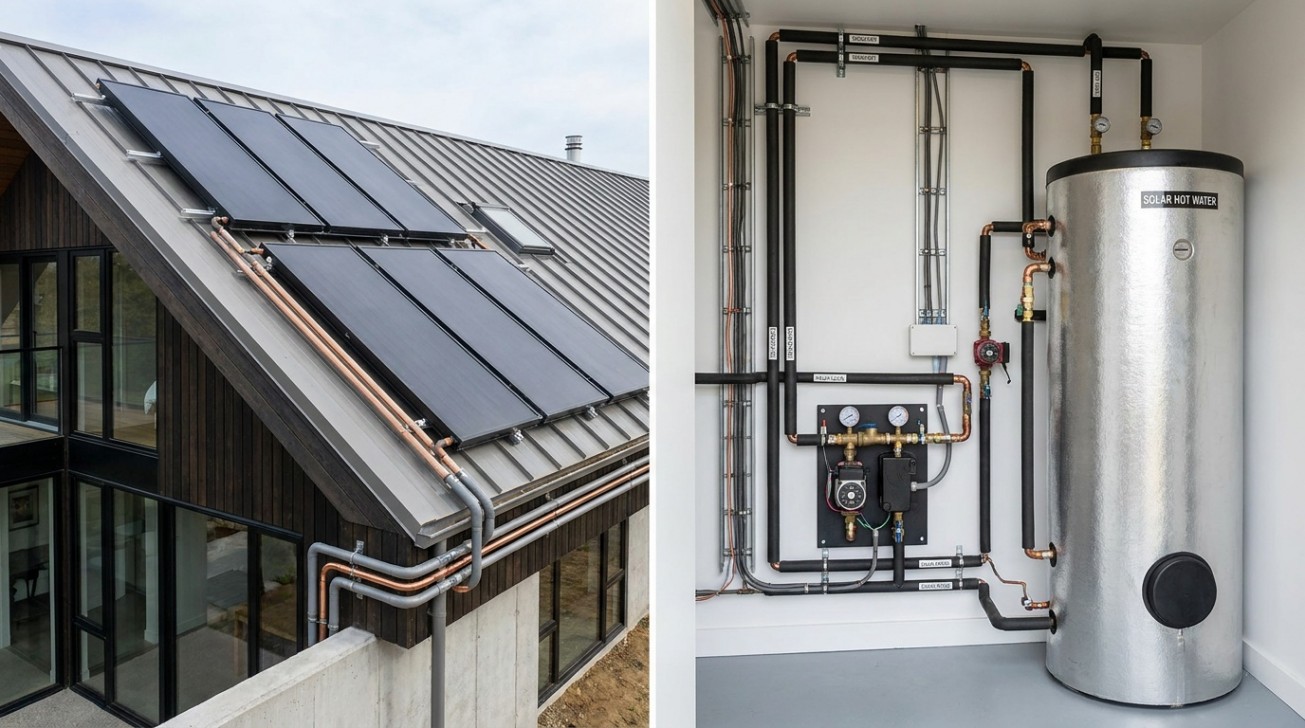
Key Components of a Split Solar Water Heater System
Why Component Understanding Matters in a Split Solar Water Heater System
A split solar water heater system is not a single product that can be judged only by appearance, tank volume, or collector size. It is a connected thermal system made of several working parts. Each component affects how efficiently solar heat is collected, transferred, stored, controlled, protected, and delivered to the user. For this reason, understanding solar water heater components is one of the most important steps before choosing, specifying, or purchasing a split solar hot water solution.
Many buyers compare systems by looking at only two things: the solar collector area and the hot water storage tank capacity. This is understandable, because these are the largest and most visible parts of the system. However, this approach is incomplete. A system with a large collector and a large tank may still perform poorly if the pump station is undersized, the solar controller is too basic, the heat exchanger is too small, the expansion vessel is not correctly matched, or the solar piping is poorly insulated.
A professional split solar water heater system works as a chain. The strength of the chain depends on the coordination of all parts, not only on the strongest part. If one component is selected incorrectly, the entire system may lose efficiency, become difficult to maintain, or face safety problems. This is especially important for B2B buyers, hotel projects, apartment buildings, schools, hospitals, villas, and commercial hot water applications.
The right way to evaluate a split system is to ask: does each part match the actual hot water demand, climate, building layout, water pressure, installation environment, and maintenance capability? If the answer is yes, the system can provide long-term value. If the answer is no, even an attractive quotation may become expensive over time.
A good component structure should support four goals: stable heat collection, efficient heat transfer, safe pressure management, and reliable hot water delivery. These goals are achieved through the combined work of the solar collector, hot water storage tank, pump station, solar controller, heat exchanger, expansion vessel, solar piping, valves, sensors, insulation, and backup heater.
The Solar Collector: Where the System Captures Heat

The solar collector is the heat source of a split solar water heater system. Its job is to absorb solar radiation and convert it into usable thermal energy. Without a properly selected collector, the rest of the system has no strong heat input to manage.
In split systems, the solar collector is usually installed on the roof, terrace, building façade, or ground frame. The collector location should receive stable sunlight, avoid shading, and allow proper orientation and tilt angle. Good installation conditions can be just as important as collector quality. A premium collector installed under partial shading may perform worse than a standard collector installed correctly.
There are two common collector types used in split solar water heating: flat plate collectors and evacuated tube collectors. A flat plate solar collector usually consists of an absorber plate, transparent cover, insulation layer, fluid channels, and a frame. It is often chosen for stable climates, architectural integration, and projects that require a clean roof appearance. An evacuated tube collector uses vacuum insulation to reduce heat loss and is often selected for colder or more demanding conditions.
For buyers, the most important point is that the collector should not be selected only by square meters or tube quantity. The collector must match the required water temperature, available sunlight, local climate, wind load, roof structure, system pressure, and hot water demand. A larger collector may produce more heat, but if the hot water storage tank is too small or the system has poor overheating control, oversizing can create problems.
A professional supplier should provide key collector data, including gross area, absorber area, working pressure, stagnation temperature, frame material, glass type, insulation, recommended tilt angle, and system compatibility. These details help buyers understand whether the solar collector is suitable for the project rather than only suitable for a catalog photo.
The collector is the first component in the heat chain. Its value is not isolated. It must work with the pump station, heat exchanger, solar controller, and tank to become a complete split solar water heater system.
The Hot Water Storage Tank: Where Solar Heat Becomes Usable

The hot water storage tank is where collected solar heat becomes practical hot water. A collector produces heat during daylight hours, but users may need hot water in the morning, evening, or during peak demand periods. The tank stores energy so the system can serve real daily usage.
In a split solar water heater system, the hot water storage tank is usually installed separately from the collector. This is the core difference between split systems and many compact rooftop systems. The tank can be placed indoors, in a utility room, in a basement, in a mechanical room, on a balcony, or in another protected space. This improves building appearance, reduces roof load, and makes maintenance easier.
A good tank is not just a water container. It may include an inner tank, insulation layer, outer shell, magnesium anode, sensor ports, electric heating element, pressure relief valve, heat exchanger coil, inspection opening, cold water inlet, hot water outlet, and connection points for circulation. Each detail affects durability and performance.
Tank material matters. Stainless steel, enamel-coated steel, and other pressure-rated materials may be used depending on market standards and application requirements. The internal anti-corrosion design should match local water quality. In hard water regions, scale and corrosion control become especially important.
Insulation is another critical factor. A hot water storage tank must retain heat effectively. If tank insulation is weak, solar energy collected during the day may be lost before users need it. Good insulation reduces standby heat loss and improves overall system value.
Tank capacity should be selected based on actual hot water demand. For residential use, this may depend on the number of people, shower habits, kitchen use, and backup heating strategy. For hotels, dormitories, gyms, schools, or hospitals, the sizing must consider peak demand, occupancy rate, usage schedule, and recovery time. A tank that is too small may cause shortages. A tank that is too large may reduce temperature performance and increase system cost.
A professional split solar water heater system does not use the tank as a random accessory. The tank is a central energy storage unit. It must match the solar collector, heat exchanger, pump station, and backup heater.
The Pump Station: The Circulation Center of the System

The pump station is one of the most important active components in a split solar water heater system. Since the collector and tank are separated, heat must be moved through a circulation loop. The pump station makes this movement possible.
A typical pump station may include a circulation pump, flow meter, pressure gauge, check valve, safety valve, filling valve, draining valve, air separator, temperature gauge, and connection fittings. In some systems, these components are assembled into a compact unit. In larger projects, the hydraulic station may be customized according to system size and pipe layout.
The main function of the pump station is to circulate heat-transfer fluid between the solar collector and the hot water storage tank or external heat exchanger. When the collector is hot enough, the pump moves heated fluid to the tank side. After releasing heat, the cooler fluid returns to the collector to be heated again.
Pump selection must be based on system resistance. Pipe length, pipe diameter, height difference, collector array size, heat exchanger resistance, and fluid type all affect pump requirements. A pump that is too weak may cause low flow and poor heat transfer. A pump that is too strong may waste electricity, create noise, and increase component wear.
The pump station also supports commissioning and maintenance. Technicians can check system pressure, verify flow rate, fill or drain the loop, remove air, and diagnose circulation issues. This service value is especially important in B2B projects. A hotel or apartment building cannot rely on guesswork when hot water supply is unstable.
For buyers, a pump station should not be treated as a low-value accessory. It is part of the system’s operating reliability. A good pump station can improve heat transfer, reduce troubleshooting time, and make the entire split solar water heater system easier to manage.
The Solar Controller: The Decision Maker Behind the System

The solar controller is the intelligence center of the system. It determines when the pump should run, when it should stop, and how the system should respond to temperature changes. Without a proper solar controller, a split system cannot operate efficiently.
The basic function of the controller is differential temperature control. A sensor measures the collector temperature. Another sensor measures the tank temperature. When the solar collector is hotter than the hot water storage tank by a set temperature difference, the controller activates the pump station. When the temperature difference becomes too small, the controller stops the pump.
This logic prevents wasted circulation. If the pump runs when the collector is not hot enough, the system may move heat out of the tank instead of into it. This can happen at night, during cloudy weather, or in low sunlight conditions. A good solar controller avoids this problem by moving heat only when heat transfer is useful.
More advanced controllers may support antifreeze protection, overheating protection, holiday mode, tank temperature limit, backup heating control, fault alarm, sensor failure detection, multiple pump outputs, and remote monitoring. These functions are important for larger or more demanding systems.
For residential systems, a simple controller may be enough. For commercial projects, the solar controller should provide clearer monitoring and fault information. Maintenance teams need to know whether the pump is running, whether sensors are working, whether the tank has reached target temperature, and whether protection modes have been activated.
A controller should also be user-friendly. If the interface is too confusing, installers may set it incorrectly. Wrong settings can reduce performance even if all hardware is good. For this reason, controller manuals, wiring diagrams, and technical support are part of supplier value.
The solar controller turns a collection of hardware into a managed solar thermal system. It is not the most expensive component, but it often determines whether the system behaves intelligently.
The Heat Exchanger: The Bridge Between Collector Heat and Domestic Water

The heat exchanger transfers heat from the collector loop to domestic water. In many split systems, especially indirect systems, the collector loop does not mix with household water. Instead, a heat-transfer fluid circulates through the collector and releases heat through the heat exchanger.
There are two common types: internal coil heat exchangers and external plate heat exchangers. An internal coil is built inside the hot water storage tank. Heated fluid from the collector loop flows through the coil, and heat passes through the coil wall into the stored water. This structure is common in residential and small commercial systems.
An external plate heat exchanger is installed outside the tank. It allows two fluids to pass through separate channels while transferring heat across metal plates. This design may be used in larger systems, high-flow applications, or projects that need easier service access.
Heat exchanger sizing is very important. If the heat exchanger is too small, the collector loop may become hot but fail to transfer heat quickly into the tank. This reduces system efficiency and may increase overheating risk. If the heat exchanger is correctly sized, heat transfer becomes smoother and more effective.
Material selection also matters. Copper, stainless steel, and other suitable materials may be used depending on system design, water quality, pressure rating, and corrosion requirements. In areas with hard water, scaling can reduce heat transfer over time, so maintenance access and water treatment considerations may be necessary.
The heat exchanger is especially valuable in cold climates. It allows the collector loop to use antifreeze fluid while keeping domestic water separate. This improves freeze protection and system durability.
For buyers, the heat exchanger should be evaluated together with collector area and tank volume. A system with strong collectors but a weak heat exchanger may not deliver good real-world performance. In a well-designed split solar water heater system, heat exchange capacity must match the heat collection capacity.
The Expansion Vessel: Small Component, Big Safety Role

The expansion vessel is often overlooked because it is not visually impressive. However, it plays a major role in pressure stability and system safety.
When fluid heats up, it expands. In a closed solar loop, this expansion increases pressure. If there is no proper expansion vessel, pressure may rise too high and trigger safety valves, cause leakage, damage components, or reduce system life. The expansion vessel absorbs this volume change and helps maintain stable pressure.
In a split solar water heater system, the expansion vessel must be sized according to fluid volume, temperature range, pressure setting, collector area, pipe length, and system design. A vessel that is too small may not absorb enough expansion. A vessel that is incorrectly pre-charged may not work properly.
The expansion vessel is especially important in indirect pressurized systems because the collector loop may experience high temperatures. During stagnation or low water demand, the collector loop temperature can rise significantly. The expansion vessel helps the system handle these changes safely.
A good installation should also include safety valves, pressure gauges, and correct filling procedures. These components work together with the expansion vessel to protect the system. In larger commercial systems, expansion design becomes even more important because fluid volume is greater and operating conditions can vary widely.
From a B2B perspective, the expansion vessel reflects whether the supplier understands system safety. A low-cost quotation may include collectors and tanks but ignore correct pressure management. That may reduce upfront cost, but it increases long-term risk.
A professional split solar water heater system must be designed not only to collect heat but also to survive heat. The expansion vessel is one of the key components that makes this possible.
Solar Piping and Insulation: The Hidden Efficiency Factor

Solar piping connects the solar collector, pump station, heat exchanger, and hot water storage tank. It may seem like a simple connection element, but it has a strong effect on system efficiency.
In a split system, the collector and tank are separated. This means heat must travel through pipes. If the pipe route is too long, poorly designed, or weakly insulated, a significant amount of heat can be lost before it reaches the tank. This is why solar piping is not only a plumbing issue. It is a thermal performance issue.
Pipe material must withstand temperature, pressure, and fluid conditions. Copper, stainless steel corrugated pipe, and other suitable materials may be used depending on local standards and project design. The pipe diameter must match required flow rate. Too small a pipe can increase resistance and reduce circulation. Too large a pipe can increase cost and fluid volume unnecessarily.
Insulation is critical. Outdoor solar piping should use high-temperature insulation that can resist UV exposure, weather, moisture, and mechanical damage. Indoor piping should also be insulated to reduce heat loss and improve system efficiency. Poor insulation is one of the most common reasons a solar hot water system underperforms.
Pipe routing should minimize unnecessary bends, long exposed sections, and areas where air can become trapped. Good routing improves flow, reduces pump load, and simplifies maintenance. Installers should also consider drainage, venting, freeze protection, and service access.
For commercial systems, solar piping design becomes more complex because collector arrays may be larger and pipe runs may be longer. Balanced flow across multiple collectors is important. If one collector bank receives more flow than another, heat collection may become uneven.
A professional split solar water heater system uses piping as part of system design, not as an afterthought. The best collector cannot compensate for poor pipe insulation or bad hydraulic layout.
Valves, Sensors, and Safety Accessories: The Control Details That Matter

Many solar water heater components are small but essential. Valves, sensors, air vents, pressure gauges, temperature gauges, check valves, mixing valves, and safety valves help the system operate safely and predictably.
Check valves prevent reverse flow. Without them, unwanted circulation may occur when the pump is off, causing heat loss from the tank. Safety valves protect the system from excessive pressure. Air vents help remove trapped air from the collector loop. Pressure gauges allow technicians to monitor system condition. Temperature gauges help verify performance during commissioning and maintenance.
Sensors are especially important because the solar controller depends on accurate temperature readings. If a collector sensor is installed incorrectly, the controller may start the pump too early or too late. If the tank sensor is placed poorly, the controller may misjudge stored water temperature. Small sensor errors can lead to large performance losses.
A mixing valve may be used to control outlet temperature and protect users from scalding. This is especially important when solar heating can produce high tank temperatures. In residential and commercial applications, stable and safe outlet temperature improves user comfort.
Isolation valves are useful for maintenance. They allow technicians to service pumps, tanks, gauges, or heat exchangers without draining the entire system. Drain valves and filling valves are necessary for commissioning and fluid replacement.
These small components may not be the focus of product brochures, but they strongly affect installation quality and serviceability. A system with good accessories is easier to commission, safer to operate, and easier to repair.
For B2B buyers, accessory configuration should be checked carefully. A cheaper system may omit important valves or use low-quality fittings. That may not be obvious during purchase, but it can create problems during installation and after-sales service.
Backup Heater: Reliability When Solar Energy Is Not Enough

A backup heater ensures reliable hot water when solar input is insufficient. No solar thermal system can fully control the weather. Cloudy days, rainy seasons, winter conditions, and peak usage can all reduce the available solar contribution. For this reason, most split systems need backup heating.
The backup heater may be an electric heating element inside the tank, a gas boiler, a heat pump, biomass boiler, district heating connection, or another existing heat source. The correct choice depends on project size, local energy prices, building infrastructure, and user expectations.
In a residential split solar water heater system, an electric backup element inside the hot water storage tank is common. It is simple and easy to control. In commercial projects, solar may work as a preheating system before a boiler or heat pump. This allows solar energy to reduce energy consumption while backup equipment guarantees final water temperature.
The solar controller may help manage backup heating. For example, it can allow solar energy to heat the tank first and activate backup only when the tank temperature falls below a target level. This improves energy savings because backup heating is not used unnecessarily.
A backup heater should not be seen as a weakness. It is part of reliable system design. Users need hot water every day, not only on sunny days. A professional solar hot water solution balances renewable energy use with practical reliability.
For hotels, hospitals, dormitories, and commercial buildings, backup design is especially important. These facilities cannot tolerate unstable hot water supply. The system should be designed to reduce operating cost while maintaining service continuity.
When evaluating a supplier, buyers should ask how backup heating connects to the solar system, whether the controller can manage it, and how the system prioritizes solar energy. A strong split solar water heater system uses backup heating intelligently rather than wastefully.
Mounting Structure and Installation Hardware
The mounting structure holds the solar collector in place. It must support weight, resist wind load, match roof conditions, and maintain the correct collector angle. Although it is not part of the heat transfer chain, it is essential for system safety and long-term durability.
Collector mounting may be designed for pitched roofs, flat roofs, façade installations, ground frames, or customized structures. The correct mounting solution depends on roof material, building structure, wind zone, snow load, available space, and orientation.
For flat plate collectors, mounting may support flush roof installation or tilted frame installation. For evacuated tube collectors, the structure must support the manifold and tube alignment. In all cases, the frame should be corrosion-resistant and mechanically stable.
Poor mounting design can cause water leakage, roof damage, vibration, collector misalignment, or safety risk during storms. It can also affect performance if the collector angle is wrong or if the system shifts over time.
Installation hardware includes brackets, rails, clamps, fasteners, seals, roof penetrations, waterproofing accessories, and pipe supports. These details may seem minor, but they affect the reliability of the installed system.
For B2B buyers and distributors, mounting hardware should match local building practices. A system that is easy to install in one country may require different brackets in another country. This is why export suppliers should provide flexible mounting options and clear installation instructions.
A complete split solar water heater system should not only include thermal components. It should also include practical installation solutions that help the system survive real site conditions.
How Components Work Together as a System

The real value of a split solar water heater system appears when all components work together.
The solar collector captures heat.
The solar piping carries heat-transfer fluid.
The pump station drives circulation.
The solar controller decides when circulation should occur.
The heat exchanger transfers heat into domestic water.
The hot water storage tank stores heat under usable conditions.
The expansion vessel manages pressure changes.
Valves and sensors protect and monitor the system.
The backup heater ensures reliable supply when solar input is low.
If all parts are correctly matched, the system can provide stable and efficient hot water. If one part is weak, the system may lose performance.
For example, a large collector with a small heat exchanger may create poor heat transfer. A good tank with poor insulation in the pipe loop may still waste energy. A high-quality pump with wrong controller settings may run at the wrong time. A well-sized system with poor mounting may face structural problems. A reliable collector loop without an expansion vessel may face pressure instability.
This is why system integration is more important than component listing. A supplier should not only say what parts are included. The supplier should explain why those parts are selected and how they match the application.
For professional projects, component coordination should be documented through system diagrams, specifications, installation manuals, control logic, pressure ratings, and maintenance guidelines. These documents help distributors, installers, and end users understand the system.
A split solar water heater system is successful when components are selected as one solution rather than purchased as disconnected items.
What B2B Buyers Should Check Before Purchasing

B2B buyers should evaluate solar water heater components more carefully than ordinary retail customers because they often purchase for projects, distribution, or long-term customer support.
The first thing to check is the collector specification. Buyers should confirm collector type, absorber area, working pressure, frame material, glass quality, insulation, and compatibility with the intended climate.
The second thing is the hot water storage tank. Buyers should check volume, pressure rating, material, insulation thickness, coil structure, backup heater option, corrosion protection, and safety accessories.
The third thing is the pump station. Buyers should ask whether the pump is matched with system size, whether flow and pressure can be monitored, and whether maintenance access is convenient.
The fourth thing is the solar controller. Buyers should confirm temperature sensor inputs, pump control logic, antifreeze protection, overheating protection, backup heating control, and alarm functions.
The fifth thing is the heat exchanger. Buyers should check type, material, heat transfer area, pressure rating, and whether it matches collector output and tank size.
The sixth thing is the expansion vessel and safety accessories. Buyers should confirm pressure management, safety valve rating, air venting, and filling/draining arrangements.
The seventh thing is solar piping and insulation. Buyers should check pipe material, insulation temperature rating, UV resistance, connection method, and installation accessories.
The eighth thing is technical support. A supplier should provide drawings, manuals, installation guidance, troubleshooting documents, and spare parts support. Without technical support, even good components may be installed incorrectly.
The ninth thing is system adaptability. A residential system, hotel system, school system, and commercial preheating system may require different component combinations. One standard package cannot fit every project.
The tenth thing is long-term service cost. Low-cost components may reduce purchase price but increase maintenance risk. B2B buyers should think about warranty, spare parts availability, after-sales training, and field service capability.
Common Mistakes in Component Selection

One common mistake is choosing the largest solar collector without checking whether the hot water storage tank and heat exchanger can absorb the heat. Oversizing can create overheating risk and unnecessary cost.
Another mistake is choosing tank capacity only by catalog standards. Real hot water demand varies by user behavior, climate, outlet temperature, and peak usage. A tank should be selected according to actual demand.
A third mistake is ignoring the pump station. Some buyers focus on collectors and tanks while treating the pump station as a simple accessory. In reality, circulation quality strongly affects performance.
A fourth mistake is using a basic solar controller for a project that requires more protection functions. Cold climates, commercial buildings, and complex systems may need more advanced control.
A fifth mistake is undersizing the expansion vessel. Pressure instability may not appear immediately, but it can create long-term safety and maintenance issues.
A sixth mistake is using poor solar piping insulation. This is one of the easiest ways to lose energy after it has already been collected.
A seventh mistake is forgetting the role of the backup heater. Solar contribution changes with weather. Without backup planning, the system may fail to meet user expectations.
An eighth mistake is ignoring maintenance access. Components should be installed where technicians can inspect, service, and replace them. A system that is difficult to maintain may become expensive over time.
These mistakes show that component selection is not only a procurement task. It is a system design task.
Focused FAQ
What are the main components of a split solar water heater system?
The main solar water heater components include the solar collector, hot water storage tank, pump station, solar controller, heat exchanger, expansion vessel, solar piping, valves, sensors, mounting structure, and backup heater.
Why does a split solar water heater system need a pump station?
A split solar water heater system needs a pump station because the collector and tank are installed separately. The pump station circulates heat-transfer fluid between the collector and the tank or heat exchanger.
What does the solar controller do?
The solar controller monitors collector and tank temperatures. It starts the pump when the collector can provide useful heat and stops the pump when circulation would waste energy.
Why is the heat exchanger important?
The heat exchanger transfers heat from the collector loop to domestic water without mixing the two fluids. It is especially important in indirect systems and cold-climate applications.
What is the role of the expansion vessel?
The expansion vessel absorbs fluid expansion caused by heating. It helps stabilize pressure and protects the solar loop from excessive pressure changes.
How important is solar piping insulation?
Solar piping insulation is very important because the pipe loop carries heat from the collector to the tank. Poor insulation can cause major heat loss and reduce system efficiency.
Does every split solar water heater need a backup heater?
Most systems need a backup heater to ensure reliable hot water during cloudy weather, winter, or peak demand. Backup heating may be electric, gas, boiler-based, or heat pump-based.
How should buyers evaluate solar water heater components?
Buyers should evaluate each component based on system compatibility, pressure rating, climate suitability, heat transfer capacity, maintenance access, safety protection, and supplier technical support.
Conclusion
A split solar water heater system is only as strong as its component coordination. The solar collector captures heat, but the system also needs a properly sized hot water storage tank, a reliable pump station, an intelligent solar controller, an efficient heat exchanger, a correctly selected expansion vessel, well-insulated solar piping, safety accessories, and a suitable backup heater.
For residential users, these components affect comfort, water pressure, and energy savings. For commercial projects, they affect system reliability, maintenance cost, and long-term operating value. For distributors and B2B buyers, they determine whether the product can be sold as a professional solar hot water solution rather than just a collection of parts.
The best system is not always the one with the largest collector or the lowest price. It is the one where every component matches the application. A well-designed split solar water heater system should collect heat efficiently, transfer heat with minimum loss, store hot water safely, manage pressure correctly, control operation intelligently, and provide reliable hot water even when solar conditions change.
That is the real difference between a simple solar product and a professional solar water heating solution.