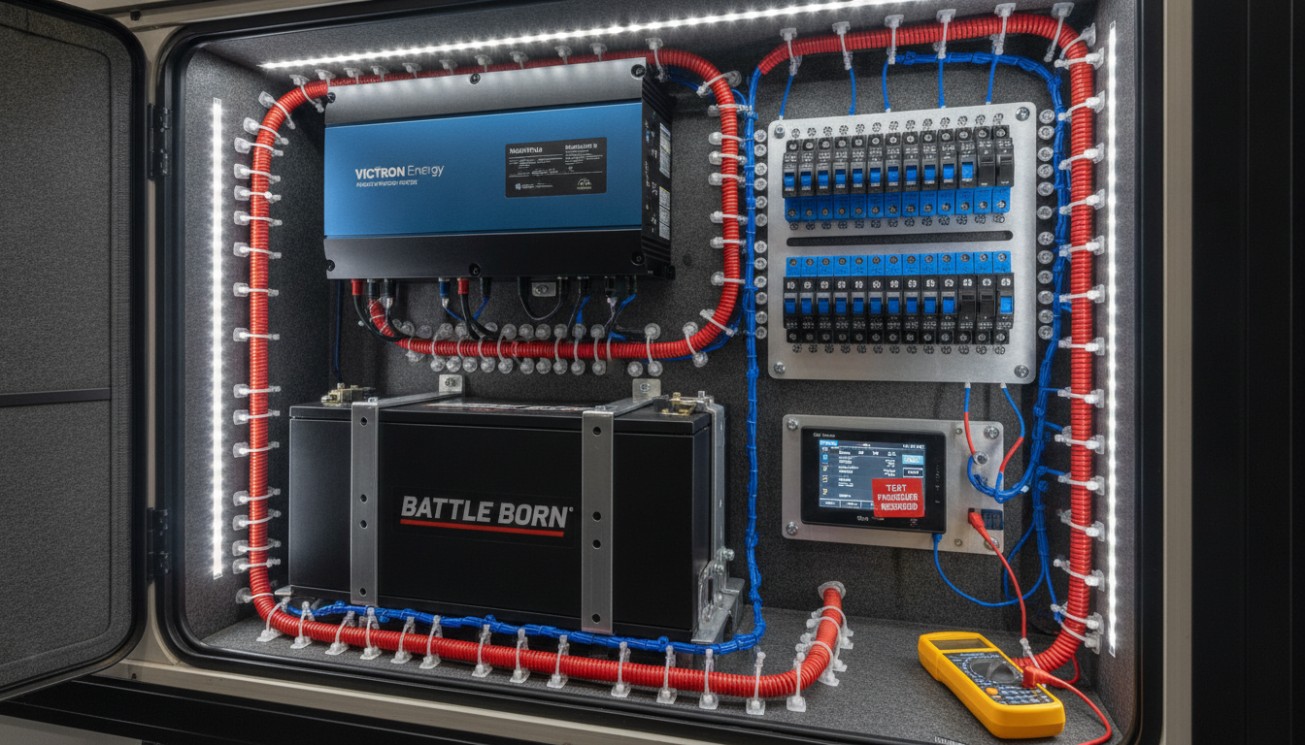
Can an RV Solar Power System Run an Air Conditioner? Battery, Inverter, Runtime and Real-World Limits
Running RV Air Conditioning Is a System Question, Not a Solar Panel Question
Few RV power questions create more unrealistic expectations than air conditioning. Many owners ask a simple question: can solar run my RV air conditioner? The honest answer is possible, but not simple. RV air conditioner solar power is not only about putting more panels on the roof. It is a complete system problem involving battery capacity, inverter output, compressor startup surge, daily heat conditions, solar recovery, charging backup, wiring design, monitoring and user behavior.
This distinction matters because air conditioning is different from most RV loads. LED lights, water pumps, fans, laptops and phone chargers are relatively manageable. Even microwaves or coffee makers may be high power, but they often run briefly. An air conditioner can combine high startup demand, meaningful running wattage and long runtime. That means it affects almost every layer of the system at once. To run RV AC on solar, the owner needs more than a large solar array. The system must be able to start the compressor, keep the unit running, handle battery discharge safely, recover energy afterward and avoid draining reserve faster than expected.
This article continues the System category with a high-load use case. The foundation article on RV power system design explains how solar, lithium storage, inverter charging, wiring protection and monitoring work together. The RV load planning guide explains why systems should begin with real appliance behavior. The multi-source RV charging guide explains why solar, shore power, generator input and alternator charging should be coordinated. This guide applies those principles to one of the hardest loads in an RV: air conditioning.
A reliable RV AC battery system should not be sold as a fantasy of unlimited cooling. It should be explained as a controlled runtime strategy. The question is not simply whether the air conditioner can turn on. The better questions are: how long can it run, under what weather, at what battery state of charge, with what inverter, with what charging recovery, and with what backup plan? Those questions turn a marketing claim into a real power system discussion.
Why RV Air Conditioners Are Harder Than Most RV Appliances
An RV air conditioner is difficult because it is both a comfort load and a climate-response load. A coffee maker runs because the user chooses to make coffee. A laptop runs because the user chooses to work. An air conditioner runs because the inside temperature demands it. In hot weather, that demand may last for hours. This makes RV air conditioner power consumption more complex than looking at a single wattage number.
Startup Surge Is the First Challenge
Many air conditioners need a high surge of power when the compressor starts. This startup demand may be much higher than the running demand. If the inverter cannot handle the surge, the air conditioner may fail to start even when the battery appears full. This is why an RV inverter for air conditioner must be selected around both continuous output and surge capacity. It is also why some systems use an RV soft start device to reduce compressor startup stress.
Running Load Is the Second Challenge
After startup, the air conditioner continues to consume power while running. The exact running demand depends on unit size, efficiency, ambient temperature, thermostat setting, humidity, insulation, sunlight exposure and whether the compressor cycles or runs continuously. In hot conditions, the compressor may run for long periods. That turns air conditioning into a large energy problem, not only a high-power problem.
Runtime Expectation Is the Third Challenge
Many owners want the phrase “solar can run AC” to mean they can cool the RV all afternoon and overnight without concern. That is not a reasonable assumption for most systems. RV solar AC runtime depends on the available battery energy, the air conditioner’s actual consumption, solar input during the day, other loads running at the same time and the reserve the owner wants to keep for essential functions.
Heat Load Is the Hidden Challenge
The air conditioner does not operate in isolation. It fights heat entering the RV through windows, roof, walls, vents, air leaks and direct sun exposure. A poorly insulated RV parked in full sun may require much more cooling than a smaller, shaded or better-insulated vehicle. System design cannot ignore the thermal behavior of the RV itself.
The Four Conditions Required to Run RV AC on Solar and Battery

To run RV AC on solar with confidence, four conditions must be satisfied at the same time. If one condition is weak, the system may start the air conditioner but fail to support practical cooling.
Condition 1: The Inverter Must Start and Carry the Load
The inverter must support the compressor startup and the running load. A small inverter may power laptops and outlets but fail when the air conditioner starts. A larger inverter may start the AC, but only if the battery bank, cables, fuses and ventilation are also designed for the current. This is why the RV inverter for air conditioner is not a standalone selection. It is part of the high-current DC and AC distribution architecture.
Readers focused on AC circuit planning can review the RV AC/DC power distribution guide, which explains why inverter-supported circuits should be separated from shore-only loads. Air conditioning should never be casually added to inverter output without checking the full system.
Condition 2: The Battery Must Deliver High Current Safely
The battery bank must provide enough energy and enough discharge current. A lithium battery for RV AC is often more suitable than older lead-acid storage because LiFePO4 can usually provide deeper usable capacity and stronger discharge performance when properly specified. However, not every lithium battery bank is suitable for air conditioning. Battery management system limits, parallel battery configuration, cable size, fuse rating and inverter demand all matter.
A LiFePO4 RV battery upgrade should therefore be treated as a system change. Installing lithium batteries does not automatically mean the RV can run air conditioning off-grid. The battery bank must be designed for the actual load.
Condition 3: Solar Must Recover Enough Energy, Not Just Exist
Solar panels can help support daytime air conditioning, but they do not remove the energy math. A large roof array may reduce net battery draw during bright sunlight. It may also help recover energy after AC use. But if the air conditioner consumes more than solar produces, the battery still declines. In shade, clouds, winter sun or high panel temperature, recovery may be much lower than expected.
This is why RV air conditioner solar power should be framed as solar-assisted cooling, not automatic unlimited cooling. Readers comparing solar wattage tiers can review the RV solar panel wattage guide, but AC loads require a more serious runtime analysis than basic wattage comparison.
Condition 4: Charging Backup Must Be Realistic
If the system uses heavy air conditioning, backup recovery becomes important. Shore power, generator input and alternator charging may all support the overall system. A user who wants long AC runtime in hot weather cannot depend only on solar unless the system is very large and conditions are favorable. A practical high load RV power system often uses multiple recovery paths to protect comfort and battery reserve.
Understanding RV Air Conditioner Power Consumption

RV air conditioner power consumption should be understood in three parts: startup surge, running power and duty cycle. These three elements determine whether the system can start the unit, how much energy it uses while operating and how long the battery can support it.
Startup Surge
Startup surge happens when the compressor begins operating. This moment may last only a short time, but it can be the hardest moment for the inverter. If the inverter trips at startup, the system cannot run the air conditioner regardless of battery capacity. An RV soft start can reduce the starting demand and make inverter operation more practical, although it does not reduce the basic energy required for cooling over time.
Running Power
Running power is the demand after the compressor starts. This is what drains the battery during operation. A smaller or more efficient unit may be easier to support than a large rooftop AC. However, real running power changes with heat conditions. In high ambient temperature, the compressor may work harder and cycle less often.
Duty Cycle
Duty cycle describes how much of the time the compressor is actually running. In mild weather, the compressor may cycle on and off. In extreme heat, it may run almost continuously. This is why two RV owners with the same air conditioner can experience very different battery runtime. One camps in dry moderate weather with good shade. Another camps in humid summer heat under full sun. Their RV solar AC runtime will not be the same.
Other Loads Still Matter
Air conditioning rarely runs alone. Refrigerators, fans, lights, chargers, internet equipment and inverter standby draw may also consume energy. A system designed only around AC nameplate power may underestimate total demand. This is why the load-first approach in RV load planning is essential.
The Role of an RV Soft Start
An RV soft start device is often discussed when owners want to run an air conditioner from an inverter, generator or limited shore connection. Its purpose is to reduce the compressor startup surge. It can make the air conditioner easier to start and may prevent trips or overloads during startup. For solar and battery systems, this can be very valuable.
However, a soft start should not be misunderstood. It helps with the starting event. It does not make the air conditioner a low-energy appliance. Once the compressor is running, the unit still consumes power. The battery still drains. Solar still needs to recover energy. Heat conditions still matter. A soft start can make a system possible, but it does not make the system unlimited.
When a Soft Start Is Useful
An RV soft start is useful when the inverter has enough running capacity but struggles with compressor startup. It may also help smaller generators start an air conditioner more smoothly. It can reduce stress during repeated compressor cycling. For RV owners designing a battery-powered AC system, it is often worth evaluating early.
When a Soft Start Is Not Enough
A soft start will not fix an undersized battery bank, weak inverter, poor cable sizing or insufficient solar recovery. If the system lacks enough stored energy, a soft start only helps the AC begin running before the battery drains. If the inverter is too small for running power, the soft start cannot solve that. If the battery BMS cannot support the current, the system may still shut down.
How Suppliers Should Explain Soft Start
Suppliers should avoid presenting soft start as a magic solution. The better message is: a soft start can reduce compressor startup demand and improve compatibility with limited power sources, but a complete RV AC battery system still requires proper inverter, battery, wiring, protection and recovery design.
Battery Design for RV Air Conditioning

A lithium battery for RV AC must be evaluated by usable energy and discharge capability. Many buyers focus on amp-hours, but amp-hours alone do not tell the whole story. Voltage, usable capacity, maximum continuous discharge, BMS limits, temperature behavior and system wiring all affect performance.
Usable Energy
Usable energy determines runtime. If the air conditioner draws significant power, even a large battery bank can decline quickly. The owner should decide how much battery reserve can be dedicated to cooling and how much must remain for essentials. Running the AC until the battery is nearly empty may leave the RV without lights, refrigeration, fans or communication equipment later.
Discharge Capability
Discharge capability determines whether the battery can support the inverter current. A high-capacity battery bank with a low discharge limit may still be unsuitable for a large air conditioner. Multiple lithium batteries in parallel may support higher current, but only when the system is designed correctly. Cable lengths, busbars, fuses and battery balancing should be reviewed.
Voltage Architecture
Higher-voltage systems may reduce current for the same power level, which can help with cable size and efficiency in high-load applications. Some advanced RV builds consider 24V or 48V architectures for larger inverter loads. However, higher voltage also changes equipment selection and integration. Readers comparing voltage architecture can review the 12V, 24V and 48V RV solar battery system guide.
Battery Location and Temperature
Battery location affects performance and safety. Lithium batteries should be installed where temperature, ventilation, service access and cable routing are suitable. Extreme cold, excessive heat or poor access can create problems. A battery designed to support air conditioning should also be part of a serviceable installation, not hidden where inspection is difficult.
Inverter Design for RV Air Conditioning

The RV inverter for air conditioner is often the part buyers focus on first. That is reasonable, because the inverter must supply AC power to the air conditioner. But inverter selection should be made after understanding the AC unit, battery bank, surge behavior and supported circuits.
Continuous Output
Continuous output must cover the air conditioner running demand and any other AC loads that may operate at the same time. If the inverter is already supporting a refrigerator, laptop chargers or kitchen appliances, available headroom may be lower than expected. Air conditioning should not be added to a fully loaded inverter without reviewing total demand.
Surge Rating
Surge rating matters for compressor startup. An inverter may advertise a high surge rating, but real performance depends on duration, battery voltage stability and installation quality. An RV soft start may reduce the required surge and improve compatibility, but the inverter must still be suitable.
Pure Sine Wave Output
Most modern AC appliances should be powered by a pure sine wave inverter. Air conditioners, control boards and sensitive electronics may not operate well on poor waveform output. A serious high load RV power system should not rely on low-quality conversion hardware for major loads.
Ventilation and Placement
Inverters generate heat, especially under high load. Air conditioning use can keep the inverter working hard for extended periods. The inverter should be installed with proper ventilation, short high-current cable runs where practical, accessible protection devices and clear labeling. This connects directly with RV power system serviceability.
Solar Recovery: Why Rooftop Wattage Does Not Equal AC Runtime
Solar panels are important, but RV air conditioner solar power should not be calculated by panel rating alone. A 1000W array does not mean the air conditioner has 1000W available all day. Solar output rises and falls across the day. It changes with shade, clouds, season, panel angle and temperature. The air conditioner may run hardest exactly when the panels are hot and operating below ideal output.
Solar Can Reduce Net Battery Draw
During strong sunlight, solar can offset part of the air conditioner load. If the AC is consuming more than the solar array produces, the battery still discharges, but more slowly. If solar production exceeds all active loads, the battery can charge. For many RV systems, solar does not fully power AC continuously; it extends runtime and improves recovery.
Solar Can Refill After Cooling Use
Solar may also help recover the battery after morning or afternoon cooling periods. This is especially useful when AC use is limited and scheduled around high solar production. For example, a user may cool the RV during the hottest part of the day while solar is strongest, then reduce AC use in the evening to protect overnight reserve.
Shade Changes the Entire Equation
An RV parked under trees may stay cooler, which reduces cooling demand, but solar production may also drop. An RV parked in full sun may produce more solar but require more cooling. This creates a practical tradeoff. The best parking location for solar is not always the best location for thermal comfort. A well-managed system considers both heat gain and energy recovery.
Portable Solar Has Limited AC Impact
Portable panels can help supplement recovery, especially when the RV is shaded. However, most portable arrays are not large enough to support major air conditioning loads by themselves. They can support the overall energy strategy, but they should not be treated as the main answer for long AC runtime.
Runtime Planning: The Question Is Not Can It Run, But How Long
RV solar AC runtime should be planned as a range, not a fixed promise. Runtime changes with outside temperature, AC unit size, insulation, battery state of charge, solar input, inverter efficiency, thermostat setting and other loads. A responsible design does not promise one universal number. It explains the variables that make runtime longer or shorter.
Short Cooling Windows
Some RV owners only need short cooling windows. They may want to cool the interior before sleeping, support a pet-safe temperature for a limited time, or reduce heat during the afternoon. Short windows are easier to support than all-day air conditioning. A moderate RV AC battery system may be practical for this use when paired with a capable inverter and monitoring.
Daytime Solar-Assisted Cooling
Daytime cooling can be easier than overnight cooling because solar may contribute during operation. However, solar contribution depends on real conditions. This strategy works best in open sun with a large array, strong battery reserve and a clear plan for high heat hours.
Overnight Battery Cooling
Overnight air conditioning is much harder because solar is not producing. The battery must carry the full load along with refrigerators, fans, lights and other overnight devices. Running AC overnight can require a large lithium bank and disciplined load management. This is where off-grid RV air conditioning becomes a serious system investment rather than a casual upgrade.
Continuous Cooling in Hot Weather
Continuous cooling in extreme heat is the hardest use case. It often requires large battery capacity, strong inverter design, significant solar recovery, backup charging and careful thermal management. Many RV owners who need reliable continuous cooling should still plan for shore power or generator backup.
Charging Backup for High-Load Cooling
A high load RV power system should not rely on one recovery source. Air conditioning can consume enough energy that solar alone may not restore the system quickly, especially in poor weather or shaded campsites. Backup charging protects both comfort and battery health.
Shore Power
Shore power remains the most predictable way to run RV air conditioning. Campground hookups can support AC loads and recharge the battery system. Even if the RV has a strong off-grid setup, shore power may still be the best choice during extreme heat or long stationary stays.
Generator Input
Generator input can support air conditioning when shore power is unavailable and battery reserve is limited. Many RV owners want to reduce generator use, not necessarily eliminate it completely. A well-designed system can use solar and battery power for quieter periods and keep generator support as backup for high heat or extended cooling.
Alternator Charging
Alternator charging through a DC-DC charger can help recover energy on travel days. It does not usually solve stationary air conditioning demand by itself, but it can restore battery reserve between campsites. For users who drive frequently, this can be an important part of off-grid RV air conditioning strategy.
Pre-Cooling Before Off-Grid Use
When shore power is available, the owner can pre-cool the RV and fully charge the batteries before leaving. This reduces the initial load on the battery system. It is not a substitute for system design, but it is a useful operating habit.
Thermal Management: Reduce Cooling Demand Before Increasing Electrical Capacity
The cheapest watt-hour is the one the system does not need to supply. Before enlarging batteries and inverters, RV owners should reduce the heat load when possible. This improves RV solar AC runtime without adding as much hardware.
Shade and Orientation
Parking orientation affects heat gain. Reducing direct sun on large windows and walls can lower cooling demand. However, shade may reduce solar production, so the owner must balance thermal comfort and solar recovery. In some cases, partial shade plus portable solar may work better than full sun with higher cooling demand.
Window Covers and Insulation
Reflective window covers, insulated shades and roof vent insulation can reduce heat entering the RV. These low-tech measures can improve AC runtime because the air conditioner cycles less often. They also support comfort when the air conditioner is not running.
Ventilation Before Cooling
Ventilation can remove trapped hot air before the air conditioner begins. Running fans briefly, opening vents when appropriate, or cooling during lower temperature periods can reduce the initial burden on the AC unit.
Thermostat Discipline
Small thermostat changes can affect runtime. Trying to maintain a very low indoor temperature in extreme heat may drain the battery quickly. A more realistic setpoint can extend runtime significantly. RV energy monitoring helps users see how thermostat decisions affect battery reserve.
Monitoring Makes RV AC Runtime Manageable

Without monitoring, air conditioning from battery becomes stressful. The owner may not know whether the battery can support another hour, whether solar is helping, whether the inverter is near its limit or whether other loads are draining energy. A strong monitoring layer is essential for off-grid RV air conditioning.
Watch State of Charge
State of charge tells the owner how much reserve remains. Air conditioning should not be allowed to consume the entire battery if essential loads are still needed. A planned cutoff point can protect the rest of the RV’s electrical needs.
Watch Inverter Load
Inverter monitoring shows how the AC behaves during startup and running. If load spikes or overload warnings appear, the system may need an RV soft start, larger inverter, better wiring or different operating habits.
Watch Solar Contribution
Solar monitoring shows whether daytime production is meaningfully offsetting AC use. If solar is weak, the owner may reduce AC runtime, move portable panels, drive for charging or connect to shore power. The existing guide on RV energy monitoring explains how data turns power systems into manageable systems.
Use Data to Create Cooling Rules
Data should lead to operating rules. For example: do not start AC below a certain state of charge; use AC mainly during peak solar hours; turn off unnecessary inverter loads during cooling; switch to shore power in extreme heat; keep a reserve for refrigeration and communication. These rules help the owner use comfort loads without losing control of the system.
When RV Solar AC Makes Sense—and When It Does Not
Run RV AC on solar is a useful goal for some owners, but not all. The right answer depends on travel style, climate, vehicle size, battery budget and comfort expectations.
It Makes Sense for Limited Cooling
Solar and lithium can make sense for short cooling periods, daytime solar-assisted cooling, pre-sleep cooling, remote work comfort during peak heat, or reducing generator runtime. In these cases, the system does not need to replace shore power completely. It only needs to support a defined comfort window.
It Makes Sense for High-End Off-Grid Builds
Large motorhomes, fifth wheels and advanced van conversions may justify a larger RV AC battery system. These builds can include large lithium banks, high-output inverters, 24V or 48V architecture, serious solar arrays, alternator charging and detailed monitoring. For full-time travelers, the cost may be justified by lifestyle needs.
It May Not Make Sense for Casual Camping
Occasional campers who use shore power often may not benefit from a costly AC-capable battery system. A smaller solar setup may be enough for lights, fans, refrigeration and electronics. The money required for battery-powered air conditioning may not match the actual use case.
It May Not Replace Shore Power in Extreme Heat
Extreme heat changes everything. If safety, pets, health needs or long-term cooling are involved, shore power or generator backup may still be necessary. Solar and battery can support resilience, but they should not be oversold as a guaranteed replacement for every climate condition.
How Suppliers and Installers Should Communicate RV AC Power Systems
For suppliers and installers, RV air conditioner solar power is a strong content and sales topic, but it must be handled carefully. Overpromising AC runtime creates customer dissatisfaction. Underexplaining the system makes buyers focus on the wrong parts.
Start with the Cooling Use Case
The first question should not be “How many watts of solar do you want?” It should be “How do you want to use air conditioning?” Short afternoon cooling, pet safety, overnight cooling, full-time desert camping and emergency backup all require different system levels.
Explain Startup and Runtime Separately
Customers need to understand the difference between starting the AC and running it for hours. An RV soft start may help with startup, but runtime depends on battery energy and recovery. This explanation prevents confusion.
Sell Recovery Strategy, Not Only Battery Size
A large lithium battery for RV AC helps only if the system can recover energy. Solar, shore power, generator input and alternator charging should be discussed together. This creates a more professional recommendation.
Document Supported Circuits
If the air conditioner is inverter-supported, the system documentation should explain that clearly. If it is shore-only or generator-only, that should also be clear. AC-capable systems need labeled circuits, breaker logic, transfer behavior and user instructions.
Focused FAQ
Can RV solar power run an air conditioner?
RV air conditioner solar power can run an air conditioner in some systems, but it requires a suitable inverter, lithium battery bank, solar recovery, wiring protection, monitoring and realistic runtime expectations. Solar alone is usually not enough unless the system is large and conditions are favorable.
What do I need to run RV AC on solar?
To run RV AC on solar, the system usually needs a capable inverter, enough lithium battery capacity, proper discharge current, solar panels, charge controllers, safe wiring, AC circuit planning and backup charging. An RV soft start may help reduce compressor startup surge.
How large should an RV AC battery system be?
The right RV AC battery system depends on air conditioner size, runtime target, outside temperature, insulation, inverter efficiency, solar input and reserve needs. It should be sized around watt-hours and discharge capability, not amp-hours alone.
Why is RV air conditioner power consumption hard to estimate?
RV air conditioner power consumption changes with startup surge, running load, compressor duty cycle, outdoor temperature, humidity, insulation and thermostat setting. The same AC unit can use very different energy in mild weather versus extreme heat.
Does an RV soft start reduce energy use?
An RV soft start mainly reduces compressor startup demand. It can help the inverter or generator start the air conditioner more smoothly, but it does not eliminate the running energy required for cooling.
What size inverter do I need for an RV air conditioner?
The correct RV inverter for air conditioner must support the AC unit’s running power and startup surge while also matching battery discharge capability, wiring, fusing and supported circuits. The inverter should be selected as part of the system, not by wattage alone.
Are lithium batteries better for RV air conditioning?
A lithium battery for RV AC is often better than lead-acid because it can provide deeper usable capacity and stronger discharge performance when properly specified. However, the BMS rating, wiring, inverter compatibility and charging recovery still matter.
How long can RV solar run an air conditioner?
RV solar AC runtime depends on battery size, solar output, AC consumption, heat conditions, other loads and backup charging. Some systems may support short cooling windows, while larger systems may support longer daytime cooling. Continuous overnight cooling requires a much larger system.
Conclusion: RV Solar Can Help Run AC, But Only a System Can Make It Reliable
Running an RV air conditioner from solar and lithium batteries is possible, but it should not be reduced to a simple yes-or-no answer. Air conditioning is one of the most demanding loads in mobile power. It requires startup capability, running energy, battery discharge strength, solar recovery, backup charging, safe distribution and clear monitoring. A system that can turn on the AC once is not the same as a system that can support practical comfort for hours.
The most important lesson is that RV air conditioner solar power is a system architecture problem. The solar array helps recover energy. The lithium battery stores energy. The inverter converts energy. The soft start reduces compressor startup stress. The wiring and breakers protect the system. The monitor tells the owner what is happening. Shore power, generator input and alternator charging provide backup recovery. When these parts work together, off-grid RV air conditioning can become realistic for defined use cases.
For RV owners, the right starting point is not the largest solar panel kit. It is the cooling goal. Do you need a short comfort window, daytime solar-assisted cooling, overnight battery cooling or long-duration extreme-heat operation? Each answer requires a different system. For suppliers and installers, the opportunity is to explain these differences clearly and avoid overpromising. Customers will trust a system more when they understand its limits.
The future of RV solar and storage will include more air-conditioning-capable systems, especially as lithium batteries, efficient inverters, smart monitoring and higher-voltage architectures improve. But the best systems will still be designed around real use. A true high load RV power system does not promise unlimited cooling. It creates a controlled, documented and recoverable way to use one of the RV’s hardest loads with confidence.
#RVAirConditionerSolarPower #RunRVACOnSolar #RVACBatterySystem #RVAirConditionerPowerConsumption #RVSoftStart #RVInverterForAirConditioner #LithiumBatteryForRVAC #OffGridRVAirConditioning #RVSolarACRuntime #HighLoadRVPowerSystem