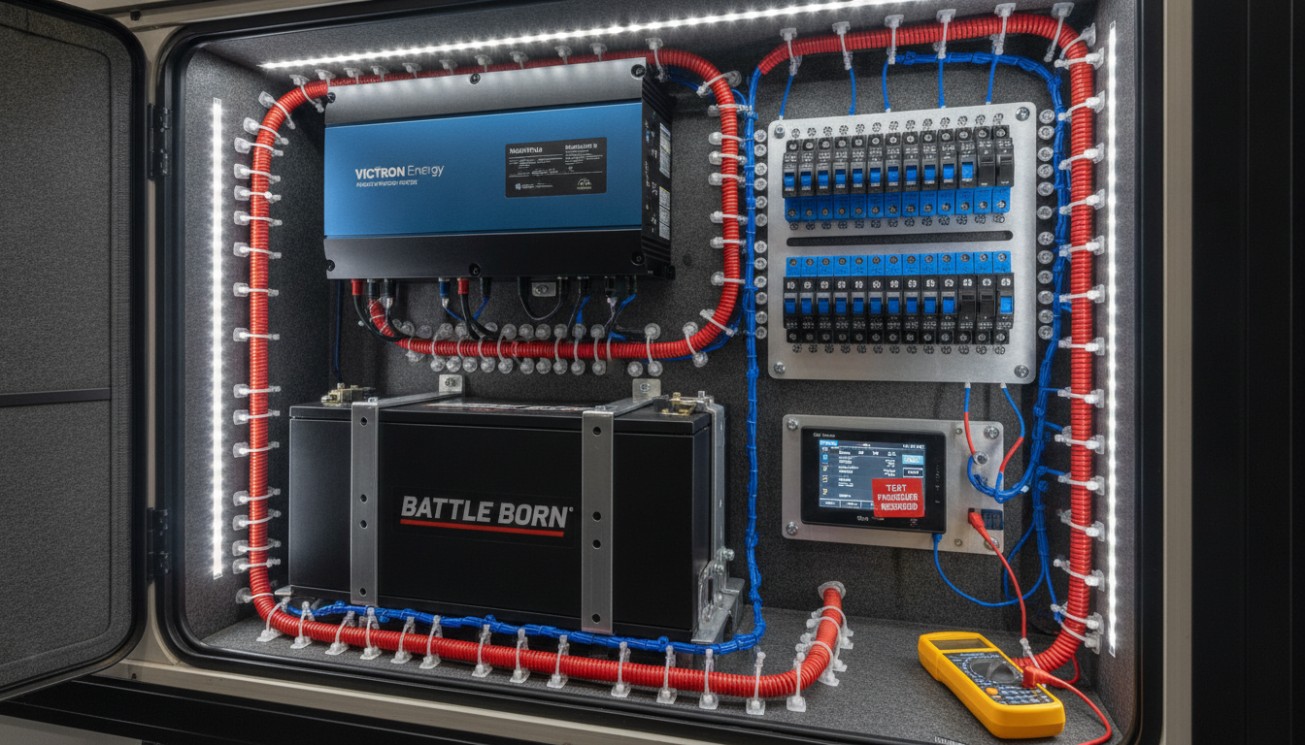
RV Multi-Source Charging System: How Solar, Shore Power, Generator Input and Alternator Charging Work Together
A Reliable RV Power System Needs More Than One Way to Recharge
A strong RV charging system is not defined by how much energy it can store on the first day of a trip. It is defined by how reliably it can recover energy after real use. Solar panels, lithium batteries and inverters often receive the most attention, but charging recovery is the layer that decides whether the system can keep working beyond the first night. A large battery bank may feel impressive at the campsite, but if the owner cannot refill it through solar, shore power, generator input or alternator charging, the system becomes a limited reserve rather than a dependable power platform.
This is why multi-source RV charging has become a central design topic for modern off-grid travel. RV owners no longer use power only for lights and a water pump. Many now expect refrigerators, laptops, cameras, routers, Starlink terminals, coffee makers, microwaves, induction cooking, entertainment devices and sometimes air conditioning support. These loads change the system from a simple battery-maintenance setup into a mobile energy network. The charging architecture must be planned with the same seriousness as battery capacity or inverter size.
Earlier system content explained how a complete RV power system design connects generation, storage, conversion, distribution, protection and monitoring. Load-first planning then explained why real appliance behavior should guide system decisions. This article moves to the recovery layer: how energy gets back into the battery through different pathways, and why a dependable design should not depend on only one source.
In practical terms, an RV can recharge from four main sources: solar, shore power, generator power and the vehicle alternator. Each source has strengths. Each source also has limits. RV solar charging is quiet and automatic, but sunlight is variable. RV shore power is powerful and convenient, but it requires access to an external electrical hookup. RV generator charging can provide backup in poor conditions, but it brings noise, fuel use and maintenance. RV alternator charging can be valuable on travel days, but it must be controlled carefully, especially with lithium batteries.
The best system does not blindly add every charging method. It chooses the right recovery mix for the way the RV is used. A weekend camper may only need modest solar and occasional shore charging. A remote worker may need predictable daily recovery from solar and alternator charging. A full-time boondocker may need all four pathways, coordinated through chargers, monitoring and clear operating habits. The goal is not complexity. The goal is recovery confidence.
Charging Recovery Is Different from Battery Capacity
Many RV buyers focus on battery capacity first. That is understandable because capacity is easy to compare. A larger lithium bank promises longer runtime. However, RV power recovery is just as important as storage. Capacity tells the owner how much energy can be carried. Recovery tells the owner how quickly that energy can be replaced after use.
Think of the battery bank as a water tank. A larger tank provides more reserve, but the refill rate still matters. If the water source is slow, the tank may take too long to recover. If the water source is unreliable, the owner must ration use more carefully. The same logic applies to off-grid RV charging. A 600Ah lithium bank can support more loads than a small battery bank, but if the system only has weak solar and no meaningful backup charging, the owner may still face power anxiety after cloudy days or heavy appliance use.
Why Recovery Speed Matters
Recovery speed affects daily comfort. If the system uses 2,000Wh per day but only recovers 700Wh under real conditions, the battery will gradually decline. If the same system can recover from solar during the day, from a DC-DC charger while driving, and from shore power when available, the owner has more flexibility. The design becomes less dependent on perfect weather.
Why Recovery Timing Matters
Charging sources do not operate at the same time. Solar works during daylight. Shore power works when plugged in. Alternator charging works while driving. Generator charging works when the user chooses to run the generator. A mature RV charging system understands when each source is available. The best charging source is not always the strongest one. It is the one that matches the user’s travel rhythm.
Why Recovery Control Matters
Charging a battery is not just pushing current into it. The charger must apply the correct charging profile, voltage limits, current limits and protection behavior. This is especially important for lithium RV battery charging. LiFePO4 batteries can accept current efficiently, but they still need chargers that match their voltage settings, temperature requirements and battery management system limits.
The Four Main Charging Sources in an RV System
A complete multi-source RV charging design usually considers four inputs: solar, shore power, generator power and alternator charging. They should not be treated as interchangeable. Each source plays a different role inside the energy strategy.
Solar Charging: Quiet Daily Recovery
RV solar charging is the most popular recovery source for off-grid camping because it is silent, fuel-free during use and automatic once installed. Rooftop solar can charge while parked or driving, and portable solar can sometimes be moved into better sunlight. Solar is especially valuable for long stays, storage maintenance and users who want to reduce generator dependence.
However, solar is not a fixed-output source. It depends on roof space, panel angle, sun season, shading, temperature, cloud cover, charge controller efficiency and battery state of charge. A solar array may produce strong output in open desert conditions and weak output under trees. A system that performs well in summer may recover slowly in winter. Solar should be viewed as a daily recovery layer, not a guaranteed unlimited power source.
Shore Power: High-Confidence Reset Charging
RV shore power is the external AC connection usually found at campgrounds, homes, storage locations or service areas. When connected correctly, shore power can support onboard AC loads and recharge the house battery through a converter charger or inverter charger. It is one of the most reliable ways to reset the system after heavy use.
Shore power is especially important before and after trips. An RV can leave home with a full battery bank, recover at a campground, or recharge after several cloudy days. For lithium upgrades, the key issue is charger compatibility. An older converter may not apply the charging behavior a lithium battery needs. In that case, the owner may need a lithium-compatible charger or an inverter charger with suitable settings.
Generator Charging: Backup When Conditions Are Uncertain
RV generator charging remains relevant even as solar and lithium systems become more capable. Some owners want to avoid generators entirely, but others use them as a practical backup. A generator can support charging when solar is weak, when high-power loads are needed, or when the RV is far from shore power for an extended period.
Generator charging should still be designed carefully. The generator output, charger current, battery acceptance rate and noise restrictions all matter. Running a generator for hours at a low charging rate may be inefficient. A well-matched charger can make generator runtime more productive by pushing meaningful energy into the battery bank during the allowed operating window.
Alternator Charging: Travel-Based Recovery
RV alternator charging uses the vehicle’s charging system to recover house battery energy while driving. This is powerful for travelers who move frequently. A motorhome, van conversion or truck camper may recover energy between campsites without relying only on sun. For remote workers and full-time travelers, alternator charging can become one of the most dependable recovery tools because it is linked to travel behavior.
However, alternator charging must be controlled. Lithium batteries can accept high current, and a direct connection may stress the alternator or create unsafe wiring conditions. A DC-DC charger is often used to manage current, apply a proper charging profile and isolate the vehicle starting battery from the house battery. The charger size should match alternator capacity, cable length, battery bank size and expected driving time.
Solar Charging Should Be Planned Around Real Conditions

Solar is often presented as the cleanest and most independent charging path. That is true in many ways, but a professional RV charging system should describe solar honestly. Solar output is not a promise; it is a variable input. The same rooftop array can behave very differently depending on location and season.
For example, an RV parked in full desert sun can recover energy far better than the same RV parked under trees near a mountain campground. A flat rooftop panel array may produce less than ideal output in low winter sun. Panels placed near air conditioners, vents or roof racks may suffer from partial shade. Portable panels can solve some shading problems but introduce setup work and cable management.
Solar Is Best as a Baseline Recovery Layer
In most off-grid systems, RV solar charging works best as the baseline recovery layer. It reduces how much energy must come from other sources. It can maintain the battery during daylight and support daily loads when sunlight is available. It can also keep batteries healthier during storage if the system is designed for that purpose.
But solar should not be asked to solve every problem. If an RV owner wants to run electric cooking, remote work equipment and high evening loads, solar must be matched with enough battery storage and backup charging. If the owner frequently camps in shade, solar may need support from alternator charging or shore power. If the RV has limited roof space, portable panels or more efficient appliances may be part of the answer.
MPPT Control and Battery Chemistry
Solar panels do not usually charge the battery directly in a properly designed system. They charge through a solar charge controller, commonly an MPPT controller in more capable systems. The controller should be matched to panel voltage, panel current, battery voltage and battery chemistry. For lithium RV battery charging, the settings should match the battery manufacturer’s recommendations.
A solar array with the wrong controller or poor settings can underperform. In a system with multiple panel orientations or shading patterns, separate controllers or thoughtful string design may improve performance. This is why solar design is not just a wattage number. Readers comparing solar panel size tiers can review the existing RV solar panel wattage guide for a deeper look at different output levels.
Shore Power Is the System’s Most Predictable Recovery Source
For many RV owners, RV shore power remains the most predictable and convenient charging source. It allows the RV to recover quickly when plugged into a campsite, home outlet or service location. It can also support high AC loads directly, depending on the hookup capacity and the RV electrical design.
In a traditional RV, shore power may feed a converter charger that charges lead-acid or AGM batteries and supports DC loads. In a modern lithium-based system, the shore power path may use an inverter charger. The inverter charger can charge the battery, manage AC input and transfer power to selected circuits. This makes shore power part of the broader system architecture rather than only a campground convenience.
Why Lithium Upgrades Often Expose Charger Problems
When an older RV is upgraded to lithium, the battery may be new but the shore charging hardware may still reflect older lead-acid assumptions. This can create incomplete charging, slow recovery or settings that do not match the battery. A lithium battery may still work in a limited way, but the owner may not receive the full benefit of the upgrade.
This is why lithium RV battery charging should include a review of the converter charger or inverter charger. The question is not only whether shore power exists. The question is whether the shore charging pathway applies the correct behavior for the battery chemistry, capacity and use case.
Shore Power as a System Reset
Shore power is also useful because it can reset the system before the next off-grid cycle. A traveler may spend several days boondocking, then use a campground stay to fully recharge batteries, run laundry equipment, power heavy appliances and prepare for the next remote destination. This reset function is important for system planning because it reduces the need to design for indefinite off-grid operation in every case.
Generator Charging Is Not the Opposite of Solar
In RV discussions, generators and solar are sometimes treated as opposing choices. In real system design, they can be complementary. RV generator charging is not always a sign that the solar system failed. It may simply be the backup layer for weather uncertainty, seasonal travel, high loads or emergency needs.
A generator can provide strong AC input when shore power is unavailable. That input can support appliances or charge the battery through a converter charger or inverter charger. The important question is how efficiently the generator time is converted into battery recovery. A weak charger may require long runtime to add meaningful energy. A better-matched charger can reduce generator hours by charging more effectively within safe limits.
When Generator Charging Makes Sense
Generator charging may make sense for users who travel in cloudy regions, camp under trees, run large appliances, need backup for medical or work-critical power, or want a safety net for long off-grid stays. It may also be useful for large motorhomes and fifth wheels with higher comfort expectations.
When Generator Charging Should Be Reduced
Generator dependence can be reduced when the RV has efficient appliances, realistic load planning, enough battery reserve, strong solar recovery, alternator charging and accurate monitoring. The point is not to remove the generator at any cost. The point is to stop using the generator because the rest of the system was underplanned.
Generator Charging and User Expectations
Some users want silent camping and may tolerate lower power use. Others prioritize comfort and accept generator backup. Suppliers and installers should clarify this expectation early. A customer who wants no generator use while running high loads needs a much larger system than a customer who accepts occasional generator support.
Alternator Charging Turns Driving Time into Energy Recovery
RV alternator charging is one of the most practical recovery sources for travelers who move often. Unlike solar, it does not require ideal sun. Unlike shore power, it does not require a hookup. Unlike generator charging, it does not require a separate fuel-burning device at the campsite. It uses travel time to replace battery energy.
This is especially valuable for vanlife, motorhomes, truck campers and compact RVs that change location frequently. A user may work online in the evening, sleep overnight, then drive to the next destination and recover a large portion of the consumed energy. In that travel pattern, alternator charging can sometimes matter more than adding another rooftop panel.
Why a DC-DC Charger Matters
A DC-DC charger helps regulate charging between the vehicle alternator and the house battery. It can limit current, apply the right voltage profile and protect the starting battery from being drained by the house system. In lithium systems, this control becomes especially important because lithium batteries can accept charge more aggressively than lead-acid batteries.
The correct DC-DC charger is not simply the largest available model. If it is too large for the alternator, it may create heat or reliability concerns. If it is too small for the user’s driving pattern, recovery may be disappointing. The right size depends on alternator capacity, vehicle design, cable length, battery bank size and daily energy consumption.
Driving Pattern Decides Value
A DC-DC charger is most valuable when the RV drives regularly. If the vehicle stays parked for a week at a time, solar and shore/generator charging may matter more. If the owner drives every day or every other day, alternator charging can become a major part of the energy strategy. This is why multi-source RV charging should begin with travel behavior, not only component features.
How the Four Charging Sources Work Together
A mature RV charging system does not simply add four chargers and hope they work. It coordinates sources through proper connection, protection, charger settings and user understanding. Solar, shore power, generator power and alternator charging all feed the same energy storage system, but they enter through different pathways.
Scenario 1: Sunny Boondocking
During sunny boondocking, solar may handle most daily recovery. The battery bank provides power overnight, and the panels refill much of that energy during the day. The owner may only need generator or alternator support if loads increase or weather changes. In this scenario, RV solar charging is the primary source, and monitoring helps confirm whether recovery is keeping up with consumption.
Scenario 2: Forest Campsite
At a shaded forest campsite, fixed rooftop solar may drop sharply. Portable panels may help if they can be placed in open sun. If not, the system may rely on battery reserve, alternator charging during day trips, shore power if available, or generator backup. This scenario shows why solar-only expectations can be risky.
Scenario 3: Travel Day Recovery
On a travel day, a DC-DC charger can recover energy while the RV moves. Solar may also contribute while driving if panels are exposed to sun. When the owner arrives, the battery may be healthier than if the system relied only on solar. This is one of the strongest arguments for including RV alternator charging in mobile systems.
Scenario 4: Campground Reset
When plugged into RV shore power, the system can recharge the battery bank, power AC circuits and prepare for the next off-grid period. If the RV uses an inverter charger, the shore connection may become a central part of the AC and charging workflow. The owner can use this period to fully reset the system rather than running the battery in a constant partial state.
Scenario 5: Heavy Load or Emergency Backup
If the owner needs high-power use during poor solar conditions, RV generator charging may support battery recovery or AC loads. This is especially relevant for hot weather, medical equipment, work obligations or large family energy use. A generator is most useful when it is part of a planned backup strategy rather than a rescue tool after the system has already been exhausted.
The Role of Monitoring in Multi-Source Charging
Monitoring is the layer that helps the owner understand whether the charging strategy is working. Without monitoring, the system may have several charging sources but still feel confusing. The user may not know whether the solar array is producing well, whether the battery is actually receiving charge, whether the inverter is drawing too much standby energy, or whether driving time is enough for meaningful recovery.
A good monitoring setup can show state of charge, input current, output current, solar production, charger status and historical energy use. For off-grid RV charging, this information changes behavior. The user may choose to drive longer, reduce inverter use, move portable panels, connect to shore power earlier or run a generator at a more efficient time.
Monitoring Prevents False Confidence
A battery voltage reading alone can be misleading, especially with LiFePO4 batteries. Lithium voltage remains relatively stable for much of the discharge cycle, so voltage may not show the true remaining capacity. A shunt-based monitor or integrated system monitor provides better insight for lithium RV battery charging and discharge management.
Monitoring Helps Compare Charging Sources
Monitoring can reveal which charging source contributes the most under real conditions. Some owners discover that alternator charging is more valuable than expected. Others learn that rooftop solar is frequently shaded. Some realize that generator runtime is inefficient because the charger current is too low. These insights help refine the system over time.
Design Mistakes in RV Charging Systems

Charging mistakes often happen when components are chosen separately. A system may have solar panels, batteries and an inverter, but the recovery pathways may not match the use case.
Mistake 1: Depending Only on Solar in Variable Conditions
Solar can be excellent, but it is not always available at full output. Users who camp under trees, travel in winter or run heavy loads may need backup recovery. A solar-only mindset can create disappointment if the system was designed around ideal sunlight.
Mistake 2: Upgrading to Lithium Without Reviewing Chargers
A lithium battery upgrade should include review of solar controller settings, shore charging hardware, inverter charger settings and alternator charging design. If the chargers are still configured for lead-acid behavior, lithium RV battery charging may be incomplete or inefficient. Readers focused on battery upgrades can review the LiFePO4 RV battery upgrade guide.
Mistake 3: Oversizing Alternator Charging
A larger DC-DC charger may sound better, but it must match the vehicle alternator and wiring. Oversizing the charger can create heat and stress. Undersizing it can make recovery too slow. The charger should be selected as part of the vehicle and battery system, not only as a product number.
Mistake 4: Ignoring Shore Power Quality and Limits
Shore power connections vary. Some users plug into campground pedestals, home outlets or generator sources. The system should respect input limits and use appropriate protection. The owner should understand what can run from the hookup and what should remain limited.
Mistake 5: No Clear Charging Priority
Some systems have multiple sources but no clear operating strategy. The owner may not know when to rely on solar, when to drive for charging, when to plug in or when generator use is justified. A good RV charging system should include user guidance, not only hardware.
How Suppliers and Installers Should Present Multi-Source Charging
For suppliers and installers, multi-source RV charging is a strong opportunity to communicate professional value. Many customers understand batteries and solar panels at a basic level, but they do not understand recovery architecture. Explaining recovery pathways helps customers make better decisions and reduces unrealistic expectations.
Instead of asking only how many watts of solar the customer wants, a supplier should ask how the RV is used. Does the customer drive daily or stay parked? Do they use campgrounds often? Are they trying to eliminate generator runtime or simply reduce it? Do they work remotely? Do they use electric cooking? Do they camp in shaded forests, deserts, mountains or coastal areas? Does the RV already have a generator, converter charger or solar pre-wire?
Use Case-Based Charging Packages
Suppliers can present charging architectures by use case. A light-use package may include modest solar and shore charging. A travel-based package may add a DC-DC charger. A full-time package may combine solar, alternator charging, shore charging, generator compatibility and advanced monitoring. This is more helpful than selling every buyer the same kit.
Documentation as Part of the Product
Every charging source should be documented. The customer should know charger ratings, fuse sizes, cable routes, battery settings, operating limits and maintenance steps. Good documentation turns a complex system into a serviceable system. It also helps future technicians understand how the RV was built.
Honest Performance Expectations
Professional communication should avoid promising unlimited power. It should explain recovery conditions. Solar depends on sunlight. Alternator charging depends on driving time. Shore power depends on hookups. Generator charging depends on fuel, noise rules and charger capacity. Customers respect honesty when it helps them avoid disappointment.
Planning Checklist for an RV Multi-Source Charging System
Before selecting components for a complete RV charging system, review the following planning points.
Energy Use and Recovery Need
- How much energy does the RV consume on a normal day?
- How much reserve is needed for nights and cloudy days?
- Which appliances create the heaviest loads?
- How often does the owner need full battery recovery?
Solar Charging
- How much roof space is realistically available?
- Will panels be shaded by vents, air conditioners or roof accessories?
- Is portable solar useful for shaded campsites?
- Does the MPPT controller match the array and battery chemistry?
Shore Power Charging
- Does the RV frequently use campground hookups?
- Is the converter charger or inverter charger compatible with lithium batteries?
- Can shore power fully reset the battery bank before the next off-grid period?
- Does the owner understand input limits and AC load behavior?
Generator Charging
- Is a generator already installed or planned as backup?
- What charging current can the system accept from generator input?
- Can generator runtime be reduced through better solar, alternator charging or load management?
- Are noise rules and fuel availability part of the travel plan?
Alternator Charging
- How often does the RV drive between campsites?
- What alternator capacity is available?
- What DC-DC charger size is appropriate?
- Is the cable route protected and sized correctly?
- Can driving time provide meaningful battery recovery?
Monitoring and Operation
- Can the user see battery state of charge accurately?
- Can the user compare solar, shore, generator and alternator input?
- Does the system show charging current and historical energy behavior?
- Is there a simple operating guide for different travel scenarios?
Focused FAQ
What is an RV charging system?
An RV charging system is the group of components that recharge the house battery from different sources. It may include solar panels, an MPPT solar charge controller, shore power charger, inverter charger, generator input and a DC-DC charger for alternator charging.
What does multi-source RV charging mean?
Multi-source RV charging means the RV battery can recover energy from more than one input source, such as solar, shore power, generator power and vehicle alternator charging. This improves flexibility because the system does not depend on perfect sunlight or campground hookups alone.
Is RV solar charging enough for off-grid camping?
RV solar charging can be enough for some users, especially with efficient appliances, good sunlight and a balanced battery bank. It may not be enough for shaded campsites, heavy inverter loads, winter travel or long periods without backup charging.
Why is RV shore power still important in a solar system?
RV shore power provides predictable external AC input. It can recharge the battery bank, support AC loads and reset the system before the next off-grid stay. It is especially useful after cloudy weather or heavy energy use.
What is RV alternator charging?
RV alternator charging uses the vehicle charging system to recharge the house battery while driving. It is often managed by a DC-DC charger, especially in lithium battery systems, to control current and apply a suitable charging profile.
Do lithium RV batteries need special charging?
Yes. Lithium RV battery charging should use chargers with appropriate voltage settings, current control and temperature-related protections. Solar controllers, shore chargers, inverter chargers and DC-DC chargers should all be reviewed when upgrading to lithium.
Is generator charging still useful with solar?
RV generator charging can still be useful as backup during poor weather, high-load use or long off-grid stays. A good solar system can reduce generator runtime, but it does not always eliminate the need for backup recovery.
How do I choose the right off-grid RV charging setup?
The right off-grid RV charging setup depends on daily energy use, camping style, driving frequency, shore power access, climate, shade conditions and battery size. A weekend camper may need a simpler system, while a full-time traveler may need solar, alternator charging, shore charging, generator compatibility and detailed monitoring.
Conclusion: Recovery Confidence Is the Real Goal
A complete RV power system is not only about storing energy. It is about recovering energy with confidence. Solar panels, lithium batteries and inverters receive much of the attention, but charging architecture decides whether the system can support real travel over time. A large battery bank without dependable recovery becomes a temporary reserve. A smaller system with well-planned charging sources may perform better in daily life.
The strongest RV charging system is designed around use. RV solar charging supports quiet daily recovery when sunlight is available. RV shore power provides predictable reset charging when hookups exist. RV generator charging offers backup for uncertainty and heavy loads. RV alternator charging turns driving time into useful energy recovery through a properly selected DC-DC charger. When these sources work together, the owner gains more flexibility and less power anxiety.
For RV owners, the practical lesson is to plan charging recovery before buying more storage. For suppliers and installers, the market lesson is to sell charging architecture, not just components. Customers need to know how the system recovers after real appliance use, cloudy weather, shaded campsites and travel days. A system that explains recovery clearly will feel more professional, more reliable and more honest.
The future of off-grid RV charging will not be defined by one perfect power source. It will be defined by coordinated pathways, compatible chargers, lithium-aware settings, accurate monitoring and use-case-based design. In a mobile environment, energy freedom comes from options. The best RV power system is the one that knows how to refill itself when conditions change.
#RVChargingSystem #MultiSourceRVCharging #RVSolarCharging #RVShorePower #RVAlternatorCharging #DCDCCharger #RVGeneratorCharging #LithiumRVBatteryCharging #RVPowerRecovery #OffGridRVCharging