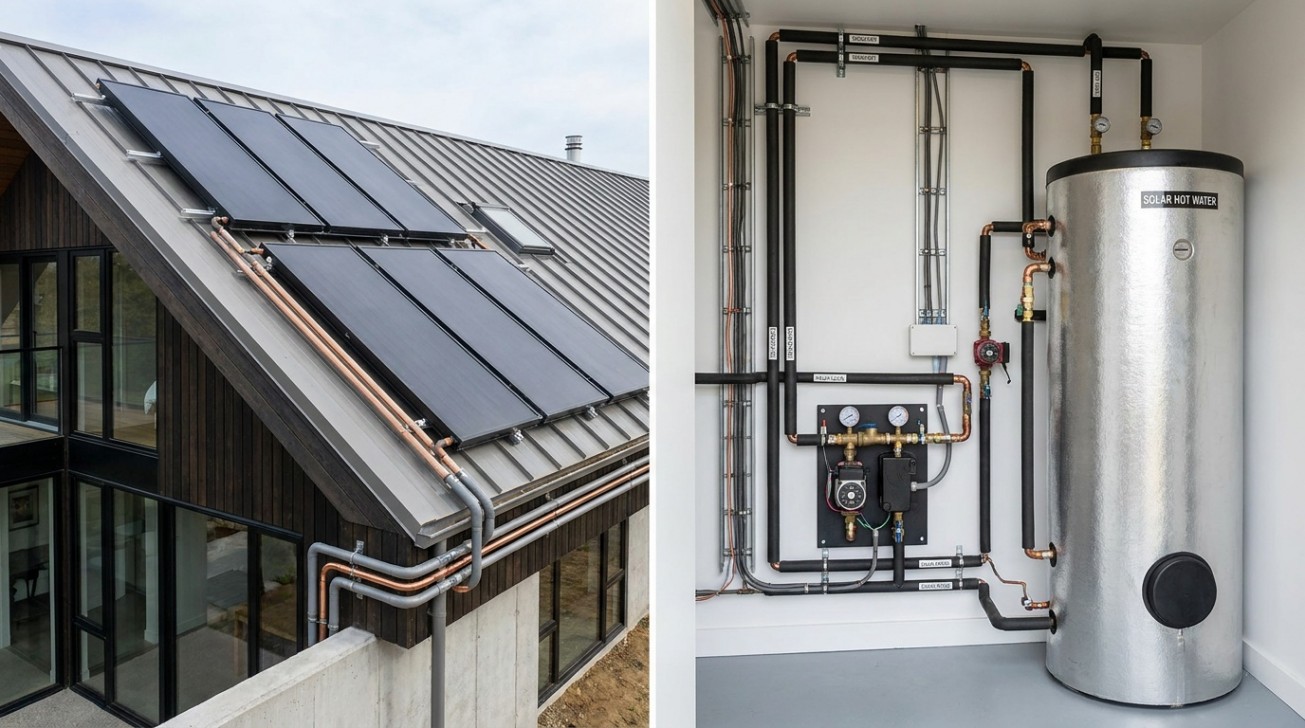
How a Split Pressurized Solar Water Heater Works
How a Split Pressurized Solar Water Heater Works as a Complete System
A split pressurized solar water heater works by separating solar heat collection from hot water storage, then using a controlled circulation loop to move heat from the roof-mounted collector to a pressurized indoor tank. This sounds simple, but the real value of the system is not only that the collector and tank are separated. The real value is that every part of the system has a specific function: the solar collector captures heat, the pump station moves heat, the solar water heater controller decides when circulation should happen, the heat exchanger transfers energy safely, the storage tank stores usable hot water, and the backup heater keeps the system reliable when solar input is not enough.
This is why a split solar water heating system should not be viewed as a single product. It is a thermal energy system. It turns sunlight into practical domestic hot water through a managed process. In a simple rooftop unit, the system may depend more on natural circulation or direct tank heating. In a split pressurized solar water heater, the system usually depends on active circulation, temperature sensors, pressure-rated storage, safety valves, and controlled heat transfer.
The word “pressurized” is especially important. A pressurized system is designed to work with modern plumbing pressure, which is important for homes, villas, hotels, apartments, schools, hospitals, and commercial buildings. Users do not only want warm water. They want stable hot water flow at showers, faucets, kitchens, laundry rooms, and service points. A good solar hot water system must therefore deliver both energy efficiency and user comfort.
To understand how it works, it is useful to follow the heat path from sunlight to the final outlet. Sunlight reaches the collector. The collector absorbs heat. The circulation loop carries that heat to the tank. The heat exchanger transfers the heat to domestic water. The storage tank stores the heated water under pressure. The controller monitors temperatures and protects the system. The backup heater supports the system during cloudy days, high demand, or low solar radiation.
In other words, a split pressurized solar water heater is not only about collecting solar energy. It is about controlling solar energy so that it becomes reliable hot water.
The System Starts with Solar Heat Collection

The first stage of any solar thermal system is heat collection. The solar collector is installed in a location where it can receive strong sunlight, usually on the roof, terrace, or a ground-mounted frame. Its job is to absorb solar radiation and convert it into thermal energy.
In a split solar water heating system, the collector may be a flat plate collector or an evacuated tube collector. Both can be used, but they behave differently in real projects. A flat plate collector uses a dark absorber plate inside an insulated box with a transparent cover. Sunlight passes through the cover and heats the absorber. Tubes or channels inside the collector carry the heat-transfer fluid. This design is stable, durable, and often suitable for residential and commercial roof installations.
An evacuated tube collector uses glass tubes with vacuum insulation. In heat pipe designs, the heat pipe inside the tube absorbs heat and transfers it to the manifold. This type of collector can perform well when heat loss needs to be reduced, especially in colder or windy conditions. For a split pressurized solar water heater, the choice between flat plate and evacuated tube collectors depends on climate, roof area, target water temperature, budget, appearance requirements, and maintenance strategy.
The collector does not directly define the whole system. It only defines how heat is captured. The system performance also depends on circulation control, tank size, pipe insulation, heat transfer design, and user demand. This is a common misunderstanding in solar water heating. Some buyers compare only collector area or tube quantity, but a strong solar hot water system depends on how the collector works together with the rest of the system.
A well-designed solar collector should absorb heat efficiently, lose as little heat as possible, withstand outdoor weather, resist corrosion, and allow stable fluid circulation. It should also match the building. A collector that performs well in a catalog may not perform well if it is installed at a poor angle, shaded by nearby structures, connected with long uninsulated pipes, or paired with an undersized tank.
This is why the first step is not simply buying the biggest collector. The first step is matching the solar collector to the system’s real operating conditions.
The Collector Loop Transfers Heat Instead of Storing Water on the Roof

A major difference between a split pressurized solar water heater and many integrated rooftop systems is that the collector does not need to hold the main volume of domestic hot water. Instead, heat is transferred through a collector loop.
This loop usually contains water or a heat-transfer fluid, depending on climate and system design. In warm regions without freezing risk, some systems may use direct circulation, where potable water circulates through the collector. In colder or more demanding applications, an indirect loop is common. In an indirect design, a separate heat-transfer fluid circulates through the collector, then passes through a heat exchanger to heat domestic water inside the tank.
This separation is important because it gives the split solar water heating system more flexibility. The tank can stay indoors. The collector can stay outside. The roof does not need to carry a full water tank. The system can use antifreeze fluid when needed. The collector loop can be designed for thermal performance, while the domestic water side can be designed for hygiene, pressure, and user comfort.
The collector loop is also where many engineering details matter. Pipe diameter must be correct. Pipe length must be reasonable. Insulation must be strong enough. Outdoor pipe sections must be protected from weather. The system must handle expansion as fluid heats up. The circulation direction must be clear. Air must be removed from the loop. Pressure must be checked during installation.
If the collector loop is poorly designed, even a high-quality collector cannot deliver good performance. Heat may be lost before it reaches the tank. The pump may work harder than necessary. Air pockets may reduce circulation. The fluid may overheat. The system may become noisy or unstable.
For this reason, the collector loop should be treated as a thermal highway. Its job is to move heat from the roof to the tank with minimum loss and maximum reliability. In a professional solar thermal system, this loop is not an afterthought. It is one of the most important design areas.
The Pump Station Drives Active Circulation

The pump station is the movement center of an active solar water heating system. It circulates fluid between the solar collector and the storage tank. Without the pump station, a split system would not be able to reliably move heat across distance, height differences, pipe resistance, and building layout constraints.
A typical pump station may include a circulation pump, flow meter, check valve, pressure gauge, safety valve, filling and draining valves, air separator, and sometimes temperature or flow monitoring accessories. These parts may look less visible than collectors and tanks, but they strongly affect system stability.
The pump must be selected according to system resistance. If the pump is too small, circulation may be weak. The collector may overheat, and heat transfer to the tank may be insufficient. If the pump is too large, the system may waste electricity, create noise, and reduce control precision. Correct pump sizing depends on pipe length, pipe diameter, height difference, collector area, heat exchanger resistance, and flow requirement.
The pump station also helps installers and technicians service the system. It provides access points for filling the loop, checking pressure, reading flow, removing air, and diagnosing circulation problems. In B2B projects, this serviceability is important. A hotel or apartment project cannot rely on guessing whether the system is circulating properly. Technicians need visible and measurable system data.
In a split pressurized solar water heater, the pump station is not only a pump. It is a hydraulic control assembly. It helps make the system manageable. It supports commissioning, maintenance, and troubleshooting. When the pump station is well designed, the system becomes easier to install and easier to maintain.
For distributors and project buyers, pump station quality should be part of the purchasing evaluation. A low-cost system may reduce cost by simplifying this assembly, but that can increase future service problems. A professional solar hot water system should include a pump station that matches the collector array and tank design.
The Controller Decides When Heat Should Move

The solar water heater controller is the decision-making part of the system. It does not create heat, but it determines when heat should be moved. This is one of the most important differences between an ordinary system and a well-managed active solar water heating system.
The controller usually reads temperature sensors. One sensor is placed near the collector outlet or manifold. Another sensor is placed in the storage tank, often near the lower part of the tank. The controller compares these temperatures. When the collector temperature is higher than the tank temperature by a set difference, the controller starts the pump. When the difference becomes too small, the controller stops the pump.
This logic is often called differential temperature control. It prevents the system from circulating fluid when the collector is not hot enough. Without this logic, the pump might move heat in the wrong direction, especially in the evening or during cloudy periods. Instead of heating the tank, the system could lose stored heat through the collector. The controller prevents this waste.
A good solar water heater controller may also manage other functions. It may include antifreeze protection, overheating protection, holiday mode, tank temperature limit, pump delay, error alarms, sensor fault detection, and backup heater control. Some systems may support multiple tanks, multiple collector fields, or integration with boilers and heat pumps.
The controller is especially important in a split pressurized solar water heater because the system is not purely passive. It depends on intelligent timing. The pump should not run all day. It should run only when solar heat is useful. This improves efficiency and reduces unnecessary pump operation.
For end users, the controller is usually invisible unless there is a problem. For installers and service teams, it is a key diagnostic tool. If the system is not producing enough hot water, the controller can help identify whether the issue is sensor placement, pump failure, low solar input, wrong settings, or poor circulation.
This is why a professional split solar water heating system should use a controller that is reliable, easy to understand, and suitable for the application.
The Heat Exchanger Separates Heat Transfer from Domestic Water

The heat exchanger is the bridge between the collector loop and the domestic water side. It allows heat to move from one fluid to another without mixing them. In many split pressurized solar water heater designs, this is one of the core safety and performance components.
There are two common arrangements. One is an internal coil heat exchanger inside the storage tank. The heated fluid from the collector loop flows through the coil, and heat passes through the coil wall into the water stored in the tank. Another arrangement is an external plate heat exchanger, where collector fluid and domestic water pass through separate channels. Heat transfers across thin plates between the two fluids.
The internal coil design is common in residential and small commercial systems because it is compact and simple. The external heat exchanger design may be used in larger systems where higher heat transfer capacity, easier service access, or more flexible system design is needed.
The heat exchanger matters because it affects how quickly solar heat enters the tank. If the heat exchanger area is too small, the collector loop may become hot, but the tank may heat slowly. If it is correctly sized, solar heat can be transferred efficiently.
In indirect systems, the heat exchanger also protects potable water from antifreeze fluid. This is important in cold climates where the collector loop may use glycol or another heat-transfer fluid. The domestic hot water remains separate, while the collector loop gains freeze protection.
However, a heat exchanger also adds resistance and complexity. It must be matched with pump capacity, flow rate, collector area, and tank volume. It must also be made from suitable materials. Poor materials can lead to corrosion, scaling, leakage, or reduced thermal performance.
For B2B buyers, heat exchanger design should not be ignored. A supplier may advertise collector size and tank capacity, but the heat exchanger determines how effectively the system converts collected heat into usable hot water. In a strong solar thermal system, the heat exchanger is sized as part of the complete thermal chain.
The Pressurized Storage Tank Turns Heat into Usable Hot Water

The storage tank is where solar heat becomes practical. A collector may capture heat during the day, but users often need hot water in the morning, evening, or at different times. The tank stores thermal energy so that hot water is available when needed.
In a split pressurized solar water heater, the storage tank is designed to operate under pressure. This means it can connect with pressurized water supply systems and deliver hot water with better flow and comfort. For modern homes, villas, hotels, and commercial buildings, this pressure compatibility is a major advantage.
A pressure-rated tank is not just a container. It may include an inner tank, insulation layer, outer shell, heat exchanger coil, temperature sensor ports, electric backup heater, magnesium anode, safety valve, pressure relief device, and hot/cold water connections. Each part affects system durability and performance.
Insulation is especially important. Solar heat is valuable because it is collected gradually. If the tank loses heat quickly, the whole system becomes less useful. A high-quality storage tank should keep water hot for long periods and reduce standby heat loss. This is important for overnight use and cloudy periods.
Tank size is another key factor. If the tank is too small, the system may overheat during strong sun and run out of hot water during peak demand. If the tank is too large, water may not reach a useful temperature, and the system cost may rise unnecessarily. Correct tank sizing depends on user number, water consumption habits, climate, collector area, and backup heating strategy.
In hotels and commercial buildings, tank design becomes even more important. The system may need multiple tanks or larger centralized storage. It may also need to coordinate with boilers, heat pumps, or recirculation systems. In these projects, the storage tank becomes part of a building energy system, not just a household appliance.
A good split solar water heating system stores heat safely, delivers water comfortably, and supports long-term maintenance.
Pressurized Hot Water Delivery Improves User Comfort
The biggest user-facing advantage of a split pressurized solar water heater is often not visible in the equipment room. It is felt at the shower.
A pressurized system is designed to deliver hot water under pressure. This makes it more compatible with modern bathrooms, mixer valves, multiple outlets, and buildings where users expect stable water flow. In many markets, this is a major difference between basic solar water heaters and premium solar hot water solutions.
A non-pressure system can still provide hot water, but water flow may depend more on tank height or gravity. That can be acceptable in simple homes, but it may not satisfy users who expect comfortable shower pressure. A pressurized solar water heater can better support the experience that users associate with conventional electric or gas water heating.
For a villa, pressure comfort is part of lifestyle quality. For a hotel, it is part of guest satisfaction. For an apartment, it is part of daily usability. For a commercial facility, it may affect cleaning, kitchen operation, or service efficiency.
This is why pressure should not be treated as a minor specification. In a solar hot water system, energy saving is only meaningful if the system also serves users properly. A system that saves energy but delivers weak water flow may create complaints. A well-designed split pressurized solar water heater aims to combine renewable energy with normal plumbing comfort.
Buyers should check pressure rating, safety valve configuration, inlet water pressure conditions, local plumbing standards, and tank certifications where applicable. They should also confirm whether the solar tank is directly pressurized or uses a coil-based heat exchange structure. Different markets use different designs, so product names alone are not enough.
Backup Heating Makes the System Reliable
A solar hot water system depends on sunlight, but users need hot water even when sunlight is weak. This is why most split pressurized solar water heater systems include backup heating.
Backup heating can come from an electric element, gas boiler, heat pump, biomass boiler, district heating, or another energy source. The goal is not to replace solar energy. The goal is to guarantee hot water availability when solar input is not enough.
This is especially important in hotels, apartments, schools, and hospitals. These buildings cannot tell users to wait for better sunlight. They need reliable hot water every day. Solar energy can reduce the energy load, but backup heating provides continuity.
A smart solar water heater controller may help manage backup heating. It can allow solar energy to heat the tank first, then activate backup only when tank temperature is below the required level. This improves energy use because backup heating does not run unnecessarily.
For residential systems, an electric backup heater inside the storage tank is common. For larger systems, solar preheating may feed water into a boiler or heat pump. This arrangement can reduce fuel or electricity consumption while keeping the final supply temperature stable.
The correct backup strategy depends on project type. A small home may only need simple electric backup. A hotel may need staged boiler integration. A commercial building may need a more advanced control strategy. A professional split solar water heating system should be designed around real hot water demand, not only average sunlight.
Backup heating also changes how system performance should be evaluated. The goal is not always 100% solar coverage. In many projects, the goal is reliable hot water with reduced energy cost. This is a more realistic and professional way to position a solar thermal system.
Safety Protection Keeps the System Stable
A split pressurized solar water heater must handle heat, pressure, expansion, and changing weather. Safety components are therefore essential.
When fluid heats up, it expands. If the system has no expansion capacity, pressure can rise too high. An expansion vessel absorbs this volume change and helps maintain stable pressure in the collector loop. Safety valves provide pressure relief when necessary. Pressure gauges allow installers and technicians to monitor system condition.
Overheating protection is also important. During sunny days with low water use, the collector may continue to produce heat even after the tank is already hot. If heat cannot be used or released properly, system temperature can rise. A good solar water heater controller may stop the pump, activate protection modes, or manage heat according to system design.
Freeze protection is another safety issue. In cold climates, water in exposed pipes or collectors can freeze and damage components. An indirect system with antifreeze fluid can reduce this risk. Pipe insulation, controller logic, and correct installation are also important.
Air removal matters too. Air trapped in the collector loop can reduce circulation and cause noise or performance issues. Proper filling, venting, and commissioning are necessary.
Safety protection should not be simplified as a few accessories. It is part of system reliability. A professional solar hot water system should include pressure relief, expansion control, temperature control, freeze protection where needed, and clear maintenance procedures.
For B2B buyers, safety configuration is one of the differences between low-end product supply and professional system supply. A supplier that only sells collectors and tanks may not provide enough protection logic. A supplier that understands complete solar thermal system design will pay attention to pressure, temperature, fluid condition, and service access.
The Working Sequence from Morning to Night

A practical way to understand a split pressurized solar water heater is to look at how it behaves during a normal day.
In the early morning, the storage tank may still contain warm water from the previous day or from backup heating. The collector is cool because there is little or no sunlight. The solar water heater controller keeps the pump off because moving fluid would not add useful heat.
As sunlight increases, the solar collector begins to heat up. The sensor at the collector detects rising temperature. When the collector becomes hot enough compared with the tank, the controller activates the pump station. Heat-transfer fluid begins circulating through the collector loop.
The heated fluid travels from the collector to the heat exchanger. Heat passes into the water inside the tank. Cooler fluid returns to the collector to be heated again. This cycle continues as long as the collector can provide useful heat.
By midday or afternoon, the tank temperature may rise significantly. If the tank reaches its target temperature, the controller may stop circulation or limit operation to prevent overheating. If hot water is used during the day, cold water enters the tank, and the system may continue transferring solar heat.
In the evening, solar input decreases. The collector cools. When the collector is no longer hotter than the tank by the required difference, the controller stops the pump. This prevents stored heat from being carried back to the roof and lost to outdoor air.
At night, users may still draw hot water from the storage tank. If the temperature is too low, backup heating may operate according to the controller or thermostat. The next morning, the cycle begins again.
This daily sequence shows why control is essential. A split solar water heating system must know when to collect heat, when to stop circulation, when to store heat, and when to rely on backup. The system is efficient because it moves heat only when the movement is useful.
Direct and Indirect Working Modes
A split pressurized solar water heater can be designed in direct or indirect mode. This is one of the most important technical choices.
In a direct system, potable water circulates through the solar collector and returns to the storage tank. This can be efficient and simpler because there is no separate heat-transfer fluid loop. However, it is mainly suitable for regions where freezing is not a concern and water quality is acceptable. If water is hard or corrosive, scaling and corrosion may become problems inside collector channels.
In an indirect system, the collector loop contains heat-transfer fluid. This fluid collects heat from the collector and transfers it to domestic water through a heat exchanger. The domestic water does not flow through the collector. This design is more suitable for colder climates and areas where water quality may damage collectors.
The indirect system is usually more complex. It requires fluid maintenance, expansion control, proper filling, and heat exchanger sizing. However, it provides better protection and design flexibility. For many professional solar thermal system projects, indirect circulation is preferred because it separates the collector loop from the domestic water side.
The choice between direct and indirect should not be based only on cost. It should be based on climate, freezing risk, water quality, maintenance ability, and local installation practice. A direct system may be excellent in warm regions. An indirect system may be necessary in cold or demanding environments.
For buyers, this is an important question to ask suppliers: Is the system direct or indirect? What fluid is used? How is freeze protection handled? What type of heat exchanger is included? What maintenance is required? These answers reveal whether the supplier understands the real operating conditions.
What Can Reduce System Performance

Even a good split pressurized solar water heater can underperform if the design or installation is poor. Performance is not determined by one component. It is determined by the full thermal chain.
Shading is one common issue. If the solar collector is shaded by trees, walls, chimneys, nearby buildings, or roof structures, heat output will drop. Collector orientation and tilt angle also matter. A collector facing the wrong direction may receive less solar radiation.
Poor pipe insulation is another major issue. The collector may produce heat, but the system may lose that heat before it reaches the tank. This is especially important for split systems because the collector and tank are separated.
Incorrect pump flow can reduce performance. If the pump is too weak, heat may not transfer efficiently. If flow is too strong, the system may lose control efficiency or waste electricity. The pump station must match the hydraulic design.
Sensor placement can also cause problems. If the collector sensor or tank sensor is installed incorrectly, the solar water heater controller may start or stop the pump at the wrong time. This can reduce heat gain or increase heat loss.
Tank sizing is another factor. An oversized storage tank may not reach useful temperature. An undersized tank may overheat or fail to provide enough water during peak demand.
Scaling and fluid degradation can reduce heat transfer. Hard water can affect heat exchangers and tanks. Glycol or heat-transfer fluid may require periodic checking. Air in the collector loop can interrupt circulation.
These issues show why a solar hot water system should be designed, installed, and maintained as a system. The best collector cannot compensate for poor installation. The best tank cannot compensate for weak control. The best controller cannot compensate for bad pipe insulation.
How Buyers Should Read a System Specification
When evaluating a split pressurized solar water heater, buyers should read the specification as a system document, not as a product flyer.
Collector information should include collector type, absorber area, gross area, working pressure, stagnation temperature, frame material, glass type, insulation, and recommended installation angle. For the solar collector, these details help determine whether it is suitable for the climate and application.
Tank information should include volume, pressure rating, inner tank material, insulation thickness, coil area, backup heater power, anode type, temperature sensor ports, and safety accessories. For the storage tank, these details determine pressure comfort, durability, and heat retention.
Pump station information should include pump model, flow range, pressure range, valves, gauges, safety valve rating, and service ports. For the pump station, these details determine circulation reliability and maintenance convenience.
Controller information should include sensor inputs, pump control logic, temperature range, antifreeze function, overheating protection, backup heater control, and alarm functions. For the solar water heater controller, these details determine how intelligently the system operates.
Heat exchanger information should include coil material, coil area, plate heat exchanger capacity, pressure rating, and connection method. For the heat exchanger, these details determine how effectively heat moves into domestic water.
A professional supplier should be able to explain how these parts work together. If the supplier only provides tank size and collector number, the buyer may not have enough information to judge system quality.
A split solar water heating system is a system purchase. The quotation should reflect system design, not only component price.
Focused FAQ
How does a split pressurized solar water heater work?
A split pressurized solar water heater works by using a roof-mounted solar collector to capture heat, a pump station to circulate heat-transfer fluid, a heat exchanger to transfer heat into domestic water, and a pressurized storage tank to store hot water for daily use.
Why does a split solar water heating system need a pump?
A split solar water heating system usually needs a pump because the collector and tank are installed separately. The pump moves heat-transfer fluid between the collector and the tank so that solar heat can be transferred efficiently.
What does the solar water heater controller do?
The solar water heater controller monitors collector and tank temperatures. It starts the pump when the collector is hot enough to heat the tank and stops the pump when circulation would no longer be useful.
Is a split pressurized solar water heater suitable for modern homes?
Yes. A split pressurized solar water heater is suitable for modern homes because it can provide pressurized hot water, allow indoor tank installation, support cleaner roof appearance, and integrate with backup heating.
What is the role of the heat exchanger?
The heat exchanger transfers heat from the collector loop to domestic water without mixing the two fluids. It is especially important in indirect systems that use antifreeze or heat-transfer fluid.
Can a split solar water heating system work in cold climates?
Yes, but the system must be designed correctly. A cold-climate split solar water heating system usually needs indirect circulation, antifreeze fluid, insulated piping, expansion control, and proper controller settings.
Does a split pressurized solar water heater need backup heating?
Most systems need backup heating to ensure reliable hot water during cloudy days, winter periods, or high-demand times. Backup heating can be electric, gas, boiler-based, heat pump-based, or integrated with another hot water source.
What affects the efficiency of a solar hot water system?
The efficiency of a solar hot water system depends on collector quality, installation angle, sunlight exposure, pipe insulation, pump flow, controller settings, heat exchanger sizing, tank insulation, water usage, and maintenance.
Conclusion
A split pressurized solar water heater works by managing the full journey of heat: collecting solar energy, moving it through a controlled circulation loop, transferring it through a heat exchanger, storing it in a pressurized storage tank, and delivering it as comfortable hot water. Its value comes from system coordination, not from one single component.
Compared with simpler rooftop systems, a split solar water heating system offers stronger flexibility. The collector can be installed where sunlight is best, while the tank can be placed indoors or in a mechanical room. The system can support pressurized water delivery, backup heating, freeze protection, and commercial-scale design.
For homes, it improves comfort and building appearance. For hotels and commercial projects, it supports larger capacity and better service access. For distributors and installers, it creates a higher-value solution that requires technical understanding rather than simple product selling.
The key lesson is clear: a split pressurized solar water heater should be evaluated as a complete solar thermal system. The solar collector, pump station, solar water heater controller, heat exchanger, storage tank, piping, insulation, safety components, and backup heater must work together. When the system is designed and installed correctly, it can provide reliable hot water, reduce energy demand, and deliver long-term value for residential and commercial applications.
#SplitPressurizedSolarWaterHeater #SplitSolarWaterHeatingSystem #ActiveSolarWaterHeatingSystem #SolarHotWaterSystem #SolarThermalSystem #SolarCollector #HeatExchanger #PumpStation #StorageTank #SolarWaterHeaterController