Heat Pipe or Flat Plate Collector for Split Solar Water Heating?
Why Collector Choice Matters in a Split Solar Water Heating System
Choosing between a heat pipe solar collector and a flat plate solar collector is one of the most important technical decisions in a split solar water heating system. Many buyers first think of a split system as a tank, pump station, controller, and pipe loop. Those components are important, but the collector is where solar heat enters the system. If the collector type does not match the climate, temperature target, installation environment, and project demand, the whole system may underperform even when the tank and controller look correct.
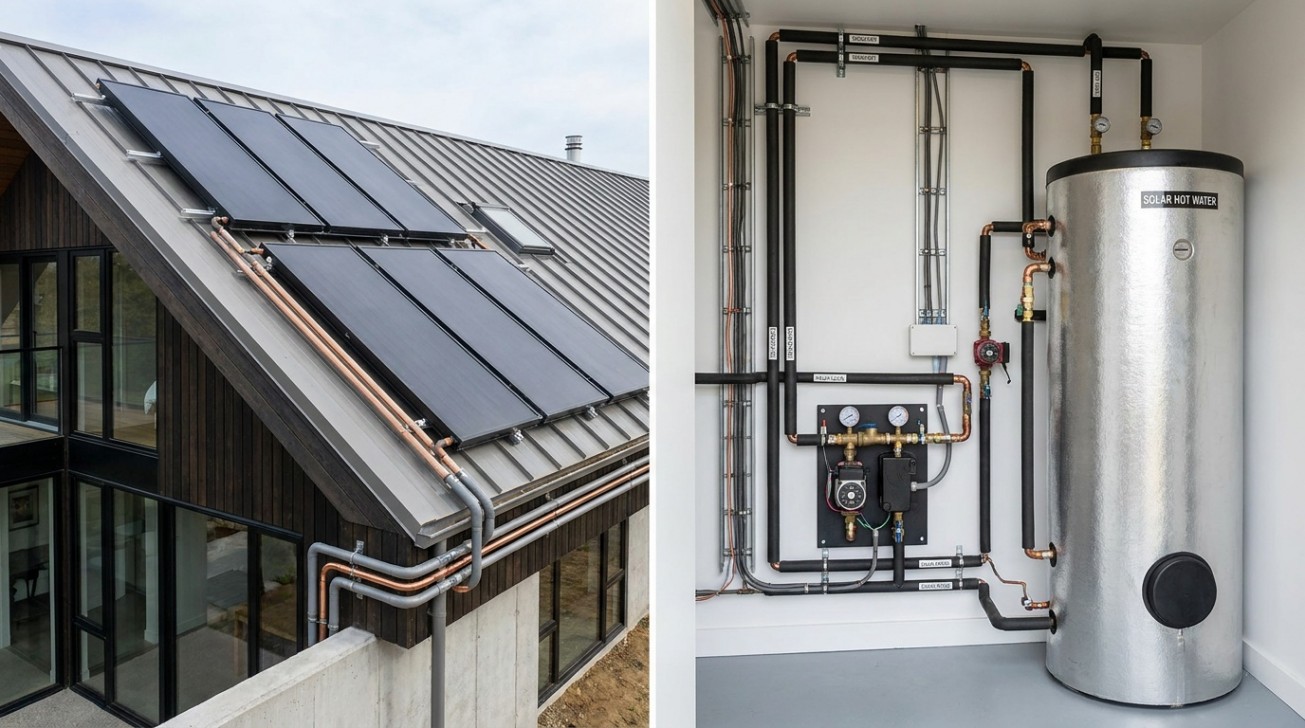
A split solar water heater is flexible because the collector and storage tank are separated. This means the collector can be selected according to the actual project instead of being fixed as part of a compact rooftop unit. For some projects, a flat plate solar collector is the better choice because it is robust, visually clean, and suitable for large roof arrays. For other projects, a heat pipe solar collector or evacuated tube solar collector may be better because it can reduce heat loss and perform well in colder or more variable conditions.
This decision should not be treated as a simple “which one is more efficient” question. Efficiency changes with temperature, sunlight, wind, climate, installation angle, collector design, and system operating conditions. A collector that performs well in a cold winter region may not be the best choice for a warm hotel project. A collector that looks neat on a modern roof may not provide the best value for a high-temperature application. A collector that is easy to replace tube by tube may have a different maintenance logic than one large flat panel.
The correct question is: which collector type produces the most useful heat for the real solar hot water system under the project’s conditions?
For B2B buyers, distributors, engineers, and installers, solar collector selection is not only a product decision. It is a system strategy. The collector must match water temperature demand, storage tank capacity, circulation type, pump flow, heat exchanger size, roof structure, climate zone, service capability, and expected project life.
Understanding the Role of the Collector in Split Systems
In a split solar water heating system, the collector is usually installed on the roof, façade, terrace, or ground frame. Its job is to absorb solar radiation and transfer heat into the collector loop. That heat is then moved by a pump station to a storage tank or heat exchanger.
Because the tank is separated from the collector, the system designer has more freedom. The collector does not need to carry the water storage volume. This makes it easier to use larger collector arrays, arrange panels across a roof, connect multiple collector banks, or place tanks in a mechanical room. This is why split systems are often used in villas, hotels, apartments, schools, hospitals, and commercial solar water heating projects.
However, this flexibility also means the collector must be selected carefully. A solar thermal collector is not just a surface that becomes hot in the sun. It is part of a heat chain. Heat must be collected, carried through pipes, transferred through a heat exchanger, stored in the tank, and finally delivered as usable hot water. If the collector produces heat at the wrong temperature range, loses too much heat in cold weather, or does not match the tank and pump design, system performance can suffer.
For example, a large collector array paired with a small tank may cause overheating. A collector type selected for high-temperature output may be unnecessary for low-temperature domestic hot water in warm climates. A collector with fragile installation requirements may increase maintenance risk in commercial projects. A collector with excellent winter performance may cost more than needed in tropical markets.
That is why solar collector selection should begin with the project application, not the catalog image.
What Is a Heat Pipe Solar Collector?

A heat pipe solar collector is usually a type of evacuated tube solar collector. It uses vacuum-insulated glass tubes to reduce heat loss. Inside each tube, a heat pipe transfers heat from the absorber area to a manifold. The heat pipe contains a working fluid that evaporates when heated and condenses at the top section, transferring heat into the collector header.
The main idea is thermal separation and efficient heat transfer. The vacuum around the absorber reduces convection heat loss. The heat pipe transfers collected heat to the manifold without requiring the domestic water to flow directly through each glass tube. In many split systems, a heat-transfer fluid circulates through the manifold and carries heat to the tank-side heat exchanger.
A heat pipe solar collector is often chosen when the project needs stronger insulation against outdoor heat loss. This can be useful in colder climates, windy regions, high-temperature domestic hot water systems, or applications where solar radiation may be available but ambient temperatures are low. Because each tube is separated, some systems allow individual tube replacement without draining the entire system, depending on the design.
The visual appearance of a heat pipe solar collector is also distinctive. It usually has rows of glass tubes connected to a top manifold. This appearance is acceptable in many industrial, residential, and commercial settings, but it may not be preferred in some modern architectural projects where flat, low-profile collectors are desired.
A heat pipe solar collector is not automatically better than a flat plate collector. Its value depends on operating conditions. If the climate is warm and the required water temperature is moderate, its insulation advantage may not justify higher cost or different mounting requirements. But in cold climates, seasonal conditions, or applications needing higher collector outlet temperatures, the heat pipe design can be a strong option.
What Is a Flat Plate Solar Collector?

A flat plate solar collector is one of the most widely used types of solar thermal collector. It usually consists of a dark absorber plate, fluid channels, transparent cover, insulation layer, and metal frame. Sunlight passes through the transparent cover and heats the absorber plate. The heat is transferred to fluid flowing through channels connected to the absorber.
The design is simple, robust, and visually clean. A flat plate solar collector looks like a panel, which often makes it easier to integrate into roof layouts. For modern homes, apartment buildings, hotels, and commercial roofs, this low-profile appearance can be an advantage.
A flat plate solar collector is often suitable for projects where the target water temperature is moderate, the climate is stable, and large roof areas are available. It can be used in residential domestic hot water, hotel preheating, school dormitory hot water, swimming pool support, and many commercial solar water heating applications.
Because flat plate collectors have a large absorber surface and a solid frame, they are often perceived as durable and easy to arrange in arrays. They may also be easier to clean in dusty areas compared with tube-based collectors, depending on installation angle and local conditions. Their structure can be straightforward for installers familiar with panel-type mounting.
However, a flat plate solar collector can lose more heat than an evacuated tube collector when the temperature difference between collector and outdoor air is high. In cold or windy conditions, heat loss may reduce performance. This does not mean flat plate collectors cannot be used in cold regions, but the system must be designed correctly, and the application temperature should be realistic.
The strength of the flat plate design is balance: simple structure, clean appearance, stable performance, and good suitability for many standard solar hot water system applications.
Heat Pipe vs Flat Plate: The Main Difference

The main difference between a heat pipe solar collector and a flat plate solar collector is how each collector manages heat loss and heat transfer.
A heat pipe solar collector uses evacuated tubes and heat pipe transfer. The vacuum insulation helps reduce heat loss from the absorber to the surrounding air. This is especially useful when outdoor temperatures are low or wind conditions are strong. The heat pipe transfers energy into the manifold, where the collector loop carries heat away.
A flat plate solar collector uses a flat absorber plate inside an insulated panel. It has a larger continuous absorber surface and a simpler panel structure. It is efficient in many moderate-temperature applications, especially when ambient conditions are favorable.
In practical terms, a heat pipe solar collector often has an advantage when the system needs higher temperature output or operates in colder conditions. A flat plate solar collector often has an advantage when the project needs a clean roof appearance, robust panel layout, simpler array design, and cost-effective performance in moderate climates.
This difference should be connected to the system’s temperature requirement. A domestic hot water system that only needs moderate tank temperatures may not need the highest-temperature collector. A hotel or industrial preheating system may need consistent heat input over a wide range of seasons. A cold climate solar water heater may require a collector that reduces heat loss more effectively during winter.
Therefore, the collector decision is not about which technology is more advanced. It is about which technology is more suitable for the operating conditions.
Climate: The First Factor in Solar Collector Selection

Climate is usually the first major factor in solar collector selection.
In warm and sunny regions, a flat plate solar collector can be a strong choice for many split systems. The outdoor temperature is not extremely low, so heat loss is less severe. The system can collect useful heat efficiently, especially when the required hot water temperature is moderate. For villas, apartments, resorts, and hotels in warm climates, flat plate collectors often provide a good balance of cost, appearance, and performance.
In colder climates, a heat pipe solar collector or evacuated tube solar collector may offer stronger seasonal performance. When outdoor air is cold, a collector loses heat to the environment. Vacuum insulation helps reduce this loss. This can make evacuated tube designs attractive for a cold climate solar water heater, especially when the project expects useful winter contribution.
Wind also matters. Wind increases convective heat loss. Flat plate collectors are insulated, but their glass surface and panel structure still lose heat under cold and windy conditions. Evacuated tubes can reduce this loss due to vacuum insulation. For exposed roofs, high-altitude areas, or windy winter regions, this can influence the choice.
However, climate should not be oversimplified. A cold region with excellent sun exposure may perform differently from a cloudy mild region. A hot desert region may create overheating risk. A coastal region may require corrosion-resistant frames and fittings. A snowy area may require collectors that shed snow or are mounted at a suitable angle.
A professional split solar water heating system supplier should ask about local climate before recommending collector type. The same collector may not be the best choice in every country, city, or building location.
Required Water Temperature and System Purpose
The target water temperature is another key factor. A solar hot water system for residential showers may have a different temperature requirement than a hotel laundry preheating system, a commercial kitchen, or an industrial process.
A flat plate solar collector is often very suitable for moderate-temperature domestic hot water. If the system is mainly designed to preheat water or supply common household hot water, the flat plate option may provide enough performance with good cost control.
A heat pipe solar collector may be more suitable when the system requires higher outlet temperatures or better performance at higher temperature differences. Because evacuated tube insulation reduces heat loss, heat pipe collectors can maintain useful output when collector temperature is significantly higher than outdoor air temperature.
This does not mean every high-temperature project must use heat pipes. System design still matters. Tank volume, heat exchanger size, pump flow, pipe insulation, and backup heating strategy all influence final water temperature. But collector type affects how easily the system reaches and maintains higher temperatures under different weather conditions.
In commercial solar water heating, solar thermal is often used for preheating rather than final heating. In this case, the required temperature may be moderate, and a flat plate solar collector can be effective. If the project expects stronger winter preheating or higher temperature contribution, a heat pipe solar collector may deserve consideration.
The buyer should define the system purpose clearly. Is the system designed for domestic hot water? Boiler preheating? Hotel hot water? Dormitory showers? Pool heating? Process water? Each purpose may point to a different collector preference.
Installation Conditions and Roof Layout
The roof or installation area can strongly influence collector choice.
A flat plate solar collector usually works well when the roof has enough continuous area for panel arrays. Its rectangular panel shape makes layout planning straightforward. It can also look cleaner on modern roofs because the panels sit as flat surfaces. For architecture-sensitive projects, this can be a strong reason to choose flat plate collectors.
A heat pipe solar collector requires tube rows and manifold placement. The tubes may need careful handling during transport and installation. The mounting structure must support the manifold and tube alignment. In some systems, the ability to replace individual tubes can be a maintenance advantage, but the installer must understand the collector structure.
Roof angle also matters. Both collector types need proper tilt and orientation. A poor angle can reduce solar gain. If a roof is flat, mounting frames may be required. If a roof is pitched, the collector must match roof structure and load conditions. If the roof has shading from nearby buildings, trees, HVAC equipment, parapets, or chimneys, the collector array should be placed carefully.
Snow, dust, and cleaning conditions also affect selection. Flat plate collectors may present a broad surface that can be cleaned more uniformly. Evacuated tube collectors may handle some conditions differently due to tube spacing and shape. In dusty environments, cleaning access should be planned regardless of collector type.
For large commercial solar water heating systems, layout becomes more important. Multiple collector banks must be connected with balanced flow. Pipe routes should avoid unnecessary heat loss. Maintenance pathways should be available. The collector choice must match not only performance but also practical installation and service access.
System Integration with Split Tanks and Heat Exchangers
A split solar water heating system does not stop at the collector. The collector must be integrated with the tank and heat exchanger.
A heat pipe solar collector may produce high collector-loop temperatures under strong sunlight. The tank, heat exchanger, expansion vessel, pressure relief devices, and controller must be able to manage that heat. If the heat exchanger is undersized, the collector loop may become hot while the tank heats slowly. This can reduce system efficiency and increase overheating risk.
A flat plate solar collector may have more moderate temperature behavior, depending on conditions. It still requires correct tank matching and pump flow. If the tank is too small, overheating can occur. If the tank is too large, water may not reach useful temperature. If the pipe insulation is poor, heat can be lost before reaching the tank.
The heat exchanger is especially important in indirect systems. It must match collector capacity. A strong collector paired with a weak heat exchanger creates a bottleneck. This is true for both heat pipe and flat plate systems.
The pump station must also be selected correctly. Collector type, array size, pipe length, and heat exchanger resistance influence flow requirements. A solar thermal collector cannot work properly if the pump flow is too low or too high.
The controller must manage circulation based on temperature difference. In systems using high-performance evacuated tubes, overheating protection may be more important. In systems with larger flat plate arrays, balanced control across collector banks may matter more.
This is why solar collector selection should always be connected to complete system design.
Maintenance and Service Considerations
Maintenance logic is different for heat pipe and flat plate systems.
A heat pipe solar collector with evacuated tubes may allow individual tube replacement in some designs. If one tube is broken, it may be possible to replace that tube without replacing the entire collector. This can reduce service cost in certain situations. However, tubes require careful handling, and the collector manifold must remain in good condition. Tube breakage, vacuum loss, seal aging, and heat pipe performance should be considered in long-term maintenance planning.
A flat plate solar collector has a more integrated panel structure. It may be less modular in terms of individual absorber replacement, but it is often robust and simple. Maintenance may focus on glass cleaning, frame inspection, seal condition, insulation integrity, fluid leakage, and array connection checks.
In dusty or polluted environments, both collector types need cleaning. A dirty glass surface reduces solar absorption. In coastal regions, corrosion-resistant materials and fasteners are important. In snowy climates, mounting angle and snow behavior should be considered. In high-wind regions, mounting strength is essential.
For B2B buyers, maintenance should be evaluated from the perspective of local service capability. Can local installers handle evacuated tube replacement? Are spare tubes available? Can flat plate panels be transported and replaced easily? Does the supplier provide installation manuals and spare parts? Are mounting accessories standardized?
A split solar water heater should not only be selected for first-year performance. It should be selected for service life. Maintenance access, spare parts, installer training, and after-sales support all affect long-term value.
Durability and Project Risk
Durability is not only a material question. It is a project risk question.
A flat plate solar collector has fewer visible separate elements and often provides a solid panel structure. This can be attractive for commercial roofs and projects where uniform appearance and mechanical simplicity matter. However, flat plate collectors must have good insulation, frame sealing, glass strength, absorber coating, and corrosion protection.
A heat pipe solar collector uses multiple glass tubes and a manifold. The vacuum tubes provide strong insulation, but glass tube handling and long-term seal quality matter. The heat pipe itself must transfer heat reliably over time. The manifold must resist weather exposure, thermal cycling, and corrosion.
In some markets, buyers may prefer heat pipe collectors because individual tubes can be replaced. In other markets, buyers may prefer flat plate collectors because the panel format feels more robust and architectural. Both views can be valid depending on project conditions.
For commercial solar water heating, durability should be evaluated through total system risk. A collector failure on a single home is a service issue. A collector failure on a hotel roof with dozens of collectors can become a larger project problem. The buyer should consider installation quality, wind load, hail risk, snow load, corrosion exposure, and maintenance access.
A professional supplier should provide technical data, not only marketing claims. Buyers should ask about working pressure, stagnation temperature, absorber material, coating, glass strength, frame material, insulation, manifold design, and warranty conditions.
Cost: Initial Price vs Useful Heat Value

Cost comparison between a heat pipe solar collector and a flat plate solar collector should not focus only on unit price.
A flat plate solar collector may offer attractive cost performance in many standard applications. Its panel structure, roof integration, and array layout can make it practical for residential and commercial projects. When climate is moderate and water temperature demand is not extreme, the flat plate option may deliver strong useful heat value.
A heat pipe solar collector may have a higher initial cost depending on design, tube quality, manifold structure, and market conditions. But it may produce more useful heat in colder or higher-temperature conditions. If the project needs winter contribution or higher outlet temperature, the extra cost may be justified.
The key concept is useful heat value. A cheaper collector is not cheaper if it produces less useful heat under the project’s conditions. A more expensive collector is not better if the system does not need its performance advantage.
For B2B buyers, cost should include installation labor, mounting structure, transportation, replacement parts, maintenance, performance in local climate, and after-sales risk. In some cases, a flat plate solar collector may reduce overall project complexity. In other cases, a heat pipe solar collector may reduce winter performance complaints.
The right cost question is not “Which collector is cheaper?” The right question is “Which collector delivers the best long-term useful heat per project risk?”
Residential Applications: Which Collector Fits Better?

For residential homes, the choice depends on climate, roof style, budget, and comfort expectations.
A flat plate solar collector may be a strong choice for modern homes in mild or warm climates. It offers a clean appearance and can integrate well with roofs. For households with typical domestic hot water demand, flat plate collectors often provide enough performance when the system is correctly sized.
A heat pipe solar collector may be better for homes in colder climates, areas with strong seasonal variation, or projects where the user wants stronger performance during lower ambient temperatures. It can also be attractive where the roof layout suits tube collectors and where spare tube maintenance is practical.
For a villa or premium residential project, appearance may be very important. Some homeowners prefer flat panels because they look similar to other roof-mounted energy systems. Others accept evacuated tubes because they prioritize performance. The decision should balance aesthetics and thermal need.
A residential solar hot water system should not be oversized only to look powerful. It should be matched to household hot water demand, tank volume, climate, and backup heating. Both collector types can work well when selected properly.
Commercial Applications: Hotels, Apartments, Schools, and More

In commercial solar water heating, collector selection becomes more strategic because the system scale is larger and the consequences of poor performance are greater.
Hotels need stable hot water and often use solar as a preheating source. If the hotel is in a warm or moderate climate with large roof area, a flat plate solar collector array may provide strong value. If the hotel is in a colder region or wants higher winter contribution, a heat pipe solar collector may be more suitable.
Apartment buildings and dormitories often have predictable hot water demand. They may benefit from large collector arrays and centralized storage. Flat plate collectors can be attractive for broad roof coverage and clean layout. Heat pipe collectors can be considered if seasonal performance or higher temperature output is important.
Schools, hospitals, resorts, and gyms all have different usage patterns. A school may have peak shower demand in dormitories. A hospital may require reliability and hygiene. A resort may care about appearance and guest perception. A gym may have high shower demand at certain times. These differences affect collector choice.
For commercial projects, the collector should be selected together with storage strategy, backup heating, system monitoring, maintenance access, and hydraulic balancing. A solar thermal collector is part of a larger energy system. The goal is not only maximum collector output but stable, maintainable, cost-effective heat supply.
Common Mistakes in Collector Selection
One common mistake is choosing a collector only by claimed efficiency. Efficiency data may be measured under specific conditions. Real performance depends on temperature difference, sunlight, wind, installation angle, and system operation. A collector with higher peak efficiency may not always deliver better annual useful heat.
Another mistake is selecting a heat pipe solar collector simply because it sounds more advanced. If the project is in a warm climate with moderate water temperature demand, a flat plate solar collector may provide better cost value and easier roof integration.
A third mistake is selecting a flat plate solar collector only because it looks cleaner. If the project is in a cold climate and requires higher winter contribution, the flat plate choice should be evaluated carefully against evacuated tube options.
A fourth mistake is ignoring tank and heat exchanger matching. Collector output must be absorbed by the system. Oversized collector arrays can create overheating risk if tank capacity or heat exchanger area is insufficient.
A fifth mistake is ignoring maintenance conditions. If spare tubes are not available locally, heat pipe maintenance may become difficult. If flat plate panels are large and roof access is poor, replacement may also be difficult.
A sixth mistake is using one standard collector package for every market. A split solar water heating system should be adapted to local climate, water demand, building structure, and service capability.
Practical Selection Framework

Choose a heat pipe solar collector when the project is in a colder climate, has higher target water temperature, faces windy conditions, needs better thermal insulation, has limited collector area but higher heat demand, or requires strong seasonal performance. It can also be a good option when the buyer values modular tube replacement and accepts the appearance of evacuated tube arrays.
Choose a flat plate solar collector when the project is in a warm or moderate climate, has enough roof area, requires clean architectural integration, needs robust panel-style installation, targets standard domestic hot water temperatures, or prioritizes cost-effective performance for large arrays.
For residential homes, consider climate, roof appearance, hot water habits, and budget. For commercial solar water heating, consider daily load profile, maintenance access, roof structure, hydraulic balancing, backup heating, and long-term service support.
For B2B procurement, ask the supplier these questions:
What is the local climate and minimum winter temperature?
What is the target tank temperature?
Is the system direct or indirect?
What heat exchanger size is used?
How much roof area is available?
Is architectural appearance important?
What is the expected annual hot water demand?
What collector data can the supplier provide?
What maintenance parts are available?
Which collector type has lower lifecycle risk in this market?
When these questions are answered clearly, solar collector selection becomes a professional system decision rather than a catalog comparison.
Supplier Responsibility in Recommending Collector Type
A professional supplier should not push only one collector type for every split solar water heating system. Both heat pipe and flat plate technologies have value. The supplier’s role is to match the right collector to the right project.
If a supplier always recommends a heat pipe solar collector, the buyer should ask why. Is the climate cold? Is the temperature target high? Is the system designed for winter contribution? Or is the recommendation only based on product availability?
If a supplier always recommends a flat plate solar collector, the buyer should also ask why. Is the project in a warm region? Is roof appearance important? Is the target temperature moderate? Or is the supplier avoiding a more suitable evacuated tube solution?
Good suppliers provide options. They explain tradeoffs. They connect collector choice with system design. They discuss tank size, pump station, controller, heat exchanger, pipe insulation, pressure protection, and backup heating. They do not treat the collector as an isolated product.
For export markets, this matters even more. A collector package that works well in one region may not be right for another. Climate, water habits, installation skills, roof structures, and market expectations all vary. A supplier that understands these differences creates more long-term value for distributors and project buyers.
Focused FAQ
Is a heat pipe solar collector better than a flat plate solar collector?
A heat pipe solar collector is not always better than a flat plate solar collector. Heat pipe collectors may perform better in colder or higher-temperature conditions, while flat plate collectors can offer strong value, clean appearance, and stable performance in warm or moderate climates.
Which collector is better for a split solar water heating system?
The best collector for a split solar water heating system depends on climate, target water temperature, roof area, installation conditions, maintenance capability, and project budget. Both heat pipe and flat plate collectors can work well when matched correctly.
Is a flat plate solar collector suitable for commercial solar water heating?
Yes. A flat plate solar collector can be very suitable for commercial solar water heating, especially in warm or moderate climates with enough roof area and standard domestic hot water temperature requirements.
When should I choose an evacuated tube solar collector?
An evacuated tube solar collector, including heat pipe types, is often suitable for colder climates, windy areas, higher temperature requirements, or projects that need stronger seasonal performance.
Which collector is better for cold climates?
A heat pipe solar collector or evacuated tube solar collector is often preferred for a cold climate solar water heater because vacuum insulation helps reduce heat loss in low ambient temperatures.
Which collector looks better on modern buildings?
A flat plate solar collector often has a cleaner, lower-profile appearance, which may fit modern buildings better. However, design preference depends on the project and roof layout.
Does collector type affect maintenance?
Yes. A heat pipe solar collector may allow tube-level replacement in some designs, while a flat plate solar collector has a more integrated panel structure. Maintenance planning should consider spare parts, roof access, cleaning, and local installer capability.
What is the biggest mistake in solar collector selection?
The biggest mistake in solar collector selection is choosing by product name, price, or claimed efficiency alone. The collector must match climate, hot water demand, tank size, heat exchanger capacity, installation conditions, and maintenance strategy.
Conclusion
Choosing between a heat pipe solar collector and a flat plate solar collector is not a simple technology ranking. It is a project-matching decision inside a complete split solar water heating system. The collector must match climate, water temperature demand, roof layout, storage tank capacity, heat exchanger design, pump station flow, maintenance ability, and long-term project expectations.
A heat pipe solar collector can be a strong choice for colder climates, windy conditions, higher temperature demand, and systems that benefit from vacuum insulation. A flat plate solar collector can be a strong choice for warm and moderate climates, clean roof integration, large collector arrays, and cost-effective domestic hot water production.
For residential users, the right choice depends on comfort, budget, climate, and appearance. For hotels, apartments, schools, hospitals, resorts, gyms, and other commercial solar water heating projects, the decision should be based on annual useful heat, serviceability, system integration, and lifecycle risk.
The best solar hot water system is not created by choosing the most expensive collector or the most popular collector. It is created by selecting the collector that fits the real project. A professional split solar water heater supplier should explain the tradeoffs clearly, provide technical data, and help buyers make a decision based on climate, application, and long-term value.
That is the real purpose of solar collector selection: not to choose a product that looks good in a catalog, but to build a solar thermal system that performs reliably in the building where it will actually be used.
#HeatPipeSolarCollector #FlatPlateSolarCollector #SplitSolarWaterHeatingSystem #SolarCollectorSelection #EvacuatedTubeSolarCollector #SolarThermalCollector #SolarHotWaterSystem #SplitSolarWaterHeater #ColdClimateSolarWaterHeater #CommercialSolarWaterHeating