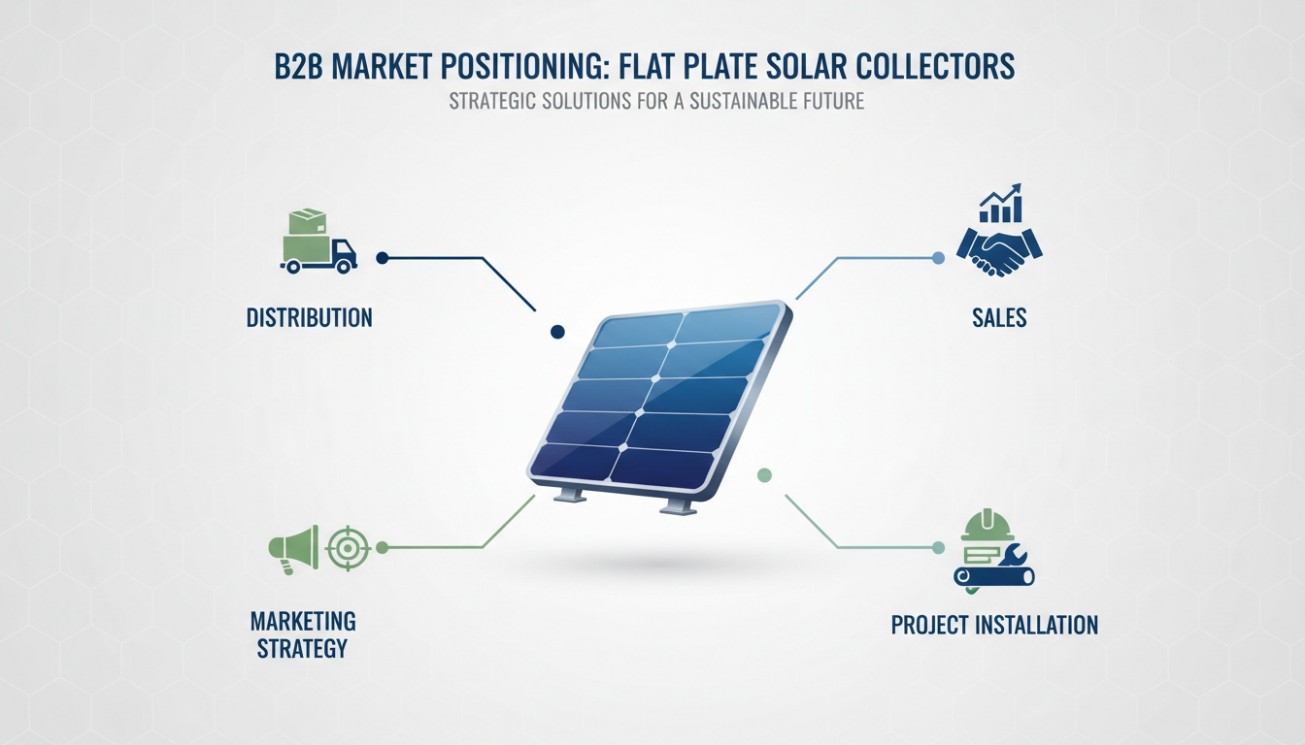
Flat Plate vs Heat Pipe Solar Collector: How to Choose the Right Collector for Real Hot Water Projects
Choosing a Solar Collector Is Not a Beauty Contest
Many buyers compare a flat plate vs heat pipe solar collector by looking at product photos. A flat plate solar collector looks clean, simple, and architectural. A heat pipe solar collector looks more technical, more modular, and more visually distinctive. This first impression often influences the buying decision before the buyer understands the actual project requirement.
That is risky.
A solar water heater collector should not be selected because one product looks more modern or because another looks more familiar. It should be selected because its thermal behavior, structural design, installation logic, maintenance requirements, and lifecycle cost match the project.
In real solar hot water projects, the better collector is not the one that wins a general argument. It is the one that fits the specific climate, roof, user demand, storage strategy, installation skill, and service environment. A collector that performs well in one market may create problems in another. A collector that works well for a villa may not be the best choice for a school. A collector that looks cost-effective in a quotation may become expensive if it increases maintenance pressure, breakage risk, installation complexity, or customer complaints.
This is why a serious solar collector comparison should not begin with the question “Which technology is better?” It should begin with a more useful question: “What kind of hot water project are we designing for?”
This article compares flat plate solar collector and heat pipe solar collector technologies from a project-based perspective. The goal is not to declare a universal winner. The goal is to help importers, distributors, installers, project buyers, and OEM customers understand how to match collector type to real application conditions.
The Two Technologies Solve the Same Problem in Different Ways

Both flat plate solar collector and heat pipe solar collector products are designed to capture solar energy and turn it into usable heat. Both can be used in solar water heating. Both can support residential, commercial, and project-level hot water applications. But the way they collect, retain, and transfer heat is different.
The Flat Plate Route: Broad Absorption and Structural Simplicity
A flat plate solar collector uses a broad absorber surface inside a flat insulated box. Sunlight passes through a glass cover, reaches the absorber plate, and is converted into heat. Fluid channels or tubes then transfer that heat into water or a heat transfer loop.
The strength of this design is its simplicity and integration. The collector is one panel. Its absorber, glass, insulation, tubes, and frame are assembled into a single flat structure. This creates a clean appearance and a familiar installation style. In many projects, especially where roof appearance, structural strength, and stable hot water demand matter, this format is easy to understand and easy to specify.
The main value of a flat plate collector advantages discussion is not that flat plate is always cheaper or always simpler. The real value is that flat plate collectors often offer a balanced thermal personality. They are well suited to applications where the project needs reliable daily heat gain, manageable operating behavior, and strong architectural compatibility.
The Heat Pipe Route: Tube-Based Capture and Modular Heat Transfer
A heat pipe solar collector usually uses evacuated tubes with internal heat pipes. Each tube captures solar energy, and the heat pipe transfers that energy to a manifold where it can heat the circulating fluid. Because the tube is evacuated, heat loss to the surrounding air can be reduced compared with ordinary exposed surfaces.
The value of this design is often discussed in terms of cold-weather response, modular tube replacement, and stronger heat retention under less favorable ambient conditions. In many markets, the visual identity of the tube collector also creates a strong technical impression. Buyers often associate it with advanced solar thermal performance.
The strongest heat pipe solar collector advantages are usually found in projects where heat retention, colder ambient temperature, tube replacement flexibility, or performance perception strongly influence the decision. But this does not mean the heat pipe route automatically wins every project. It simply means its strengths must be matched to the right project conditions.
Why General Efficiency Claims Can Mislead Buyers

One common problem in the solar thermal collector types market is that efficiency is often discussed too generally. A supplier may say one collector is “high efficiency” or another collector is “better in winter.” These claims can be directionally useful, but they are not enough for decision-making.
Efficiency depends on operating conditions. A collector may perform well when the temperature difference between the absorber and the surrounding air is small. Another collector may hold its performance better when the surrounding air is cold. A collector may gain heat aggressively during strong sun but may also require better system control to avoid overheating. Another collector may have more moderate thermal behavior that fits ordinary domestic hot water demand better.
In other words, the best solar collector for water heating is not the one with the most impressive single claim. It is the one whose performance curve fits the climate, temperature target, and usage pattern.
This matters because solar hot water projects are not laboratory demonstrations. They are buildings, roofs, tanks, pipe runs, valves, pumps, controllers, users, and maintenance habits. A collector works inside that full environment.
A strong solar collector comparison must therefore look at several questions:
What temperature does the system actually need?
How cold is the local climate?
How much roof area is available?
Does the user need year-round performance or seasonal support?
Is the system residential, commercial, or industrial?
How much maintenance capacity exists in the local market?
How important is roof appearance?
How difficult is transportation and installation?
What kind of after-sales service will the distributor need to provide?
Once these questions are asked, the comparison becomes more professional. The collector stops being a product image and becomes a project decision.
Climate: The First Filter, But Not the Final Answer

Climate is often the first factor people mention in an evacuated tube vs flat plate discussion. This makes sense. Ambient temperature, wind, solar radiation, humidity, snow, and seasonal variation all affect solar thermal performance.
Warm and Moderate Climates
In warm and moderate climates, a flat plate solar collector can be highly practical. When ambient temperatures are favorable and solar radiation is strong, the collector does not need to fight extreme heat loss. Its panel structure, broad absorber area, and simple installation logic can support stable hot water production.
This is one reason flat plate collectors remain attractive in many residential, hotel, apartment, and institutional hot water projects. The project does not always need the strongest cold-weather heat retention story. It may need stable output, clean roof appearance, predictable maintenance, and reasonable cost.
A heat pipe solar collector can also work well in warm climates, but the buyer should ask whether the additional complexity or tube-based structure creates enough practical value. In some warm markets, heat pipe collectors are selected because they are popular, easy to market, or associated with premium performance. That may be valid commercially, but it should still be checked against project reality.
Cold or Variable Climates
In colder climates, the heat pipe solar collector often receives more attention. Evacuated tubes can reduce heat loss and may support stronger thermal retention when ambient air is cold. This can be useful where winter performance is a major buying concern.
However, cold climate selection is not automatic. A flat plate solar collector can still be suitable if the system is designed with correct freeze protection, insulation, storage, backup heating, and operating logic. The real question is not simply whether the climate is cold. The real question is how much solar contribution is expected in winter and what level of system support is available.
If the project requires aggressive winter performance, heat pipe may have a stronger argument. If the project values architectural integration, durability, predictable operation, and moderate hot water support, flat plate may still fit well.
Hot Climates and Overheating Risk
In very hot climates, the discussion changes again. The challenge may not be cold-weather performance but overheating and stagnation management. A collector that gains heat very aggressively may sound attractive, but if the system does not have enough storage, load, control, or heat dissipation, the result can be excessive temperature stress.
In these conditions, a flat plate solar collector may offer a more manageable thermal profile for some projects. But the exact answer depends on storage size, daily hot water demand, controller logic, pump operation, expansion control, and user behavior.
Climate is therefore a filter, not a verdict. It helps narrow the decision, but it does not replace project design.
Roof Space and Building Appearance Matter More Than Many Buyers Expect

A solar collector is not installed in a showroom. It is installed on a building. That building has roof limits, structural limits, aesthetic expectations, wind exposure, maintenance access, and sometimes architectural restrictions.
When Flat Plate Fits the Roof Better
A flat plate solar collector usually creates a cleaner, flatter roof appearance. For villas, modern residential buildings, hotels, resorts, schools, and commercial buildings, this can be a real advantage. In some projects, the roof must look organized and integrated. A panel-style collector can appear more architectural and less mechanical.
This is one of the practical flat plate collector advantages that is often underestimated. In B2B markets, appearance affects acceptance. A building owner may reject a technically strong system if it looks messy, heavy, or inconsistent with the building design.
Flat plate collectors can also be arranged in neat rows for larger projects. This helps commercial roof planning and can make the system look more professional. For some distributors, the clean visual identity of flat plate collectors makes them easier to position in premium residential and commercial building segments.
When Heat Pipe Fits the Roof Better
A heat pipe solar collector may be attractive where modularity matters. Tube-based systems can sometimes allow individual tube replacement, which may reduce service cost after physical damage. The tube format also creates a strong solar thermal appearance that some buyers recognize immediately.
In markets where evacuated tube systems are widely accepted, the visual identity of a heat pipe collector can support sales. Users may already associate the tube structure with solar hot water. This can help distributors explain the product quickly.
However, the tube structure can also create handling and breakage considerations. Buyers should evaluate local installation skills, packaging quality, transportation distance, and replacement part availability before assuming the tube route is automatically safer or easier.
Installation Logic: Simple on Paper Is Not Always Simple on Site

Installation affects performance and after-sales cost. A collector that is technically strong but difficult to install may create market problems for distributors.
Flat Plate Installation Considerations
A flat plate solar collector is usually installed as a complete panel. This can simplify layout planning, but it may also require careful handling because the panel can be large and heavy. Installers need proper lifting, roof support, mounting brackets, pipe connection planning, and waterproofing discipline.
For projects with experienced installers, this is manageable. For markets with less trained installation teams, the supplier must provide clear instructions, mounting drawings, packaging protection, and technical support.
The advantage is that once the panel is installed correctly, the structure is unified and visually stable. The installer is not handling many separate tubes. The system can look organized and professional.
Heat Pipe Installation Considerations
A heat pipe solar collector may involve frame assembly, manifold mounting, and tube installation. This can offer some flexibility, especially during transport and handling. Tubes may be installed after the frame and manifold are in place, reducing the need to lift a complete heavy panel in some cases.
But tube installation also requires care. Tubes can break if handled poorly. Heat pipe insertion must be correct. Seals, manifold connection, and alignment must be checked. If installers are careless, the system may suffer from broken tubes, poor heat transfer, or service complaints.
For B2B buyers, the question is not which collector is theoretically easier to install. The question is which collector your local installer network can install correctly and repeatedly.
Maintenance and Service: The Hidden Side of Collector Selection

Many buyers focus on initial performance but ignore service reality. Over five or ten years, maintenance experience can shape brand reputation more than brochure claims.
Flat Plate Service Profile
A flat plate solar collector has an integrated panel structure. There are no individual glass tubes to replace one by one. This can be good for structural stability and appearance. Cleaning is usually straightforward because the front surface is flat glass.
However, if there is a serious internal failure, such as leakage, moisture entry, absorber damage, or glass breakage, repair may be less modular. The whole collector may need more significant service or replacement depending on the issue.
This is why manufacturing quality is important. A flat plate collector must have reliable sealing, strong frame design, good absorber bonding, durable insulation, and stable pressure performance. Good products can provide long service life, but poor products may create problems that are not easy to fix locally.
Heat Pipe Service Profile
A heat pipe solar collector may offer modular tube replacement. If one tube breaks, the service team may replace that tube instead of replacing the whole collector. This can be a strong advantage in markets where spare tubes are available and installers know how to service them.
But modularity is useful only when the supply chain supports it. If spare parts are hard to source, if tube sizes are not standardized, or if installers are not trained, the theoretical service advantage may not become real value.
Heat pipe collectors also require attention to manifold integrity, heat pipe condition, tube vacuum quality, and correct installation. Poor-quality tubes or weak packaging can increase breakage risk before the system even reaches the customer.
Durability Is Not Only About Product Type

Some buyers assume flat plate is stronger because it is a panel. Others assume heat pipe is better because evacuated tubes reduce heat loss. Both assumptions are incomplete.
Durability depends on design quality and manufacturing consistency.
A strong flat plate solar collector should have durable absorber coating, reliable tube bonding, strong glass, effective insulation, corrosion-resistant frame, good sealing, and pressure-tested construction. If these details are weak, the collector may suffer from condensation, leakage, heat loss, or reduced output.
A strong heat pipe solar collector should have stable evacuated tubes, reliable heat pipes, strong manifold design, good seals, proper insulation, and careful packaging. If these details are weak, the system may suffer from broken tubes, vacuum failure, poor heat transfer, or replacement difficulties.
In a professional solar collector comparison, product type is only the first layer. Supplier quality is the second layer. Production control is the third layer. Local installation quality is the fourth layer. Maintenance support is the fifth layer.
A strong technology from a weak supplier can still create poor project results. A mature technology from a disciplined supplier can create better long-term value.
Logistics and Packaging: An Important B2B Factor

For international trade, the collector does not move from factory to roof by magic. It must survive packing, container loading, sea transport, unloading, warehousing, local delivery, and jobsite handling.
Flat Plate Logistics
A flat plate solar collector is usually shipped as a full panel. It needs strong packaging, edge protection, glass protection, pallet stability, and careful loading. The panel format can be efficient for organized container shipments, but damage prevention is critical.
If the collector arrives with glass damage, frame deformation, or hidden sealing damage, the distributor may face warranty pressure. Therefore, B2B buyers should evaluate packaging design, loading photos, carton strength, pallet method, and previous shipping experience.
Heat Pipe Logistics
A heat pipe solar collector may be shipped with tubes packed separately. This can reduce some handling challenges, but it also creates tube breakage risk if packaging is poor. Tube cartons, foam protection, shock resistance, and spare tube planning become important.
For distributors, heat pipe logistics can be attractive if replacement tubes are easy to stock and sell. But if breakage rates are high or local delivery is rough, after-sales cost may increase.
In international B2B procurement, the best collector is not only the one that performs after installation. It is also the one that can arrive safely, be stored correctly, and be installed without excessive damage claims.
Cost Comparison Should Include More Than Unit Price

Many purchasing decisions begin with a price comparison. That is understandable, but it is incomplete.
A flat plate vs heat pipe solar collector cost comparison should include:
Initial collector price
Mounting system cost
Installation labor
Transport and packaging risk
Breakage or damage rate
Spare parts availability
Expected service workload
Local installer familiarity
Warranty pressure
Customer satisfaction
Project lifespan
The lowest unit price does not always create the lowest total cost. A slightly more expensive collector may be better if it reduces installation mistakes, service calls, or complaints. A cheaper collector may be acceptable if the application is simple, the market is price-sensitive, and the distributor has enough service support.
For B2B buyers, the right question is not “Which collector is cheaper?” The better question is “Which collector creates the best margin after installation, warranty, and customer satisfaction are included?”
Residential Projects: Comfort, Appearance, and Ownership Simplicity

Residential projects often involve emotional buying decisions as well as technical ones. Homeowners care about hot water comfort, roof appearance, maintenance, noise, reliability, and trust.
A flat plate solar collector may fit residential buildings where the owner wants a clean roof profile, stable daily hot water support, and a product that visually blends with the building. This is especially relevant for villas, premium homes, and modern buildings.
A heat pipe solar collector may fit residential projects where winter performance, tube replacement, or visible solar technology matters more. In markets where evacuated tubes are already familiar, buyers may feel more confident with the tube format.
The decision should consider the household’s daily demand. A family with consistent hot water use may benefit from a stable and well-sized system. A property with irregular use may need more careful control to avoid overheating or underuse. Collector choice should match how the home is actually used.
Commercial Projects: Demand Stability Changes the Decision

Commercial hot water projects often have larger and more predictable demand. Hotels, apartments, dormitories, gyms, schools, and public facilities may use hot water every day. This creates a stronger opportunity for solar thermal value.
A flat plate solar collector can be attractive in commercial arrays because of its clean layout, panel-style installation, and stable appearance. For hotels and apartments, roof organization can matter. Facility managers may prefer systems that look orderly and are easy to inspect.
A heat pipe solar collector can also work well in commercial projects, especially when climate conditions, modular maintenance, or stronger heat retention are priorities. However, a large heat pipe array requires careful planning for tube handling, replacement access, and spare parts.
In commercial projects, the collector decision should be connected to load profile. Does the building use hot water mainly in the morning and evening? Is there daytime demand? Is storage large enough? Is backup heating properly integrated? Is maintenance handled by trained staff?
A commercial system succeeds when collector behavior and demand behavior support each other.
Industrial and Preheating Projects: Temperature Target Comes First

Industrial solar thermal applications can be very different from household hot water. Some factories need low-temperature washing water. Some need boiler feed preheating. Some need process support water. Some need seasonal or daytime heat.
For industrial preheating, the most important question is required temperature. If the project needs moderate preheating and has enough roof or ground area, a flat plate solar collector can be practical and cost-effective. Its stable structure and array layout can support large installations.
If the project needs higher thermal response or operates in colder conditions, a heat pipe solar collector may be considered. But the system must still be evaluated by flow rate, storage, heat exchanger design, backup heat source, and control strategy.
Industrial buyers are usually less interested in marketing claims and more interested in numbers. They want to know expected energy contribution, installation area, maintenance workload, payback logic, and reliability. For this reason, the best solar collector for water heating in industrial use is the one that matches the required temperature and operating schedule, not simply the one with the strongest product description.
Distributor Strategy: Which Collector Is Easier to Sell?

For distributors, the decision is not only technical. It is also commercial. A distributor must consider what the local market understands, what installers can handle, what spare parts are available, and what type of customer the business wants to attract.
When Flat Plate Is Easier to Position
A flat plate solar collector is often easier to position for customers who value building appearance, durable panel structure, and professional project design. It can fit premium residential, commercial buildings, schools, hotels, and applications where visual integration matters.
The sales language can focus on architectural integration, stable performance, durable structure, clean roof layout, and long-term project value. This can help the distributor avoid competing only on low price.
When Heat Pipe Is Easier to Position
A heat pipe solar collector is often easier to position where customers already associate evacuated tubes with strong solar hot water performance. It can also be effective in markets that value visible technology, cold-weather claims, and modular replacement.
The sales language can focus on heat retention, tube replacement, winter response, and technical identity. But the distributor must support these claims with correct installation, spare tube availability, and reliable after-sales service.
Avoid Mixing the Message
A common mistake is trying to sell both technologies with the same argument. If both are described as simply “high efficiency,” buyers become confused. Each collector type should have a distinct position.
Flat plate should not be sold as an outdated low-cost alternative. Heat pipe should not be sold as a universal upgrade. Both should be presented as professional choices for different project conditions.
A Project-Based Selection Matrix

Instead of asking which collector wins, use a project matrix.
Choose Flat Plate More Often When:
The project is in a warm or moderate climate
The building needs a clean roof appearance
The buyer values architectural integration
The hot water demand is stable and predictable
The project wants a durable panel structure
The distributor wants a professional commercial project image
The installation team is comfortable handling panel collectors
The project values moderate and manageable thermal behavior
The system has sufficient roof space
The buyer wants strong long-term value rather than visible technical drama
These are typical flat plate collector advantages in real projects.
Choose Heat Pipe More Often When:
The climate is cold or variable
Winter performance is a strong buying concern
The market strongly recognizes evacuated tube products
Tube replacement flexibility is valuable
The buyer wants a more technical solar appearance
Roof installation can support tube-based assembly
Spare tubes are easy to stock and service
The system needs stronger heat retention under less favorable conditions
The distributor has installer training for tube systems
The project can manage temperature control and maintenance properly
These are typical heat pipe solar collector advantages in real projects.
Common Mistakes in Flat Plate vs Heat Pipe Decisions

Mistake 1: Treating Collector Choice as a Universal Ranking
There is no universal winner in evacuated tube vs flat plate selection. The right collector depends on project conditions. Buyers who ask only “Which one is better?” often receive oversimplified answers.
Mistake 2: Ignoring the System Around the Collector
A collector does not work alone. Storage tank size, circulation method, pipe insulation, controller settings, backup heating, and user demand all affect performance. A strong collector in a weak system can still disappoint users.
Mistake 3: Buying the Story Instead of the Product
Marketing language can be useful, but it can also distort decisions. A buyer should ask for specifications, installation requirements, pressure rating, material details, performance data, packing method, and after-sales policy.
Mistake 4: Forgetting Local Installation Skill
A collector that works well in one country may fail in another if installers are not trained. Local skill level should influence technology selection.
Mistake 5: Comparing Only Initial Price
Initial price is only one part of cost. Installation, damage, spare parts, maintenance, warranty, and reputation all influence real cost.
How Professional Buyers Should Ask Suppliers Better Questions

A professional buyer should not ask only for price and dimensions. Better questions create better quotations.
Ask the supplier:
Which climate conditions does this collector suit best?
What is the recommended application range?
What is the absorber or tube material?
What is the working pressure?
What is the stagnation temperature?
What mounting systems are available?
What is the packaging method for export?
What spare parts should distributors stock?
What are the common installation mistakes?
What documentation can support installers?
What certifications or test reports are available?
How does the collector behave in cold, hot, or windy regions?
What system types are recommended with this collector?
What kind of projects should avoid this collector?
The last question is especially important. A professional supplier should be able to explain not only where a product fits, but also where it does not fit. That honesty helps buyers avoid mismatch.
Focused FAQ
Is a flat plate solar collector better than a heat pipe solar collector?
A flat plate solar collector is better for some projects, while a heat pipe solar collector is better for others. Flat plate collectors often fit projects that value clean roof appearance, stable daily performance, structural simplicity, and commercial array layout. Heat pipe collectors often fit projects that value cold-weather heat retention, tube replacement flexibility, and strong technical appearance.
What is the main difference between flat plate and heat pipe collectors?
The main difference is heat collection and transfer structure. A flat plate solar collector uses a broad absorber plate inside an insulated panel. A heat pipe solar collector usually uses evacuated tubes with internal heat pipes transferring heat to a manifold.
Which collector works better in cold climates?
A heat pipe solar collector often has a stronger argument in cold climates because evacuated tubes can reduce heat loss. However, a flat plate solar collector can also work in cold regions if the system includes proper freeze protection, insulation, storage, and backup heating.
Which collector is better for hot climates?
In hot climates, both technologies can work. The decision should consider overheating risk, storage size, daily hot water demand, and system control. A flat plate solar collector may offer a more manageable thermal profile in some projects, while heat pipe systems may need careful temperature management.
Which collector is easier to maintain?
It depends on the service model. A heat pipe solar collector may allow individual tube replacement if spare tubes are available. A flat plate solar collector has an integrated panel structure with fewer visible modular parts, but serious internal damage may require larger service action.
Which collector looks better on a roof?
A flat plate solar collector usually offers a cleaner and more architectural roof appearance. A heat pipe solar collector has a more technical tube-based appearance that may be preferred in markets where evacuated tube systems are already familiar.
Which collector is better for hotels and apartments?
Both can work. For hotels and apartments, the choice depends on climate, roof area, daily hot water demand, storage design, maintenance team capability, and budget. A flat plate solar collector may be attractive for clean commercial arrays, while a heat pipe solar collector may be considered where winter performance is more important.
Which collector is better for distributors?
The better collector for distributors depends on local market awareness, installer skill, spare parts availability, logistics, customer expectations, and after-sales capacity. A good distributor should choose the collector type that can be installed, explained, serviced, and sold repeatedly in the local market.
Is evacuated tube always better than flat plate?
No. The evacuated tube vs flat plate question has no universal answer. Evacuated tube collectors may perform strongly in certain conditions, but flat plate collectors may deliver better project value when roof integration, stable demand, simple layout, and long-term system balance matter more.
How should buyers make the final decision?
Buyers should compare climate, roof space, temperature target, system type, installation skill, maintenance plan, logistics, certifications, budget, and customer expectations. The best solar collector for water heating is the collector that fits the project, not the one with the strongest general claim.
Final Thought: The Right Collector Is the One That Fits the Project Logic
The debate around flat plate vs heat pipe solar collector selection becomes useful only when it leaves generic marketing language and enters project logic. Both technologies have real value. Both can support solar hot water applications. Both can fail when selected for the wrong reason.
A flat plate solar collector often fits projects that value clean roof integration, structural simplicity, stable daily operation, commercial array layout, and long-term architectural acceptance. A heat pipe solar collector often fits projects that value heat retention, cold-weather confidence, modular tube replacement, and visible technical identity.
The better choice depends on what the project needs.
For residential projects, the decision may be shaped by comfort, roof appearance, and maintenance simplicity. For hotels and apartments, it may depend on hot water load, roof planning, and facility management. For industrial preheating, it should begin with temperature target and operating schedule. For distributors, it should include logistics, installer skill, spare parts, warranty pressure, and market positioning.
This is why a mature solar collector comparison should never be reduced to “flat plate is simple” or “heat pipe is advanced.” Those labels are too shallow. The real industry-level question is whether the collector’s thermal behavior, structure, installation method, and service model fit the project.
The strongest solar thermal decisions come from matching, not hype. When buyers understand this, they stop searching for a universal winner and start building better solar hot water projects.
#FlatPlateSolarCollector #HeatPipeSolarCollector #SolarCollectorComparison #SolarThermalCollector #SolarWaterHeating #EvacuatedTubeVsFlatPlate #SolarHotWaterCollector #SolarCollectorSelection #RenewableEnergy #SolarCollectorBuyerGuide