When a Trailer Winch Isn’t the Problem: Diagnosing Loading and Retrieval Failures at the Ramp
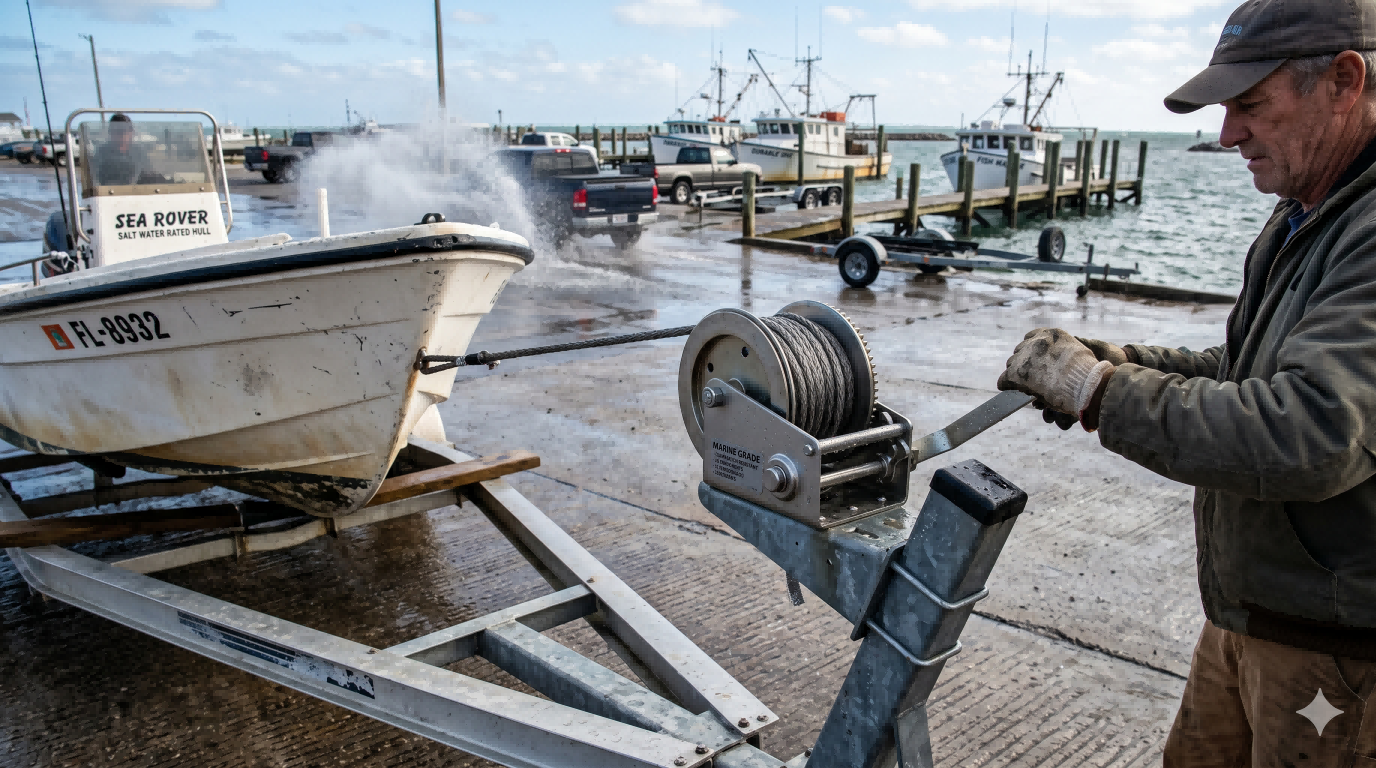
When a boat becomes difficult to load, the boat trailer winch is often blamed first. The operator feels resistance, the bow stops short, the handle becomes hard to turn, or the electric winch slows under load. From that moment, many buyers assume the solution is simple: install a stronger winch.
In real trailer use, that conclusion is often wrong.
Many boat trailer loading problems are not caused by the winch alone. They are caused by trailer immersion depth, ramp angle, bunk friction, centering error, bow stop position, pull-path geometry, or a mismatch between the trailer setup and the boat’s actual retrieval behavior. A stronger winch may hide part of the problem, but it does not necessarily solve it.
That is why a serious trailer winch troubleshooting process should not begin with the motor, the strap, or the pull rating. It should begin with a better question: what part of the trailer-retrieval system is creating the resistance?

For marine buyers, dealers, and trailer operators, this distinction matters. If the system problem is diagnosed correctly, the trailer can load more smoothly, more safely, and with less strain on both equipment and operator. If the problem is diagnosed incorrectly, buyers often overspend on winch upgrades while leaving the real cause untouched.
Why the Winch Gets Blamed First
The reason the winch gets blamed first is understandable. The winch is the component the operator touches. It is the part that visibly slows, strains, or becomes difficult to use. That makes it the most obvious suspect.
But the winch is not creating resistance. It is responding to resistance.
If a boat is hard to retrieve, the winch may simply be the first place where the system reveals that something else is wrong. The handle feels heavy because the hull is dragging on dry bunks. The electric motor sounds strained because the trailer is too shallow or too deep on the ramp. The line angle looks poor because the bow eye is not aligning with the pull path. In each case, the winch may be functioning normally while the system around it is not.
This is the first key truth behind why boat is hard to winch onto trailer: resistance felt at the winch is not proof that the winch caused the resistance.
That is why experienced trailer operators often troubleshoot the ramp, the trailer position, and the hull alignment before they criticize the winch itself.
A Boat Trailer Retrieval System Is More Than a Winch

A proper boat trailer winch guide should treat retrieval as a system, not a single hardware event.
When a boat comes onto a trailer, several variables interact at the same time:
- hull support surface
- trailer immersion depth
- ramp angle
- bunk or roller behavior
- centering accuracy
- winch pull angle
- final bow-stop positioning
- operator timing and control
If even one of these variables is poorly matched, the whole loading process can feel harder than it should. In many cases, the boat is not difficult to retrieve because it is too heavy. It is difficult to retrieve because the trailer system is asking the winch to overcome unnecessary drag or misalignment.
That is why boat trailer retrieval problems should always be diagnosed as system behavior, not just product weakness.
Trailer Depth on the Ramp Can Make a Correct Winch Feel Wrong
One of the most common causes of ramp loading issues is incorrect trailer depth.
If the trailer is backed too shallow, too much of the hull remains supported by dry bunks or rollers before the boat is properly aligned. This creates excessive friction and makes the boat feel heavy, even if the boat trailer winch is correctly sized.
If the trailer is backed too deep, the opposite problem may appear. The boat may float above the intended support path, arrive off-center, or fail to seat correctly against the bow stop. In this case, the winch may pull, but the boat may still load poorly because it is not entering the trailer system in a controlled way.
Too Shallow: Excess Friction
When the trailer is too shallow, operators often notice:
- harder cranking effort
- slow electric winch response
- abrupt drag near the beginning of the pull
- the sense that the boat is “stuck” on the bunks
Too Deep: Poor Control
When the trailer is too deep, operators often notice:
- centering problems
- poor bow-stop engagement
- the boat drifting sideways
- difficulty achieving stable final positioning
This is why the first step in trailer winch troubleshooting at the ramp is often to reassess trailer depth rather than to replace the winch.
Bunk Friction Is One of the Most Underestimated Causes of Loading Difficulty
For many boat trailer loading problems, bunk friction is the hidden force multiplier.
A hull sliding over dry, high-friction bunks creates a completely different loading experience from one moving over a well-matched, properly wetted, correctly aligned support surface. Two boats of the same size can require very different winching effort depending on how the bunks interact with the hull during retrieval.
That is why bunk friction boat trailer issues are so often mistaken for insufficient winch capacity. The buyer feels resistance and concludes that the winch is too weak. In reality, the trailer may be creating unnecessary drag.
What Increases Bunk Friction
Common causes include:
- trailer backed in too shallow
- bunk surfaces too dry
- bunk material not well matched to the hull
- hull not centered on the support path
- worn or uneven bunk condition
- poor retrieval timing relative to water depth
This matters because adding a stronger winch may reduce the symptom but still leave the system inefficient, stressful, and harder on components than it should be.
Centering Errors Create Resistance That Feels Like Winch Failure
Another common source of boat trailer centering problems is incorrect hull alignment during retrieval.
When the boat is not centered as it enters the trailer, the winch is forced to do more than pull. It begins to fight side-load, uneven bunk contact, and alignment correction. This makes the loading process feel heavier and less predictable.
In those moments, the operator may believe the trailer winch not pulling boat is the problem. But the winch may be doing exactly what it is supposed to do. The harder question is why the hull is not entering the trailer correctly.
What Poor Centering Usually Looks Like
Poor centering often shows up as:
- the bow approaching the winch stand at an angle
- one side of the hull loading harder than the other
- uneven contact with guides, bunks, or rollers
- repeated need to stop and reposition
- difficulty getting the bow eye to line up cleanly
A centered boat loads more easily not only because it looks neater, but because centered loading reduces unnecessary side resistance.
Bow Stop and Winch Stand Position Can Create False “Power” Problems
Buyers often focus on the winch rating but ignore where the winch stand and bow stop sit relative to the boat.
If the boat trailer setup guide is wrong at this point, the final stage of retrieval becomes harder than it should be. The pull angle may become inefficient, the bow eye may approach the winch awkwardly, or the final seating force may rise sharply at the wrong moment.
That creates a familiar complaint: “the winch struggles right at the end.”
In many cases, the winch is not undersized. The trailer geometry near the front support area is incorrect.
Why Final Seating Gets Hard
Final seating usually becomes difficult when:
- the bow stop is positioned poorly
- the winch stand height is mismatched
- the pull angle lifts or binds the bow instead of guiding it cleanly
- the hull reaches a high-friction position near the end
- the trailer depth does not support clean final approach
This is one of the clearest examples of why why boat is hard to winch onto trailer cannot be answered by winch rating alone.
Pull Angle Matters More Than Buyers Expect
A boat trailer winch does not only need enough force. It needs a useful pull angle.
If the line pulls too high, too low, or off-axis relative to the bow eye, the retrieval process becomes less efficient. Instead of guiding the boat smoothly forward, the line may introduce lift, downward bind, or side influence. That makes the final pull feel harder and less stable.
This matters even more at the ramp because the boat is already transitioning between buoyancy and trailer support. A poor line angle in that transition zone creates unnecessary load on the winch and unnecessary uncertainty for the operator.
Good Pull Geometry Usually Means
A better retrieval setup usually aims for:
- clean line path to the bow eye
- minimal side-loading influence
- smoother transition into final seating
- less abrupt increase in resistance
- better operator confidence during the last part of loading
In other words, the winch should pull the boat into position, not fight the trailer geometry.
Ramp Angle Can Magnify Small Setup Mistakes
A trailer that feels acceptable on one ramp may feel frustrating on another. That is often because ramp angle magnifies setup weaknesses.
On a moderate ramp, minor misalignment or shallow immersion may still be manageable. On a steeper ramp, the same setup can produce much higher drag, poorer boat behavior, and much more operator frustration. This is why some operators report that their trailer works well “at some ramps but not others.”
The explanation is not always that the winch becomes weaker. It is that the ramp changes how the whole system behaves.
For a useful boat trailer retrieval problems diagnosis, the buyer should therefore ask:
- Is the problem consistent at every ramp?
- Does it happen more on steep ramps?
- Does it become worse in low water or changing tide conditions?
- Does it appear only at the final seating stage?
These are system-diagnostic questions, not product-spec questions.
Operator Technique Can Either Reduce or Increase System Drag
It is also important to say that not every loading problem comes from hardware. Sometimes the issue is retrieval sequence.
A boat can be technically matched to its trailer and still load poorly if the timing, trailer depth, or centering approach is off. This does not mean the operator is careless. It means trailer systems require consistent method.
Common Technique-Related Triggers
Loading becomes harder when:
- the boat approaches off-center
- the trailer is repositioned too late
- the pull begins before the hull is aligned
- the operator tries to force final seating from a poor starting position
- the retrieval sequence changes from ramp to ramp without adjustment
This is one reason why boat trailer setup guide content matters so much for dealers and suppliers. Better setup reduces operator dependence on trial-and-error technique.
The Stronger Winch Solution Is Often an Incomplete Solution
A stronger winch can help. There are cases where a more capable manual or electric unit is the right upgrade. But the industry mistake is to assume that more winch automatically means better retrieval.
If the root cause is bunk drag, poor trailer depth, bad centering, or a poor pull angle, then a stronger winch mainly masks the inefficiency. The operator feels more power, but the trailer system remains badly matched. Over time, that can still produce rougher loading, more stress on components, and lower confidence at the ramp.
This is why experienced buyers do not ask only whether the current winch can move the boat. They ask whether the retrieval process is mechanically clean.
That is a much higher-quality question.
Most Difficult Retrievals Come from System Mismatch, Not Isolated Product Failure
A valuable industry perspective is this: many complaints that sound like trailer winch not pulling boat are actually symptoms of system mismatch.
The mismatch may involve:
- trailer too shallow or too deep
- hull not centered
- pull angle poorly aligned
- bunk friction too high
- bow-stop geometry poorly set
- ramp conditions amplifying trailer weakness
- operator sequence exposing setup inconsistency
In these cases, replacing the winch alone rarely produces the best long-term outcome. The smarter move is to correct the retrieval system first and upgrade the winch only if the application still justifies it.
This is what separates casual troubleshooting from professional trailer diagnosis.
How Professional Buyers Should Diagnose Ramp Retrieval Problems
A good trailer winch troubleshooting process should follow a structured order.
Start with the Retrieval Environment
Check ramp angle, water depth, and whether the problem appears consistently or only in certain conditions.
Evaluate Trailer Depth
Determine whether the trailer is too shallow or too deep during initial loading and final seating.
Review Hull Support and Friction
Assess bunk or roller condition, wetted surface, and whether the boat is dragging more than expected.
Check Centering and Pull Path
Watch how the bow enters the trailer and whether the line is pulling cleanly toward the bow eye.
Inspect Front-End Geometry
Confirm that the winch stand and bow stop support smooth final seating rather than fighting it.
Upgrade the Winch Only After the System Makes Sense
Choose a stronger or different winch only when the retrieval system itself is already reasonably correct.
This order matters because it prevents buyers from spending money at the wrong point in the system.
Final Thoughts
When a boat becomes difficult to load, the boat trailer winch is often the first thing blamed and the last thing properly diagnosed.
In reality, many boat trailer loading problems are created by trailer depth, bunk friction, centering, pull angle, bow-stop position, and ramp geometry rather than by a weak winch alone. The winch may show the symptom, but the trailer system often creates the cause.
That is why the best answer to why boat is hard to winch onto trailer is usually not just “buy a stronger winch.” The better answer is to understand how the boat, trailer, ramp, and pull path interact during retrieval.
When buyers diagnose those relationships correctly, loading becomes smoother, safer, and more repeatable. And when the winch is upgraded after that, it becomes a real performance improvement rather than a costly attempt to overpower a setup problem.
That is where better marine trailer performance begins.
#Boat Trailer Winch #Boat Trailer Loading Problems #Trailer Winch Troubleshooting #Boat Trailer Setup #Marine Trailer Equipment #Trailer Retrieval Guide #Towing Safety #Ramp Loading Issues #Boat Trailer Centering #Trailer Parts