Active Solar Water Heating Why Pumps and Controllers Matter in Split Systems
The Real Core of a Split Solar Water Heater Is Not Only the Tank and Collector
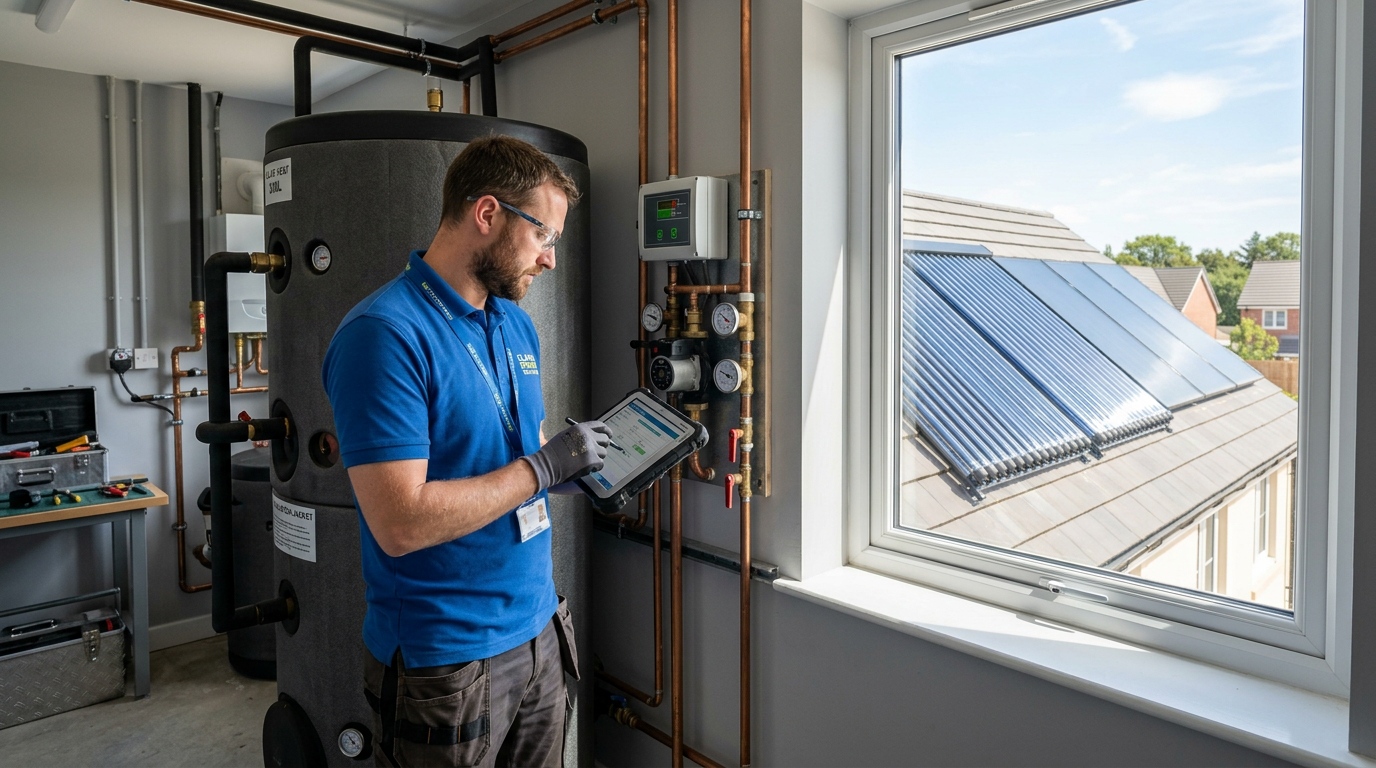
Many buyers first understand a split solar system through its visible structure: solar collectors on the roof and a storage tank installed separately at ground level, indoors, or inside a utility room. This is correct, but it is only the surface of the system.
The real operating core of a split solar water heater system is not only the collector or the tank. It is the circulation logic between them.
A split system must move heat from the roof collector to the storage tank. Because the tank is not directly attached to the collector, heat cannot always move naturally by gravity or thermosiphon circulation. This is why most split systems are designed as active solar water heating systems.
In an active system, a solar water heater pump moves water or heat transfer fluid through the solar loop. A solar hot water controller decides when the pump should start and when it should stop. A solar water heater sensor measures temperatures at key points. A solar pump station combines circulation, flow control, safety, filling, and service functions into a more manageable unit.
This means the performance of a split solar system depends heavily on control, circulation, and component matching. A good collector cannot perform well if circulation is poor. A good tank cannot store enough useful heat if the controller runs at the wrong time. A high-end system can still disappoint users if the pump, sensor, and piping design are not properly coordinated.
For this reason, professional buyers should not evaluate a split system only by collector type, tank capacity, or price. They must also understand the pump, controller, sensor, and circulation design behind the system.
What Active Solar Water Heating Means in Practical Terms

Active solar water heating means that the system uses mechanical and electronic control to transfer heat. Instead of relying only on natural circulation, the system uses a pump and controller to manage heat movement from the solar collector to the storage tank.
In a typical split system, the solar collector is installed on the roof. The storage tank may be installed below the collector, beside the building, or inside a service room. Since the tank may be far from the collector and often lower than the collector, natural circulation is usually not enough.
This is where the solar water heater pump becomes essential. The pump creates forced circulation through the solar loop. When the collector becomes hotter than the tank, the controller starts the pump. The fluid flows through the collector, absorbs heat, and carries that heat to the tank. The tank then stores the heat for domestic hot water use.
When the collector temperature drops or when there is not enough useful temperature difference, the controller stops the pump. This avoids wasting energy and prevents the system from moving heat in the wrong direction.
This is why a split system is often described as a forced circulation solar water heater. The word “forced” does not mean the system is aggressive or complicated. It simply means circulation is driven by a pump rather than by natural movement alone.
For homeowners, this provides layout flexibility. For installers, it creates more design responsibility. For suppliers, it means the product must be sold as a system, not as a collection of separate parts.
Why Pumps Matter More Than Many Buyers Realize

The solar water heater pump is sometimes treated as a small accessory, but in a split system it plays a central role.
The pump controls whether heat can actually move from the collector to the tank. If the pump is too weak, circulation may be slow and heat transfer may be poor. If the pump is too strong, the system may consume unnecessary electricity, create noise, or disturb the expected temperature difference. If the pump is not suitable for high-temperature solar use, its service life may be reduced.
A good pump must match several conditions.
It must match the collector area. More collectors usually require more circulation capacity.
It must match pipe length. Longer pipes create more resistance and more heat loss.
It must match pipe diameter. Narrow pipes may require more pump pressure.
It must match the heat transfer fluid. Some closed-loop systems use glycol mixtures, which have different flow characteristics from plain water.
It must match system temperature. Solar thermal systems can reach high temperatures, especially during strong sunlight or low water use.
It must match local voltage and service conditions. For export markets, this is especially important.
A forced circulation solar water heater depends on reliable pump operation. If the pump fails, the system may stop collecting heat effectively. In some cases, poor circulation may also contribute to overheating, stagnation, or pressure issues.
For B2B buyers, pump quality is not a minor detail. It directly affects customer satisfaction and after-sales cost.
What a Solar Pump Station Actually Does

A solar pump station is more than a pump inside a box. In many professional systems, it is a compact circulation and service unit designed to make installation, operation, and maintenance easier.
A typical solar thermal pump station may include the circulation pump, flow meter, pressure gauge, safety valve, check valve, fill and drain ports, air separator, temperature display, insulation shell, and sometimes connections for an expansion tank.
The value of a solar pump station is that it organizes several important functions into one system area.
It helps installers fill the solar loop.
It helps remove air from the circuit.
It helps control or observe flow rate.
It helps monitor pressure.
It helps prevent reverse circulation.
It supports safer operation during high-temperature conditions.
It makes service and troubleshooting easier.
This is especially important for split systems because field installation quality can vary. If every component is installed separately on site, the final system may depend heavily on installer experience. A well-designed solar pump station reduces uncertainty and improves system consistency.
For distributors, a pump station also makes the product easier to explain. Instead of selling only a collector and tank, they can present the system as a complete engineered package. This improves the professional image of the product and helps customers understand why Split systems cost more than basic integrated systems.
The Controller Is the Brain of the System

If the pump is the heart of a split solar system, the solar hot water controller is the brain.
The controller receives temperature data from sensors and decides when circulation should happen. In most systems, the controller compares the temperature of the collector with the temperature inside the storage tank.
If the collector is sufficiently hotter than the tank, the controller starts the pump. If the temperature difference becomes too small, the controller stops the pump.
This basic logic sounds simple, but it is extremely important. A split system should collect heat only when useful heat is available. If the pump starts too early, the system may circulate fluid before the collector has enough heat. If the pump stops too late, it may move low-value heat or even cool the tank. If the controller settings are wrong, the system may perform poorly even when all hardware components are good.
A good solar temperature controller may also include additional functions, such as freeze protection logic, overheating protection, maximum tank temperature setting, vacation mode, backup heater control, pump speed control, error alarms, and sensor fault detection.
In advanced systems, the controller may also manage multiple tanks, multiple collector fields, or integration with auxiliary heating.
For B2B buyers, controller capability should be matched to the target market. A simple warm-climate residential system may not need every advanced function. A cold-climate or project-based system may require more complete control logic.
The key is not to choose the most complicated controller. The key is to choose the right control logic for the application.
Sensors Decide Whether the Controller Sees the System Correctly

A solar water heater sensor is a small component, but it has a large effect on system behavior.
The controller does not “feel” heat directly. It depends on sensor data. If the sensor is inaccurate, damaged, poorly installed, or placed in the wrong location, the controller may make poor decisions.
Most split solar systems use at least two sensors.
One sensor measures collector temperature. It is usually installed near the collector outlet or in a location that reflects the useful heat available from the collector.
Another sensor measures tank temperature. It may be installed in a sensor pocket inside the tank or attached to a suitable tank position depending on the tank design.
If the collector sensor is installed incorrectly, it may read a temperature that is too high or too low. If the tank sensor is placed poorly, it may not represent the real storage condition. These mistakes can cause the pump to run at the wrong time.
For example, if the collector sensor reads high because it is exposed to direct sun but not properly connected to the fluid path, the pump may start too early. If the tank sensor is placed too high in the tank, it may show hot water while lower parts of the tank are still cool. If the sensor wire is damaged, the controller may display errors or stop operation.
This is why the solar water heater sensor should be treated as part of system design, not as a basic cable accessory.
For exporters and suppliers, sensor quality, sensor pockets, cable length, temperature rating, and installation instructions should be clearly defined.
The Difference Between Direct and Indirect Active Circulation
Not every active solar water heating system uses the same circulation method. The two common ideas are direct circulation and indirect circulation.
In direct circulation, household water itself is pumped through the collectors and then back into the storage tank. This structure can be simpler, but it is generally more suitable for regions without freezing risk and with acceptable water quality.
In indirect circulation, a heat transfer fluid circulates through the solar loop. This fluid absorbs heat from the collector and transfers it to domestic water through a heat exchanger inside or outside the tank. This design is often used in cold-climate systems because the solar loop can use antifreeze fluid.
Both methods can be used in a split solar water heater system, but the selection depends on climate, water quality, cost, and system requirements.
Direct circulation may be more cost-effective in warm regions. Indirect circulation may be more suitable for freezing climates or markets where water quality could create scaling problems inside collectors.
This is why a solar hot water controller, pump, sensor, and tank design must match the circulation method. The wrong combination can reduce efficiency or increase maintenance risk.
For example, an indirect glycol loop may require a pump suitable for glycol, a heat exchanger with enough capacity, an expansion tank, pressure relief protection, and proper filling equipment. A direct system may require stronger attention to water quality, scaling, and freeze risk.
The circulation type must be selected before the system is marketed, installed, or quoted.
Flow Rate: The Hidden Detail Behind System Efficiency
Flow rate is one of the most overlooked factors in a forced circulation solar water heater.
If the flow rate is too low, the fluid may become very hot in the collector but not carry enough total heat to the tank. This can reduce system efficiency and increase overheating risk.
If the flow rate is too high, the fluid may not gain enough temperature during each pass through the collector. The pump may also consume more energy than necessary. In some systems, excessive flow can create noise or unnecessary pressure drop.
The right flow rate depends on collector type, collector area, pipe length, heat transfer fluid, pump capacity, and tank heat exchanger design.
A professional solar pump station often includes a flow meter so installers can check and adjust circulation. This is important because a system that looks correct from the outside may still perform poorly if flow is not within the proper range.
For B2B buyers, flow control is a sign of system maturity. Low-cost systems may include a pump but lack practical tools for commissioning. More professional systems make it easier to verify that the system is actually operating as intended.
For project applications, flow balancing becomes even more important. Multiple collectors, longer pipe runs, or larger storage tanks require more careful hydraulic design.
Control Settings Should Match Real User Behavior
A solar temperature controller cannot be set correctly without understanding how the system will be used.
A household with morning and evening hot water demand may need different control priorities from a guesthouse with high evening demand. A villa with low occupancy may need stronger overheating protection during long periods of low water use. A small hotel may need backup heating coordination to maintain comfort during cloudy days.
The controller’s start temperature difference, stop temperature difference, maximum tank temperature, freeze protection setting, and backup heater logic should all match the application.
For example, if the pump starts when the temperature difference is too small, the system may circulate fluid without collecting much useful heat. If the stop difference is too low, the pump may continue running when the collector is no longer meaningfully heating the tank. If the maximum tank temperature is set too high, users may face scalding risk or system stress. If backup heating is set too aggressively, the solar contribution may be reduced.
This is why a solar hot water controller should not be installed with random default settings in every market. Suppliers should provide recommended parameters based on system type, climate, and user scenario.
For distributors, this creates an opportunity to offer better technical support. A dealer who understands control logic can reduce complaints and improve customer trust.
Backup Heating and Active Solar Control
Most solar hot water systems need some form of backup heating. Solar energy is variable. Cloudy days, winter weather, high demand, or unusual usage patterns can reduce available solar heat.
In a split solar water heater system, backup heating may be electric, gas, boiler-based, or connected to another heating source. The relationship between solar collection and backup heating should be carefully managed.
If backup heating heats the tank too early in the day, the solar system may have less opportunity to contribute. The tank may already be hot before the collector can add useful heat. This reduces solar energy utilization.
If backup heating starts too late, users may experience insufficient hot water.
A well-configured solar hot water controller or system control strategy can help balance comfort and solar contribution. In some systems, backup heating may be scheduled for certain times. In others, it may be controlled by tank temperature or user demand.
This is especially important in premium residential and small commercial applications. Users expect reliable hot water, but the system should still maximize solar use when possible.
For B2B buyers, backup integration should be clearly explained in product documentation. It is not enough to say “electric backup available.” Buyers need to understand where it is installed, how it is controlled, what power rating is used, and how it affects system operation.
Common Problems Caused by Poor Pump and Controller Design
Many split system complaints are not caused by collectors or tanks alone. They are caused by weak circulation and poor control.
One common problem is low hot water temperature. This may happen when the pump is undersized, the flow rate is too low, the controller settings are wrong, sensors are misplaced, or the heat exchanger is not transferring enough heat.
Another problem is the pump running at the wrong time. If the solar water heater sensor gives inaccurate readings or if the controller settings are incorrect, the pump may start when useful solar heat is not available.
Air lock is another common issue. If air remains inside the solar loop, circulation may be reduced or blocked. A good solar thermal pump station with proper filling and air removal functions can reduce this risk.
Overheating can also occur. If the system has poor flow, low water use, weak pressure control, or inadequate expansion design, the collector loop may reach excessive temperatures.
Noise can appear when pump speed, pipe diameter, pressure, or air content is not properly managed.
Frequent service calls may happen when the system lacks clear troubleshooting indicators. Controllers with error display and sensor diagnostics can make service easier.
These problems show why a split solar hot water system must be designed as a complete operating system. Component matching is not optional.
What B2B Buyers Should Check Before Purchasing

For importers, distributors, and project buyers, pump and controller details should be part of the purchasing checklist.
First, check the pump specification. Is it suitable for solar thermal operation? Does it match the collector area and pipe length? Is it compatible with the heat transfer fluid? Is it suitable for the target market voltage?
Second, check the solar pump station configuration. Does it include a flow meter, pressure gauge, safety valve, fill and drain ports, check valve, air separator, and insulation? Are spare parts available?
Third, check the solar hot water controller functions. Does it support differential temperature control? Does it include freeze protection, overheating protection, maximum tank temperature setting, backup heating control, and sensor fault alarms?
Fourth, check the solar water heater sensor quality. Are the sensors rated for high temperature? Are the cables long enough? Are sensor pockets included? Are installation positions clearly explained?
Fifth, check system documentation. Does the supplier provide wiring diagrams, hydraulic diagrams, installation manuals, commissioning steps, and troubleshooting guides?
Sixth, check whether the supplier understands climate differences. A system for tropical regions may not be suitable for cold climates without changes.
A professional solar water heater supplier should be able to explain these points clearly. If the supplier only talks about tank capacity and collector area, the buyer should be cautious.
How Suppliers Can Use Pump and Controller Knowledge in Marketing
Many solar water heater product pages look similar. They often mention efficiency, energy saving, stainless steel tanks, strong collectors, and long service life. These claims are common and sometimes not specific enough.
A better marketing approach is to explain system intelligence.
For a split solar water heater system, the supplier can explain how the pump moves heat, how the controller protects performance, how sensors guide operation, and how the pump station simplifies installation.
This helps buyers understand that the product is not just hardware. It is a controlled thermal system.
For residential customers, the message can be simple: the system automatically circulates heat when the sun can usefully heat the tank.
For installers, the message can focus on easy commissioning, clear sensor wiring, flow control, and service access.
For distributors, the message can emphasize lower installation risk, better troubleshooting, and stronger after-sales support.
For project buyers, the message can discuss system stability, backup integration, flow design, and repeatable installation quality.
This type of content gives the brand more industry authority. It also helps differentiate a professional forced circulation solar water heater from a basic low-cost system.
Focused FAQ
What is active solar water heating?
Active solar water heating is a solar hot water method that uses a pump and controller to move heat from solar collectors to a storage tank. It is commonly used in split systems where the collector and tank are installed separately.
Why does a split solar water heater need a pump?
A split solar water heater system usually needs a solar water heater pump because the tank is not directly attached to the collector. The pump creates circulation between the roof collector and the storage tank so heat can be transferred efficiently.
What does a solar pump station do?
A solar pump station manages circulation and service functions in a solar hot water system. It may include the pump, flow meter, pressure gauge, safety valve, check valve, fill and drain ports, air separator, and insulation.
What is the function of a solar hot water controller?
A solar hot water controller compares collector temperature and tank temperature. When the collector is hot enough to provide useful heat, it starts the pump. When the temperature difference becomes too small, it stops the pump.
Why are sensors important in a solar water heater?
A solar water heater sensor provides temperature data to the controller. If the sensor is inaccurate or installed in the wrong position, the controller may run the pump at the wrong time and reduce system performance.
Is a forced circulation solar water heater better than a passive system?
A forced circulation solar water heater is not always better, but it is more flexible. It allows the tank to be installed away from the collector and supports more complex building layouts. Passive systems may be simpler and suitable for certain warm-climate applications.
What should buyers check in a solar temperature controller?
Buyers should check whether the solar temperature controller supports differential temperature control, freeze protection, overheating protection, maximum tank temperature settings, backup heater control, and sensor fault alarms.
Are pump and controller quality important for B2B buyers?
Yes. Pump and controller quality directly affect performance, installation success, service cost, and customer satisfaction. B2B buyers should treat these items as key solar water heating components, not as minor accessories.
Conclusion: A Split System Is Only as Good as Its Circulation Control
A split solar water heater system is more than a collector on the roof and a tank in the utility room. Its real value comes from how well it transfers heat between those two points.
That transfer depends on active solar water heating logic. The solar water heater pump moves heat through the loop. The solar hot water controller decides when circulation should happen. The solar water heater sensor provides the data that guides the controller. The solar pump station helps organize circulation, safety, filling, flow control, and service functions.
When these parts are well designed and properly matched, a split system can provide flexible installation, better building integration, stable hot water performance, and easier maintenance. When these parts are poorly selected or badly installed, even a good collector and tank may fail to deliver expected results.
For homeowners, the benefit is a system that works automatically and adapts to daily hot water needs. For installers, the benefit is clearer commissioning and easier service. For distributors, the benefit is fewer complaints and a stronger product story. For project buyers, the benefit is more reliable system performance across multiple installations.
This is why pumps and controllers should never be treated as secondary details. They are central solar water heating components.
A professional forced circulation solar water heater succeeds because every part works together: collector, tank, pump, controller, sensor, piping, heat exchanger, valves, and backup heating. The more clearly buyers understand this system logic, the better they can select, install, sell, and maintain Split solar hot water solutions.
#ActiveSolarWaterHeating #SolarWaterHeaterPump #SolarPumpStation #SolarHotWaterController #SolarTemperatureController #SplitSolarWaterHeaterSystem #ForcedCirculationSolarWaterHeater #SolarWaterHeatingComponents #SolarThermalPumpStation #SolarWaterHeaterSensor