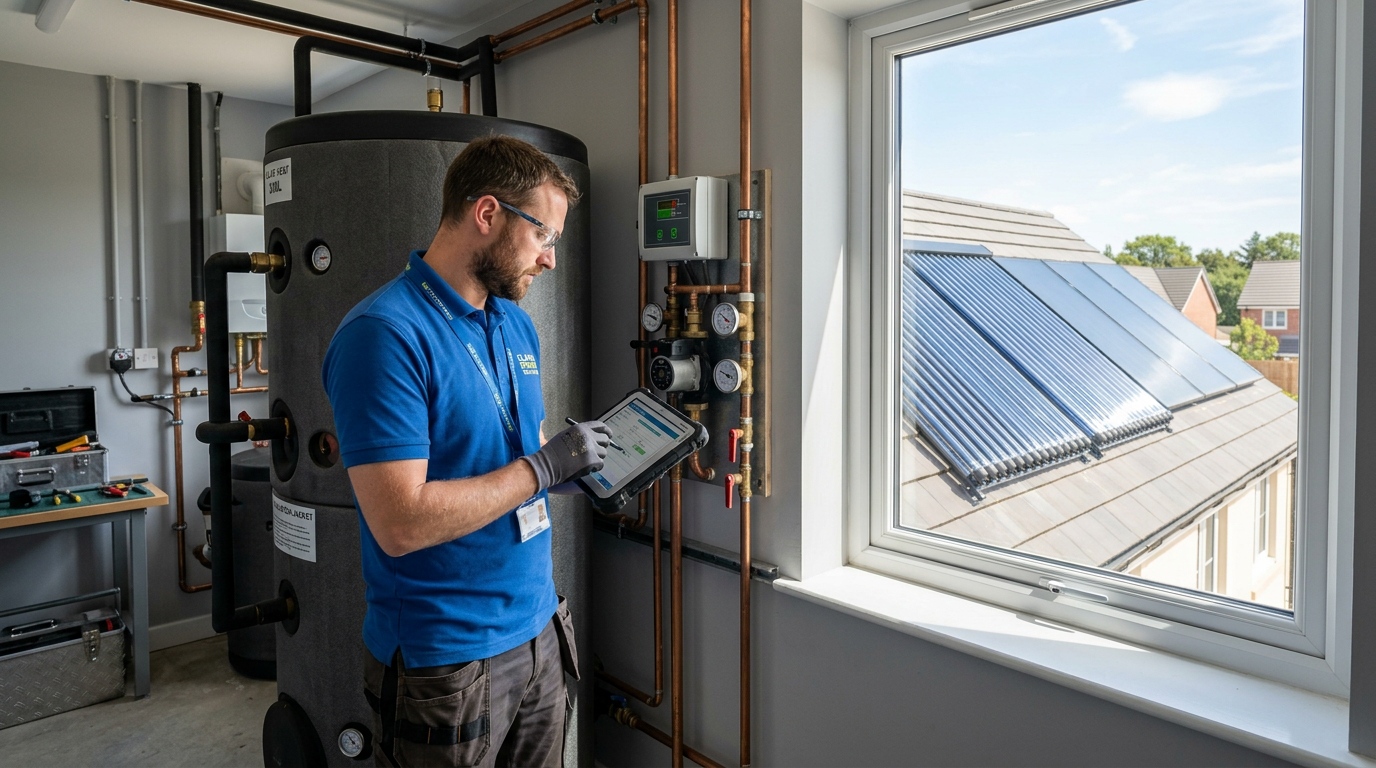
How B2B Buyers Should Evaluate Split Solar Water Heater Suppliers
Supplier Selection Is Not Just a Price Comparison
For many B2B buyers, the first stage of solar water heater sourcing often starts with a simple question: how much is the system? That question is understandable, but it is not enough. A split solar water heater supplier is not only selling a tank, collectors, a pump, and a controller. The supplier is providing a system that must be selected, installed, commissioned, supported, and trusted in real buildings.
A split system has more variables than a basic integrated rooftop unit. The collector may be flat plate or evacuated tube. The tank may be pressurized or non-pressurized. The system may use direct circulation, closed-loop glycol circulation, a heat exchanger, electric backup, gas backup, or hybrid heating. The installation may be residential, villa-based, commercial, or project-based. The climate may be tropical, temperate, cold, coastal, windy, or high-altitude.
That means the wrong supplier choice can create hidden costs long after the purchase order is signed.
A low price may look attractive at the quotation stage, but weak documentation, poor packaging, unstable quality, missing spare parts, unclear warranty terms, and limited technical support can quickly turn a cheap system into an expensive business problem.
A professional B2B solar water heater buyer should evaluate suppliers as long-term partners, not only as product sellers. The real question is not “Who gives the lowest unit price?” The better question is “Which supplier can help us sell, install, support, and grow this category with lower risk?”
That is the starting point of serious supplier evaluation.
A Split System Supplier Must Understand Systems, Not Only Components

A basic trading company can list product parts. A real solar hot water system supplier should understand how those parts work together.
This distinction is important.
A split solar water heater includes collectors, tank, pump station, controller, sensors, piping, valves, expansion components, insulation, backup heating, and installation accessories. If these parts are selected separately without system logic, the final product may appear complete but perform poorly.
For example, the tank size may not match the collector area. The pump may not match the pipe length. The heat exchanger may be too small. The controller may not support the required sensor logic. The expansion tank may be undersized for a glycol loop. The installation kit may not fit local roof types. The packaging may not protect collectors during export shipment.
A qualified split solar water heater supplier should be able to explain system matching.
They should know when to recommend flat plate collectors and when evacuated tubes make more sense. They should understand when a direct system is acceptable and when an indirect closed-loop design is safer. They should ask about climate, water pressure, roof area, daily demand, backup heating, and installation capability before recommending a configuration.
This is especially important for distributors who want to build a real solar thermal product line. A distributor does not only need one model. They need a product structure that matches different customer groups: entry-level homes, modern villas, cold-climate buyers, small hotels, guesthouses, and small commercial projects.
A supplier who only says “we have 150L, 200L, 300L, 500L” is not enough. A supplier who can explain which system fits which market is much more valuable.
Product Range Should Match Market Segmentation

A serious buyer should evaluate whether the supplier’s product range supports market segmentation.
Different markets need different product positions. A price-sensitive rural market may need a simpler system with easy installation and standard capacity. A modern urban home may need a clean roof appearance and hidden tank placement. A villa customer may care about pressure, comfort, aesthetics, and service access. A cold-climate buyer may need glycol freeze protection. A small commercial project may need larger storage, stronger backup heating, and more reliable service documentation.
A good solar thermal product line should not be a random collection of models. It should have logic.
For example, the supplier may offer:
Entry-level residential split systems.
Premium residential flat plate systems.
Evacuated tube systems for higher heat output.
Closed-loop glycol systems for freezing climates.
Larger systems for villas and small commercial use.
OEM-ready systems for branded distributors.
Project-based packages with customized tanks, collector area, and control logic.
This kind of structure helps a solar water heater distributor sell more clearly. Instead of offering one product to everyone, the distributor can match the product with the customer segment.
For B2B buyers, product range is not about having as many models as possible. Too many similar models can create inventory pressure and confusion. The best range is broad enough to cover real demand but organized enough to explain easily.
A supplier who understands segmentation can help buyers avoid stocking the wrong products.
Quality Control Must Be Visible, Not Only Claimed

Every solar water heater manufacturer says it controls quality. The question is whether that control is visible, documented, and repeatable.
Solar water heater quality control should cover materials, production, welding, pressure testing, tank insulation, coating, collector assembly, sensor testing, controller checking, pump station assembly, packaging, and final inspection.
For tanks, quality control may include pressure tests, leakage tests, welding inspection, inner tank material verification, insulation consistency, enamel or stainless-steel quality checks, anode position if applicable, and backup heater safety.
For collectors, it may include absorber coating quality, glass inspection, frame sealing, tube vacuum checks, manifold leakage checks, mounting hardware inspection, and packaging protection.
For pump stations and controllers, quality control should include electrical testing, sensor input testing, pump operation, flow direction, valve condition, wiring accuracy, and packaging verification.
For export orders, packaging quality is part of solar water heater quality control. A system that leaves the factory in good condition but arrives with broken tubes, dented tanks, damaged glass, or missing accessories still creates business loss.
A serious buyer should ask for inspection photos, test reports, quality process descriptions, packaging details, and sample order feedback. Factory claims should be supported by evidence.
Good suppliers do not hide quality control behind general language. They show the buyer how quality is controlled.
Documentation Is a Core Product Feature
Many buyers underestimate documentation. They focus on hardware and forget that a split solar system must be installed and serviced correctly.
For a B2B solar water heater buyer, documentation is not decoration. It is part of the product.
A professional solar hot water system supplier should provide:
Product specifications.
System diagrams.
Installation manuals.
Wiring diagrams.
Hydraulic connection drawings.
Controller instructions.
Commissioning procedures.
Maintenance checklists.
Troubleshooting guides.
Packing lists.
Spare parts lists.
Warranty terms.
OEM label and packaging guidelines if needed.
Without documentation, the buyer may still receive products, but the local sales and installation teams will struggle. Incorrect installation leads to performance complaints. Weak service information increases warranty disputes. Missing spare part references make after-sales work slower.
For project buyers, documentation is even more important. Projects often involve multiple installers, site supervisors, engineers, and end users. A clear manual helps different teams follow the same logic.
For a solar water heater distributor, good documentation also supports training. Sales staff can explain the system better. Installers can reduce mistakes. Service teams can troubleshoot faster. Customers trust the product more.
The supplier who provides better documentation often provides better long-term value, even when the unit price is not the lowest.
OEM Capability Is More Than Printing a Logo
Many international buyers request an OEM solar water heater. Some only mean putting a logo on the tank or carton. But real OEM cooperation should go deeper.
A strong OEM solar water heater supplier should support brand positioning, product configuration, labels, manuals, packaging, model naming, warranty cards, technical documents, and sometimes market-specific accessories.
For example, a distributor serving premium residential markets may need a clean product appearance, better packaging, detailed installation manuals, and a stronger warranty presentation. A buyer serving project customers may need system drawings, compliance documents, commissioning forms, and spare part kits. A buyer serving price-sensitive retail markets may need simplified models, clear capacity options, and easy-to-understand sales materials.
OEM also requires consistency. A brand cannot build trust if tank labels change randomly, packaging is inconsistent, accessories differ between batches, or manuals do not match the delivered product.
A professional solar water heater manufacturer should manage OEM details carefully.
For B2B buyers, the question should not be “Can you print my logo?” The better question is “Can you help us build a stable branded product line for our market?”
That is the difference between basic OEM and strategic OEM cooperation.
Supplier Evaluation Should Include Technical Communication

Technical communication is one of the most practical ways to judge a supplier.
A strong split solar water heater supplier should ask questions before recommending products. They should want to know the project country, climate, water pressure, hot water demand, roof type, tank location, backup heating plan, installation skills, and target customer segment.
If a supplier immediately sends a price list without asking any project details, that may be a warning sign. It does not always mean the supplier is bad, but it suggests they may be selling products rather than solving system problems.
Good technical communication includes clear answers, realistic limitations, and practical suggestions.
A supplier should be able to explain:
Why one collector type fits better than another.
Why a certain tank size is suitable.
Whether the system needs glycol.
How pump and controller selection works.
What installation risks should be avoided.
What maintenance is required.
Which spare parts should be stocked.
How the system should be positioned in the buyer’s market.
This kind of communication builds trust.
For a solar water heater distributor, supplier communication also affects local business confidence. If the distributor cannot get clear technical answers, it will be difficult to support installers and end customers.
After-Sales Support Is Part of the Supplier’s Real Value

A split system is not a one-time shipment. It has a lifecycle.
That is why solar water heater after-sales support should be evaluated before cooperation begins.
After-sales support includes spare parts availability, troubleshooting help, warranty response, controller support, installation guidance, maintenance advice, and failure analysis. It may also include video training, remote support, replacement parts, and documentation updates.
The most important question is not whether problems will happen. In real markets, problems always happen. The real question is whether the supplier can help solve them efficiently.
A professional solar water heater after-sales support system should help buyers answer field questions such as:
Why is the water temperature low?
Why is the pump noisy?
Why is there no circulation?
Why does the controller show an error?
What sensor should be replaced?
How should glycol be checked?
What spare parts should the distributor keep?
How should a warranty claim be documented?
For export markets, after-sales support matters even more because the supplier may not be physically present. Remote troubleshooting depends on clear manuals, photos, videos, wiring diagrams, and structured communication.
A supplier with strong after-sales support reduces business risk. A supplier with weak support leaves the buyer alone after shipment.
Spare Parts Strategy Decides Service Speed
A solar water heater distributor should not wait until a system fails before thinking about spare parts.
For split systems, common spare parts may include controllers, sensors, pumps, valves, seals, pressure gauges, expansion vessels, heating elements, anodes, tubes, mounting hardware, fittings, and recommended service tools.
A good solar hot water system supplier should help the buyer build a spare parts list based on the product line and expected sales volume. The list does not need to be excessive, but it should cover the parts most likely to be needed for service.
Spare parts support affects customer confidence. If a small sensor failure takes six weeks to solve because no part is available locally, the customer will blame the brand. If a pump can be replaced quickly, the problem becomes manageable.
For distributors, spare parts also create service revenue and professional positioning. The buyer is not only selling equipment but also supporting a system.
This is especially important for project customers. Hotels, guesthouses, villas, and commercial users cannot wait long for basic service parts. Their business depends on reliable hot water.
Spare parts planning should be part of supplier evaluation, not an afterthought.
Certification and Compliance Should Match the Target Market
International solar water heater sourcing often involves certification and compliance questions. Requirements differ by country and project type, so buyers should verify what is needed in their target market.
A supplier should be honest about certifications, test reports, material standards, electrical components, pressure ratings, safety labels, and installation requirements. If specific certification is required, the buyer should confirm whether the documents are valid, current, and applicable to the exact product model.
For some markets, pressure vessel standards, electrical safety, potable water contact materials, energy performance, and solar thermal performance may be important. For other markets, project specifications may require certain documentation even if retail sales do not.
A solar water heater manufacturer should not casually claim compliance without supporting documents. Buyers should request copies and verify whether the documents apply to the selected model.
Compliance is not only about passing customs or project review. It also affects liability, warranty, and market trust.
For a B2B solar water heater buyer, unclear compliance can delay sales, block projects, or create legal risk. It should be checked early.
Packaging and Logistics Are Part of Product Quality
Solar water heater systems include large, fragile, and sometimes heavy components. Packaging and logistics are therefore part of product quality.
A tank may be dented. A flat plate collector glass may break. Evacuated tubes may crack. Accessories may be missing. Pump stations may be damaged. Labels may be unclear. Mixed components may create installation confusion.
A professional split solar water heater supplier should have export packaging experience. Packaging should protect tanks, collectors, tubes, controllers, pumps, and accessories during handling, container loading, sea transport, unloading, and local distribution.
The buyer should ask about packaging structure, carton strength, wooden crate options, palletizing, tube protection, labeling, spare part packaging, and container loading plans.
Good logistics planning also affects cost. A system that packs inefficiently may increase freight cost. A system that packs too tightly without protection may increase damage risk.
For a solar water heater distributor, receiving damaged goods creates cash loss and customer delay. For project buyers, missing parts can delay installation schedules.
Packaging should be checked during sample orders before large orders begin.
Sample Orders Should Be Tested Like Real Products
A sample order should not be treated only as a visual inspection.
A serious buyer should evaluate the sample as if it were a real product entering the market. This includes packaging, product appearance, accessory completeness, manual clarity, installation logic, tank quality, collector quality, controller function, pump station design, labeling, and customer presentation.
If possible, the sample should be installed and operated. This reveals issues that photos cannot show.
Does the manual match the product?
Are the fittings compatible?
Is the pump station easy to understand?
Are the sensor cables long enough?
Is the controller menu clear?
Is the tank finish acceptable?
Is the collector mounting structure practical?
Is the packaging strong enough?
Are spare parts identified?
A good solar water heater sourcing process uses samples to reduce uncertainty. The sample order should produce a written evaluation report. That report can guide product improvements before the first bulk order.
A supplier who responds positively to sample feedback is often easier to work with long term.
Price Should Be Compared by Total Business Cost

Price is important. But for B2B sourcing, the correct comparison is total business cost, not only unit price.
A low-cost supplier may create hidden costs through damage, missing parts, weak documentation, installation problems, high warranty claims, poor communication, and slow spare parts supply.
A higher-priced supplier may reduce risk through better packaging, clearer manuals, stable quality, stronger technical support, and faster after-sales response.
The buyer should compare:
Product price.
Freight efficiency.
Damage rate.
Installation difficulty.
Warranty rate.
Spare parts cost.
Documentation quality.
Training cost.
Customer complaint risk.
Brand positioning value.
A strong B2B solar water heater strategy does not ignore price. It understands price in context.
If the buyer sells to low-end retail markets, price may be the main competitive factor. If the buyer serves villas, projects, or cold-climate customers, reliability and support may matter more.
The right supplier is not always the cheapest. The right supplier is the one that matches the buyer’s business model.
Red Flags in Supplier Selection
There are several warning signs when evaluating a split solar water heater supplier.
One red flag is price-first communication with no technical questions.
Another is unclear product configuration. If the supplier cannot explain tank, collector, pump, controller, and accessory matching, system risk increases.
A third red flag is weak documentation. If manuals are generic, incomplete, or inconsistent with the delivered product, installation problems may follow.
A fourth is unstable specifications. If materials, components, or accessories change without notice, the buyer may face inconsistent market feedback.
A fifth is poor packaging evidence. If the supplier cannot show export packaging details, damage risk may be higher.
A sixth is unclear warranty terms. Warranty without process is not useful.
A seventh is no spare parts plan. A supplier who cannot support spare parts may not be suitable for distributor business.
An eighth is overpromising. Claims such as “no maintenance,” “works in all climates,” or “never fails” should be treated carefully.
Professional suppliers explain limits. Weak suppliers hide them.
How to Build a Long-Term Supplier Partnership

The best supplier relationship is not only transactional. It becomes a partnership.
A buyer and solar water heater manufacturer can work together on product range, packaging, documentation, market positioning, training, spare parts, and feedback improvement.
For a solar water heater distributor, long-term cooperation may include exclusive models, regional branding, marketing materials, installer training, seasonal promotion, and technical webinars.
For an OEM solar water heater buyer, long-term cooperation may include private labels, custom color, custom manuals, packaging design, model naming, system kits, and market-specific configurations.
For project buyers, cooperation may include project drawings, capacity calculations, installation guidance, commissioning records, and maintenance plans.
The supplier should not only deliver products. The supplier should help the buyer reduce mistakes and improve market competitiveness.
A true partnership grows through feedback. Field problems should be analyzed, not ignored. Customer complaints should be used to improve manuals, packaging, accessories, and configuration. Sales feedback should shape the product line.
This is how a solar thermal product line becomes stronger over time.
Focused FAQ
How should B2B buyers evaluate a split solar water heater supplier?
B2B buyers should evaluate a split solar water heater supplier by system design capability, product quality, documentation, OEM support, spare parts, after-sales service, packaging, compliance, technical communication, and long-term cooperation value.
What makes a good solar water heater manufacturer?
A good solar water heater manufacturer should provide stable production quality, clear technical specifications, reliable testing, proper packaging, system matching knowledge, installation support, and responsive after-sales communication.
What should a B2B solar water heater buyer ask before ordering?
A B2B solar water heater buyer should ask about product range, tank material, collector type, pump station, controller, heat exchanger, freeze protection, spare parts, certifications, warranty terms, packaging, installation manuals, and maintenance support.
How do I choose a solar hot water system supplier for export markets?
A strong solar hot water system supplier for export markets should understand packaging, documentation, OEM branding, local installation differences, spare parts, compliance requirements, and remote after-sales support.
What should be included in an OEM solar water heater program?
An OEM solar water heater program should include logo application, model naming, product configuration, labels, packaging, manuals, warranty documents, spare parts support, and consistent quality across production batches.
Why does a solar water heater distributor need spare parts?
A solar water heater distributor needs spare parts to support local service quickly. Common spare parts may include pumps, controllers, sensors, valves, seals, expansion vessels, tubes, heating elements, and mounting accessories.
What is a solar thermal product line?
A solar thermal product line is a structured range of solar water heating products designed for different customer groups, such as residential homes, villas, cold-climate systems, commercial projects, and OEM distributor programs.
Why is solar water heater quality control important?
Solar water heater quality control helps ensure tanks, collectors, pumps, controllers, sensors, valves, accessories, and packaging meet consistent standards. It reduces leakage, damage, installation issues, and warranty risk.
What does solar water heater after-sales support include?
Solar water heater after-sales support includes troubleshooting guidance, spare parts, warranty handling, controller support, installation help, maintenance advice, remote diagnosis, and technical documentation.
What is the best way to manage solar water heater sourcing?
Professional solar water heater sourcing should compare total business cost, not only unit price. Buyers should evaluate quality, system matching, documentation, packaging, after-sales support, compliance, and supplier communication.
Conclusion: The Best Supplier Helps You Sell, Install, and Support the System
Choosing a split solar water heater supplier is one of the most important decisions in B2B solar thermal business. The supplier affects product quality, pricing, documentation, installation success, warranty risk, customer satisfaction, and long-term market growth.
A split system is not a simple product. It is a system of collectors, tank, pump, controller, sensors, valves, heat exchanger, piping, backup heating, and installation accessories. That is why a professional solar hot water system supplier must understand system design, not only component sales.
For a solar water heater distributor, the supplier should provide a structured solar thermal product line, clear market segmentation, spare parts, training materials, installation support, and reliable after-sales response. For an OEM solar water heater buyer, the supplier should support branding, packaging, model consistency, documentation, and stable batch quality. For project buyers, the supplier should provide technical drawings, sizing support, commissioning guidance, and maintenance planning.
Strong solar water heater quality control reduces field problems. Clear documentation reduces installation mistakes. Good packaging reduces transport damage. Responsive solar water heater after-sales support reduces warranty disputes. Reliable communication builds trust.
Price still matters, but price should be evaluated as part of total business cost. A low price with poor support can become expensive. A slightly higher price with better quality, documentation, and service can create stronger long-term value.
The best solar water heater manufacturer is not only the one that can produce the product. It is the one that helps buyers sell the right product to the right market, install it correctly, support it after delivery, and improve it over time.
For international solar water heater sourcing, this is the real standard: choose a supplier who can reduce your risk, strengthen your brand, and help you build a product category that customers can trust.
#SplitSolarWaterHeaterSupplier #SolarWaterHeaterManufacturer #B2BSolarWaterHeater #SolarHotWaterSystemSupplier #OEMSolarWaterHeater #SolarWaterHeaterDistributor #SolarThermalProductLine #SolarWaterHeaterQualityControl #SolarWaterHeaterAfterSalesSupport #SolarWaterHeaterSourcing