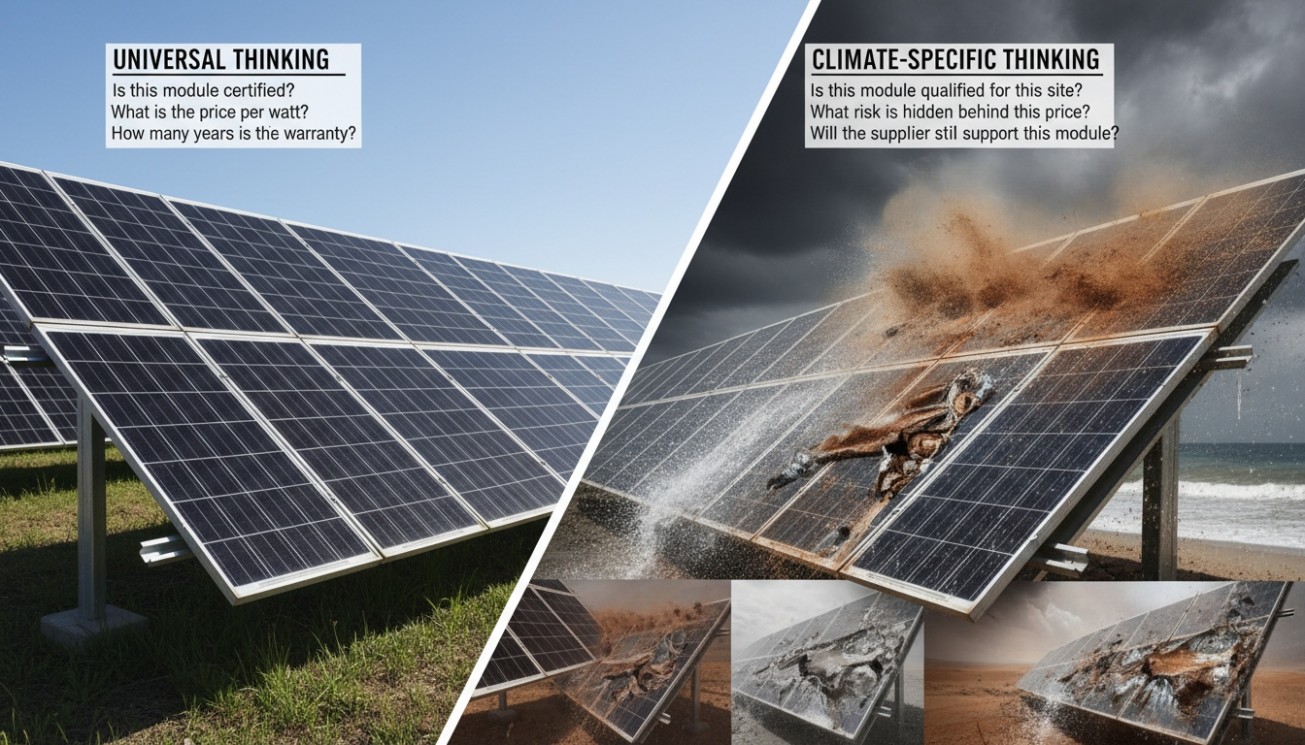
Why Solar Module Prices Change What Buyers Should Know Before Placing Orders
Solar Module Price Is Not Just a Number on a Quotation
For many buyers, solar module prices appear simple. A supplier sends a quotation. The buyer compares price per watt. If the product type, power rating and warranty look similar, the lower price seems more attractive. This is how many purchasing conversations begin.
But in professional PV procurement, module price is not only a number. It is a signal.
It reflects manufacturing capacity, inventory pressure, technology transition, raw material cost, exchange rates, shipping routes, regional tariffs, supplier cash flow, warranty risk, delivery timing and future replacement uncertainty. A module quote is not just today’s offer. It is a snapshot of the entire solar supply chain at one moment in time.
This is why PV module price trends matter. Buyers who only look at one quotation may miss the market forces behind that price. A very low offer may be a genuine opportunity. It may also be old inventory, outdated technology, weak supplier cash flow, limited warranty confidence or a clearance strategy before a product generation changes.
A higher offer may seem expensive. But it may include newer cells, better documentation, stronger warranty terms, stable production scheduling, reliable delivery and lower long-term project risk.
The purpose of this article is not to predict the exact next price move. No buyer should rely on a single forecast. The goal is to explain why prices move and how buyers should think before placing orders for standard PV modules.
The First Mistake: Treating Price Per Watt as the Whole Decision
Price per watt is useful because it allows quick comparison. A buyer can compare two offers at 0.10 USD/W and 0.12 USD/W and immediately see the cost difference. In high-volume projects, even a small difference matters.
However, price per watt can hide major differences.
One module may be monofacial PERC inventory. Another may be N-type TOPCon bifacial glass-glass. One may have a shorter product warranty. Another may include stronger degradation terms. One may be available immediately from warehouse stock. Another may require a new production slot. One supplier may have strong after-sales support. Another may be selling at a loss to release inventory.
In solar panel procurement, the question should not be “Which price is lower?” The better question is “What is included in this price, and what risk is transferred to the buyer?”
A low price can be valuable when the product is current, documented, bankable and suitable for the project. But a low price can be dangerous when it hides mismatch, weak warranty, obsolete inventory, uncertain origin, poor packaging, missing certificates or tariff exposure.
Professional buyers should compare price together with technology, specification, delivery schedule, payment terms, warranty, documentation, supplier strength and project compatibility.
A module price is only meaningful when the buyer understands the conditions behind it.
Why PV Module Prices Move in Cycles

PV module price trends are cyclical because the PV industry is capital-intensive and capacity decisions take time. Manufacturers invest in polysilicon, wafers, cells and module production based on expected demand. When demand grows quickly, manufacturers expand capacity. When too many companies expand at the same time, the market can move into oversupply.
Oversupply usually pushes solar module prices down. Manufacturers compete for orders, clear inventory and reduce margins. In extreme cases, prices can fall close to or below production cost. This can benefit project buyers in the short term, but it also puts pressure on supplier health.
When prices are too low for too long, weaker manufacturers may reduce output, delay expansion, exit the market or consolidate. Governments may also intervene through trade rules, production policies or export adjustments. If supply tightens or demand rebounds, prices can stabilize or rise.
This cycle is not unusual in solar. It has happened across different parts of the solar supply chain, including polysilicon, wafers, cells and modules. What makes the current market especially complex is that technology is changing at the same time. Buyers are not only comparing prices; they are comparing product generations.
That means a falling price may reflect oversupply, but it may also reflect a transition away from older technology. A buyer needs to understand whether a lower quote is a market-wide opportunity or a product-specific clearance.
The Cost Stack Behind a Module Price

A PV module price is built from many cost layers. Understanding these layers helps buyers ask better questions.
Silicon and Wafer Cost
The upstream material base begins with polysilicon. The polysilicon price affects wafer and cell cost, especially when supply is tight. When polysilicon supply expands faster than demand, prices can fall sharply. When capacity is constrained, prices can rise and push module prices higher.
For buyers, the polysilicon price is not something they control. But it helps explain why module quotations may change even when the product looks the same. If a supplier’s cost base changes, quotations may change.
Cell Technology Cost
Cells are one of the most important cost drivers. PERC, TOPCon, HJT and back-contact technologies have different manufacturing processes, yields, materials and equipment requirements. As the market shifts toward N-type products, TOPCon module price becomes a major reference point for mainstream standard modules.
A TOPCon module may cost more than older PERC inventory, but the price gap may narrow as production scales. In some markets, TOPCon has already moved from premium to mainstream. Buyers should not compare PERC and TOPCon only by price; they should compare efficiency, degradation, bifacial potential and long-term energy yield.
Silver and Metallization Cost
Solar cells use conductive materials, and silver paste cost can influence cell manufacturing cost. Even when manufacturers reduce silver use or adopt new metallization strategies, silver remains an important cost variable for many cell technologies.
If silver prices rise, cell and module cost pressure can increase. If manufacturers improve silver consumption, the effect may be reduced. Buyers do not need to track every material detail, but they should understand that module price is affected by more than silicon.
Glass, Frame and Encapsulation
Glass, aluminum frames, encapsulant, backsheets, junction boxes, connectors and cables all contribute to module cost. Glass-glass bifacial modules may have a different cost structure from glass-backsheet modules. Large-format modules may change packaging and transport cost.
Labor, Energy and Factory Utilization
Factories have fixed costs. When utilization is high, cost per unit may improve. When utilization is low, manufacturers may cut prices to keep lines running or clear inventory. This can create attractive short-term offers but may also signal financial stress.
Freight, Insurance and Destination Cost
A quote from a factory and a delivered cost at the buyer’s site are not the same. Freight, insurance, inland transport, port handling, customs clearance and warehousing can change the final project cost.
This cost stack explains why solar module prices are never just about one material or one manufacturer.
TOPCon Pricing: Why Technology Transition Creates Confusion

The shift from PERC to TOPCon has made price comparison harder. Many buyers now see different offers in the same market: older PERC inventory, mainstream TOPCon modules, bifacial TOPCon modules, glass-glass products, high-wattage utility modules and premium high-efficiency options.
This is why TOPCon module price deserves special attention.
At first, TOPCon may appear as a higher-priced technology. Over time, as manufacturing capacity expands and competition increases, the price premium can shrink. When a technology becomes mainstream, its price behavior starts to resemble the broader market. However, buyers must still distinguish between high-quality mature TOPCon products and low-priced offers from suppliers with weaker process control.
A low TOPCon module price may be attractive, but buyers should ask:
Is it current-generation production or old stock?
Is the cell technology clearly documented?
Is the module monofacial or bifacial?
Is it glass-glass or glass-backsheet?
What degradation warranty is offered?
Are certificates available for the exact model?
Does the supplier have stable production and after-sales support?
Technology transition creates price gaps. Some gaps are opportunities. Others are warnings.
A professional buyer should avoid two extremes: paying too much for a technology label, or buying the cheapest offer without verifying quality and documentation.
Inventory Pressure: When Low Prices Are Real but Not Always Safe

Inventory is one of the most important drivers of short-term PV module price trends. When manufacturers, distributors or installers hold too much stock, prices may fall quickly. Inventory pressure can come from overproduction, delayed projects, policy changes, seasonal demand shifts, financing delays or technology transitions.
Inventory-based discounts can be good for buyers. A distributor may offer current, certified modules at a lower price because warehouse space is limited or project demand has slowed. In that case, the buyer may benefit.
But inventory discounts can also carry risks.
The modules may be older generation.
They may have lower power ratings than current models.
They may not match future replacement needs.
They may have shorter remaining warranty interpretation depending on shipment and documentation.
They may lack sufficient batch consistency for a large project.
They may be difficult to expand later if the model is discontinued.
For small projects, a good inventory deal can work. For large projects, batch consistency, serial traceability, documentation and future support matter more. If a buyer purchases mixed batches only because they are cheap, installation and warranty management may become harder.
This is why solar panel procurement should include inventory questions. Buyers should ask when the modules were produced, where they are stored, whether they are in original packaging, whether flash test data is available and whether all certificates match the product label.
Low price is useful only when the product remains project-safe.
Regional Markets Do Not Always Move Together
Global module prices influence local markets, but local prices do not always move exactly the same way. Regional differences can be significant.
A module price in Europe may differ from a price in the Middle East, Africa, India, Latin America or the United States because of shipping routes, customs duties, tax rules, domestic content policies, inventory levels, local certification requirements and currency movements.
This is where freight and tariff risk becomes important.
A buyer may receive an attractive FOB quote from one supplier, but the final landed cost may change after shipping, tariffs, anti-dumping rules, customs classification or local documentation review. In some markets, product origin and supply chain traceability can be just as important as product price.
Regional market timing also matters. A country with strong project demand may absorb inventory quickly and keep prices firmer. Another region may have large warehouse stock and lower short-term prices. A market with policy uncertainty may see buyers delay orders, creating temporary price pressure.
For B2B buyers, the correct comparison is not factory price alone. It is delivered, compliant, documented, financeable and installable cost.
That is why freight and tariff risk should be part of every major purchase decision.
Freight, Payment Terms and Incoterms Can Change the Real Price
Two suppliers may quote the same module price, but the real cost can differ because the commercial terms are different.
FOB, CIF, DDP and EXW quotations are not interchangeable. A low EXW price may look attractive, but the buyer must arrange inland transport, export handling, ocean freight, insurance and customs. A DDP price may be higher but includes more responsibility from the supplier. A CIF price may include sea freight and insurance but not import duties or local transport.
Payment terms also affect price. A supplier may offer a lower price for full prepayment, but that increases buyer risk. Another supplier may offer better credit terms, but the unit price may be higher. For project developers, cash flow can be as important as module price.
Buyers should compare:
Unit price
Incoterms
Payment schedule
Delivery time
Currency
Insurance coverage
Port and inland transport
Tariff responsibility
Delay penalties
Warranty documentation
After-sales support
This is why solar module prices should always be compared on the same commercial basis. Otherwise, a buyer may choose the lowest number and later discover that the real landed cost is higher.
Currency and Interest Rates Also Matter
PV modules are traded globally. Currency movements can change purchase cost even when the supplier’s factory price stays the same. If a buyer pays in USD but earns revenue in local currency, exchange rate volatility can affect project economics. If the local currency weakens, module imports become more expensive.
Interest rates also influence solar panel procurement. High financing costs may cause developers to delay projects, which can reduce demand and pressure prices. Lower financing costs may accelerate demand and tighten availability. Supplier financing conditions also matter. Manufacturers under financial stress may offer aggressive prices to improve cash flow.
This is why price movement cannot be understood only by looking at manufacturing cost. Demand, financing and macroeconomic conditions also shape PV module price trends.
For buyers, this means purchase timing should consider more than the module price chart. It should also consider exchange rates, project financing, warehouse cost, installation schedule and policy deadlines.
Raw Materials: Why Polysilicon and Silver Still Matter
The solar industry has become very efficient, but raw materials still influence cost.
The polysilicon price remains a major upstream signal. When polysilicon prices fall due to oversupply, module prices often face downward pressure. When polysilicon prices rise or supply tightens, module costs can increase. The effect may not be immediate because inventories and contracts can delay price transmission, but it remains important.
Silver paste cost is another factor. Solar cells rely on conductive metallization, and silver is commonly used because of its excellent conductivity. Manufacturers continue to reduce silver consumption and explore alternatives, but price pressure in silver can still affect cell economics, especially for high-efficiency technologies.
Glass and aluminum also matter. Glass shortages, higher energy cost, frame material changes or logistics disruptions can affect module production. Packaging materials, junction boxes, connectors and cables also contribute.
For most buyers, it is not necessary to become a raw material trader. But it is useful to know when suppliers mention material cost changes. If multiple suppliers suddenly raise prices and cite upstream cost pressure, the buyer should verify whether this is market-wide or supplier-specific.
A professional buyer watches raw material signals to understand whether a price change is temporary, structural or negotiable.
Policy and Trade Rules Can Move Prices Quickly
Policy can change module prices faster than production cost. Tariffs, anti-dumping investigations, local content requirements, import restrictions, forced labor compliance, customs documentation and tax rebate changes can all affect final cost.
This is the core of freight and tariff risk. A buyer may sign a purchase contract based on one cost assumption, but if import rules change before delivery, the project budget may be affected.
Policy risk is especially important for large projects. A utility-scale developer cannot afford uncertainty in module origin, customs classification or compliance documents. A shipment delayed at port can affect project schedule, grid connection deadlines and financing milestones.
Buyers should ask suppliers for:
Country of origin documentation
Bill of materials traceability where required
Factory location
Certificate matching
Customs HS code clarity
Regional compliance documents
Tariff responsibility in contract terms
Evidence of supply chain compliance
Policy does not only affect price. It affects whether modules can be delivered, financed and installed on time.
Supplier Health: Cheap Modules From a Weak Supplier May Be Expensive
When the industry enters a low-price cycle, manufacturers face margin pressure. Some suppliers may sell at very low prices to maintain cash flow. This can create attractive opportunities, but it can also create long-term risk.
A weak supplier may struggle to honor warranty claims. It may change product models frequently. It may reduce quality control. It may delay shipments. It may lack replacement modules. It may exit certain markets.
This is why supplier health should be part of solar panel procurement.
Buyers should not evaluate suppliers only by product price. They should consider production scale, financial stability, export history, after-sales structure, project references, bankability, documentation quality and warranty process.
This does not mean buyers should only purchase from the largest brands. Smaller suppliers can be reliable when they have strong quality control and clear documentation. But a very low price from an unknown supplier should trigger additional due diligence.
The true cost of a module includes the probability that the supplier will still be there when the buyer needs support.
Purchase Timing: When Waiting Helps and When It Hurts
Many buyers ask whether they should place an order now or wait for prices to fall. The answer depends on project context.
Purchase timing is strategic because module prices can move, but project schedules also matter. Waiting for a lower price may save money if the project has flexibility. But waiting can also create risks: delivery slots may disappear, shipping windows may tighten, tariffs may change, inventory may sell out, or project deadlines may be missed.
A buyer should consider waiting only when:
The project schedule is flexible.
There is no fixed grid-connection deadline.
Multiple suppliers have confirmed availability.
The buyer can monitor price trends actively.
The expected price drop is meaningful enough to justify delay risk.
A buyer should avoid waiting when:
The project has a construction deadline.
Financing depends on a fixed schedule.
Grid connection or incentive timing is critical.
The selected module model is in limited supply.
Tariff or policy risk may increase.
Warehouse or labor schedules are already planned.
Good purchase timing is not about guessing the bottom. It is about balancing price opportunity against execution risk.
In real projects, the lowest module price is not always the best purchase moment. The best moment is when price, availability, documentation, logistics and project schedule align.
How Buyers Should Read a Supplier Quotation

A module quotation should be read like a project document. Buyers should check more than the unit price.
Product Identity
Confirm the exact model, cell type, module size, power class, structure, connector type and warranty version. Make sure the quotation matches the datasheet and certificate.
Technology Generation
Check whether the product is PERC, TOPCon, HJT or another technology. For standard PV modules, the market baseline is changing, so product generation matters.
Price Basis
Confirm whether the quotation is FOB, CIF, DDP or another term. Compare equivalent landed cost, not headline price.
Delivery Schedule
Check production lead time, shipment date, port arrival and risk of delay. A low price with uncertain delivery can harm the project.
Documentation
Request datasheets, certificates, warranty terms, installation manuals, packing lists and flash test data where relevant.
Payment Terms
Compare deposit, balance payment, letter of credit, credit period and refund conditions.
Warranty Support
Confirm who handles claims, where testing occurs, what evidence is required and whether replacements are available.
Inventory Status
Ask whether modules are new production or warehouse stock. For stock, check production date, storage condition and batch consistency.
This approach makes solar panel procurement more disciplined and less dependent on price emotion.
A Practical Price Risk Checklist
Before placing orders, buyers can use a practical checklist.
Is the price consistent with current PV module price trends?
Is the technology current or being phased out?
Is the TOPCon module price unusually low compared with comparable offers?
Does the supplier explain the price clearly?
Is the solar supply chain stable for this product?
Could polysilicon price or silver paste cost pressure affect near-term quotes?
Is there freight and tariff risk in this route?
Are Incoterms and payment terms clear?
Is the product supported by complete documentation?
Does the delivery timeline match the project schedule?
Does the warranty process look realistic?
Is the buyer choosing based on purchase timing or simply hoping for the lowest possible price?
This checklist prevents buyers from treating price as an isolated number.
What Distributors Should Understand About Price Volatility

Distributors face a different challenge from project owners. They must manage inventory in a changing market.
If they buy too early, falling prices may reduce margin. If they buy too late, they may miss demand. If they stock outdated technology, customers may shift to newer modules. If they stock only premium products, price-sensitive buyers may go elsewhere.
A distributor should segment inventory:
Fast-moving standard PV modules for general rooftop demand.
Current TOPCon modules for mainstream new projects.
Bifacial modules for ground-mounted and C&I use.
Compact high-efficiency modules for space-limited roofs.
Limited low-cost stock only when the warranty and documentation are clear.
Distributors should also educate customers. Instead of saying “this is cheaper,” they should explain why the price is lower. Is it a seasonal discount, warehouse clearance, technology transition, freight advantage or supplier promotion?
In volatile markets, trust is created by transparency.
What EPC Companies Should Understand About Module Price
For EPC companies, module price affects the full project contract. A lower module price may improve bid competitiveness, but it can also increase risk if the product is not aligned with engineering or schedule requirements.
EPC companies should lock module choices only after checking design compatibility, delivery timing, warranty, logistics and installation workflow. If the project depends on a specific inverter, tracker or mounting system, the module must be compatible before procurement.
EPC proposals should avoid vague language like “Tier 1 modules” without specifying model, warranty, technology and delivery assumptions. Buyers increasingly expect clarity because module prices are volatile and technology changes quickly.
A strong EPC offer explains how the selected module supports project value, not only how it reduces upfront cost.
Final Takeaway: The Best Price Is the One That Protects the Project
Solar module prices change because the PV industry is dynamic. Manufacturing capacity, raw materials, technology transitions, inventory, freight, tariffs, currency, financing and supplier health all influence the final quote.
For buyers, the goal is not to find the lowest number in the market. The goal is to secure the best project-safe price.
A cheap module is valuable when it is current, documented, reliable, deliverable and suitable for the project. A cheap module is risky when it hides old inventory, weak warranty, tariff exposure, supplier stress or technical mismatch.
The most professional approach is to connect price with project reality. Review PV module price trends, understand the solar supply chain, compare TOPCon module price with equivalent technologies, check polysilicon price and silver paste cost signals, evaluate freight and tariff risk, and decide purchase timing based on schedule and execution risk.
That is how buyers turn price volatility from a threat into a procurement advantage.
In solar, the best purchase is not always the cheapest order. It is the order that reaches the site on time, passes documentation review, fits the system design, supports the financial model and remains serviceable over the project lifetime.
That is the real meaning of smart solar panel procurement.
Focused FAQ
Why do solar module prices change so often?
Solar module prices change because of manufacturing capacity, inventory levels, raw material cost, technology transitions, shipping cost, tariffs, exchange rates, demand cycles and supplier competition.
What are PV module price trends?
PV module price trends describe how module prices move over time across different technologies, regions and supply conditions. Buyers use these trends to understand whether a quote reflects the broader market or a supplier-specific situation.
Why does standard PV module pricing vary between suppliers?
Standard PV modules may look similar, but pricing can vary due to cell technology, module structure, wattage, warranty, supplier strength, inventory status, delivery terms and documentation quality.
Why is TOPCon module price important?
TOPCon module price matters because TOPCon is becoming a mainstream technology for many new projects. Buyers should compare TOPCon offers by efficiency, degradation, warranty, bifacial capability and supplier reliability, not only by price per watt.
How does the solar supply chain affect module pricing?
The solar supply chain includes polysilicon, wafers, cells, modules, glass, frames, encapsulants, connectors and logistics. Changes in any major part of this chain can influence module quotations.
Does polysilicon price still matter?
Yes. Polysilicon price remains an important upstream cost signal. When polysilicon supply is tight, module cost pressure can rise. When polysilicon is oversupplied, module prices may face downward pressure.
Why does silver paste cost affect solar modules?
Silver paste cost affects cell manufacturing because silver is widely used for conductive contacts in many solar cell technologies. Higher silver cost can add pressure to cell and module prices.
What is freight and tariff risk?
Freight and tariff risk refers to cost uncertainty from shipping, insurance, customs duties, trade investigations, regional compliance rules and import documentation. It can change the final landed cost of modules.
How should buyers plan solar panel procurement?
Good solar panel procurement should compare product model, technology, price basis, Incoterms, delivery schedule, documentation, warranty support, inventory status and supplier reliability.
What is the best purchase timing for PV modules?
The best purchase timing is when price, availability, documentation, logistics and project schedule align. Waiting for a lower price may help in flexible projects, but it can hurt projects with fixed construction or grid-connection deadlines.