What Defines a Standard PV Module in Today’s Solar Market?
The Market Has Changed: Standard No Longer Means Basic
In the solar industry, the word “standard” is often misunderstood. Some buyers still think standard PV modules are simply ordinary panels with average performance, basic materials and limited project value. That view is outdated. In today’s solar market, standard does not mean low-end. It means mature, scalable, bankable and widely usable across different types of photovoltaic projects.
A standard module is the product layer that allows the solar industry to move from scattered installations to industrial-scale deployment. Without standard module formats, stable electrical characteristics, predictable mechanical dimensions, repeatable production quality and recognizable warranty structures, solar projects would be much harder to design, finance, install and maintain.
This is why standard solar panels remain the backbone of the global PV market even as new technologies appear every year. Residential customers may focus on appearance. Commercial users may care about roof load, payback and self-consumption. Utility developers may prioritize LCOE, logistics and long-term energy yield. But all of these segments still depend on a shared foundation: modules that can be selected, compared, shipped, installed and operated according to recognized industry logic.
For this reason, the Standard category in PV Modules should not be treated as a simple introduction to solar panels. It should be treated as the central technical and purchasing layer of the entire PV module ecosystem. It answers a more important question: what makes a PV module usable as a mainstream solar product rather than just an isolated technology claim?
Why Standard PV Modules Matter in the Solar Value Chain
The solar value chain is built on repeatability. A module manufacturer needs repeatable cell sourcing, lamination, framing, junction box assembly, testing and packaging. A distributor needs repeatable product codes, pallet quantities, datasheets and after-sales documentation. An installer needs repeatable dimensions, clamp zones, connector types, electrical ratings and mounting compatibility. A project owner needs repeatable power output, degradation assumptions and warranty coverage.
This is where standard PV modules create value. They reduce uncertainty across the entire chain.
For a buyer, the value of a standard module is not only the wattage printed on the label. It is the ability to compare one product with another using a structured set of parameters. Power rating, efficiency, module size, cell type, temperature coefficient, mechanical load rating, product warranty, performance warranty, certification, packaging method and supplier history all become part of a shared decision framework.
That is why a serious PV module selection guide should never start by asking, “Which panel has the highest wattage?” It should start by asking, “Which module format fits the project, the electrical design, the mounting system, the climate risk, the installation workflow and the financial model?”
The difference is important. Wattage is a product number. Standardization is a system value.
What Actually Makes a PV Module “Standard”?
A PV module becomes standard not because it is simple, but because it is accepted across multiple parts of the market. A standard module usually has several characteristics.
First, it is based on a mature cell and module architecture. Today, most mainstream modules are crystalline silicon PV modules, including mono PERC, TOPCon, HJT and other high-efficiency silicon-based designs. The exact technology may change over time, but the product still needs to fit conventional module manufacturing, testing and system integration logic.
Second, a standard module has a recognizable physical format. This does not mean every module must have the same size. The market includes different power classes and dimensions, from smaller residential formats to large-format panels used in ground-mounted projects. However, the module must still be compatible with established packaging, mounting, handling and electrical connection methods.
Third, it has standardized documentation. Professional buyers expect datasheets, installation manuals, warranty terms, certification documents, serial number traceability and flash test data. Without documentation, even a technically impressive module becomes difficult to use in a serious project.
Fourth, it is commercially available at scale. A module cannot become a market standard if it exists only as a sample, laboratory achievement or limited pilot product. Standard modules need production continuity, supply visibility and after-sales support.
Fifth, it must fit common system design practices. A module used in real projects must be compatible with string inverter voltage windows, current limits, mounting structures, cable planning, grounding rules and site-specific safety requirements. In other words, PV system design is part of the definition of standardization.
Standard Is Different From Specialized
To define Standard clearly, it helps to separate it from specialized PV module categories.
Residential modules are usually discussed from the homeowner’s viewpoint. They may emphasize roof appearance, brand trust, installer recommendation, limited roof area, shade behavior and long-term household savings. Some residential buyers care about all-black panels, lower visual impact and easier roof layout.
Commercial modules are often evaluated around operating cost reduction, roof utilization, payback period, structural load, insurance, fire safety, energy management and self-consumption. The buyer may be a factory owner, warehouse operator, school, supermarket chain or commercial property developer.
BIPV modules are different again. They are not only energy products but also building envelope materials. A BIPV panel may need to function as roof tile, façade glass, curtain wall, skylight or architectural surface. Its performance is judged together with building design, waterproofing, appearance and code compliance.
RV solar and storage products are also specialized. They focus on portability, battery compatibility, vibration, off-grid usage, compact size and user-friendly installation.
By contrast, standard solar panels are the mainstream module products used across many of these environments before a specific application layer is added. Standard does not mean application-free. It means application-flexible. It gives the market a common product base from which residential, commercial and utility solutions can be built.
This is why the Standard category should focus on module fundamentals: technology, structure, specifications, reliability, warranty, system matching and procurement logic.
The Technology Baseline: From PERC to TOPCon and Beyond
For many years, PERC was the dominant technology in mainstream solar modules. It improved the rear side of the cell to reduce losses and increase output compared with earlier conventional cell designs. As the industry matured, PERC became widely accepted, cost-effective and easy to integrate into mass production.
Now the market is moving toward N-type technologies, especially TOPCon. TOPCon is attractive because it can improve efficiency, reduce some degradation concerns and deliver better performance potential while using production pathways that many manufacturers can scale. HJT and back-contact technologies are also important, especially in high-efficiency segments, but they may involve different cost structures, manufacturing requirements or market positioning.
For buyers, the key point is not to chase every new acronym. The key is to understand when a technology becomes commercially standard. A technology becomes standard when it is not only efficient, but also widely available, cost-competitive, reliable, documented and supported by a supplier base.
This matters because module efficiency alone does not define a better purchase. A high-efficiency module may be valuable when roof space is limited, labor costs are high, or balance-of-system optimization is important. But in a project with abundant land and strict budget pressure, the best choice may be the module that delivers the strongest combination of cost, reliability, delivery stability and system compatibility.
The solar market rewards efficiency, but projects reward total value.
Reading Solar Panel Specifications With a Project Mindset

Many buyers look at solar panel specifications only to compare power and efficiency. That is not enough. A datasheet is not a marketing sheet. It is a project design document.
A serious buyer should read at least five groups of specifications.
The first group is electrical performance. This includes maximum power, voltage at maximum power, current at maximum power, open-circuit voltage, short-circuit current and power tolerance. These numbers influence string length, inverter selection, combiner box design and safety margin.
The second group is efficiency and module size. A module with higher efficiency produces more power from the same surface area, but the physical dimensions still matter. A larger module may increase wattage while also changing handling difficulty, roof layout, wind load considerations and transport planning.
The third group is temperature behavior. The temperature coefficient shows how output changes when cell temperature rises. In hot climates, this can affect real-world energy yield more than buyers expect. A module with slightly lower nameplate power but better thermal behavior may perform competitively in actual field conditions.
The fourth group is mechanical reliability. Snow load, wind load, hail resistance, frame strength, glass thickness and installation clamp zones are not small details. They decide whether the module can survive the site conditions for decades.
The fifth group is warranty and degradation. A solar module warranty should be read carefully. Product warranty and performance warranty are different. Product warranty relates to defects in materials and workmanship. Performance warranty relates to the expected output level over time. Buyers should check the first-year degradation, annual degradation and final-year guaranteed output.
When buyers read specifications this way, they stop asking which panel is “best” in general. They begin asking which panel is best for their site, structure, electrical design and long-term risk profile.
Why Module Efficiency Is Useful but Often Overrated

There is no doubt that module efficiency is important. Higher efficiency means more power in a given area. This can reduce mounting area, save roof space, simplify layout and increase project output. In space-constrained projects, high efficiency can directly improve project feasibility.
However, efficiency is not the only factor. A module is not installed in a laboratory. It works in heat, wind, dust, humidity, snow, shade, voltage mismatch and real operating conditions.
For residential roofs, efficiency matters because roof area is limited and homeowners want maximum output from available space. For commercial roofs, efficiency matters when the roof has obstacles, skylights, HVAC units or fire access zones. For ground-mounted projects, efficiency still matters, but land cost, tracker compatibility, logistics, bifacial gain and BOS cost may be equally important.
This is why standard PV modules should be evaluated by energy yield, not only by efficiency. Energy yield depends on more than the module label. It includes irradiance, temperature, orientation, tilt, inverter behavior, mismatch loss, soiling, degradation and maintenance.
A buyer who only compares efficiency may overpay for performance that the project cannot fully use. A buyer who ignores efficiency may lose valuable output over the project lifetime. The professional approach is balance.
Standard Modules for Rooftop, Commercial and Utility Projects

One reason standard solar panels remain so important is their flexibility. The same product category can serve different project types, but the selection logic changes.
For rooftop solar panels, size, weight, aesthetics, roof structure, wind zones, fire setbacks and installer handling are critical. A residential roof may benefit from compact high-efficiency modules because layout space is limited. The installer also needs modules that are easy to lift, align and clamp safely.
For commercial rooftops, the question becomes more operational. The buyer may care about electricity cost reduction, roof loading, insurance, structural evaluation, installation speed and long-term maintenance access. A slightly larger module may reduce the number of panels and electrical connections, but it may also change roof layout and handling requirements.
For utility solar modules, the logic shifts again. Large-format modules can reduce certain balance-of-system costs by increasing power per panel. They may reduce the number of modules, clamps, piles, trackers, strings and installation actions per megawatt. But they also require careful planning for transport, module handling, wind load, tracker compatibility and current matching with inverters.
This is why one standard module cannot be called the universal best option. A module is standard because it can be evaluated across projects. The final choice must still follow the project’s design and financial conditions.
The Procurement Logic Behind Standard PV Modules

In B2B purchasing, a module is not simply a product. It is a risk package. The buyer is not only buying glass, silicon and aluminum. The buyer is buying documentation, production consistency, delivery reliability, warranty credibility and project support.
A professional procurement process for standard PV modules should include several checks.
The first check is supplier consistency. Can the supplier provide the same module type over the expected purchasing period? If the buyer is planning multiple projects, sudden changes in module dimensions, current class or connector type may create design and inventory problems.
The second check is documentation quality. A buyer should request complete datasheets, warranty documents, installation manuals, certification files, packing details and test reports where relevant. Incomplete documentation often signals weak project support.
The third check is production traceability. Module serial numbers, batch control, flash test records and packaging identification help reduce confusion during installation and after-sales claims.
The fourth check is logistics planning. Module size affects container loading, pallet handling, warehouse space, forklift requirements and site unloading. A high-wattage module may look cost-effective on paper but create additional handling complexity on site.
The fifth check is after-sales process. Warranty is valuable only if the claim path is clear. Buyers should understand what evidence is required, how testing is handled, who pays freight, what replacement terms apply and how long response usually takes.
This is the difference between a product buyer and a project buyer. Product buyers ask for price. Project buyers ask for risk control.
How Standard Modules Influence PV System Design

A module decision affects the entire system. This is why PV system design should begin early, not after the module purchase.
Electrical ratings influence string design. Higher current modules may require attention to inverter input limits. Higher voltage modules affect string length and cold-weather open-circuit voltage calculations. Module dimensions influence array spacing, roof coverage and mechanical layout. Weight affects structural review. Connector type and cable length affect installation workflow.
Even warranty assumptions influence financial modeling. Lower annual degradation may improve long-term energy yield, but only if the warranty is credible and the supplier can support claims. Better temperature behavior may improve output in hot climates. Stronger mechanical ratings may reduce risk in snow or wind-prone areas.
In short, a standard module is not standard because every project uses it the same way. It is standard because designers know how to model it, installers know how to mount it, distributors know how to ship it and owners know how to evaluate it.
That shared understanding is what makes solar scalable.
Common Mistakes Buyers Make When Comparing Standard Solar Panels
The first mistake is comparing only wattage. A 700W module is not automatically better than a 585W module. The project must consider size, current, voltage, handling, inverter compatibility, mounting system and site layout.
The second mistake is ignoring module dimensions. Buyers sometimes assume higher wattage means fewer panels and lower installation cost. This can be true in some projects, especially large ground-mounted systems. But on complex rooftops, larger modules may reduce layout flexibility.
The third mistake is treating all warranties as equal. A long warranty period looks attractive, but buyers need to read the exact degradation curve, exclusions, claim procedure and supplier credibility.
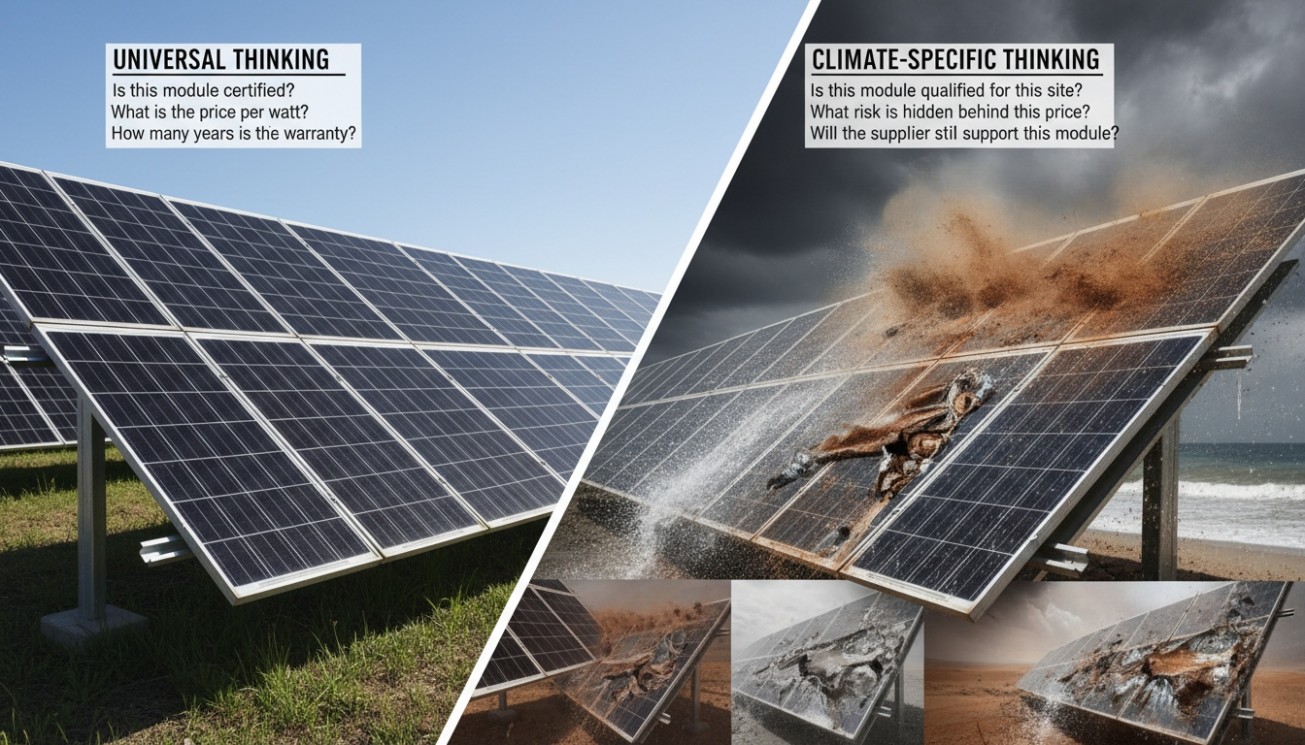
The fourth mistake is overlooking climate conditions. Hot, humid, coastal, desert, snowy and high-wind environments create different risks. A module that performs well in one region may not be the best choice in another.
The fifth mistake is buying from price lists without checking bankability. Low price can be useful, but only when it comes with acceptable documentation, supply reliability and after-sales support.
The sixth mistake is separating module purchase from system design. If the module is selected before the inverter, mounting system, site layout and electrical constraints are understood, redesign costs may appear later.
A real PV module selection guide should help buyers avoid these mistakes before an order is placed.
Why Standard Does Not Mean Static
The standard module category is constantly changing. Ten years ago, standard modules had lower power ratings, different cell formats and different efficiency expectations. Later, half-cut cells, multi-busbar designs, larger wafers, better encapsulation, improved backsheets, double-glass structures and N-type technologies reshaped the mainstream.
This evolution will continue. Some technologies that seem premium today may become standard tomorrow. Some product formats that appear attractive may disappear if they do not fit manufacturing cost, logistics or system design needs.
For this reason, the Standard category should not be written as a fixed definition. It should be written as a moving market framework.
The best question is not “What is a standard module forever?” The better question is “What product features are accepted today as scalable, reliable and bankable for mainstream solar projects?”
That question creates stronger content because it connects technology change with buyer decision-making.
A Practical Evaluation Framework for Standard PV Modules
A buyer can evaluate standard PV modules through a simple five-layer framework.
The first layer is application fit. Is the project residential rooftop, commercial rooftop, ground-mounted, carport, agricultural PV, floating PV or off-grid? Each application changes the module priority.
The second layer is electrical fit. Do the voltage and current ratings match the inverter and string design? Does the project require special attention to low-temperature voltage or high-current input limits?
The third layer is mechanical fit. Does the module size work with the mounting structure? Can installers handle the panel safely? Are clamp zones, wind load and snow load acceptable?
The fourth layer is reliability fit. Does the module structure match climate risk? Is there credible information about degradation, PID resistance, mechanical stress and long-term output?
The fifth layer is commercial fit. Is the price competitive after considering freight, installation, BOS impact, warranty, project delay risk and supplier support?
When all five layers are reviewed together, module selection becomes much more professional. The buyer is no longer choosing a panel from a catalog. The buyer is selecting a component that must perform inside a complete energy asset.
The Role of Standard PV Modules in a Changing Solar Industry

Solar is no longer a niche technology. It is now part of mainstream energy planning, industrial decarbonization, building electrification and power market transformation. As solar expands, the need for standardized products becomes stronger, not weaker.
Large-scale deployment requires modules that can be manufactured in volume. Distributed rooftop markets require modules that can be installed by thousands of contractors. Commercial users require products that can be financed and insured. Grid-scale projects require predictable performance over decades.
This is why crystalline silicon PV modules continue to dominate standard module discussions. They combine manufacturing maturity, supply depth, efficiency improvement and system familiarity. New technologies will continue to compete, but the winning technologies must eventually pass through the same test: can they become standard enough for the market to trust at scale?
That is the real meaning of Standard in PV Modules. It is not a low level of performance. It is the level of performance, reliability and compatibility that the industry can actually build on.
Final Takeaway: Standard Is the Foundation of Solar Scale
A standard PV module is not defined by one number. It is not only wattage, efficiency, cell type or price. It is a complete product logic that connects manufacturing, documentation, logistics, installation, system design, warranty and long-term energy yield.
For buyers, the most important lesson is simple: do not treat standard modules as interchangeable panels. Compare them through the lens of project value.
A module that looks powerful on a datasheet may create design friction if it does not match the inverter, roof layout, mounting structure or handling process. A module with impressive efficiency may not deliver the best financial outcome if its price, warranty or supply risk is not competitive. A low-cost panel may become expensive if documentation is weak or after-sales support is unclear.
The right standard module is the one that fits the project technically, financially and operationally.
That is why standard PV modules deserve their own category. They are not just the middle ground between residential and commercial solar products. They are the technical foundation that makes the entire PV industry scalable, comparable and investable.
Focused FAQ
What is a standard PV module?
A standard PV module is a mainstream solar panel designed for broad project use. It usually follows widely accepted electrical, mechanical, documentation and warranty practices, making it suitable for residential, commercial or utility-scale solar projects depending on its size and specification.
Are standard PV modules lower quality than premium panels?
No. Standard does not mean low quality. In the current solar market, standard often means mature, scalable and bankable. Many high-quality modules with advanced cell technology can still be considered standard if they are widely available and compatible with common project requirements.
Are standard solar panels suitable for both rooftop and ground-mounted projects?
Yes, but selection logic changes by project type. Rooftop solar panels usually require attention to size, weight, aesthetics and installation handling. Ground-mounted and utility projects may prioritize high wattage, logistics, BOS cost and tracker compatibility.
Why should buyers look beyond module efficiency?
Module efficiency is important, especially when space is limited. However, real project value also depends on temperature performance, degradation, mechanical reliability, warranty, system compatibility, installation cost and long-term energy yield.
What should be checked in solar panel specifications?
Important solar panel specifications include power rating, module efficiency, voltage, current, temperature coefficient, dimensions, weight, mechanical load rating, cable and connector type, product warranty, performance warranty and certification documents.
How does solar module warranty affect project value?
A solar module warranty helps buyers evaluate long-term risk. Product warranty covers defects in materials and workmanship, while performance warranty describes expected output over time. Buyers should check degradation terms, exclusions and claim procedures before purchase.
Are crystalline silicon PV modules still the mainstream choice?
Yes. Crystalline silicon PV modules remain the mainstream technology base for most standard solar panels because they combine manufacturing maturity, improving efficiency, broad supply availability and strong system design familiarity.
Why is PV system design connected to module selection?
PV system design depends heavily on module voltage, current, dimensions, weight, mounting requirements and degradation assumptions. Choosing the module without considering inverter matching, mounting layout and site conditions can create redesign costs later.
Can one standard module fit every solar project?
No. A module can be standard and still not be the best fit for every project. The right choice depends on roof space, climate, electrical design, mounting system, labor conditions, budget, warranty expectations and project scale.
What is the best way to compare standard PV modules?
The best approach is to compare modules through a structured PV module selection guide: application fit, electrical fit, mechanical fit, reliability fit and commercial fit. This gives buyers a more accurate view than comparing wattage or price alone.
#StandardPVModules #StandardSolarPanels #PVModuleSelectionGuide #SolarPanelSpecifications #CrystallineSiliconPVModules #UtilitySolarModules #RooftopSolarPanels #ModuleEfficiency #SolarModuleWarranty #PVSystemDesign