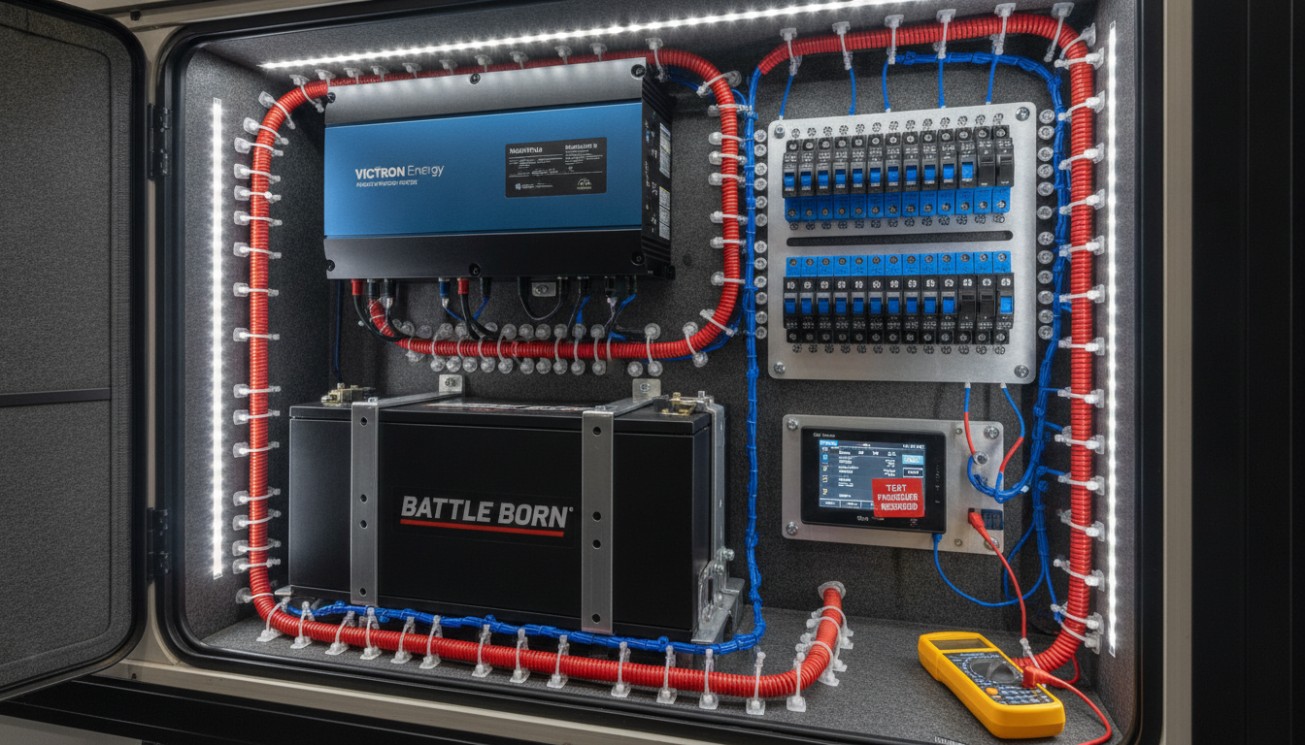
RV Power System Safety and Protection: How Fuses, Breakers, Disconnects and BMS Logic Work Together
Safety Is Not a Feature Added After the RV Power System Is Built
A serious RV power system is not only judged by how much energy it can store, how many watts of solar it can harvest, or how large the inverter looks on a product page. It must also be judged by how safely it behaves when something goes wrong. This is why RV power system safety should be treated as a design layer from the beginning, not as a final accessory added after the main equipment is installed.
Modern RV electrical systems are becoming more capable. Lithium batteries can deliver high current. Inverters can power household appliances. Solar arrays are larger. DC-DC chargers can recover energy while driving. Shore power, generator input, solar input and alternator charging may all connect to the same battery bank. This creates more freedom, but it also raises the importance of RV electrical protection. A system with more power needs more discipline.
Earlier System articles discussed the complete RV power architecture, load planning, multi-source charging, serviceability, AC/DC distribution, energy monitoring and high-load air conditioning. This guide focuses on the protection layer underneath all of them. A system may be powerful, efficient and convenient, but if fuses are missing, breakers are poorly selected, cables are unprotected, disconnects are inaccessible, or the battery management system is misunderstood, reliability becomes fragile.
The purpose of this article is not to provide a do-it-yourself wiring manual or replace qualified electrical work. RV electrical systems involve high-current DC circuits, AC circuits, mobile vibration, confined spaces and equipment-specific installation rules. The goal here is to explain the logic of protection so RV owners, suppliers, installers and buyers can ask better questions. A safer power system is not created by one component. It is created by coordinated protection: fuses, breakers, disconnects, BMS limits, cable routing, grounding, bonding, ventilation, monitoring and fault isolation.
The Real Purpose of Protection: Control the Failure, Not Just the Normal Use
Many buyers think protection devices are only there for emergencies. That is partly true, but incomplete. Protection design is really about controlling what happens when normal assumptions fail. A wire may rub against a sharp edge. A connector may loosen after vibration. A cable may be undersized for a new inverter. A charger may be configured incorrectly. A battery may reach a protection limit. An appliance may overload a circuit. A user may add equipment later without reviewing the original design.
A professional RV power system safety strategy assumes these problems can happen. It does not rely on perfect user behavior or perfect installation conditions forever. It places protection devices where faults are likely to become dangerous. It separates circuits so one problem does not disable the whole vehicle. It allows batteries and chargers to be isolated for service. It gives the user and technician enough information to diagnose the system without guesswork.
Normal Operation Is the Easy Part
During normal operation, power flows from solar panels, shore power, alternator charging or generator input into the battery and then out to DC loads or inverter-supported AC loads. If all components are sized correctly and the user stays within limits, the system may seem simple. But safety is not proven by the fact that the system works on a sunny afternoon. Safety is proven by how the system reacts to overload, short circuit, heat buildup, reverse connection risk, component failure or future modification.
Protection Devices Must Protect the Wiring, Not Only the Appliance
A common misunderstanding is that a fuse or breaker protects the appliance. In many cases, the more important role is to protect the wire. If a wire is capable of safely carrying only a certain amount of current, the protection device should prevent that wire from carrying unsafe current during a fault. This is the foundation of RV overcurrent protection. A large battery bank can deliver enough current to damage wiring quickly if the circuit is not protected correctly.
Protection Must Be Coordinated
One fuse does not protect the entire system in every condition. Different circuits need different protection because they carry different current and serve different functions. Battery-to-inverter cables, solar controller output, DC fuse panel feeds, DC-DC charger cables and small branch circuits all have different current levels. A coordinated protection strategy matches each circuit’s risk and wire size.
Overcurrent Protection: Fuses and Breakers Are the First Line of Defense

RV fuse breaker design is one of the most visible parts of electrical protection, but it is often misunderstood. Fuses and breakers are not decorative items. They are current-limiting devices intended to open a circuit when current exceeds safe limits. In RV systems, they may protect battery cables, inverter circuits, DC branch circuits, solar circuits, charger circuits and AC distribution circuits.
Fuses and Breakers Are Not Always Interchangeable
Fuses and breakers can both provide overcurrent protection, but they are not always used for the same reason. A fuse is often simple, compact and reliable for high-current DC protection. A breaker may provide resettable protection and sometimes act as a switch, depending on the product and application. However, not every breaker is suitable for every DC or AC circuit, and not every resettable device should be used where a properly rated fuse is required.
The key principle is suitability. The protection device must match the voltage, current, interrupt rating, environment and circuit type. High-current DC faults can be severe, so device ratings matter. A low-quality or incorrectly rated breaker in a lithium battery system may create risk rather than protection.
Protection Should Be Close to the Source of Energy
In many DC circuits, overcurrent protection should be located near the energy source so the wire is protected for as much of its length as possible. For example, a battery positive cable feeding an inverter should have appropriate protection near the battery side. A long unprotected cable from a high-current battery bank is a risk because a fault anywhere along that cable may not be limited quickly enough.
Main Protection and Branch Protection Serve Different Purposes
Main protection covers major high-current pathways. Branch protection covers individual circuits. A main battery fuse does not replace the need for a properly organized DC fuse panel. A branch fuse does not replace the need for safe protection at the battery. Good RV electrical protection uses both levels where appropriate.
AC Breakers and DC Fuses Belong to Different Worlds
The previous guide on RV AC/DC power distribution explained why AC and DC circuits must be separated and understood differently. The same logic applies to protection. AC breakers protect AC branch circuits. DC fuses or DC-rated breakers protect DC circuits. A professional system does not casually mix protection devices without respecting circuit type and rating.
Battery Disconnects: Safe Isolation for Storage, Service and Emergency Response
An RV battery disconnect is one of the simplest protection ideas, but it is also one of the most important. It allows the house battery system to be isolated from downstream loads or equipment. In real RV use, disconnects matter for storage, maintenance, troubleshooting, upgrade work and emergency isolation.
Disconnects Should Be Accessible
A disconnect that cannot be found quickly is less useful. It should be labeled and placed where the owner or technician can reach it safely. If the disconnect is hidden deep behind panels or buried behind cargo, it may not help during an urgent situation. Accessibility is part of protection.
Disconnects Are Not a Substitute for Fuses
A disconnect allows manual isolation, but it does not automatically protect against overcurrent. It should not be confused with a fuse or breaker unless the device is specifically designed and rated to provide both functions. A safe system may need both a disconnect and overcurrent protection. One does not automatically replace the other.
Solar, Inverter and Charger Isolation May Need Separate Planning
A battery disconnect may not isolate every power source. Solar panels can still produce voltage when exposed to sunlight. Shore power may still be present if connected. A generator may feed AC circuits. Alternator charging may connect through a DC-DC charger. This is why RV fault isolation should consider multiple energy sources. A complete system may require separate disconnects or isolation procedures for solar input, inverter service, charger service and battery service.
BMS Protection Is Valuable, But It Is Not the Whole Safety System

Many lithium batteries include a battery management system. RV BMS protection can monitor cell voltage, temperature, current and other battery conditions. It may protect against overcharge, over-discharge, overcurrent or temperature-related issues. This is valuable, but it is not a replacement for proper system protection.
The BMS Protects the Battery First
The primary role of the BMS is to protect the battery cells. It is not designed to replace all external fuses, breakers, disconnects, cable protection or system-level design. If a user assumes the BMS will solve every electrical fault, the system may be underprotected. A battery can protect itself and the system can still need correct external protection.
BMS Shutdown Can Surprise the User
If the BMS disconnects due to low voltage, high current, temperature limits or fault conditions, the RV may suddenly lose power. That can affect lights, refrigerators, communication devices, fans or inverter output. A well-designed system uses monitoring and reserve planning to avoid unnecessary BMS shutdown. The article on RV energy monitoring explains why visibility is essential for lithium systems.
External Protection Still Matters
Even with BMS protection, the system still needs correct RV overcurrent protection. A fuse can protect a cable from a fault. A breaker can protect a branch circuit. A disconnect can isolate equipment. A monitor can warn the owner before limits are reached. These are different functions. The best systems layer them together rather than trusting one device to do everything.
BMS Data Should Be Documented
If the battery provides Bluetooth or communication data, the owner should know what the readings mean. Voltage, current, temperature, state of charge and protection alerts should be interpreted correctly. For suppliers and installers, BMS limits should be part of the handover documentation, especially in systems with large inverters or high-load appliances.
Cable Protection: The Wire Is Part of the System, Not Just a Connection

RV cable protection is often less visible than a lithium battery or inverter, but it is one of the most important safety layers. A cable is not simply a path from one device to another. It has current limits, insulation limits, bend limits, routing needs, temperature exposure and vibration risk. If the cable is ignored, the system becomes unsafe even when the main components are high quality.
Cable Size Must Match Current and Distance
High-current DC circuits need appropriate cable size. Current, cable length and acceptable voltage drop all matter. A cable that is too small may heat up or cause voltage drop. A long cable run may need larger conductors than a short one. Inverter cables are especially important because large AC loads can create high DC current from the battery bank.
Abrasion Protection Matters in a Moving Vehicle
RVs move, vibrate and flex. Wires that pass through walls, metal edges, cabinetry or exterior compartments need protection from abrasion. Grommets, conduit, loom, clamps and strain relief can reduce the risk of insulation damage. A wire that looks safe on installation day may be damaged months later if it rubs during travel.
Heat and Bundling Must Be Considered
Cables can heat under load, especially when many cables are tightly bundled or placed in poorly ventilated spaces. High-current wires should not be packed in a way that traps heat or makes inspection impossible. Chargers and inverters also generate heat, so cable routing should consider nearby equipment temperature.
Labels Reduce Human Error
Labels are a safety tool. They reduce the chance of disconnecting the wrong cable, connecting a charger incorrectly or misunderstanding a circuit during troubleshooting. A label such as “battery positive to inverter,” “solar controller output,” “DC-DC charger input,” or “main DC bus” can prevent confusion. This connects directly with RV electrical documentation.
Grounding and Bonding: Why Mobile Electrical Systems Need Clear Rules
RV grounding and bonding is a complex subject because RVs combine mobile DC systems, AC shore power, generator input, inverter output and vehicle chassis connections. Practices can vary by region, product design and applicable standards, so qualified professionals and equipment manuals should guide final installation. Still, RV owners should understand why grounding and bonding cannot be treated casually.
Grounding Is About Reference and Fault Paths
Grounding can provide a reference point and support fault current paths in certain electrical systems. In an RV, the DC negative system, chassis connection and AC grounding arrangement must be understood according to the system architecture. Incorrect assumptions can create safety issues or troubleshooting confusion.
Bonding Is About Connecting Conductive Parts Intentionally
Bonding connects conductive parts so they remain at the same electrical potential and can support fault clearing where designed. In an RV, metal frames, equipment cases, inverter chassis, shore power grounding and generator or inverter transfer arrangements may all require careful treatment. The details depend on equipment and standards.
Inverter and Shore Power Transfer Can Change the Discussion
When the RV is connected to shore power, AC grounding behavior may differ from inverter-only operation. Some inverter chargers have transfer behavior and internal bonding logic that must be installed according to the manufacturer’s instructions. This is not a place for guesswork. A safer system follows the product manual and applicable electrical rules.
Documentation Helps Future Service
Because grounding and bonding can be misunderstood, documentation is important. The system record should identify major grounding points, chassis connections, inverter installation notes and shore/generator transfer behavior. This helps future technicians avoid unsafe assumptions.
Thermal Protection: Heat Is a System-Level Risk
RV thermal protection is not only about battery temperature. Heat can affect inverters, chargers, cables, fuses, terminals, solar controllers and enclosed compartments. RV systems often place high-power electronics in small spaces, which makes heat management important.
Inverters and Chargers Need Ventilation
Inverters and chargers can generate heat during heavy use. Running air conditioning, electric cooking or large charging currents may keep these devices working hard. If they are installed in a poorly ventilated compartment, they may reduce output, shut down or age faster. Equipment manuals should guide spacing and ventilation requirements.
Lithium Batteries Have Temperature Boundaries
LiFePO4 batteries can be sensitive to temperature, especially charging in cold conditions. Some batteries include low-temperature charging protection or heating features. The BMS may block charging when conditions are unsafe. This is useful protection, but the system should still be designed around the environment where the battery is installed.
Loose Connections Create Heat
A loose or poor connection can create resistance and heat under load. High-current circuits deserve periodic inspection by qualified personnel. Signs such as discoloration, odor, melting, repeated fuse issues or unexpected shutdowns should be treated seriously.
Thermal Monitoring Can Support Maintenance
Some advanced systems provide temperature data from batteries, inverters or chargers. Even basic visual inspection and good access can help identify heat problems early. Monitoring is useful, but it does not replace correct installation and ventilation.
Fault Isolation: Make Problems Smaller and Easier to Diagnose

RV fault isolation means designing the system so a problem can be contained and located. This is different from simply preventing every possible fault. No system can guarantee that nothing will ever fail. A better goal is to make faults less dangerous, less confusing and less likely to disable unrelated circuits.
Separate High-Current and Low-Current Circuits
High-current circuits such as inverter feeds should be separated from small DC branch circuits. A problem in a small accessory should not affect the main inverter path. A problem in the inverter should not make every DC load impossible to identify. Clear separation supports both safety and troubleshooting.
Separate Essential and Optional Loads
Essential loads such as lights, refrigerator controls, fans, water pump or communication equipment should be planned carefully. Optional comfort loads, such as entertainment systems or noncritical outlets, should not compromise essential circuits. This is especially important for off-grid travel.
Separate Charging Sources Where Possible
Solar, shore power, generator input and alternator charging have different behaviors. If the system has a charging problem, it should be possible to inspect each source separately. The article on multi-source RV charging explains why recovery pathways should be understood as separate inputs.
Use Labels and Diagrams to Reduce Diagnostic Time
Fault isolation improves when labels and diagrams exist. A technician can quickly identify which fuse protects which load, where the solar controller output enters the bus, how the inverter is connected and how the battery disconnect works. Without documentation, troubleshooting becomes expensive exploration.
Safety Planning for Different RV Power Levels

Not every RV power system has the same risk profile. A small weekend camper system and a large full-time off-grid motorhome require different levels of protection detail. The principles are the same, but the scale changes.
Small Weekend Systems
A small system may include a modest battery, limited solar, simple DC loads and a small inverter. Protection still matters. The system needs proper fusing, safe wire routing, accessible battery isolation and clear labels. Small does not mean protection can be ignored.
Remote Work Systems
A remote work system may include laptops, internet equipment, monitors, camera gear and quiet off-grid charging. These loads may not be as heavy as air conditioning, but they may be critical. Protection planning should keep communication and work circuits reliable. Monitoring can help prevent unexpected shutdowns during work hours.
High-Inverter Systems
A system with a large inverter demands more careful DC protection. Battery discharge current, cable size, fuse rating, inverter ventilation, AC circuit separation and BMS limits must be reviewed together. The article on RV solar air conditioner power systems shows why high-load appliances require system-level thinking.
Full-Time Off-Grid Systems
A full-time off-grid system may include large lithium storage, high solar capacity, DC-DC charging, inverter charger integration, multiple AC circuits and smart monitoring. In this case, RV power system safety becomes part of everyday living infrastructure. The system should be documented, serviceable and designed for inspection.
Common Protection Mistakes in RV Power Systems
Many protection problems come from treating RV electrical work as an accessory installation rather than a system design problem. The following mistakes appear often in poorly planned upgrades.
Mistake 1: Oversized Fuses That Do Not Protect the Wire
A fuse that is too large may allow the wire to carry unsafe current before opening. The protection device should be selected around the wire and circuit design, not only around the appliance rating. Oversized protection creates false confidence.
Mistake 2: No Protection Close to the Battery
A long unprotected battery cable is dangerous because the battery can deliver high fault current. Main protection near the battery side is a core part of RV overcurrent protection.
Mistake 3: Trusting the BMS as the Only Safety Device
RV BMS protection is important, but it does not replace external fuses, breakers, disconnects, wiring protection or safe installation. The BMS protects the battery; the system still needs system-level protection.
Mistake 4: Hidden Disconnects and Unlabeled Breakers
If the owner cannot find the disconnect or identify a breaker, the system becomes harder to isolate during service or faults. Safety devices should be accessible and labeled.
Mistake 5: Poor Cable Routing Through Sharp or Moving Areas
Road vibration can damage poorly protected wires over time. RV cable protection should include abrasion control, strain relief and secure routing.
Mistake 6: Adding Equipment Without Rechecking Protection
Adding a larger inverter, extra battery, new solar controller or DC-DC charger can change current flow. Protection should be reviewed whenever the system expands. The original fuse and cable choices may no longer be suitable.
How Suppliers and Installers Can Communicate Protection as Value
For suppliers and installers, safety protection can be a strong differentiator. Many marketing pages focus on battery capacity, inverter output and solar wattage. Fewer explain the protection architecture that makes the system trustworthy. This creates an opportunity to communicate expertise.
Show the Protection Map
A simple protection map can show main battery fuse, inverter protection, DC fuse panel, AC breaker panel, solar disconnect, battery disconnect, DC-DC charger protection and monitoring points. This helps customers understand why the system costs more than a basic parts bundle.
Document Fuse and Breaker Ratings
Installers should record fuse and breaker ratings in the handover documents. This supports future troubleshooting and prevents unsafe replacement with random parts. The customer should know that ratings were chosen intentionally.
Explain BMS Limits Honestly
Customers often hear that lithium batteries have BMS protection and assume everything is safe. Suppliers should explain what the BMS protects and what external protection still does. This builds trust and reduces misuse.
Use Safety Language Without Fear Marketing
Protection should not be sold by frightening customers. It should be presented as professional engineering: controlled current, accessible isolation, documented circuits, better serviceability and lower uncertainty. The best sales language is not “danger everywhere.” It is “the system is designed to behave predictably.”
Protection Checklist Before Approving an RV Power System
Before buying, installing or approving a serious RV power system, owners and suppliers should review a practical protection checklist. This checklist is not a substitute for professional design, but it helps structure the conversation.
Overcurrent Protection
- Are major battery cables protected by correctly rated fuses or breakers?
- Is protection located close enough to the energy source?
- Are DC protection devices rated for the circuit type and voltage?
- Are AC breakers and DC fuses separated according to their roles?
- Are fuse and breaker ratings documented?
Disconnects and Isolation
- Is there an accessible RV battery disconnect?
- Can solar input be isolated for service?
- Can inverter and charger circuits be isolated safely?
- Are disconnects labeled clearly?
- Does the user know what each disconnect does and does not isolate?
Battery and BMS
- Are battery BMS current limits matched to inverter demand?
- Does the battery support the required discharge current?
- Are low-temperature charging conditions considered?
- Does monitoring help avoid unnecessary BMS shutdown?
- Are battery data and limits included in the documentation?
Cable and Routing
- Are cables sized for current and distance?
- Are wires protected from abrasion and vibration?
- Are high-current cables routed with service access?
- Are cable labels clear?
- Are terminals secure and inspectable?
Grounding, Bonding and Thermal Management
- Does the system follow equipment manuals and applicable electrical rules?
- Are grounding and bonding points documented?
- Do inverters and chargers have required ventilation?
- Are batteries installed in a suitable temperature environment?
- Can heat-related issues be inspected or monitored?
Focused FAQ
What is RV power system safety?
RV power system safety is the design approach that limits electrical faults, protects wiring, isolates batteries and equipment, manages heat and makes problems easier to diagnose. It includes fuses, breakers, disconnects, BMS limits, cable protection, grounding, bonding and monitoring.
Why is RV electrical protection important?
RV electrical protection is important because modern RV systems can involve high-current lithium batteries, large inverters, multiple charging sources and both AC and DC circuits. Protection reduces the risk of wire damage, overload, unsafe heat and uncontrolled fault behavior.
What is RV fuse breaker design?
RV fuse breaker design is the process of selecting and placing fuses or breakers so they protect wires and circuits from unsafe current. The device must match the circuit type, current level, voltage and installation environment.
What does an RV battery disconnect do?
An RV battery disconnect allows the house battery system to be manually isolated from downstream loads or equipment. It is useful for storage, maintenance, troubleshooting and emergency isolation, but it does not replace proper overcurrent protection.
What is RV overcurrent protection?
RV overcurrent protection uses fuses, breakers or other approved devices to open a circuit when current exceeds safe limits. It is often designed to protect the wire from overheating or damage during a fault.
Does RV BMS protection replace fuses?
No. RV BMS protection helps protect lithium battery cells from unsafe battery conditions, but it does not replace external fuses, breakers, disconnects, cable protection or safe system design. The BMS is one protection layer, not the entire safety system.
Why is RV cable protection important?
RV cable protection prevents wires from being damaged by current overload, abrasion, vibration, heat, sharp edges or poor routing. Since RVs move and vibrate, cable support and protection are critical for long-term reliability.
What is RV fault isolation?
RV fault isolation means designing the system so problems can be contained and diagnosed by zone, such as battery storage, inverter output, solar charging, DC circuits or AC circuits. It helps reduce confusion and prevents one fault from affecting unrelated parts of the system.
Conclusion: Safer RV Power Comes from Layered Protection
A reliable RV power system is not only designed to deliver energy. It is designed to control energy when conditions are not ideal. This is the central idea behind RV power system safety. Solar panels, lithium batteries, inverter chargers and smart displays can make RV travel more comfortable, but protection design determines whether the system remains trustworthy under stress.
No single device can provide complete safety. Fuses and breakers limit overcurrent. A battery disconnect supports isolation. The BMS protects lithium cells within its own boundaries. Cable protection prevents hidden damage. Grounding and bonding support proper fault behavior when designed correctly. Thermal protection reduces heat-related risk. Monitoring helps users see problems earlier. Fault isolation makes troubleshooting more controlled. Together, these layers create safer mobile power.
For RV owners, the practical lesson is to ask protection questions before judging a system by headline wattage. Where is the main battery protection? Are fuses and breakers documented? Can the battery be isolated? Are cables protected from vibration and abrasion? Does the BMS match the inverter load? Are grounding and bonding handled according to the equipment manuals? Can a technician understand the system later?
For suppliers and installers, protection is a professional value proposition. Customers may not immediately see the value of a clean protection architecture, but they will feel it when the system is easier to service, safer to operate and less confusing during faults. In the System category, this is the message: off-grid RV power is not only about freedom from hookups. It is about controlled, documented and protected energy flow in a mobile environment. The best RV electrical systems are not only powerful. They are designed to fail safely, isolate clearly and remain understandable over time.
#RVPowerSystemSafety #RVElectricalProtection #RVFuseBreakerDesign #RVBatteryDisconnect #RVOvercurrentProtection #RVBMSProtection #RVCableProtection #RVGroundingAndBonding #RVThermalProtection #RVFaultIsolation