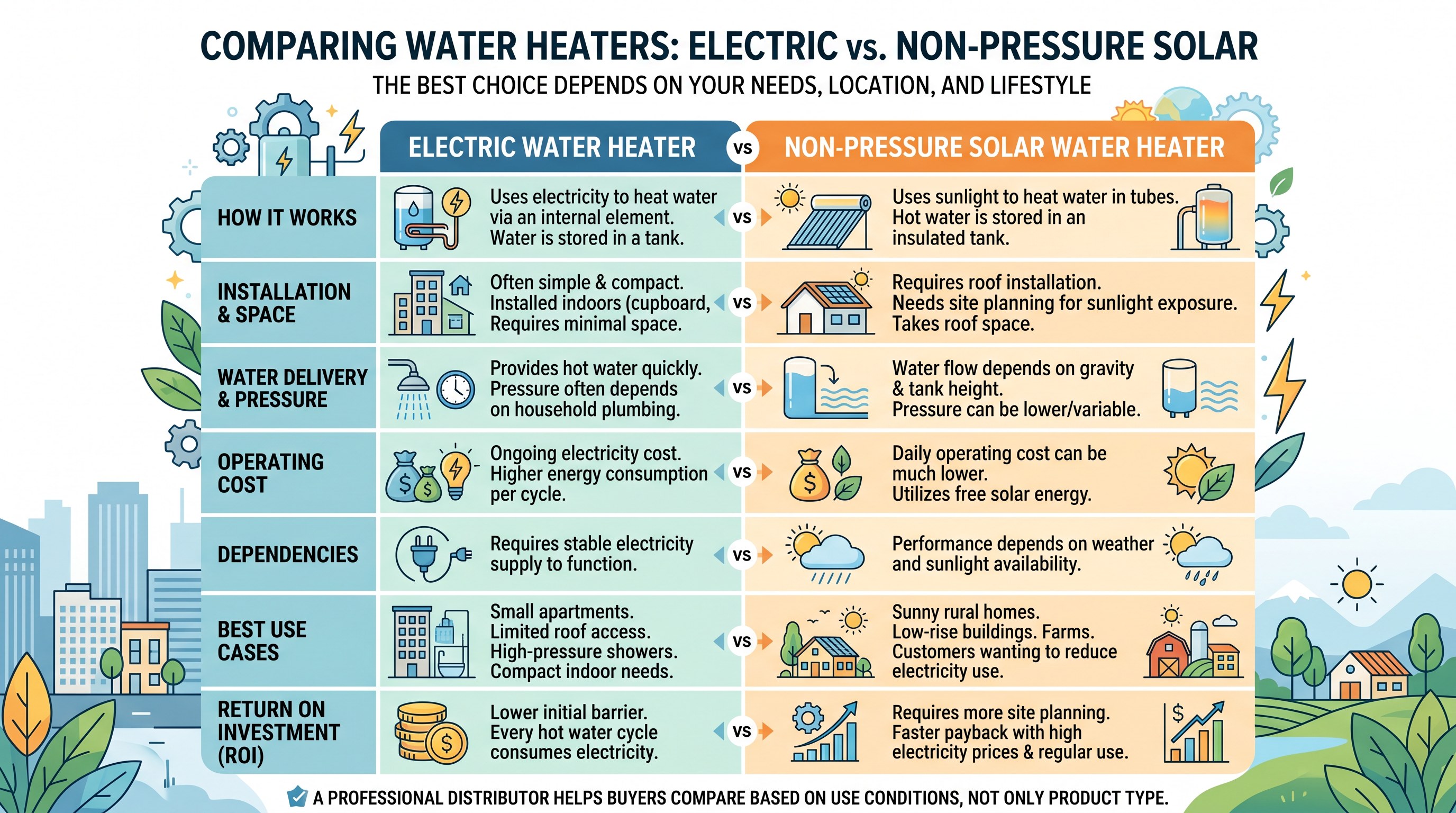
How a Non-Pressure Solar Water Heater Works: Tank, Vacuum Tubes and Natural Circulation
Understanding the System Before Judging the Product
A non-pressure solar water heater is often described as a simple solar hot water system, but “simple” should not be misunderstood as “low value.” Its working principle is based on a practical combination of solar heat collection, water density change, gravity-fed movement, and insulated storage. When these parts work together correctly, the system can provide domestic hot water without the complexity of a pressurized tank, circulation pump, or advanced control system.
This is why the non pressure solar water heater remains widely used in many international markets. It is not designed to compete with every high-pressure solar water heating system. Instead, it solves a specific type of problem: how to heat and store water using solar energy in buildings where water pressure is low, electricity may be unstable, installation budgets are limited, and the hot water demand is relatively predictable.
To understand how a non-pressure solar water heater works, the key is to look at it as a complete system, not as separate parts. The evacuated tubes are not just glass tubes. The storage tank is not just a container. The support frame is not only a metal stand. The inlet, outlet, vent, overflow, insulation, pipe height, and water level all affect performance.
A well-designed low pressure solar water heater depends on balance. The tubes must collect enough solar energy. The tank must hold enough hot water and reduce heat loss. The system must allow hot and cold water to move naturally. The outlet must be installed in a way that delivers usable flow. If one part is poorly matched, the whole system may still look correct from the outside but perform poorly in daily use.
This article explains the working principle from the inside out: how sunlight becomes heat, how the evacuated tubes transfer heat to water, how thermosiphon circulation moves water, how the storage tank keeps heat, and why gravity-fed delivery affects the user experience.
The Basic Structure of a Non-Pressure Solar Water Heater
A typical non-pressure solar water heater has five main parts: the insulated storage tank, evacuated glass tubes, support frame, water inlet and outlet system, and optional control or backup accessories. Each part has a clear function.
The storage tank is usually positioned above the evacuated tubes. It stores water before, during, and after heating. Because the system is non-pressurized or low-pressure, the tank is normally not designed to work like a fully closed pressure vessel. In many designs, the tank is open to the atmosphere through a vent or overflow structure. This helps prevent internal pressure buildup and allows the system to work under safer low-pressure conditions.
The evacuated tubes are installed below the tank at an angle. Their job is to absorb solar radiation and transfer heat to the water inside the tube. In many direct-heating non-pressure systems, water enters the tubes directly. As the water absorbs heat, it rises back into the tank. Cooler water from the tank flows down into the tubes. This creates a continuous natural circulation cycle during sunny periods.
The support frame fixes the tank and tubes at the correct angle. This angle matters because solar exposure affects how much heat the system can collect. A weak or poorly installed frame can also create safety risks, especially when the tank is full of water and the system is exposed to wind, roof vibration, and long-term outdoor conditions.
The inlet and outlet system controls how cold water enters and how hot water leaves. In a gravity fed solar water heater, the hot water outlet normally depends on the height difference between the tank and the water outlet point, such as a shower or faucet. The higher the tank is above the outlet, the stronger the natural flow can be.
Optional accessories may include a water-level controller, electric backup heater, temperature display, magnesium rod, auxiliary tank, or simple valves. These accessories do not change the basic working principle, but they can improve convenience, safety, and user experience in different markets.
How Sunlight Becomes Usable Hot Water
The first step in the working principle is solar heat collection. Sunlight reaches the evacuated tubes. The absorber surface inside the tube captures solar radiation and converts it into heat. Because the tube has a vacuum layer, heat loss to the surrounding air is reduced. This is why evacuated tube solar water heater systems are common in non-pressure applications. They can collect and retain heat efficiently under suitable sunlight conditions.
In a direct non-pressurized solar water heating system, water is usually in contact with the heated tube area. As solar radiation warms the tube, the water inside the tube absorbs heat. The temperature of this water rises gradually. Once it becomes warmer than the water in the tank, its density decreases. Hotter water becomes lighter, so it moves upward toward the storage tank.
At the same time, cooler water from the lower part of the tank moves downward into the evacuated tubes. This movement does not need a mechanical pump. It is caused by the natural difference between hot and cold water density. This is the foundation of thermosiphon solar water heater operation.
The process continues as long as there is enough sunlight and a temperature difference between the tube water and tank water. During strong sunlight, circulation becomes more active. During weak sunlight, circulation becomes slower. At night, when there is no solar radiation, the system no longer collects heat, and the storage tank’s insulation becomes the most important factor for keeping water warm.
This is why the quality of tank insulation matters so much. A system may collect heat well during the day, but if the storage tank loses heat quickly at night, the user may still experience unsatisfactory hot water in the morning. Good solar water heater design is not only about heat collection. It is also about heat storage.
Thermosiphon Circulation: The Core Working Logic

Thermosiphon circulation is the core principle behind many passive solar water heater systems. It is a natural movement of water caused by temperature and density differences. In simple terms, hot water rises and cold water sinks.
In a non-pressure solar water heater, the evacuated tubes are placed below the storage tank. When the water in the tubes is heated by sunlight, it rises into the tank. Cooler water from the tank drops into the tubes to replace it. This creates a loop: cold water moves down, hot water moves up, and the tank gradually becomes filled with warmer water.
This process is elegant because it uses physics instead of mechanical force. There is no pump to start. There is no complex controller required for basic circulation. There is no need for an external power source to move water inside the collector loop. For low-pressure homes, rural buildings, and off-grid applications, this is a major advantage.
However, thermosiphon circulation also has requirements. The tank must be positioned correctly above the tubes. The connection between the tubes and the tank must allow smooth water movement. The tubes must be installed at a suitable angle. The system must not be blocked by scale, air pockets, or poor sealing. If circulation is restricted, heat transfer becomes less efficient.
A common mistake is to assume that any tank and tube combination will perform well as long as it is exposed to sunlight. In reality, the internal flow path matters. If hot water cannot rise smoothly, or if cooler water cannot move down into the tubes, the system may collect heat unevenly. Some tubes may become very hot while the tank water remains less heated than expected.
This is one reason why experienced suppliers pay attention to tank design, tube spacing, sealing rings, manifold structure, and installation angle. A good system should support stable natural circulation, not merely look correct after assembly.
The Role of the Storage Tank

The storage tank is the center of a non-pressure solar water heater. It receives cold water, stores heated water, supports thermosiphon circulation, and supplies hot water to the user. Its design has a direct impact on daily performance.
The tank has three important functions. First, it stores water volume. The capacity of the tank determines how much hot water can be available for daily use. Common residential capacities include 100L, 150L, 200L, and 300L, but the right capacity depends on the number of users, bathing habits, climate, and water temperature expectations.
Second, the tank stores heat. The tank is usually insulated with polyurethane foam or another insulation material. The purpose is to slow heat loss after the water has been heated. Without good insulation, water may heat well during the afternoon but cool quickly by night or early morning.
Third, the tank supports water layering. In many solar hot water storage tanks, hotter water tends to stay near the top while cooler water remains lower. This temperature layering can help the user access hotter water first. However, poor tank design, excessive mixing, or unstable water filling can disturb this layering and reduce usable hot water comfort.
Because the system is non-pressurized, the tank must also manage air, overflow, and water level safely. If the tank is overfilled, water may escape through the overflow. If the tank is empty or too low while the tubes are exposed to strong sunlight, overheating or tube stress may occur. This is why some systems use float valves, water-level controllers, or auxiliary tanks to maintain proper water volume.
For B2B buyers, the tank should not be judged only by its outer appearance. Important details include inner tank material, welding quality, insulation thickness, outer shell corrosion resistance, vent design, inlet and outlet layout, electric heater port design, and packaging protection. In many export markets, after-sales problems often begin with tank leakage, poor insulation, rust, or damaged fittings.
Why Evacuated Tubes Are Common in Non-Pressure Systems

Evacuated tubes are widely used in non-pressure solar water heaters because they fit the system’s cost-performance logic. They are efficient solar heat collectors, relatively easy to assemble, and suitable for compact tank-and-tube structures.
An evacuated tube usually has a double-layer glass structure with a vacuum space between the layers. The vacuum helps reduce heat loss. The inner surface often has an absorber coating that improves solar energy absorption. When sunlight hits the tube, the absorber converts radiation into heat, and the water inside or connected to the tube absorbs that heat.
For a direct low pressure solar water heater system, evacuated tubes allow simple heat transfer. Water enters the tube, gets heated, and returns to the storage tank through natural circulation. This makes the product relatively easy to understand and easy to demonstrate to end users.
Evacuated tubes are also modular. A supplier can offer different models by changing tank size and tube quantity. For example, a smaller household model may use fewer tubes, while a larger family model may use more tubes and a bigger tank. This makes it easier for distributors to build a product lineup for different household sizes.
But tube quality matters. Low-quality tubes may lose vacuum, break more easily, absorb less heat, or fail during transport. In export trade, tube packaging is especially important because glass tubes are fragile. A buyer comparing suppliers should look beyond the quoted price and ask about tube coating, vacuum retention, wall thickness, breakage rate, spare tube supply, and packaging method.
The evacuated tube is one of the most visible parts of the product, but it should not be treated as the only performance factor. The best tube cannot compensate for a poorly insulated tank, weak frame, wrong installation angle, or unsuitable plumbing layout.
Gravity-Fed Delivery and User Experience
After the system heats water, the next question is how the hot water reaches the user. This is where non-pressure systems differ most clearly from pressurized systems.
In a gravity fed solar water heater, hot water flow depends mainly on height difference. If the storage tank is installed above the shower or faucet, water can flow downward by gravity. The greater the vertical distance between the tank and the outlet, the better the natural pressure may be.
This is why rooftop installation is common. Placing the tank on the roof can create useful height above the bathroom. However, not every roof layout provides the same result. If the bathroom is close to roof level, if the tank is not high enough, or if the pipe route is long and narrow, the hot water flow may be weak.
This point is critical for customer satisfaction. A non pressure solar water heater may produce hot water, but users may still complain if the shower flow is too low. The problem is not always heating performance. It may be hydraulic design.
Pipe diameter, pipe length, bends, valve type, shower head resistance, and mixing valve compatibility all affect flow. Some modern thermostatic mixing valves require higher pressure to work properly. If they are installed with a low-pressure system, the result may be poor temperature control or weak flow.
For this reason, installers should match fittings to the system. A low pressure solar water heater should use suitable low-resistance outlets, reasonable pipe routing, and enough tank height. If a customer demands stronger pressure, the supplier may need to recommend a booster pump or a pressurized solar water heater instead.
The honest explanation is important: non-pressure systems are not designed for high-pressure luxury showers. They are designed for practical hot water delivery under low-pressure conditions. When users understand this before purchase, satisfaction is much higher.
Water Filling, Overflow and Venting
A non-pressurized solar water heating system must manage water level correctly. In many designs, water enters the storage tank through an inlet controlled by a valve, float device, or water-level controller. When the tank reaches the designed level, extra water may exit through an overflow path. The vent helps keep the tank from building pressure.
This open or vented design is part of what makes the system non-pressure. It allows the tank to operate under safer low-pressure conditions, but it also means that installation must respect the venting and overflow design. Blocking the vent, connecting the tank incorrectly, or trying to force the tank to behave like a pressure vessel can create safety and performance problems.
Water filling also affects temperature. If cold water is added at the wrong time or too quickly, it can mix with hot water and reduce outlet temperature. In some households, users refill the tank manually or at specific times. In other systems, automatic water-level controllers maintain water volume more conveniently.
For end users, the practical rule is simple: the system should not be allowed to run dry under strong sunlight, and it should not be modified in a way that traps pressure inside the tank. For suppliers, the product manual should clearly explain inlet, outlet, overflow, vent, and electric backup connections. Many after-sales issues are caused by unclear installation instructions rather than by the product concept itself.
Why Installation Angle and Orientation Matter
The working principle of a solar water heater begins with sunlight, so placement matters. The evacuated tubes should face the proper direction for the local hemisphere and receive strong sunlight for as many hours as possible. Shadows from trees, walls, nearby roofs, chimneys, or other equipment can reduce performance.
The installation angle also matters. A suitable angle helps the tubes collect solar radiation efficiently and supports natural circulation. If the angle is too flat or too steep for the local conditions, heat collection may be reduced. If the frame is not fixed properly, wind load and long-term vibration can damage the system.
In B2B markets, installation conditions vary widely. A distributor may sell the same model to customers with tile roofs, metal roofs, concrete roofs, flat roofs, and rural structures. The frame design and installation accessories must be adaptable. A strong frame is not just a nice feature; it affects safety, durability, and brand reputation.
Roof load should also be considered. A full water tank is heavy. The frame, tank, tubes, and water together create a concentrated load. Before installation, the roof structure should be checked, especially for older houses, lightweight roofs, or improvised rural buildings.
This is another reason why non-pressure solar water heater content should be educational. The buyer may see a simple rooftop product, but safe and effective installation still requires judgment. Proper orientation, angle, fixing, pipe routing, and roof support determine whether the system works well after purchase.
Heat Storage and Nighttime Performance
A non-pressure solar water heater collects heat during the day, but many users need hot water in the evening or early morning. This makes heat storage just as important as heat collection.
The storage tank insulation determines how much heat remains after sunset. A tank with poor insulation may lose temperature quickly overnight. A tank with better insulation can keep water usable for a longer period. This is especially important in regions with large day-night temperature differences.
Nighttime performance also depends on user behavior. If the hot water is used heavily in the evening, there may be less hot water left for the next morning. If cold water refills the tank after use, the average tank temperature may drop. If the tank is oversized and not fully heated during weak sunlight, users may experience lukewarm water.
The system’s performance is therefore not a fixed number. It depends on solar radiation, tank capacity, insulation quality, usage timing, refill timing, ambient temperature, and installation quality. A professional supplier should avoid promising the same result in every climate. Instead, the supplier should help buyers match tank capacity and accessory options to local conditions.
For example, in markets with frequent cloudy days, an electric backup heater can improve user satisfaction. In sunny regions with strong afternoon radiation, good insulation may be enough for evening hot water. In cold climates, a standard open direct non-pressure system may require additional freeze protection or may not be the right product type.
What Can Go Wrong Inside the System?

A non-pressure solar water heater has fewer mechanical parts than many pressurized systems, but it is not maintenance-free. Several internal problems can reduce performance over time.
Scale is one common issue. In areas with hard water, minerals can build up inside the tank, tubes, or fittings. Scale reduces heat transfer, restricts water movement, and may shorten product life. Because direct non-pressure systems often heat water directly inside the tubes, water quality is important.
Air blockage or poor water circulation can also affect performance. If water does not move smoothly between the tank and tubes, some areas may become hotter while the storage tank heats slowly. Poor installation, blocked connections, or damaged seals can contribute to this issue.
Tube breakage is another concern. Evacuated tubes are efficient but fragile. Hail, transport damage, improper installation, or thermal shock can cause breakage. Spare tube availability is important for distributors and installers.
Tank leakage can occur if material quality, welding, or corrosion resistance is poor. This is why inner tank material and manufacturing quality matter. In coastal, humid, or chemically aggressive environments, corrosion risk is higher.
Overheating can occur when the system receives strong sunlight but hot water is not used for a long period. If the tank is empty or water level is too low, overheating risk increases. Some users may need to cover tubes during long periods of non-use or follow supplier instructions for safe shutdown.
These issues do not mean the system is unreliable. They mean the system should be selected, installed, and maintained according to its working principle.
How B2B Buyers Should Read the Working Principle

For homeowners, understanding the working principle helps set realistic expectations. For B2B buyers, it helps evaluate supplier quality.
A buyer should ask whether the product design supports smooth thermosiphon circulation. The tank and tube connection should be reliable. The sealing system should be stable. The tube angle and frame design should support both heat collection and safe installation.
A buyer should also ask about tank insulation. The supplier should be able to explain insulation thickness, material, and expected heat retention. If a supplier only emphasizes tank capacity but cannot explain insulation, the buyer should be cautious.
Material selection is another key point. Inner tank material, outer shell material, frame coating, bracket strength, sealing rings, and fasteners all affect long-term performance. For export markets, packaging should be evaluated as part of product quality. A good system that arrives with broken tubes or dented tanks creates cost for everyone.
Installation documentation is also part of the product. Non-pressure systems are often sold in markets where local installers may have different levels of training. Clear manuals, diagrams, accessory lists, and installation videos can reduce mistakes and complaints.
Finally, the supplier should be honest about application limits. If a project requires strong water pressure, multiple bathrooms, high-rise installation, or integration with modern pressure plumbing, a non pressure solar water heater may not be the best option. A professional supplier should recommend the right system, not force one product into every project.
Reading the System as a Complete Hot Water Solution
The real value of a non-pressure solar water heater becomes clear when it is understood as a complete hot water solution rather than a single product. Its logic is not complicated, but every part has a purpose.
The evacuated tubes collect solar heat.
The storage tank keeps heated water available.
Thermosiphon circulation moves water without a pump.
Gravity-fed delivery sends hot water to the outlet.
Insulation reduces heat loss.
Venting and overflow manage low-pressure safety.
Correct installation turns the product into a usable daily system.
This system logic explains both the strengths and limitations. The strength is practical simplicity. The limitation is that performance depends heavily on correct matching: sunlight, water pressure, tank height, capacity, climate, and user behavior.
For international markets, this makes the category very important. In many regions, customers need affordable solar hot water more than they need advanced pressure integration. They need products that can be installed on simple roofs, explained by local dealers, repaired with available parts, and operated without complex controls.
That is why the working principle of a low pressure solar water heater should not be hidden in technical manuals only. It should be part of sales education, product pages, distributor training, installation guides, and after-sales support.
Focused FAQ
How does a non-pressure solar water heater work?
A non-pressure solar water heater uses evacuated tubes to collect solar heat and a storage tank to hold heated water. As water in the tubes becomes hot, it rises into the tank. Cooler water moves down into the tubes. This natural circulation is called thermosiphon circulation.
Does a non-pressure solar water heater need a pump?
In most basic systems, no pump is needed for internal heating circulation. The system uses natural temperature-driven movement. However, a pump may be added in some installations to improve outlet pressure, but that is separate from the basic solar heating principle.
Why is it called a thermosiphon solar water heater?
It is called thermosiphon because water moves naturally when heated. Hot water becomes lighter and rises, while cooler water sinks. This creates circulation between the evacuated tubes and the storage tank without mechanical pumping.
What is the role of evacuated tubes?
Evacuated tubes collect solar radiation and transfer heat to the water. Their vacuum insulation helps reduce heat loss, making them effective collectors for compact non-pressure solar water heater systems.
Why does the storage tank need to be above the tubes?
The tank must be above the tubes to support natural circulation. Hot water from the tubes rises into the tank, while cooler water from the tank flows down into the tubes. If the tank position is wrong, circulation may become weak.
Why is hot water pressure lower than in pressurized systems?
Hot water pressure depends mainly on gravity and tank height. Since the system is not a fully pressurized tank, it usually cannot deliver the same outlet pressure as a pressurized solar water heater.
Can a non-pressure system provide enough hot water for a family?
Yes, if the capacity is correctly selected and the installation conditions are suitable. Common household sizes include 100L, 150L, 200L, and 300L. The right choice depends on family size, climate, and bathing habits.
What affects heating performance the most?
Heating performance is affected by sunlight, tube quality, installation angle, tank insulation, water quality, circulation design, and daily water use. The product should be evaluated as a full system, not only by tank size.
Is a non-pressure solar water heater suitable for hard water areas?
It can be used, but hard water may cause scale buildup over time. Regular inspection, cleaning, and suitable maintenance are important in areas with high mineral content.
What should B2B buyers check before purchasing?
B2B buyers should check tank material, insulation quality, evacuated tube specifications, frame strength, sealing design, accessory completeness, packaging protection, spare parts availability, and installation documentation.
Conclusion
A non-pressure solar water heater works through a practical and proven system principle. Sunlight heats water inside evacuated tubes. Hot water rises naturally into the storage tank. Cooler water moves down into the tubes. The tank stores the heated water, and gravity helps deliver it to the user.
This working principle explains why the system remains valuable in many markets. It does not require complex circulation equipment for basic operation. It can fit low-pressure homes, rural buildings, farms, and off-grid applications. It is easy to understand, relatively easy to install, and cost-effective when matched to the right environment.
At the same time, the same principle also explains its limits. Outlet pressure depends on height. Heating performance depends on sunlight and installation quality. Long-term performance depends on tank insulation, tube quality, water quality, and maintenance. A non-pressure system should not be sold as a universal replacement for every pressurized water heater.
For homeowners, the most important question is whether the system matches the building’s water pressure, roof layout, and comfort expectations. For distributors and importers, the most important question is whether the supplier provides a complete and reliable system, not just a cheap tank and tubes.
When understood correctly, a non-pressure solar water heater is more than a basic product. It is a practical solar hot water system built around natural circulation, low-pressure operation, and real-world affordability. Its value comes from matching simple solar heating technology with the needs of markets where reliable, low-cost domestic hot water still matters.
#NonPressureSolarWaterHeater #SolarWaterHeaterWorkingPrinciple #LowPressureSolarWaterHeater #ThermosiphonSolarWaterHeater #EvacuatedTubeSolarWaterHeater #GravityFedSolarWaterHeater #PassiveSolarWaterHeater #SolarHotWaterStorageTank #NaturalCirculationSolarHeater #NonPressurizedSolarHeating