What Is a Non-Pressure Solar Water Heater and Why Is It Still Widely Used?
What Is a Non-Pressure Solar Water Heater?

A non-pressure solar water heater is a solar hot water system designed to store and heat water without working under the same closed pressure conditions as a pressurized water heater. In many international markets, it is also called a low pressure solar water heater, non pressurized solar water heater, gravity fed solar water heater, passive solar water heater, thermosiphon solar water heater, or low pressure solar geyser. These names may sound different, but they often point to the same basic system idea: water is stored in a tank, heated by solar energy, and delivered mainly by gravity or low water pressure rather than by a fully pressurized plumbing network.
The most common non-pressure solar water heater design uses an insulated storage tank installed above a row of evacuated glass tubes. Cold water enters the tank, flows into the tubes, absorbs solar heat, and returns to the tank through natural circulation. As the water inside the evacuated tubes becomes hotter, it becomes lighter and rises back into the storage tank. Cooler water moves downward to replace it. This circulation continues as long as there is enough sunlight and temperature difference inside the system.
This is why a non-pressure solar water heater is often described as a passive system. It does not normally require a circulation pump. It does not depend on a complicated control system for daily heating. It uses simple thermal movement, solar radiation, tank insulation, and basic water-level management to provide usable domestic hot water.
For buyers who are only familiar with pressurized solar water heaters, the non-pressure system can seem too simple. But in many real markets, that simplicity is exactly the value. In areas where water pressure is low, electricity is unstable, buildings are scattered, installation budgets are limited, or maintenance service is not always available, a non-pressure solar water heater can still be one of the most practical hot water solutions.
The important point is this: non-pressure does not mean “outdated.” It means the system is built around a different use condition. A pressure solar system is designed for comfort, stable water pressure, and integration with modern plumbing. A non-pressure solar water heater is designed for affordability, easy installation, basic reliability, and compatibility with low-pressure or gravity-fed water supply.
Why This System Still Has a Real Market

Many people assume that as plumbing systems improve, non-pressure solar water heaters will disappear. In reality, they are still widely used in many regions because the global hot water market is not uniform. A villa in a city, a farmhouse in a rural area, a dormitory in a developing market, and an off-grid building do not share the same water supply conditions or purchasing priorities.
In a modern urban home, users may expect strong shower pressure, concealed pipes, multiple bathrooms, and stable hot water at any time of the day. In that case, a pressurized or split solar water heating system may be more suitable. However, in many rural homes and small buildings, the situation is different. The user may have a rooftop water tank, intermittent municipal water supply, a borehole pump, a simple gravity-fed pipeline, or a low-pressure plumbing layout. Under these conditions, a non-pressure solar water heater can match the existing building better than a more expensive pressure system.
Another reason is cost structure. A non-pressure solar water heater usually has fewer major components. A typical compact unit includes the storage tank, evacuated tubes, support frame, inlet and outlet fittings, vent or overflow outlet, and sometimes an electric backup heater or water-level controller. Compared with more complex split or pressurized systems, the installation process can be easier and the total project cost can be lower.
For distributors and importers, this matters. In cost-sensitive markets, customers may not only compare brands. They compare the total cost of ownership: product price, shipping cost, installation labor, roof modification, maintenance difficulty, spare parts, and after-sales risk. A non-pressure solar water heater can be attractive because it gives the buyer a visible and understandable product. The tank, tubes, and frame are all easy to explain. The function is easy to demonstrate. The value proposition is direct: use sunlight to heat water with a simple system and reduce dependence on electricity or gas.
This is especially relevant in regions where solar radiation is strong, rooftops are accessible, and household water usage is moderate. A well-sized low pressure solar water heater can serve daily bathing, washing, and basic domestic hot water needs without requiring an advanced building system.
How a Non-Pressure Solar Water Heater Works

The working principle of a non-pressure solar water heater is based on direct solar heating and natural circulation. In a typical evacuated tube solar water heater, the lower end of each tube is exposed to sunlight. The inside of the tube absorbs solar radiation and transfers heat to the water. Because the tube is vacuum-insulated, heat loss is reduced, allowing the water inside the tube to become hot more efficiently.
As the water in the tube heats up, it rises naturally into the storage tank. Cooler water from the tank moves down into the tube. This process is known as thermosiphon circulation. It does not need a pump because the movement is driven by the density difference between hot and cold water.
This is one of the biggest advantages of the system. A thermosiphon solar water heater can operate with very little mechanical assistance. The sun provides the heat. The tank stores the hot water. The height difference and temperature difference create circulation. For many households, this is enough to produce hot water during sunny hours and store it for later use.
However, the same working principle also explains the limits of the system. Because a non-pressure solar water heater is not designed as a closed high-pressure vessel, the outlet water pressure is usually related to the height of the tank above the water outlet. If the storage tank is installed too low, the hot water pressure at the shower may be weak. If the pipe layout is too long or narrow, the water flow may become even weaker. If the shower head or mixing valve is designed for high-pressure systems, the user experience may be poor.
This is why installation knowledge is important. The system itself may be simple, but simple does not mean careless. Correct tank height, proper pipe diameter, reasonable distance to the bathroom, safe roof support, correct tube installation, stable water supply, and suitable outlet fittings all affect performance.
A good non-pressure solar water heater project should not only ask, “How many liters is the tank?” It should also ask, “Where will the tank be installed? How high is it above the shower? What is the water source? How many people will use it? What is the local climate? Is an electric backup needed? Is the building suitable for gravity-fed hot water?”
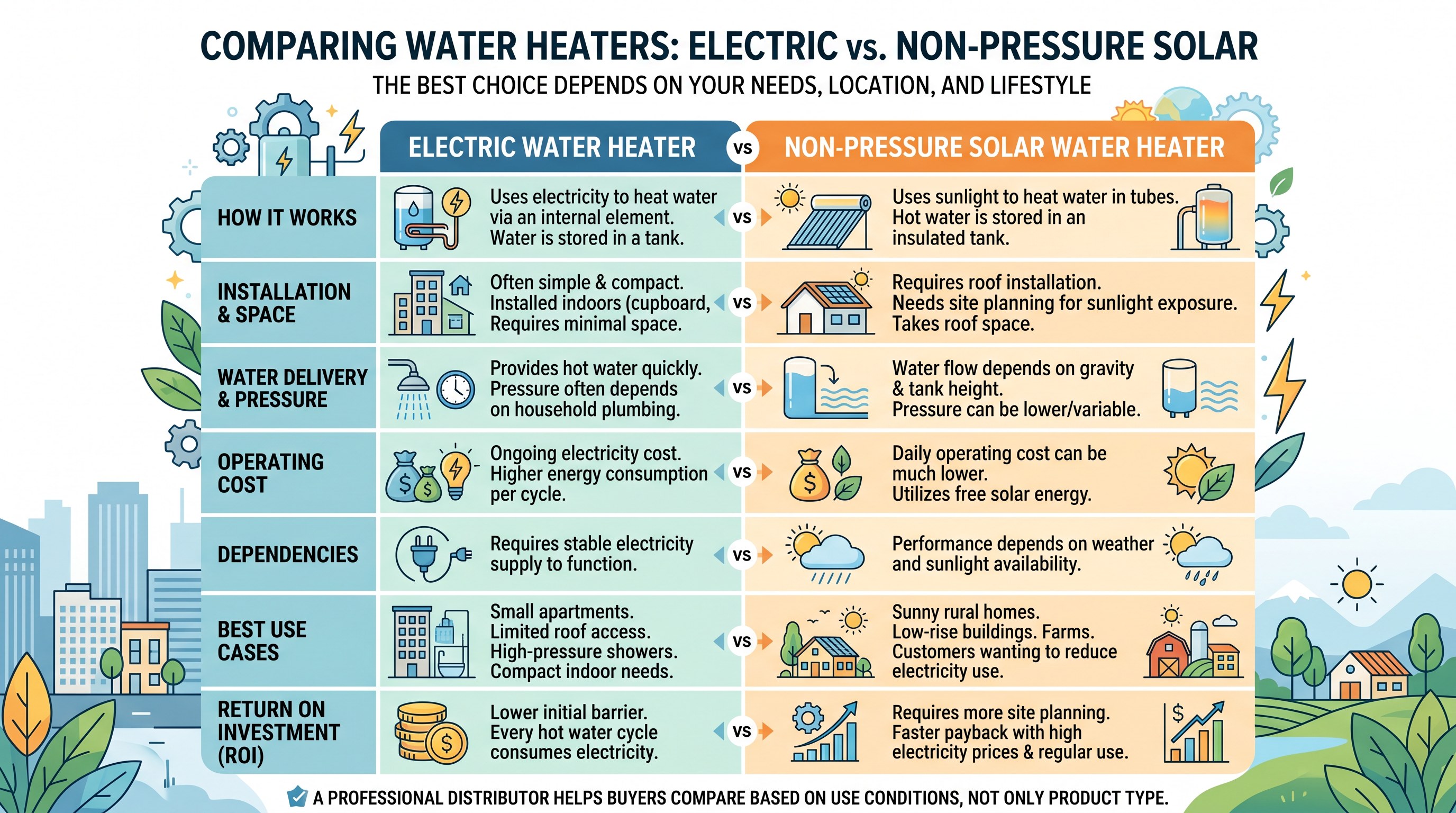
The Difference Between Non-Pressure and Pressurized Systems

A non-pressure solar water heater and a pressurized solar water heater may look similar from a distance, but they are designed for different plumbing environments.
A pressurized solar water heater is usually built to work with mains pressure or a pressure pump. It can provide stronger hot water flow and is often more compatible with modern bathrooms, mixers, and multi-point water use. It may use a pressure-rated tank, heat pipe vacuum tubes, coils, safety valves, pressure relief devices, and more advanced fittings.
A non-pressure solar water heater is usually an open or low-pressure system. It is not designed to hold the same internal pressure as a pressure-rated tank. Its advantage is not high-pressure comfort. Its advantage is simplicity, affordability, and suitability for low-pressure water supply.
This difference affects the customer experience. If a homeowner expects a strong hotel-style shower, a non-pressure system may not be the best choice unless the installation is carefully designed with enough height or supported by a suitable booster solution. But if the customer lives in a rural home where water is already supplied from a rooftop tank, the non-pressure system may fit naturally into the existing water structure.
The difference also affects B2B purchasing. Importers and distributors should not sell non-pressure systems as a universal solution for every building. Instead, they should define the target market clearly. A non pressure solar water heater is suitable for low-pressure homes, rural buildings, farms, off-grid cabins, simple dormitories, and cost-sensitive domestic hot water projects. It is less suitable for high-rise apartments, luxury bathrooms, complex multi-bathroom houses, and commercial buildings that require stable high-pressure hot water.
When the product is positioned correctly, customer satisfaction improves. When the product is sold into the wrong application, complaints increase. Most problems do not come from the concept of non-pressure solar heating itself. They come from wrong expectation, wrong installation, wrong capacity selection, or wrong plumbing match.
Where Non-Pressure Solar Water Heaters Fit Best

The strongest market for a non-pressure solar water heater is not every home. It is the right home, in the right water environment, with the right expectation.
One ideal application is a rural household with available roof space and moderate daily hot water demand. In this situation, the household may already use a water tank or low-pressure supply. The solar heater can be installed on the roof or another elevated structure. The system can heat water during the day and provide hot water for bathing or washing in the evening.
Another important application is farms. A farm may need hot water for workers, cleaning, light washing, or basic residential use. In many farm environments, utility infrastructure may be limited, but sunlight and open installation space are available. A gravity fed solar water heater can be easier to understand and maintain than a complex mechanical hot water system.
Off-grid buildings are also a natural fit. In remote cabins, eco-lodges, temporary houses, or rural service buildings, reducing dependence on electricity is valuable. A passive solar water heater does not eliminate all backup needs, especially during cloudy weather or high-demand periods, but it can reduce the daily heating load significantly.
Small dormitories, construction-site living areas, and staff housing can also use non-pressure systems if the water demand is predictable and the installation layout is simple. For these projects, the buyer may care more about low operating cost and easy maintenance than luxury-level water pressure.
In international B2B markets, the non-pressure category often performs well where three conditions appear together: strong sunlight, cost-sensitive buyers, and low-pressure water infrastructure. This is why the same product can be attractive in one region and unsuitable in another. A professional supplier should understand not only the product but also the local building habit, water supply condition, climate, and buyer expectation.
Why Evacuated Tubes Are Commonly Used

Many non-pressure solar water heaters use evacuated tubes because they offer a good balance of heating performance, cost, and product simplicity. An evacuated tube is designed with vacuum insulation, which helps reduce heat loss. This makes it useful in solar water heating because the tube can collect heat from sunlight and keep more of that heat inside the system.
In a non-pressure evacuated tube solar water heater, the tubes are usually connected directly to the tank. Water enters the tubes, gets heated, and circulates naturally. This direct heating method is simple and efficient under suitable water conditions.
The number and size of tubes affect heating capacity. Common international product descriptions may mention tube sizes such as 47 x 1500 mm or 58 x 1800 mm, and tank capacities such as 100L, 150L, 200L, or 300L. However, buyers should avoid judging performance by capacity alone. A 200L tank with poor insulation, weak tubes, bad installation angle, or low-quality fittings may perform worse than a smaller but better-designed system.
The quality of the vacuum tubes, absorber coating, tank insulation, inner tank material, support frame, sealing parts, and packaging all matter. In B2B purchasing, the visible product may look similar from supplier to supplier, but real quality differences often appear after shipment, installation, and seasonal use. Broken tubes, water leakage, rusted frames, weak tank insulation, and missing accessories can create serious after-sales problems.
This is why a non pressurized solar water heater should be evaluated as a complete system, not just a tank plus tubes. The product must be designed for transport, installation, local water quality, roof exposure, and long-term outdoor use.
Common Misunderstandings About Non-Pressure Systems
One common misunderstanding is that a non-pressure solar water heater is only chosen because it is cheap. Price is important, but it is not the full reason. Many buyers choose this system because it matches their water supply conditions. If a home already uses gravity-fed water, adding a pressure-rated solar system may increase cost without solving the real requirement.
Another misunderstanding is that non-pressure systems cannot provide comfortable hot water. In the right installation, they can provide useful and comfortable domestic hot water. The key is to understand the difference between hot water temperature and hot water pressure. The system may heat water effectively, but the outlet flow depends on tank height, pipe design, and water outlet fittings.
A third misunderstanding is that all solar water heaters work the same way. They do not. A compact non-pressure system, a pressurized heat pipe system, a split solar water heater, a flat plate system, and a forced-circulation commercial system each have different design logic. The right comparison is not “which one is best?” but “which one fits this building and user expectation?”
A fourth misunderstanding is that installation is too simple to require planning. In reality, most complaints about a low pressure solar water heater come from poor installation decisions. If the tank is too low, the shower may be weak. If the system is oversized and unused during hot seasons, overheating may occur. If the roof structure is not checked, safety risk increases. If the pipes are exposed without protection, heat loss increases. If the water contains heavy minerals and no maintenance is done, scale can reduce performance.
A professional blog, product page, or sales conversation should not hide these limitations. Explaining them clearly builds trust. Buyers do not need exaggerated promises. They need correct matching.
What Buyers Should Evaluate Before Choosing One
Before choosing a non-pressure solar water heater, buyers should evaluate the water source. Is the building supplied by municipal water, a rooftop tank, a well pump, or manual filling? Is the water pressure stable or low? Does the customer expect strong pressure or simply reliable hot water?
The second factor is installation height. Because a gravity fed solar water heater depends on height difference for outlet pressure, the tank should ideally be positioned above the shower or water outlet. The higher the tank is above the outlet, the better the natural water pressure will be. If the tank cannot be installed high enough, the buyer should understand the expected flow limitation.
The third factor is daily hot water demand. A small household may only need 100L or 150L. A larger family may need 200L or 300L. However, capacity should be matched with climate, bathing habits, number of users, and available sunlight. Oversizing increases cost and may create overheating issues if hot water is not used regularly. Undersizing leads to customer dissatisfaction.
The fourth factor is climate. A non-pressure solar water heater performs best in sunny regions with limited freezing risk. In cold climates, open direct systems may need additional freeze protection or may not be suitable without special design. In cloudy seasons, an electric backup heater may be necessary to maintain user comfort.
The fifth factor is material quality. B2B buyers should check the inner tank material, outer tank material, insulation thickness, frame strength, vacuum tube quality, sealing design, and accessory package. For coastal or humid regions, corrosion resistance becomes more important. For long-distance export, packaging strength is also critical because vacuum tubes are fragile.
The sixth factor is after-sales simplicity. One reason non-pressure systems remain popular is that they are relatively easy to understand and repair. But this advantage only exists if the product is supplied with clear instructions, spare tubes, proper fittings, and reasonable installation guidance.
Why This Category Matters for B2B Solar Suppliers
For B2B suppliers, the non-pressure solar water heater category should not be treated as a low-value product line. It should be treated as an entry-level solar hot water solution for large practical markets.
In many countries, the buyer is not always looking for the most advanced system. The buyer may be a distributor serving rural households. The buyer may be a local installer who needs products that are easy to explain and quick to install. The buyer may be a hardware store that wants visible solar products with clear capacity options. The buyer may be a project contractor for schools, farms, worker housing, or small public facilities.
For these buyers, the strongest selling points are not only “solar energy” and “energy saving.” The real value is system suitability. A good non-pressure product line should answer these questions clearly:
Can it work with low-pressure water supply?
Can it be installed without complex tools?
Can local installers understand the structure?
Can spare parts be supplied easily?
Can the system survive outdoor exposure?
Can the capacity range cover different family sizes?
Can the packaging reduce breakage during export?
Can the supplier explain when the product should not be used?
This last question is especially important. A high-quality supplier does not push a non-pressure solar water heater into every project. A high-quality supplier knows when to recommend a pressurized or split system instead. This professional positioning helps distributors reduce complaints and build a stronger local brand.
A Better Way to Position Non-Pressure Solar Water Heaters
The best positioning for this category is not “the cheapest solar water heater.” That message weakens the product. It attracts buyers who only compare price and ignore system matching. A better positioning is:
A practical solar hot water solution for low-pressure, rural, off-grid, and cost-sensitive buildings.
This positioning gives the product a clear role. It does not compete directly with every pressurized system. It does not pretend to deliver the same high-pressure shower experience. Instead, it highlights where the system performs best.
For content marketing, this positioning is also more powerful. It allows a website to build articles around real user problems: low water pressure, rural installation, roof tank systems, capacity selection, weak shower flow, cloudy-day performance, off-grid hot water, maintenance, scale, overheating, and B2B purchasing.
These topics match real search behavior. Many users do not begin by searching for a product name. They search for a problem or use case. For example, they may search “solar water heater for low pressure water supply,” “why is my solar geyser pressure weak,” “gravity fed solar water heater for farm,” or “non pressure vs pressurized solar water heater.” A strong blog category should capture these questions and then guide users toward the right product type.
Focused FAQ
What does non-pressure mean in a solar water heater?
Non-pressure means the solar water heater is not designed to operate as a fully pressurized closed tank system. It usually works with low-pressure or gravity-fed water supply. The water tank is often vented or open to the atmosphere, and hot water delivery depends largely on tank height and simple plumbing layout.
Is a non-pressure solar water heater the same as a low pressure solar geyser?
In many markets, yes. A low pressure solar geyser often refers to a non-pressure or gravity-fed solar water heater, especially in regions where the word “geyser” is used for domestic water heaters. The exact product design may vary, but the core idea is similar: solar heating with low-pressure water delivery.
Does a non-pressure solar water heater need electricity?
The solar heating process itself does not normally need electricity if the system is based on passive thermosiphon circulation. However, some systems include electric backup heating, water-level controllers, or temperature displays. These accessories may require electricity, but the basic solar heating function depends on sunlight.
Why is hot water pressure sometimes weak?
Hot water pressure is often weak because the system depends on gravity and tank height. If the tank is not installed high enough above the shower outlet, the flow may be low. Long pipes, narrow pipe diameter, unsuitable shower heads, and high-pressure mixing valves can also reduce the flow experience.
Is a non-pressure solar water heater suitable for modern bathrooms?
It depends on the bathroom and user expectation. If the bathroom requires strong water pressure, concealed plumbing, thermostatic mixers, and multi-point hot water use, a pressurized system may be better. If the building already uses a rooftop tank or low-pressure water supply, a non-pressure system may be suitable.
Can it work on cloudy days?
It can still collect some heat on cloudy days, but water temperature will usually be lower than on sunny days. In regions with frequent cloudy weather or high hot water demand, an electric backup heater or alternative backup system is recommended.
Is it suitable for winter?
A non-pressure solar water heater can work in mild winter conditions with good sunlight, especially when using evacuated tubes and well-insulated tanks. However, in freezing climates, direct open systems may face freezing risk. Buyers should check whether the product design is suitable for local winter conditions.
What capacity should a family choose?
Capacity depends on the number of users, bathing habits, climate, and daily hot water demand. Common residential options include 100L, 150L, 200L, and 300L. A supplier or installer should match capacity with user behavior rather than recommending the largest tank automatically.
What is the biggest advantage of a non-pressure system?
The biggest advantage is practical simplicity. It can be easier to install, easier to understand, and more affordable than more complex systems. It is especially useful for low-pressure water supply, rural homes, farms, and off-grid buildings.
What is the biggest limitation?
The biggest limitation is water pressure. A non-pressure solar water heater usually cannot deliver the same shower pressure as a pressurized system. Correct installation height and suitable fittings are important for acceptable user experience.
Conclusion
A non-pressure solar water heater remains widely used because many buildings around the world do not need the most complex solar hot water system. They need a practical, affordable, and understandable solution that fits low-pressure water supply, rural living conditions, farm buildings, and off-grid applications.
Its value is not in replacing every pressurized or split solar water heater. Its value is in serving the right market with the right expectations. When properly selected and installed, a non-pressure solar water heater can provide reliable domestic hot water with simple solar technology, low operating cost, and relatively easy maintenance.
For homeowners, the key is to understand whether the system matches their water pressure, roof layout, climate, and comfort expectations. For distributors and B2B buyers, the key is to evaluate product quality, capacity range, packaging, accessories, and after-sales support. For solar suppliers, the key is to position the product honestly: not as the cheapest option, but as a practical solar water heating system for low-pressure and cost-sensitive markets.
That is why the non-pressure solar water heater category still matters. It represents a realistic part of the global solar hot water market, especially where simplicity, affordability, and system compatibility are more important than high-pressure luxury.
#NonPressureSolarWaterHeater #LowPressureSolarWaterHeater #LowPressureSolarGeyser #GravityFedSolarWaterHeater #ThermosiphonSolarWaterHeater #EvacuatedTubeSolarWaterHeater #PassiveSolarWaterHeating #RuralSolarHotWater #OffGridSolarWaterHeater #SolarWaterHeaterBuyingGuide