How to Choose the Right Capacity for a Non-Pressure Solar Water Heater
Capacity Is Not Just a Number on the Tank
When buyers compare a non pressure solar water heater, the first question is often very simple: should they choose 100 liters, 150 liters, 200 liters, or 300 liters? At first glance, capacity seems like the easiest specification to understand. A bigger tank appears to mean more hot water, and more hot water appears to mean better value.
In real applications, this is only partly true.
A non-pressure solar water heater capacity decision should not be made by tank size alone. A 200 liter solar water heater may perform very well for one household and poorly for another. A 150 liter solar water heater may be enough for a small family in a sunny region but insufficient for the same family in a cloudy climate. A 300 liter solar water heater may be useful for a large household, farm staff room, or small dormitory, but it may become inefficient if the daily hot water demand is low and the tank is not heated fully.
The right capacity depends on several connected factors: number of users, bathing habits, climate, sunlight hours, water inlet temperature, desired outlet temperature, tank insulation, evacuated tube quantity, refill timing, backup heating, and the distance between the tank and the water outlet. This is why solar water heater sizing should be treated as a system decision rather than a single product choice.
For B2B buyers, this is even more important. Importers, distributors, and contractors are not only choosing one model for one family. They are often building a product range for a market. If the model range is too small, customers cannot find the right fit. If the product range is too large, inventory becomes difficult. If the capacity recommendation is wrong, complaints increase.
A good low pressure solar water heater sizing strategy should answer three questions clearly:
How much hot water does the user actually need each day?
How much solar energy can the system collect and store in the local climate?
Can the installation conditions deliver that hot water at an acceptable flow and temperature?
Only when these three questions are considered together can the capacity be selected correctly.
Start with Daily Hot Water Demand
The first step in choosing a non pressurized solar water heater sizing plan is estimating daily hot water demand. This sounds simple, but daily demand varies greatly between households and markets.
In some homes, hot water is used mainly for evening showers. In other homes, hot water is used for morning bathing, evening bathing, kitchen washing, laundry support, and general cleaning. A household that takes quick low-flow showers may need far less hot water than a household where each person takes a long shower. A family in a warm climate may use less hot water than a family in a cooler climate because the incoming water temperature is higher and less heating is needed.
For a basic residential solar water heater for family use, a common starting point is to estimate hot water demand per person. Many basic sizing discussions use a broad range such as 30 to 50 liters of hot water per person per day for bathing and simple domestic use. However, this should not be treated as a fixed rule. In rural and cost-sensitive markets, actual usage may be lower. In modern homes with multiple bathrooms, actual usage may be higher.
For a non-pressure system, the use pattern also matters. If all users bathe in a short time window at night, the system must store enough usable hot water before that time. If hot water use is spread across the afternoon and evening, the system may recover some heat during the day. If the tank refills with cold water immediately after each use, the average water temperature may drop more quickly.
The best sizing conversation should not begin with “How many people are in the home?” It should begin with “How do they use hot water?”
A family of four may be satisfied with a 150 liter solar water heater if showers are short, the climate is sunny, and water demand is moderate. Another family of four may require a 200 liter solar water heater if they use more hot water, bathe at the same time, or expect higher water temperature. A family of six may need a 300 liter solar water heater, but only if the collector area and tube quantity are sufficient to heat that volume properly.
Understand the Difference Between Stored Water and Usable Hot Water
Tank capacity tells you how much water the storage tank can hold. It does not always tell you how much usable hot water the customer will experience.
This is a critical point in solar water heater capacity guide content.
A 200 liter tank does not always mean the user can enjoy 200 liters of water at a comfortable bathing temperature. The actual usable volume depends on how hot the water becomes, how much cold water is mixed during use, how well the tank preserves temperature, and how much cold water enters during refilling.
For example, if the water in the tank is very hot, the user may mix it with cold water at the shower. In that case, the usable bathing volume can be greater than the tank capacity. If the tank water is only lukewarm, the user may not mix much cold water, and the usable volume may be lower. If the tank loses heat quickly after sunset, the usable hot water at night may be less than expected even if the tank was hot in the afternoon.
In non-pressure systems, water layering inside the tank also matters. Hotter water tends to stay near the upper part of the tank, while cooler water stays lower. If the outlet is positioned properly and the tank design supports temperature stratification, the user may access hotter water first. If cold refill water mixes too strongly with the stored hot water, the outlet temperature may drop more quickly.
This means that two solar water heaters with the same capacity can perform differently. One may have better insulation, better tube matching, better tank design, and better temperature retention. Another may have the same liters on the label but deliver a weaker user experience.
For B2B buyers, this is why capacity should never be evaluated alone. Tank material, insulation thickness, evacuated tube quantity, tube quality, tank structure, inlet design, and outlet design all affect real usable hot water.
Match Capacity with Family Size Carefully
For simple market communication, it is useful to connect tank capacity with typical family size. But these recommendations should be framed as guidance, not absolute promises.
A 100 liter solar water heater is usually suitable for one to two users with light hot water demand. It can be a practical choice for small rural homes, single users, couples, guest rooms, small cabins, or low-demand washing points. It is affordable, compact, and easier to install on smaller roofs. However, it may not satisfy a larger family or users who take long showers.
A 150 liter solar water heater is often suitable for two to three users, or sometimes a small family with moderate hot water habits. It is one of the common entry-level family sizes because it provides more flexibility than 100 liters while remaining relatively easy to handle. In sunny climates, it can serve daily bathing needs well if users manage water use reasonably.
A 200 liter solar water heater is commonly used for three to four users. This size is often considered a standard family option in many markets. It provides a better buffer for evening use and is suitable for households that want more comfort than smaller systems. For distributors, the 200 liter model is often a core selling size because it balances price, capacity, and market demand.
A 300 liter solar water heater is usually suitable for larger families, farm worker housing, small staff accommodation, or buildings with higher daily hot water demand. It can provide more stored hot water, but it also requires more roof space, stronger support, more collector capacity, and higher upfront cost. If the household does not use enough hot water, the system may be oversized.
The important point is that family size is only a starting point. A solar water heater for family use should also consider local climate, bathing habits, water inlet temperature, and whether backup heating is available.
Why Climate Changes the Right Capacity

Climate is one of the most important factors in low pressure solar water heater sizing. The same tank size can perform differently in different regions.
In a sunny, warm region, the system can collect more solar heat and the incoming cold water temperature may be higher. This means the system does not need to raise the water temperature as much to reach a comfortable bathing level. A smaller tank may be enough for the same number of users because heating conditions are favorable.
In a cloudy or cooler region, the situation changes. The system may collect less solar energy, and the incoming water may be colder. The same evacuated tube solar water heater capacity may take longer to heat. A larger tank does not automatically solve this problem. In fact, oversizing the tank without increasing collector area can result in more lukewarm water rather than enough hot water.
This is a common sizing mistake. Some buyers choose a larger tank because they want more hot water. But if the solar collector area and tube quantity are not increased properly, the system may not heat the full volume to the desired temperature. A 300 liter tank with insufficient tubes may disappoint users more than a well-matched 200 liter system.
Climate also affects heat retention. In areas with large day-night temperature differences, the tank insulation becomes very important. If hot water is needed at night or early morning, the storage tank must retain heat for several hours after sunset. A poorly insulated tank can make the system feel undersized even when the nominal capacity is correct.
In regions with freezing risk, standard direct non-pressure systems may require careful evaluation. Capacity selection alone is not enough. The buyer must consider whether the system design is suitable for winter operation, whether pipes and tubes are protected, and whether backup heating or alternative system types are needed.
For B2B suppliers, climate-based sizing is a powerful way to show professionalism. Instead of saying “200L is for four people” in every country, a better recommendation is: “200L may serve three to four users in sunny regions with moderate demand, but colder or cloudy regions may require different tube configurations, backup heating, or a different system type.”
Tube Quantity and Tank Capacity Must Be Balanced
A non-pressure evacuated tube solar water heater depends on the relationship between tank volume and tube heating capacity. The tank stores water, but the evacuated tubes collect heat. If the tank is large and the tube quantity is too small, the water may not become hot enough. If the tube quantity is high and the tank is small, the system may heat quickly but may also face overheating risk in strong sunlight when hot water is not used.
This balance is central to non pressure solar water heater capacity planning.
Many product lines use common tube sizes such as 47 x 1500 mm or 58 x 1800 mm, combined with different tank capacities. Larger tubes generally collect more heat, but real performance also depends on tube coating, vacuum quality, installation angle, sunlight, and water quality. The number of tubes is therefore not just a visual feature. It directly affects heating speed and daily recovery.
A 100 liter system may use fewer tubes because the water volume is smaller. A 150 liter or 200 liter model needs more tubes to heat the larger volume. A 300 liter model needs a stronger collector area to avoid slow heating. If a supplier offers a large tank with too few tubes only to reduce price, the system may look attractive on paper but underperform in real use.
For buyers, one useful question is: how is the tube quantity matched to the tank size? A serious supplier should be able to explain why a model has a certain number of tubes and what type of usage it is designed for. If the answer is only “because it is cheaper,” the buyer should be careful.
For distributors, tube-and-tank balance also affects product positioning. A high-performance model with more tubes may be sold as a stronger option for cooler areas or higher-demand families. A lower-cost model may fit sunny regions with light demand. This allows the distributor to build a more intelligent product range instead of selling only by liters.
Consider Water Inlet Temperature and Desired Outlet Temperature
The amount of energy needed to heat water depends on the temperature rise. This means the local water inlet temperature has a major impact on capacity satisfaction.
In warm climates, the incoming water may already be relatively mild. The solar water heater does not need to raise the water temperature as much. In cooler climates, incoming water may be much colder, especially in winter. The same solar heater must work harder to reach a comfortable outlet temperature.
Desired outlet temperature also varies by user. Some users are satisfied with warm water for quick bathing. Others expect hotter water that can be mixed with cold water. Some households use hot water for washing dishes or cleaning, which may require higher temperature than bathing.
This affects capacity because hotter stored water can create more usable mixed water. If the tank reaches a high temperature, users can mix hot and cold water to extend usable volume. If the tank reaches only a moderate temperature, there is less mixing advantage.
For example, a 150 liter tank at a higher temperature may provide enough mixed warm water for several short showers. A 200 liter tank at a lower temperature may still feel insufficient because the water is not hot enough. This is why the question is not only “how many liters?” but “how many liters at what temperature, at what time of day, in what climate?”
A good non pressurized solar water heater sizing guide should help buyers understand this relationship. It should not promise fixed results without considering temperature conditions.
Do Not Ignore Usage Timing
When people use hot water can be as important as how much water they use.
A household that uses hot water in the late afternoon may benefit from water that has just been heated by the day’s sunlight. A household that uses hot water late at night depends more on tank insulation. A household that needs hot water early in the morning depends heavily on overnight heat retention or backup heating.
For a non-pressure solar water heater, this matters because solar energy is collected during the day, but user demand may occur later. If the tank loses too much heat between afternoon and night, the user may complain even if the system heated well during the day.
Usage timing also affects refill strategy. If cold water enters the tank immediately after hot water is drawn, the stored temperature can drop. Some systems use float valves or water-level controllers to manage water level. In some markets, users manually fill the tank at certain times. The behavior of refilling can change hot water availability.
For families that all shower at night, sizing should include enough stored hot water and good insulation. For farms or staff housing where users bathe in shifts, larger tanks or multiple units may be needed. For off-grid cabins used mainly on weekends, the system must also be managed during periods of non-use.
This is why sizing cannot be reduced to a simple chart. Charts are useful, but real application understanding is better.
Installation Height Does Not Change Capacity, But It Changes Satisfaction
Capacity determines stored volume. Installation height influences water flow. They are different, but users often judge them together.
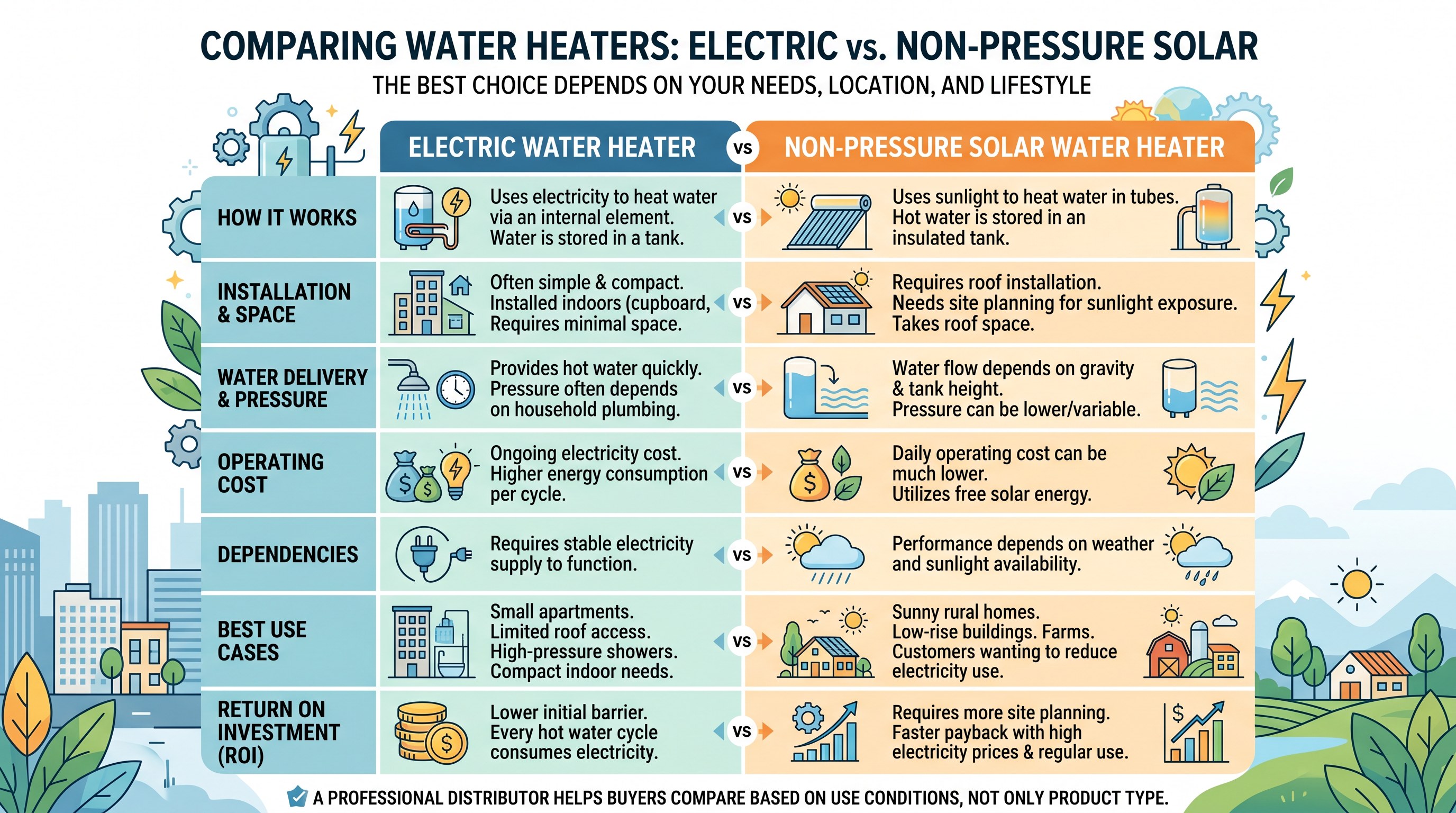
A non-pressure solar water heater may have enough hot water in the tank, but if the tank is not installed high enough above the shower or faucet, the water pressure may feel weak. The customer may then think the system is too small, even when the real problem is gravity-fed delivery.
This is especially important for low pressure solar water heater sizing because user satisfaction depends on both temperature and flow. A properly sized tank with poor outlet flow can still create complaints. A slightly smaller tank with good installation height and efficient use may feel better.
Before choosing capacity, installers should check where the system will be installed. How high is the tank above the outlet? How long is the pipe route? How many bends are in the pipe? What type of shower head will be used? Is the bathroom close to the roof or far below the tank? Are low-pressure fixtures available?
If the customer expects stronger flow, the solution may not be a larger tank. It may be a better installation height, a different pipe layout, a booster pump, or a pressurized system. Oversizing the tank will not solve low outlet pressure.
For B2B buyers, this distinction should be part of sales training. Distributors and installers should learn to separate capacity complaints from pressure complaints. Otherwise, they may recommend the wrong product upgrade.
Capacity Planning for Rural Homes
Rural homes are one of the most common applications for non-pressure solar water heaters. Capacity planning in rural homes should be practical and based on real routines.
In many rural households, hot water is mainly used for bathing and basic washing. The usage may be lower than in urban homes with multiple bathrooms and modern appliances. A 100 liter solar water heater may be suitable for one or two people. A 150 liter system may serve a small family. A 200 liter system is often a safer standard family option. A 300 liter system may be used for larger families or homes with more frequent hot water use.
However, rural homes may have unique conditions. The water source may be a rooftop tank, well, borehole, or intermittent municipal supply. The water may be hard. The roof may be older. The users may prefer simple fixtures. The household may not want complex controllers.
For this reason, capacity should be selected together with installation feasibility. A larger tank means more weight. The roof must support the filled tank, frame, and tubes. If the roof structure is weak, a smaller model or reinforced installation may be safer. If the roof receives partial shade, the system may need a different location or a more suitable model.
A good rural recommendation should be conservative and clear. It is better to recommend a reliable size that can be installed safely and maintained locally than to push a larger model that creates roof load or performance problems.
Capacity Planning for Farms and Staff Housing
Farms and staff housing require a different sizing approach because users may not behave like a single family.
A farm may have several workers using hot water at similar times. A staff house may have shared bathrooms. A small dormitory may have peak demand in the morning or evening. In these cases, one household sizing rule may not work.
Instead of asking only how many people live there, the buyer should ask: how many people will use hot water in the same time window? How many showers or outlets are connected? Is hot water needed every day? Is the building occupied full time or seasonally? Is there backup heating? Can multiple smaller systems be installed instead of one large system?
For small staff housing, multiple non-pressure systems may be more practical than one oversized unit. For example, several 200 liter systems can serve different bathroom zones. This reduces pipe length, improves local availability, and makes maintenance easier. If one unit needs repair, the entire facility does not lose hot water.
A 300 liter solar water heater may be useful where demand is concentrated, but the collector area must be adequate. The roof must also support the load. For larger dormitories, hotels, or high-demand facilities, a standard household non-pressure system may not be enough. A more engineered solar hot water solution may be required.
For B2B buyers, the farm and staff housing market can be valuable, but it requires honest capacity planning. Overselling small units to high-demand buildings creates complaints. Overengineering simple buildings increases cost. The right answer often lies in modular deployment.
Capacity Planning for Off-Grid Buildings
An off-grid solar water heater must be sized with energy independence in mind. In off-grid buildings, hot water demand affects the whole energy system. If water heating relies on electricity, it can consume a large amount of battery or generator capacity. A non-pressure solar thermal system can reduce this load by heating water directly with sunlight.
For off-grid cabins, eco-lodges, remote houses, and rural service buildings, capacity should match occupancy patterns. A small cabin used by one or two people may only need 100L or 150L. A larger off-grid family home may need 200L. A small eco-lodge or shared facility may need multiple systems or a larger design.
The challenge is that off-grid buildings may not be occupied every day. Long periods of non-use can create overheating risk in sunny climates if the system remains full and exposed. In other cases, the system may be drained or managed seasonally. The user needs clear instructions.
Backup heating should also be considered. A small electric backup heater may be possible if solar PV and battery capacity are sufficient, but it must be planned carefully. Gas backup may be used in some off-grid buildings. The non-pressure solar water heater can reduce the daily load, but it should not be expected to solve every weather condition by itself.
Capacity planning for off-grid use should therefore include three layers: normal sunny-day demand, cloudy-day backup strategy, and non-use management.
B2B Model Matrix: How Distributors Should Build a Product Line

For a distributor, capacity selection is not only about one project. It is about creating a model matrix that matches market demand.
A practical non-pressure solar water heater product line may include:
100L model for single users, couples, cabins, small rural homes, and entry-level markets.
150L model for small families and moderate daily demand.
200L model as a standard family product and core retail model.
300L model for larger families, farm housing, staff rooms, and higher-demand domestic use.
But the matrix should not stop at liters. Each capacity can have different tube configurations, frame materials, tank materials, and accessory packages. For example, a sunny-market 200L model may use a standard tube configuration, while a cooler-market 200L model may require more collector capacity or better insulation. A coastal-market model may require stronger corrosion resistance. A rural-market model may require simplified accessories and stronger packaging.
Distributors should also consider inventory logic. The 200L model may be the best-selling size in many family markets, while 100L and 150L serve entry-level demand. The 300L model may move more slowly but provide an option for larger homes and small projects. Stocking too many variations can create inventory pressure, but stocking too few can reduce sales opportunities.
A professional supplier can support distributors by providing a capacity recommendation chart, target user profiles, installation notes, spare parts lists, and sales training. This makes the product line easier to sell and reduces random recommendations.
Common Sizing Mistakes to Avoid
The first common mistake is assuming bigger is always better. A larger tank costs more, weighs more, needs more roof support, and requires enough collector capacity. If demand is low, an oversized system may not deliver better value.
The second mistake is choosing capacity only by the number of users. User habits, climate, inlet water temperature, usage timing, and tank insulation all matter. Two families with the same number of people may need different sizes.
The third mistake is ignoring evacuated tube quantity. Tank size and tube count must be matched. A large tank with insufficient tubes may heat slowly and disappoint users.
The fourth mistake is confusing pressure problems with capacity problems. Weak shower flow may be caused by low installation height or poor pipe layout, not by a small tank.
The fifth mistake is ignoring roof load. A full tank is heavy. Larger systems require safer roof assessment and stronger support.
The sixth mistake is ignoring backup heating. In cloudy regions or high-demand homes, backup heating may be necessary. Without backup, users may blame the system for weather-related limitations.
The seventh mistake is using one sizing chart for every country. Climate, water habits, building design, and income level vary by market. A good solar water heater capacity guide should be adapted locally.
A Practical Capacity Selection Process
A professional capacity selection process can be simple but structured.
First, identify the user type. Is it a single user, couple, small family, large family, farm staff, small dormitory, or off-grid building?
Second, estimate daily hot water demand. Ask how many people use hot water, how often they bathe, how long showers last, and whether hot water is used for washing or cleaning.
Third, check local climate. Is the area sunny, cloudy, warm, cold, or freezing? Does the system need backup heating or freeze protection?
Fourth, evaluate installation conditions. Is there enough roof space? Can the tank be installed high enough? Is the roof strong enough? Is the pipe route short and simple?
Fifth, match tank capacity with tube quantity. Do not select liters alone. Make sure the collector area can heat the tank volume.
Sixth, consider user expectations. Does the customer accept low-pressure flow? Do they need strong shower pressure? Are they expecting pressurized comfort from a non-pressure system?
Seventh, decide whether accessories are needed. Water-level controller, electric backup heater, magnesium rod, stronger frame, or upgraded insulation may improve performance in certain markets.
This process helps prevent the most common sizing errors. It also helps suppliers sound more professional because the recommendation is based on real conditions rather than generic selling.
What a Good Supplier Should Provide

A supplier of non pressure solar water heater systems should provide more than a product list. Capacity selection requires support materials.
A good supplier should provide a capacity guide for different user groups. It should explain which model is suitable for one to two users, small families, standard families, large families, farm use, and staff housing. The guide should include clear notes about climate and usage assumptions.
A good supplier should provide tube specifications and explain how tube quantity matches tank volume. The buyer should understand whether a model is designed for sunny climates, moderate climates, or higher-demand use.
A good supplier should provide tank insulation information. Heat retention affects nighttime performance, and buyers should know what insulation material and thickness are used.
A good supplier should provide installation instructions. These should cover roof angle, orientation, frame fixing, pipe layout, inlet and outlet connections, overflow, venting, and water-level management.
A good supplier should provide packaging details. Broken tubes and damaged tanks can destroy profit. Export packaging should be strong enough for long-distance shipping.
A good supplier should provide spare parts planning. Tubes, sealing rings, valves, controllers, and fittings should be available for after-sales support.
For B2B buyers, these support materials are not small details. They are part of the product’s real value.
Focused FAQ
How do I choose the right non-pressure solar water heater capacity?
Choose capacity based on daily hot water demand, number of users, climate, tank insulation, evacuated tube quantity, usage timing, and installation conditions. Do not choose by tank size alone.
Is a 100 liter solar water heater enough for a family?
A 100 liter solar water heater is usually more suitable for one to two users or light hot water demand. It may be too small for a standard family unless usage is very limited and the climate is sunny.
Who should choose a 150 liter solar water heater?
A 150 liter solar water heater can suit two to three users or a small family with moderate hot water demand. It is often used in rural homes, small houses, and cost-sensitive residential applications.
Is a 200 liter solar water heater the best family size?
A 200 liter solar water heater is often a strong standard option for three to four users, depending on climate and hot water habits. It is commonly used as a core family model in many markets.
When is a 300 liter solar water heater suitable?
A 300 liter solar water heater is suitable for larger families, farm staff housing, small dormitories, or higher daily hot water demand. It needs enough evacuated tubes, roof space, and roof load capacity.
Does a bigger tank always mean more hot water?
Not always. A bigger tank needs enough solar collector area to heat the water. If the evacuated tube quantity is too low, a large tank may only produce lukewarm water.
Why does climate affect solar water heater sizing?
Climate affects sunlight, inlet water temperature, and heat loss. Sunny and warm regions may need smaller systems, while cloudy or cooler regions may require better insulation, more collector capacity, or backup heating.
How many evacuated tubes should a non-pressure solar water heater have?
The correct tube quantity depends on tank capacity, tube size, climate, and expected heating performance. Tank volume and tube quantity should be matched by the supplier rather than selected randomly.
Can weak water pressure be solved by choosing a larger tank?
No. Weak water pressure is usually related to tank height, pipe layout, and outlet fittings. A larger tank increases stored volume but does not automatically improve gravity-fed water pressure.
What should B2B buyers check when comparing capacities?
B2B buyers should check tank volume, tube quantity, tube size, insulation thickness, roof load, packaging, spare parts, target user group, climate suitability, and supplier sizing guidance.
Conclusion
Choosing the right capacity for a non-pressure solar water heater is more complex than choosing the biggest tank within budget. A good sizing decision must connect tank volume with real hot water demand, climate, evacuated tube capacity, insulation, installation height, user expectations, and after-sales conditions.
A 100 liter solar water heater may be ideal for a small cabin or one to two users. A 150 liter solar water heater may fit small families with moderate demand. A 200 liter solar water heater is often a strong standard family option. A 300 liter solar water heater can serve larger families, farm housing, and small staff buildings. But none of these sizes should be recommended blindly.
The best capacity is the one that matches the user’s daily routine and the system’s ability to heat and store water reliably. If the tank is too small, users run out of hot water. If the tank is too large, the system may heat slowly, cost more, and place extra load on the roof. If the tube quantity is not matched, performance suffers. If the installation height is poor, users may complain about weak water pressure even when the tank size is correct.
For homeowners, the goal is daily comfort at a reasonable cost. For farms and off-grid buildings, the goal is practical hot water with simple operation. For B2B buyers, the goal is a model range that fits local customer groups and reduces after-sales risk.
A professional non pressure solar water heater capacity guide should therefore do more than list 100L, 150L, 200L, and 300L models. It should explain how capacity works in real life. It should help buyers understand stored water, usable hot water, sunlight, tubes, insulation, usage timing, and installation conditions. When capacity is selected this way, the system is more likely to deliver reliable performance and long-term customer satisfaction.
#NonPressureSolarWaterHeater #SolarWaterHeaterCapacityGuide #LowPressureSolarWaterHeaterSizing #100LiterSolarWaterHeater #150LiterSolarWaterHeater #200LiterSolarWaterHeater #300LiterSolarWaterHeater #EvacuatedTubeSolarWaterHeaterCapacity #SolarWaterHeaterForFamily #NonPressurizedSolarWaterHeaterSizing