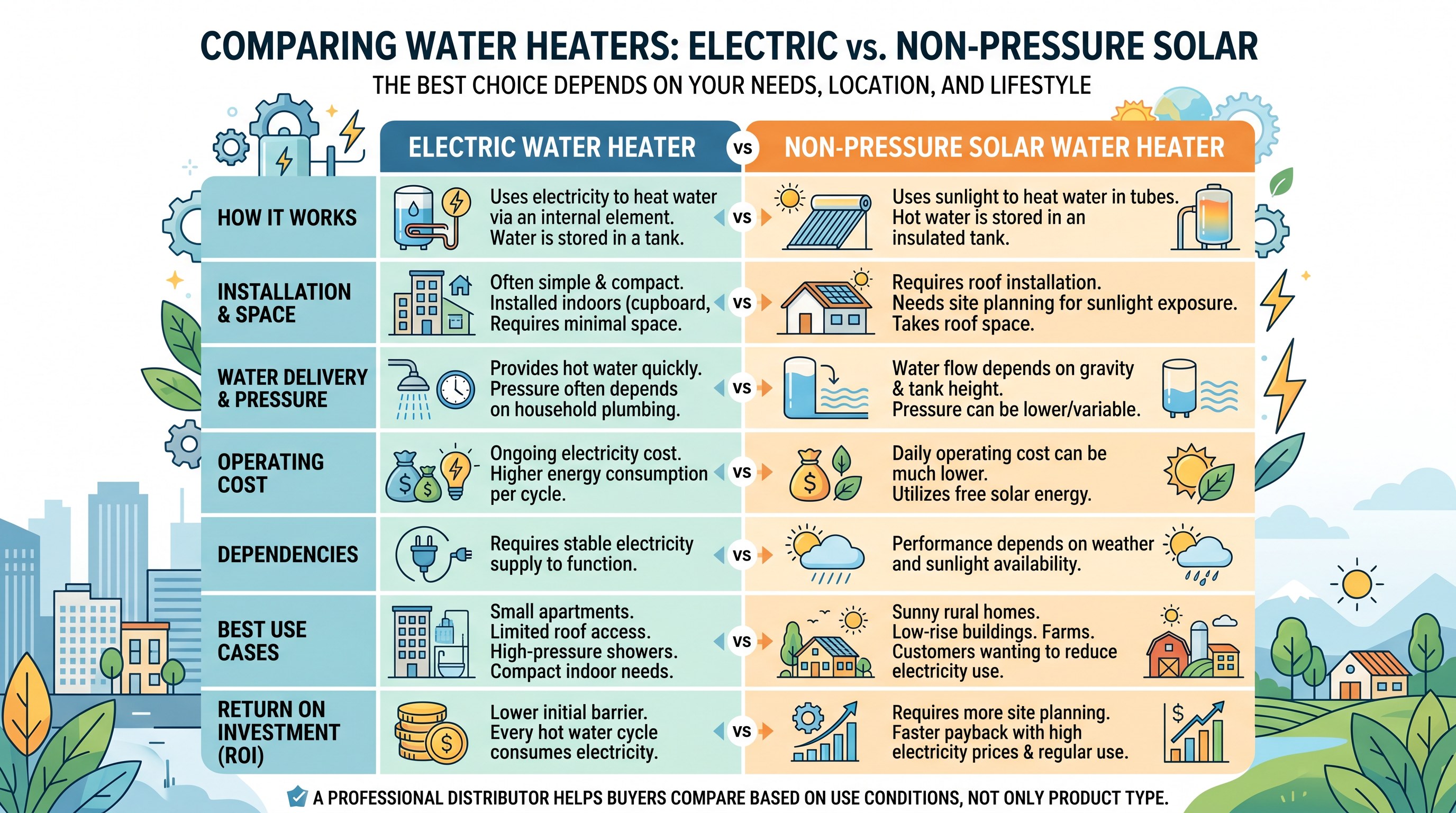
Solar Thermal vs PV for Hot Water: Should You Replace a Non-Pressure System?
Keep the Working System Until the Replacement Solves a Measured Problem
A rooftop photovoltaic array does not automatically make an existing non pressure solar water heater redundant. The useful question is whether another configuration can deliver the required hot water, at the required time and pressure, with a better combination of future cost, reliability and service support.
For an owner with a sound tank, adequate solar collection and acceptable gravity-fed flow, keeping the equipment may be the strongest starting position. For a property facing tank failure, a major roof renovation, changing water demand or persistent backup electricity use, replacement deserves a serious comparison. A distributor needs to distinguish these situations before recommending either more thermal equipment or a new electrical package.
This guide examines solar thermal vs PV for hot water through that replacement decision. It compares retaining a conventional open-vented thermal system, installing dedicated PV water heating, using surplus household PV electricity, and considering a heat pump. The calculations are transparent hypothetical examples, not measured product performance or guaranteed savings.
The scope matters. Non-pressure describes the water-storage pressure arrangement. Thermosiphon describes natural circulation. A thermosiphon system can have a different pressure architecture from the open-vented, direct-water evacuated-tube system considered here. Likewise, a split installation describes component placement, not whether its tank is pressurized. Identify the actual equipment before comparing alternatives.
Why the Replacement Question Has Become More Relevant
In December 2025, IEA SHC Task 69 reported that lower PV hardware costs and improved controls were encouraging PV hot water applications across several markets. That development makes electrical water heating worth reassessing, particularly where an existing PV installation produces daytime surplus. It does not establish that every thermal system should be removed. IEA SHC's market discussion emphasizes different applications rather than a single universal winner.
A more concrete comparison appeared in May 2026. IEA SHC reported initial Namibia Energy Institute monitoring from December 2025 through March 2026. Three installations had 200-litre tanks, but different solar collection areas:
| Monitored configuration | Solar collection area | Reported solar heat |
|---|---|---|
| Flat-plate thermosiphon | 2.52 m² | 515 kWh |
| Evacuated-tube thermosiphon | 2.42 m² | 377 kWh |
| PV-to-heat | 5.20 m² | 386 kWh |
These are early results from one location and test arrangement, not annual savings predictions. The systems were not identified as interchangeable examples of household non-pressure products. Their differing areas also prevent a simple capacity-label comparison. The published Namibia study summary supports comparing defined systems under common conditions; it does not prove which replacement is best for another building.
For procurement, the practical response is to require a common service specification. Two proposals labelled “200 litres” can still differ in daily recovery, usable delivery, electrical demand and roof occupation. A useful quotation makes those differences visible before purchase.
Four Configurations That Should Not Be Mixed Together

Retaining the Existing Thermal System
The existing collector captures heat, while the tank stores water for later use. In a passive system, circulation through the collector does not normally require an electrical pump. Outlet delivery remains a separate hydraulic question. The US Department of Energy's thermosiphon overview explains the natural-convection principle and the importance of suitable installation conditions.
Retaining equipment can mean doing nothing beyond normal maintenance, repairing a defined fault, or improving an approved backup arrangement. Those are different scopes with different costs. A replacement vendor should compare against a functioning, appropriately maintained baseline, not against an obviously neglected system that needs a modest repair.
Dedicated PV-to-Heat
Dedicated PV water heating allocates a solar array to a compatible electrical heating system. Some designs use DC power conversion; others use an inverter. A PV hot water controller must be specified for its particular array, heater and protection arrangement. The presence of an immersion element alone does not establish compatibility.
IEA SHC's PV hot water technology brief distinguishes dedicated PV-to-heat from other arrangements and explains why electrical matching matters. For a buyer, the important deliverable is a complete supported configuration, including temperature control and approved backup operation, rather than a loose collection of nominally compatible components.
Surplus Electricity From a Household PV System
A household PV system may supply other loads before any electricity reaches the water heater. A diverter can use measured surplus for a compatible resistive heater. For example, myenergi describes this function for its eddi diverter. This is evidence of a control approach, not a recommendation that the product fits every tank.
The distinction changes the energy budget. A large household array may leave little surplus after daytime appliances, cooling, vehicle charging and battery priorities. Conversely, a smaller array at a lightly occupied property may export useful daytime energy. Array nameplate capacity alone cannot answer how much electricity remains available for hot water.
A Heat Pump, With or Without PV
A heat pump uses electricity to transfer environmental heat into stored water. It is not simply another resistance element. The DOE heat pump water heater overview describes this distinction and notes that hybrid equipment can also use resistance backup.
A meaningful heat pump vs solar water heater comparison therefore needs installation conditions and operating modes. Check the selected model's ambient-temperature range, recovery capability, air requirements and service arrangements. A quoted efficiency at one test condition should not be treated as a guaranteed result through every season or high-demand period.
Set the Service Requirement Before Looking at Efficiency

Begin with what occupants actually need. Record daily hot-water volume at a stated delivery temperature, the timing of major draws, the longest acceptable recovery period and the availability of an alternative energy source. A family drawing water mainly after sunset presents a different requirement from a guesthouse with concentrated morning demand.
Keep comfort and energy separate. A complaint about weak showers may be hydraulic, even when the water is adequately heated. Changing the source of heat will not necessarily correct that problem. If pressure is the concern, first review the causes of weak flow in a gravity-fed solar water heater and have the proposed water circuit assessed.
Then check the building constraints. Does the roof have room for another array without shading the thermal collector? Can an indoor tank be accommodated? What is the condition of roof fixings and waterproofing? Would an electrically driven alternative require a supply upgrade? These items belong in the initial comparison because they can determine feasibility before operating costs are considered.
For an off-grid hot water system, distinguish water-heating independence from whole-building independence. Passive solar heating may operate without circulation electricity, but the property can still depend on a pump for its water supply. A battery-free PV heater may heat during daylight but provide no new heating after sunset. Neither description is a complete reliability specification.
Finally, define failure tolerance. A household may accept occasional backup operation. A lodging business may need a documented recovery arrangement when occupancy rises or a component fails. The supplier should price that service requirement explicitly instead of assuming that every installation has the same expectations.
A Common 200-Litre Load Makes the Comparison Clearer
Consider an illustrative batch of 200 litres of water heated from 20°C to 55°C. These temperatures are calculation inputs, not recommended storage or delivery settings. Actual temperature control, hygiene management and scald protection must follow the relevant system requirements. For this calculation, assume water density is approximately one kilogram per litre and specific heat is 4.186 kJ/kg·K.
Heat required, kWh = water volume, litres × temperature rise, °C × 0.001163.
The result is 200 × 35 × 0.001163, or approximately 8.14 kWh of heat. This is the energy added to the water. It excludes tank standing losses, pipe losses and other system consumption. It also does not mean that every 200-litre household tank requires a complete reheat every day.
| Illustrative heating route | Calculation | Interpretation |
|---|---|---|
| Resistance heating, idealized | 8.14 ÷ 1.0 = 8.14 kWh electricity | Approximately the electrical input to the element, before the excluded system losses |
| Heat pump at assumed COP 3 | 8.14 ÷ 3 = 2.71 kWh electricity | Only if COP 3 applies over this heating operation |
| Solar thermal plus backup | 8.14 minus useful solar heat supplied | The remaining heat must be supplied by backup in this illustrative batch calculation |
COP is heat delivered divided by electrical energy consumed within a defined boundary. The assumed value of three is not a product rating, annual performance guarantee or promise that the electrical draw will always be one third of resistance heating. Including resistance boosting, standby consumption and different operating temperatures changes the result.
Cold inlet water also changes the load. Heating the same 200 litres from 10°C rather than 20°C to the same illustrative endpoint requires about 10.47 kWh, approximately 29% more heat. A system that appears comfortable in one season may therefore face a larger load in another even before solar conditions change.
This is why a useful solar geyser vs PV comparison starts with the same draw profile and inlet conditions. Comparing a thermal installation serving four people with a PV package demonstrated on a lightly used tank tells the buyer very little. The site's non-pressure solar water heater sizing guide provides additional context on capacity and demand.
Check Daily Energy, Available Surplus and Recovery Power Separately
Suppose a dedicated PV array is rated at 1.5 kWp. Assume five equivalent peak-sun hours and a combined factor of 0.80 for conversion and other losses up to energy delivered to a compatible resistive heater. The illustrative daily contribution is 1.5 × 5 × 0.80 = 6.0 kWh. These are chosen assumptions, not a forecast for a specific location.
That contribution is below the 8.14 kWh batch load before tank losses. Under the assumptions, at least 2.14 kWh of additional heat would still be needed. At two equivalent peak-sun hours, the same simplified calculation gives 2.4 kWh. This sensitivity check is more informative than describing the heater as “solar powered” without defining the operating conditions.
Peak-sun hours express an equivalent solar-energy resource; they are not a promise that the array operates at nameplate power for that many clock hours. A final proposal should use appropriate local resource data, shading, module orientation, electrical design and the actual load. Do not use this simplified example as an installation size recommendation.
Recovery power creates another constraint. An ideal 1.5 kW heater requires roughly 5.43 hours to add 8.14 kWh. A 3 kW heater needs about 2.71 hours if that power is continuously available. A higher-rated element cannot obtain energy that the supply does not provide, and a daily energy balance can look adequate while a short morning recovery requirement remains unmet.
For shared household PV, replace total generation with genuinely available surplus. Review intervals during the planned heating window, not only the monthly generation total. Record which loads have priority and whether backup can import from the grid. The comparison should show both expected solar contribution and what happens when competing loads remove that contribution.
Can PV Heat Water Without Batteries?

PV water heating without batteries is possible because the system can store heat in water instead of storing electricity electrochemically. That does not make a hot-water tank equivalent to a household battery: it cannot return electricity to lights or appliances, and its useful storage depends on temperature, volume, losses and future hot-water demand.
Consider 200 litres cooling from an illustrative 55°C to 40°C. The sensible heat released over that interval is approximately 200 × 15 × 0.001163 = 3.49 kWh. This is a simplified thermal quantity, not a guarantee of useful shower delivery. Real tanks stratify, incoming water mixes, distribution loses heat and the minimum acceptable condition varies with the installation.
The distinction prevents a common sales error: assuming that a tank heated on one sunny day guarantees several cloudy days of service. Draws remove stored heat, and standing losses continue between draws. If the application requires reliable hot water throughout a low-solar period, the proposal must explain backup availability and recovery rather than relying on the word “storage.”
Battery priorities also require deliberate control. Owners may prefer to reserve electrical storage for essential evening loads and heat water during daytime generation. Others may value exporting electricity or operating a heat pump at another time. There is no single correct priority for every property; the controller should implement an agreed schedule and make unexpected grid or battery consumption visible.
When Repairing and Keeping the Thermal Heater Is the Stronger Option

Before deciding to replace a solar water heater with PV, establish why replacement is being considered. A leaking tank, unsuitable pressure arrangement and expensive routine backup are different problems. So are poor nighttime heat retention and a collector shaded by a newly installed PV array. Each calls for a different investigation.
Arrange an assessment of tank condition, insulation, collector performance, seals, water quality, pipe losses and controls. A healthy thermal installation with a small correctable defect should not be compared with a replacement as though its entire useful life has ended. The existing maintenance and fault-checking guide can help organize that discussion.
IEA SHC's July 2026 thermosiphon durability discussion identifies ageing, leakage, overheating, nighttime heat loss and freezing as meaningful performance issues. Those issues support condition-based assessment. They do not establish a universal replacement age or justify applying experimental protection methods to an existing household product.
Retaining a working system can be particularly reasonable when spare parts are accessible, the household accepts its delivery characteristics and the remaining backup bill is modest. Removing it may create a new electrical load that previously did not exist. The new PV equipment then has to supply that load before producing any additional benefit.
However, preserving equipment is not an objective by itself. Repeated tank failures, unsuitable water quality, inaccessible maintenance or an unavoidable roof redesign can change the decision. Ask for a written repair scope, a realistic assessment of remaining condition and a separate replacement quotation. Comparing those documents is more useful than arguing over which technology is newer.
Two Worked Cost Comparisons Show Why the Starting Point Matters
The following figures are invented to demonstrate the method. They are not market prices, local electricity tariffs, quotations or investment forecasts. All options are assumed to meet the same hot-water service requirement. Replace every input with locally supported information before using the result for a purchase decision.
Example A: Replacing Equipment That Still Works
Assume the existing thermal system requires a $200 repair. After that repair, its annual purchased energy would cost $180 and planned maintenance would average $60. An alternative fully installed PV water-heating package costs $1,400, with estimated annual purchased energy of $100 and planned maintenance of $40. Assume the estimates cover comparable future service.
| Input | Repair and retain | Replace with PV package |
|---|---|---|
| Immediate expenditure | $200 | $1,400 |
| Annual purchased energy | $180 | $100 |
| Annual planned maintenance | $60 | $40 |
| Total annual operating allowance | $240 | $140 |
The replacement requires $1,200 more immediately and saves an assumed $100 each year. Its incremental simple payback is therefore 12 years. Comparing the new package against a resistance-only household would exaggerate the benefit because this property already obtains useful thermal energy from its existing collector.
That simple payback excludes discounting, major component replacements, residual value, price changes and differences in useful life. A short remaining life for the repaired tank could favor replacement; an unexpectedly expensive controller replacement could change the result in the other direction. Record those uncertainties instead of hiding them inside one optimistic annual savings figure.
Example B: Using Exported PV Electricity for Hot Water
Now assume a different property already has a suitable PV installation and compatible electrical water heater. It can divert 1,000 kWh per year that would otherwise be exported. Suppose each diverted kilowatt-hour replaces one kilowatt-hour of imported resistance heating, the import price is $0.25/kWh and the forgone export payment is $0.08/kWh.
The illustrative gross benefit is 1,000 × ($0.25 − $0.08), or $170 per year. If the complete installed diversion upgrade costs $600, its simple payback before additional costs is approximately 3.5 years. This calculation is valid only for energy that is genuinely surplus, can be accepted by the tank and displaces the assumed imported electricity.
If the diverted energy instead replaces heat-pump water heating, the saving is different. If it would otherwise charge a valuable backup battery, the opportunity cost also changes. If the existing thermal collector has already heated the tank, little useful electrical demand may remain. “Use all surplus” is therefore not automatically the same as “maximize savings.”
For a broader ownership discussion, the site's solar water heater ROI guide outlines relevant cost categories. For this replacement decision, retain the incremental comparison: future expenditure and service with the existing system versus future expenditure and service with the proposed alternative.
A Retrofit Must Respect Both the Water Circuit and the Electrical Circuit

A solar hot water retrofit can retain useful equipment, but compatibility must be established component by component. An open-vented tank must not be sealed or directly subjected to mains pressure simply because a new heater or control system has been added. Electrical heating does not change the pressure rating of the vessel.
Likewise, the existence of an AC immersion element does not authorize connecting it directly to a PV string. The IEA SHC technology brief discusses electrical matching, MPPT and the difficulty of safely interrupting DC current with unsuitable controls. Specify an approved heating and control arrangement with the required isolation and temperature protection; do not turn a comparison article into an improvised wiring plan.
Ask the supplier to identify which existing components remain, which are replaced and who warrants the combined installation. Obtain the permitted inlet pressure, inlet temperature, water-quality limits and backup operating sequence for each relevant component. Preheated water is not automatically acceptable to every downstream appliance or control strategy.
Where a proposed heat pump is an indoor air-source model, space and ambient conditions deserve particular attention. ENERGY STAR's buying guidance discusses air-space and temperature considerations, as well as the possibility of increased resistance-backup operation under challenging conditions. Use the selected model's installation requirements rather than applying one generic room-size rule to all equipment.
The solar water heating backup strategy should also be documented. State what triggers it, which energy source it uses, how hot-water availability is maintained and how operators know that an abnormal amount of backup is being consumed. A system can appear reliable while quietly importing far more electricity than the sales calculation assumed.
What B2B Buyers Should Ask Suppliers to Put in the Quotation
For distributors, the strongest product comparison is one that another person can check. Ask each supplier to complete the same schedule. Do not accept a thermal collector's peak efficiency, a PV module's nameplate power and a heat pump's best-condition COP as though they describe the same delivered service.
| Quotation item | Evidence or statement required |
|---|---|
| Hot-water service | Daily volume, delivery temperature, draw timing and recovery requirement |
| Local conditions | Inlet-water temperature range, solar resource, shading and relevant ambient conditions |
| System boundary | Included tanks, collectors, arrays, controls, backup and installation work |
| Performance estimate | Useful heat, purchased energy and assumptions, including the low-solar case |
| Hydraulic suitability | Pressure ratings, allowable temperatures and approved connection arrangement |
| Operating priorities | Interaction with household loads, exports, battery charging and backup |
| After-sales responsibility | Component ownership, warranty boundaries, diagnostics and spare-part availability |
Require the supplier to identify whether figures are laboratory ratings, simulations, monitored field results or sales estimates. Ask for the applicable test conditions and how the quoted configuration differs from the tested one. If a product's certification is cited, confirm the model and scope rather than assuming a certificate covers every tank, controller and accessory combination.
For a new distribution line, request a commissioning record and a fault-report template alongside the catalogue. An installer should be able to record the settings, component identifiers and initial operating checks. A service team should be able to distinguish a failed heater from insufficient solar availability or an incorrect priority setting without repeatedly visiting the property.
This extends the site's B2B solar water heater supplier checklist into a technology-transition purchase. The new question is not only whether a supplier can manufacture a tank; it is whether the supplier can support the complete configuration that the buyer intends to sell.
Run a Short Baseline Check Before Committing to Replacement

A seven- to fourteen-day observation period can reveal obvious mismatches, although it cannot establish annual performance. Include different weather and occupancy conditions when possible. Record data at consistent times and use suitable installed instrumentation or professional measurements rather than opening electrical enclosures or accessing dangerous roof areas.
Useful records include hot-water draw estimates, cold-inlet temperature, available tank-temperature readings, purchased backup energy, PV generation, exported electricity and complaints about delivery. Note unusual events such as guests, water interruptions or changes to the heating schedule. Without those notes, a large energy increase can be mistaken for equipment deterioration.
Look for patterns. Good afternoon temperatures followed by disappointing morning delivery suggest a different investigation from poor heating throughout a sunny day. A household with little midday export has a different diversion opportunity from one exporting consistently. Large backup consumption immediately before the solar window may indicate a scheduling question, but settings must still preserve the installation's required hygiene and service controls.
Ask the contractor to translate the findings into three proposals: maintain the existing configuration, improve a defined weakness, and replace the relevant equipment. Each should state what it will change and what it will leave unresolved. This prevents an attractive new heat source from being sold as a solution to pressure, plumbing or usage problems outside its scope.
For larger orders, pilot a representative installation before standardizing a product range. Agree on data collection, service responsibility and acceptance criteria in advance. A successful demonstration should show repeatable hot-water service and understandable operating costs, not merely a high temperature on the sunniest afternoon.
Choose the Next Action From the Evidence
Keep the thermal system when it remains serviceable, fits the building and delivers useful heat at an acceptable future cost. Improve it when a specific, repairable weakness explains the complaint. Consider dedicated PV heating when a supported electrical package better meets the site requirements. Consider surplus diversion when genuine usable surplus and a compatible heater already exist.
Evaluate a heat pump when its installation conditions, recovery performance and service network are suitable, particularly if reducing purchased electricity is important. A combined configuration can also be reasonable, but every additional component should have a clear function and a defined responsibility for maintenance.
The decision should finish with a documented configuration and assumptions, not a slogan that one technology has replaced another. For owners, that means predictable hot-water service. For B2B buyers, it means a product offer that can be installed, explained and supported consistently across the intended market.
Focused FAQ
Can solar panels replace a solar water heater?
PV panels can supply electricity to a suitably designed water-heating system, but panels alone do not replace the tank, temperature control, plumbing and backup functions. Whether replacement is worthwhile depends on the condition of the existing heater and the complete proposed configuration. A functioning thermal collector may still provide useful heat alongside household PV.
Is solar thermal or PV better for hot water?
There is no universal winner. Compare the same hot-water demand, weather, roof constraints, backup requirements and ownership period. Thermal collection directly supplies heat; PV supplies electricity that may have other valuable uses. A heat pump changes the comparison again because it transfers additional environmental heat using electrical input.
Can a non-pressure tank be used with a PV heater?
Only when the tank manufacturer and heating-system supplier support the exact configuration. Check the element, controller, temperature limits, electrical protection and pressure arrangement. Adding electrical heating does not make an open-vented tank pressure-rated. If compatibility cannot be documented, compare a complete approved replacement rather than assuming the old tank can be reused.
Do I need batteries for solar-powered hot water?
Not necessarily. A properly designed system can heat water during daylight and store the heat for later use. However, storage is finite and loses heat. The absence of batteries does not guarantee heating after sunset or through prolonged low-solar weather. Define the required service and the backup arrangement before selecting equipment.
Will a PV conversion improve weak shower pressure?
Changing the heating source alone will not necessarily improve pressure. Gravity head, pipe resistance, fixtures and the tank's pressure rating remain relevant. If the conversion also changes the storage and distribution system, those changes need their own design assessment. Do not seal a non-pressure tank to try to obtain mains-pressure delivery.
How many PV panels are needed to heat a 200-litre tank?
There is no dependable answer based on tank volume alone. Specify the temperature rise, actual water use, local solar resource, array output, control losses and backup contribution. The 8.14 kWh example in this guide describes one complete 200-litre temperature rise before losses; it is not a universal daily requirement or a panel-count recommendation.
Should an existing thermal heater be removed when household PV is installed?
Not automatically. First determine whether it remains reliable and whether removing it would create additional electrical demand. Coordinate roof space and shading, then compare the future cost of retaining or replacing it. A roof renovation or failing tank may justify replacement, while a healthy, well-performing system may justify keeping both technologies.
What is the most useful number to request from a supplier?
Request expected purchased energy while meeting a clearly specified hot-water load, together with the calculation assumptions and low-solar operating case. Pair that figure with installed cost, maintenance responsibilities and replacement allowances. Efficiency labels are useful evidence, but they do not replace a project-specific service and cost comparison.
Sources and Evidence Notes
The Namibia figures are reported field observations from the stated period. All other worked numerical examples in this article are independently constructed illustrations. No example represents a supplier quotation, universal tariff or guaranteed result.
- IEA SHC: PV hot water market and control developments, December 2025.
- IEA SHC: Namibia thermosiphon and PV-to-heat comparison, May 2026.
- IEA SHC: The Emergence of PV Hot Water Systems, April 2025.
- IEA SHC: Thermosiphon market fit and durability, July 2026.
- US DOE: Thermosiphon solar water heaters.
- US DOE: Heat pump water heater operation.
- ENERGY STAR: Heat pump water heater buying considerations.
- myenergi: An example of surplus-electricity diversion; product compatibility remains model-specific.