Non-Pressure vs Pressurized vs Split Solar Water Heaters: Which System Fits Your Project?
Choosing a Solar Water Heater Is a System Decision, Not Just a Product Decision
Many buyers compare solar water heaters by tank capacity, tube quantity, price, or appearance. These details matter, but they do not answer the most important question: does this solar hot water system fit the building and the user’s water conditions?
A non pressure solar water heater, a pressurized solar water heater, and a split solar water heater are not simply three price levels of the same product. They represent three different system logics. Each system is designed around a different relationship between water pressure, collector position, tank position, plumbing design, user comfort, installation difficulty, and maintenance expectation.
This is why a solar water heater comparison should not begin with “which one is best?” A better question is: “Which system fits this project?” A rural home with a rooftop water tank, a farm house with low water pressure, a modern villa with multiple bathrooms, and a commercial building with hidden plumbing do not need the same solution. If the wrong system is installed in the wrong environment, even a good product can create poor user experience.
A non-pressure solar water heater is often practical for low-pressure water supply, gravity-fed systems, simple roof installation, and cost-sensitive markets. A pressurized solar water heater is more suitable when the user expects stronger hot water pressure and better integration with modern plumbing. A split solar water heater offers more flexible installation, because the collector and tank can be separated, but it usually requires more components, more installation skill, and a higher budget.
For homeowners, this comparison helps avoid the wrong purchase. For importers, distributors, and contractors, it helps define the right product portfolio. For manufacturers, it helps position each system honestly instead of treating all solar water heaters as interchangeable products.
The Three System Types in Simple Terms

Before comparing performance, it is important to define the three systems clearly.
A non-pressure solar water heater is usually a compact system with an insulated tank installed above evacuated tubes. It often works through natural circulation and low-pressure or gravity-fed water delivery. It is also commonly described as a low pressure solar water heater, non pressurized solar water heater, thermosiphon solar water heater, passive solar water heater, or gravity fed solar water heater. Its main value is simplicity, affordability, and compatibility with low-pressure water supply.
A pressurized solar water heater is designed to work with higher water pressure. Depending on the product design, it may use a pressure-rated tank, heat pipe evacuated tubes, internal coils, safety valves, pressure relief devices, and more durable fittings. The user experience is usually closer to a conventional pressurized water heater because hot water flow can be stronger and more stable.
A split solar water heater separates the solar collector from the storage tank. The collector is installed on the roof or another sun-facing area, while the tank can be installed indoors, in a utility room, on a balcony, or in another protected location. Split systems may use pumps, controllers, sensors, heat exchangers, antifreeze fluid, or forced circulation. They are often used when roof appearance, freezing protection, high-end plumbing integration, or architectural flexibility is important.
These systems may all use solar energy to heat water, but their design priorities are different. The non-pressure system prioritizes practical simplicity. The pressurized system prioritizes water pressure and comfort. The split system prioritizes flexibility and system integration.
Comparison at a Glance

A clear comparison should look at system suitability rather than only technical specifications.
| Comparison Point | Non-Pressure Solar Water Heater | Pressurized Solar Water Heater | Split Solar Water Heater |
|---|---|---|---|
| Main value | Simple, affordable, suitable for low-pressure water supply | Better water pressure and modern plumbing comfort | Flexible tank and collector placement |
| Typical installation | Tank and tubes installed together on roof | Compact rooftop or integrated pressure-rated system | Collector on roof, tank can be separate |
| Water pressure | Low or gravity-fed | Medium to high, depending on plumbing | Usually compatible with pressurized plumbing |
| System complexity | Low | Medium | Medium to high |
| Installation difficulty | Relatively simple | Moderate | More technical |
| Maintenance requirement | Lower, but scale and tube care still matter | Moderate, safety valves and pressure parts matter | Higher, pump/controller/heat exchanger may need service |
| Best fit | Rural homes, farms, off-grid buildings, low-pressure areas | Urban homes, villas, modern bathrooms | High-end homes, cold regions, architectural projects |
| Budget level | Lower | Medium | Higher |
| Main limitation | Outlet pressure | Higher cost than non-pressure | More components and installation complexity |
This table shows why there is no single winner. Each system wins in the right application and loses in the wrong one.
Water Pressure Is the First Decision Point

Water pressure is often the most important difference between these systems.
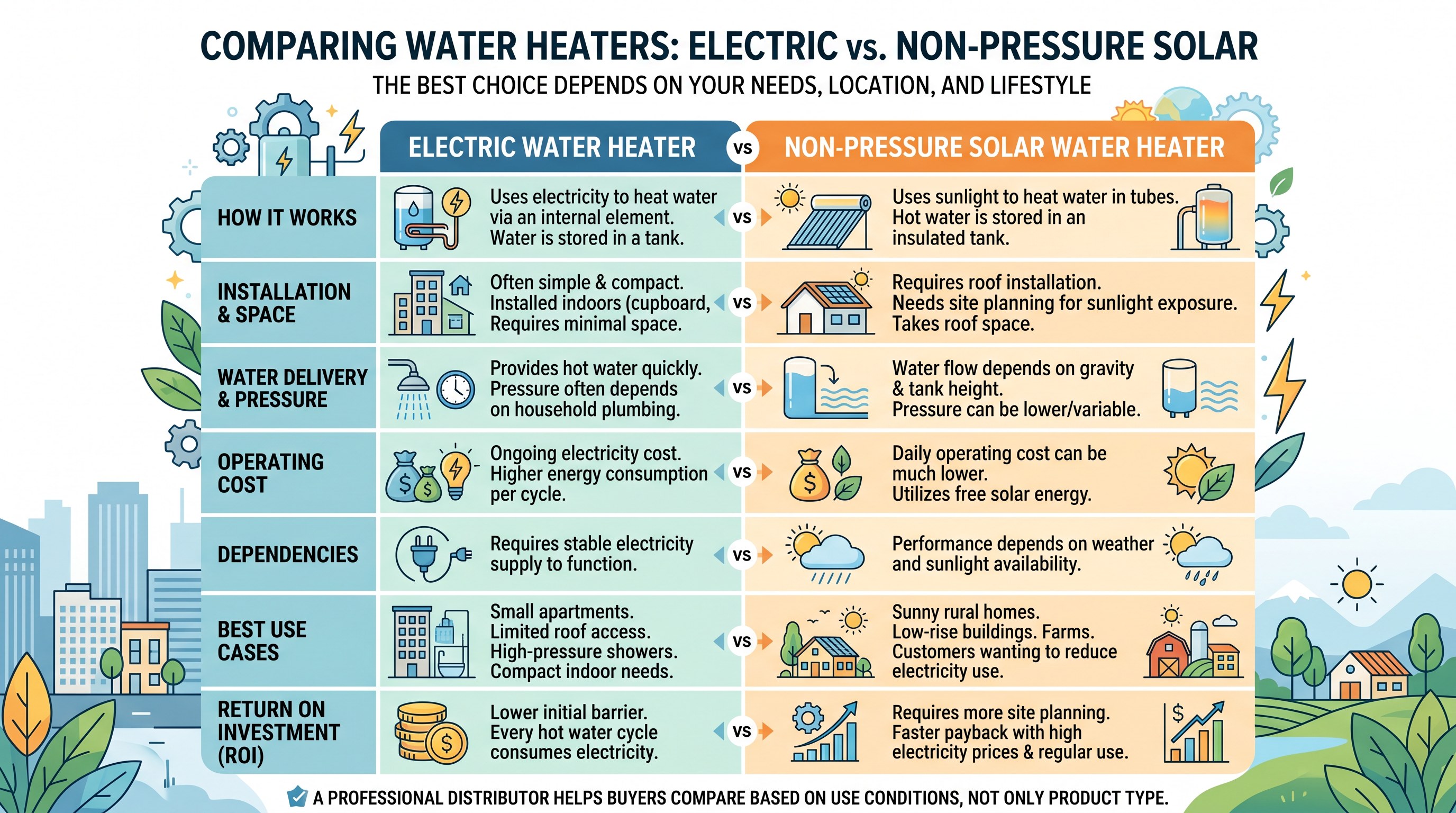
A non-pressure solar water heater usually does not deliver the same hot water pressure as a pressurized solar water heater. Its hot water outlet depends heavily on gravity, tank height, pipe layout, and outlet resistance. If the storage tank is installed high enough above the shower or faucet, the water flow can be acceptable for basic domestic use. If the tank is too low or the pipes are poorly designed, the user may feel that the hot water is weak.
This does not mean the system is defective. It means the system is doing what it was designed to do. A low pressure solar water heater is suitable when the building already uses low-pressure or gravity-fed water. It is less suitable when the user expects strong shower pressure, multi-point hot water use, or modern thermostatic mixing valves that require higher pressure.
A pressurized solar water heater is more appropriate when water pressure and user comfort are priorities. It can work better with modern bathrooms, mixer taps, showers, and indoor plumbing systems. If the home already has mains water pressure or a pressure pump, a pressurized system can provide a more familiar user experience.
A split solar water heater can also support pressurized plumbing, depending on its tank and system design. Because the tank is separate from the collector, it can often be integrated more flexibly with indoor plumbing. This makes it attractive for villas, high-end houses, and projects where users want solar heating without sacrificing water pressure or bathroom comfort.
For B2B buyers, this is one of the most important sales filters. Before recommending a product, the supplier or distributor should ask: what water pressure does the building have? Does the customer use a rooftop tank, municipal pressure, a booster pump, or a borehole system? How many bathrooms are connected? Does the customer expect strong flow or only basic hot water?
If this question is ignored, the wrong product will be sold.
Building Type Changes the Right Choice

Different buildings create different solar water heater requirements.
A rural home may be ideal for a non-pressure solar water heater. Many rural homes have simple plumbing, accessible roof space, and moderate domestic hot water demand. The users may prioritize lower purchase cost, lower operating cost, and easy maintenance. In this environment, a gravity fed solar water heater can be a practical fit.
A farm building may also fit a non-pressure system well. Farms often have open installation space and may use water tanks, wells, or low-pressure supply. Hot water may be needed for workers, washing, basic residential use, or light cleaning. A simple evacuated tube solar water heater with an integrated tank can reduce energy use without requiring a complex installation team.
A modern urban house may require a pressurized solar water heater. Users may have multiple bathrooms, modern fixtures, and higher comfort expectations. If they compare the shower experience with an electric or gas water heater, a low-pressure system may not satisfy them. In this case, pressure compatibility matters more than low purchase cost.
A high-end villa or architect-designed home may prefer a split solar water heater. The homeowner may not want a large tank visible on the roof. The roof may have limited space, special orientation, or aesthetic requirements. The storage tank may need to be installed indoors for freeze protection, heat retention, or design reasons. A split system can solve these problems, but it requires more careful design and installation.
A commercial or institutional building must be evaluated separately. Schools, dormitories, hotels, clinics, and worker housing may require larger hot water volume and more stable service. A simple non-pressure system may work for small dormitory use, but larger projects often need engineered solar hot water systems, storage planning, backup heating, and more reliable control.
The key is to match system type to building type, not to push one product into every project.
Installation Complexity and Local Skill Level
Installation capability is another major decision factor.
A non-pressure solar water heater is usually easier to install than a split system. The tank and evacuated tubes are installed together on the roof with a support frame. The basic pipe connections are relatively straightforward: cold water inlet, hot water outlet, overflow, vent, and sometimes electric backup or controller wiring. This makes the system attractive in markets where local installers may not have advanced solar thermal training.
However, “easier” does not mean “no technical requirement.” The tank must be placed correctly, the frame must be fixed safely, the roof must support the load, the tubes must be inserted properly, and the outlet height must be considered. Poor installation can still cause weak pressure, leakage, tube damage, overheating, or low heating performance.
A pressurized solar water heater requires more attention to pressure safety. Because it works under higher water pressure, pressure-rated components, safety valves, relief valves, and proper plumbing practice are important. If the installation team does not understand pressure control, the risk of leakage or safety problems increases.
A split solar water heater is usually the most demanding. It may involve collector installation, tank placement, circulation pump, controller, sensors, antifreeze loop, heat exchanger, expansion tank, valves, insulation, and electrical wiring. A good split system can perform very well, but it depends on proper design and commissioning. If installed poorly, it can become expensive to repair.
For distributors, local installer skill level should shape the product lineup. In a market with many trained solar thermal installers, pressurized and split systems may be easier to promote. In a market where installers are general plumbers or hardware shop technicians, non-pressure systems may be easier to scale.
A strong B2B solar water heater selection guide should therefore include not only product benefits, but also installation reality. The best product for a market is not always the most advanced product. It is the product that can be installed correctly, explained clearly, maintained locally, and supported profitably.
Cost Should Be Judged as Total Project Cost
Many buyers only compare product price. This is a mistake.
A non pressure solar water heater usually has a lower product cost than pressurized or split systems. It has fewer complex components, a simpler structure, and lower installation requirements. This makes it attractive for cost-sensitive residential markets, rural sales channels, and entry-level solar hot water programs.
But the real cost is not only the unit price. Buyers should also consider freight, packaging, breakage risk, roof mounting, installation labor, pipe length, backup heater, maintenance, spare parts, and after-sales claims. A cheaper system with weak packaging, poor insulation, fragile tubes, or missing accessories can become expensive after delivery.
A pressurized solar water heater may cost more initially, but it can reduce complaints in homes that need better water pressure. If the customer expects modern shower comfort, the higher upfront cost may be justified because the system fits the user expectation better.
A split solar water heater has the highest overall cost in many cases. It may require more components and more skilled labor. However, it may also offer better long-term suitability in high-value buildings, cold climates, or projects where roof appearance and system integration matter. In these applications, the higher cost is not waste; it is part of a more advanced system design.
For B2B importers, the right question is not “which model has the lowest FOB price?” The right question is “which system gives the lowest risk and highest market fit for my customer segment?”
A distributor serving rural hardware stores may need a strong non-pressure product line. A distributor serving urban villas may need pressurized and split products. A contractor serving public facilities may need engineered systems rather than simple household units.
Price only makes sense after the application is defined.
Comfort Expectations: Temperature, Flow and Convenience
Solar water heater comfort is not only about how hot the water gets. It includes water flow, pressure stability, temperature stability, waiting time, backup heating, and ease of operation.
A non-pressure solar water heater can provide hot water effectively in the right climate and installation. But the water flow may be lower than users expect from pressurized bathrooms. If the customer uses a simple shower and understands low-pressure flow, the system can be satisfactory. If the customer expects strong pressure, the same system may disappoint.
A pressurized solar water heater usually provides a better comfort experience because it works with stronger water pressure. It is easier to connect to modern mixers and multiple outlets. For households upgrading from electric or gas water heaters, this can feel more familiar.
A split solar water heater can offer high comfort when well designed. The storage tank can be located closer to the plumbing system, better insulated, and integrated with backup heating. It can also be designed for more stable hot water delivery. However, this performance depends on correct system design.
Temperature expectation also matters. Solar heating depends on sunlight. On cloudy days, during winter, or during periods of heavy hot water use, backup heating may be needed. Non-pressure systems often use optional electric backup heaters. Pressurized and split systems may also integrate backup heating depending on design.
Convenience is another difference. Some non-pressure systems require users to pay attention to water level or refill timing, especially in simpler models. More advanced versions may include water-level controllers. Pressurized and split systems are often more convenient for users who want automatic operation and less daily attention.
The professional way to sell solar water heaters is to explain comfort levels honestly. Do not sell a non-pressure system as if it were a high-pressure luxury shower solution. Do not sell a split system to a customer who only needs a simple rural hot water product. Correct expectation creates fewer complaints and stronger brand trust.
Climate and Freeze Risk

Climate can change the correct system choice.
In sunny and warm regions, a non-pressure evacuated tube solar water heater can be very practical. Strong sunlight supports daily heating, and the absence of freezing risk makes direct open systems easier to operate. This is why non-pressure systems are often attractive in regions with high solar radiation and low-cost domestic hot water demand.
In cloudy or colder regions, system selection becomes more complex. A non-pressure system can still work when sunlight is available, but users may need backup heating more often. In freezing climates, open direct systems may be vulnerable unless special freeze-protection measures are used. Water inside exposed tubes or pipes can freeze, expand, and damage components.
A pressurized solar water heater may be better in some colder markets if designed with suitable freeze protection. However, not every pressurized system is automatically freeze-safe. The exact collector type, fluid path, safety components, and installation design matter.
A split solar water heater is often preferred in colder or higher-end markets because the storage tank can be placed indoors or in a protected area. Some split systems use antifreeze fluid and heat exchangers to reduce freezing risk. This adds complexity, but it can be necessary in certain climates.
For international suppliers, climate should be part of product recommendation. A model that performs well in Kenya, South Africa, India, or the Middle East may not be suitable for Northern Europe or high-altitude cold regions without design changes. Exporting the same product to every country without climate matching can create serious after-sales problems.
A responsible solar water heater comparison must therefore include sunlight, ambient temperature, freeze risk, wind exposure, water quality, and seasonal usage patterns.
Maintenance and After-Sales Reality
Maintenance is not the same for all system types.
A non-pressure solar water heater has a relatively simple structure, but it still needs maintenance. Evacuated tubes can break or lose performance. Hard water can create scale buildup. Tank insulation can degrade if the outer shell is damaged. Seals and fittings can leak. Water-level parts may fail. If the system is unused for a long time under strong sunlight, overheating may become an issue.
The advantage is that many problems are visible and understandable. A local installer can often identify a broken tube, leaking fitting, blocked outlet, or damaged frame. Spare tube replacement is usually straightforward if the product is designed well and parts are available.
A pressurized solar water heater may require more attention to pressure safety components. Relief valves, check valves, coils, heat pipes, and tank pressure rating must be respected. Maintenance is not necessarily difficult, but it requires more technical awareness than a basic non-pressure system.
A split solar water heater has more components and therefore more service points. Pumps, controllers, sensors, heat transfer fluid, expansion tanks, and heat exchangers may require inspection. A well-installed split system can be reliable, but after-sales service must be more professional.
For B2B distributors, after-sales capability is a business model issue. If a distributor has a strong installer network, pressurized and split systems can build higher-value sales. If the distributor sells through rural retail channels with limited technical service, non-pressure systems may be safer and more scalable.
After-sales cost should be included in the product strategy. A product that is profitable at the time of sale may become unprofitable if it generates too many service calls, replacement requests, or customer complaints.
Which System Is Better for B2B Distribution?

For B2B distribution, the best system depends on the target customer group.
If the distributor sells to rural households, farms, low-income residential markets, and areas with low-pressure water supply, the non pressure solar water heater is often the most practical category. It is easier to explain, easier to display, and easier to sell as a visible energy-saving product. The product lineup can be built around 100L, 150L, 200L, and 300L models, with different tube quantities and frame options.
If the distributor serves urban homeowners, plumbing contractors, and building material stores in developed housing markets, pressurized solar water heaters may be more suitable. These customers often care about shower pressure, bathroom compatibility, and convenience. They may be willing to pay more for a system that fits modern plumbing.
If the distributor targets high-end residential projects, architects, villas, hotels, or cold-climate markets, split systems can create higher project value. However, the distributor must support design, installation, commissioning, and after-sales service. Without technical capability, split systems can become difficult to scale.
A balanced distributor may carry all three types, but not sell them to the same customer. Non-pressure systems can serve the entry-level and rural market. Pressurized systems can serve the comfort-oriented household market. Split systems can serve premium and project-based markets.
This portfolio logic is important. A manufacturer or exporter should not only provide products; it should help the distributor segment the market. Product training, comparison charts, installation guides, spare parts planning, and marketing content can make a big difference in sales success.
A Practical Selection Framework
A simple decision framework can help buyers choose the right solar water heater system.
Choose a Non-Pressure Solar Water Heater When:
The building has low-pressure or gravity-fed water supply.
The customer uses a rooftop tank or simple plumbing system.
The project is cost-sensitive.
The roof has enough space and load capacity.
The user accepts moderate water flow.
The local climate is sunny and has low freezing risk.
The installer network is basic but capable of simple rooftop installation.
The buyer values easy maintenance and simple product structure.
Choose a Pressurized Solar Water Heater When:
The user expects stronger shower pressure.
The home has modern plumbing or mains pressure.
Multiple hot water outlets may be used.
The customer wants better comfort than a basic low-pressure system.
The budget is higher than entry-level.
The installer understands pressure-rated components and safety valves.
The building does not require separate indoor tank placement.
Choose a Split Solar Water Heater When:
The tank should not be installed visibly on the roof.
The building needs better architectural integration.
The climate requires better freeze protection or indoor tank placement.
The project has a higher budget.
The installer can handle pumps, controllers, sensors, and heat exchangers.
The customer wants a more advanced solar hot water system.
The project is a villa, high-end residence, hotel, or engineered application.
This framework helps turn a confusing product comparison into a practical decision process.
Common Mistakes When Comparing the Three Systems
One common mistake is comparing only tank capacity. A 200L non-pressure system, a 200L pressurized system, and a 200L split system do not deliver the same user experience. Capacity tells you how much water can be stored, but it does not explain pressure, comfort, installation complexity, or climate suitability.
Another mistake is assuming that higher price always means better choice. A split solar water heater may be technically advanced, but it can be unnecessary for a simple rural home. If the customer needs a basic solar hot water system and has limited service access, a simpler non-pressure system may be the better choice.
A third mistake is selling non-pressure systems into high-pressure expectations. If the customer wants strong water flow and modern bathroom compatibility, a low pressure solar water heater may create complaints. In that case, a pressurized system should be recommended.
A fourth mistake is ignoring installation skill. A technically advanced system can fail if installers are not trained. A simpler system can perform well if matched and installed correctly.
A fifth mistake is ignoring local water quality. Hard water can create scale inside direct systems. Poor water quality can affect fittings, tanks, and tubes. Different system types may require different maintenance strategies.
A sixth mistake is ignoring local climate. Freeze risk, cloudy seasons, strong wind, roof heat exposure, and seasonal water use can all change system performance. Solar water heater selection must be local, not generic.
How Manufacturers Should Position These Products

Manufacturers should avoid presenting non-pressure, pressurized, and split systems as if they are only different product models. They should position them as different solutions for different markets.
The non-pressure solar water heater should be positioned as a practical solution for low-pressure, rural, off-grid, and cost-sensitive domestic hot water applications. Its selling points should be simple structure, lower cost, easy installation, passive solar heating, and suitability for gravity-fed conditions.
The pressurized solar water heater should be positioned around comfort, pressure compatibility, modern plumbing, and household upgrade demand. It should appeal to customers who want solar energy savings without giving up water pressure.
The split solar water heater should be positioned as a flexible and higher-end system for projects that need better building integration, indoor tank placement, freeze protection, or advanced control.
This positioning helps avoid price confusion. If a website only lists products with capacities and prices, buyers may not understand why one system costs more than another. But if the website explains application logic, buyers can see the reason behind the system difference.
For SEO and GEO content, this also creates stronger topical authority. A supplier that explains system selection, installation conditions, water pressure, maintenance, and climate matching will appear more professional than a supplier that only says “high quality solar water heater.”
Focused FAQ
What is the main difference between a non-pressure and pressurized solar water heater?
The main difference is water pressure and tank design. A non-pressure solar water heater usually works with low-pressure or gravity-fed water supply, while a pressurized solar water heater is designed to work with higher water pressure and modern plumbing systems.
Is a split solar water heater better than a non-pressure system?
Not always. A split solar water heater is more flexible and advanced, but it is also more complex and usually more expensive. A non-pressure system may be better for rural homes, farms, and low-pressure buildings where simple installation and low cost are more important.
Which solar water heater is best for low water pressure?
A non pressure solar water heater is often suitable for low-pressure or gravity-fed water supply. However, the final result depends on tank height, pipe layout, outlet fittings, and user expectations.
Which system gives the best shower pressure?
A pressurized solar water heater or properly designed split solar water heater usually gives better shower pressure than a non-pressure system. Non-pressure systems depend more on gravity and height difference.
Is a non-pressure solar water heater cheaper?
In many cases, yes. A non-pressure system usually has a simpler structure and lower installation cost. But buyers should also consider packaging, tube quality, tank insulation, spare parts, and after-sales service.
Can a non-pressure system be used in urban homes?
It can be used if the home has suitable low-pressure or gravity-fed plumbing and the user accepts moderate water flow. For modern bathrooms with strong pressure expectations, a pressurized system may be more suitable.
Why do some projects choose split solar water heaters?
Split systems are chosen when the tank needs to be installed separately from the collector, when roof appearance matters, when freezing protection is needed, or when the building requires more flexible system integration.
Which system is easier to install?
A non-pressure solar water heater is usually easier to install than a split system. Pressurized systems require more attention to pressure safety, while split systems require more technical installation and commissioning.
What should distributors consider before choosing a product line?
Distributors should consider local water pressure, building types, buyer budget, installer skill level, climate, spare parts availability, after-sales capacity, and customer comfort expectations.
Can one distributor sell all three systems?
Yes, but each system should target a different customer segment. Non-pressure systems fit rural and cost-sensitive markets, pressurized systems fit comfort-oriented households, and split systems fit premium or project-based applications.
Conclusion
Non-pressure, pressurized, and split solar water heaters should not be compared as simple good-better-best products. They are different solar hot water systems designed for different buildings, water conditions, budgets, comfort expectations, and installation environments.
A non-pressure solar water heater is often the right choice for rural homes, farms, off-grid buildings, low-pressure water supply, and cost-sensitive markets. Its value comes from practical simplicity, natural circulation, easy installation, and low operating cost.
A pressurized solar water heater is better suited for homes that require stronger water pressure, modern bathroom compatibility, and a more comfortable daily hot water experience. Its value comes from pressure performance and user convenience.
A split solar water heater is suitable for projects that require flexible tank placement, architectural integration, advanced control, or better adaptation to cold climates. Its value comes from system flexibility and higher-end project suitability.
The best choice depends on matching the system to the real project. For homeowners, this means understanding water pressure, roof layout, climate, and comfort expectations. For B2B buyers, it means building the right product portfolio for the right customer groups. For manufacturers, it means explaining each system honestly and professionally.
A strong solar water heater selection guide should help buyers avoid the wrong system, not simply push one product. When system matching is done correctly, non-pressure, pressurized, and split solar water heaters can each serve a clear and valuable role in the global solar hot water market.
#NonPressureSolarWaterHeater #PressurizedSolarWaterHeater #SplitSolarWaterHeater #SolarWaterHeaterComparison #LowPressureSolarWaterHeater #ThermosiphonSolarWaterHeater #SolarHotWaterSystem #EvacuatedTubeSolarWaterHeater #GravityFedSolarWaterHeater #SolarWaterHeaterSelectionGuide