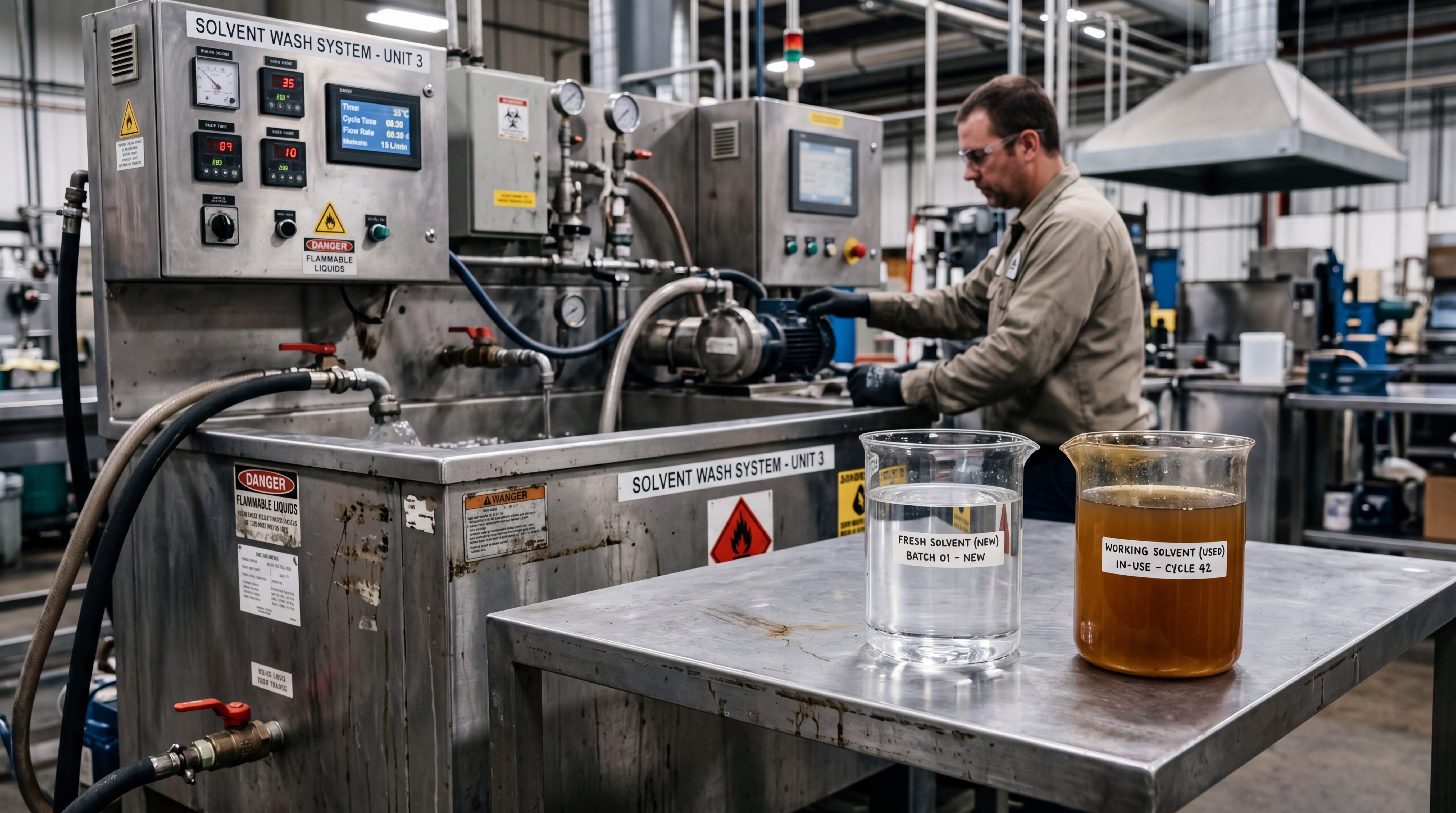
How Hydrocarbon Solvents Are Selected Differently in Coatings, Adhesives, Cleaning and Chemical Processing
The biggest solvent mistake is assuming one good result can be copied everywhere
A common belief in industry is that once a solvent has proven successful in one application, it should be able to perform well in many others. A team sees a product working in a degreasing station, then assumes it may also be a strong candidate for a formulation process. A coating line approves one hydrocarbon blend for viscosity adjustment, and someone later wonders whether the same product could simplify adhesive handling in another department. A cleaning manager sees a low-odor solvent gain good operator acceptance and starts asking whether it could become a broader site standard.
This way of thinking is understandable. It comes from a desire for simplification, consolidation and procurement efficiency. Fewer products often seem easier to buy, easier to store and easier to explain. But in the world of hydrocarbon solvents, that logic can become expensive very quickly.
The reason is simple: different industrial applications do not buy the same kind of value from a solvent. Even when the chemistry category looks similar, the operating objective changes from one process to another. In coatings, the solvent is helping shape movement, leveling, film behavior and drying logic. In adhesives, it influences interaction, tack development, open time and substrate response. In industrial cleaning solvents, the priority may shift toward deposit removal, residue control, operator handling and contact efficiency. In chemical processing solvents, the focus becomes repeatability, compatibility, process control and consistency across production cycles.
This is why solvent selection cannot be standardized around a single idea of what a good solvent is. There is no universal definition. A solvent that performs beautifully in one environment may create hidden instability in another. A product valued for its cleaning strength may be too aggressive for a formulation task. A solvent chosen for its calm operating profile may lack the decisive action needed for heavy contamination removal. A route selected because it supports a strong customer-facing story may not deliver the throughput a plant actually needs.
That does not mean industrial buyers should abandon the idea of structured decision-making. It means the structure needs to be better. Instead of starting with product loyalty or inherited site habits, teams should begin with application logic. What role is the solvent playing in this process? What must it control? What can it not afford to disturb? What does success look like from the perspective of the actual operation?
Once those questions are taken seriously, the category becomes much clearer. Hydrocarbon solvents stop looking like interchangeable drums and start revealing themselves as application-specific tools. The same family of industrial solvents may support four entirely different kinds of performance across coatings, adhesives, cleaning and chemical processing. Understanding that difference is one of the clearest signs that a buyer or engineer is no longer treating solvents as commodities.
A good solvent in one department can be the wrong solvent in the next

Many industrial sites inherit solvent habits rather than designing them. A product enters the plant because it solved a historical problem, then gradually becomes normalized. Over time, that product may be used in additional tasks simply because it is already available, familiar and easy to reorder. Nobody initially intends to make a poor technical decision. The process just drifts toward convenience.
This drift is where many long-term inefficiencies begin.
A hydrocarbon solvent that works well for a specific cleaning task may become the unofficial answer to unrelated problems. An older aromatic route may remain in use for years because it once delivered reliable solvency, even though newer low odor solvents or dearomatized solvents might now provide a better fit in certain areas. A coating team may accept a solvent because it helps with one resin system, while overlooking that the same product complicates drying balance in another formulation. In adhesive production, a solvent may seem technically acceptable but subtly shift working behavior in ways that operators compensate for without ever formally reporting.
The danger is not always catastrophic failure. More often, the wrong solvent choice creates a slower and less visible form of process tax. It asks workers to adjust. It introduces extra caution steps. It weakens consistency. It reduces confidence in the line. It creates more debate between production and quality teams. It increases the distance between lab approval and shop-floor reality.
This is why application-driven solvent thinking matters so much. When teams understand that the value of coatings solvents, adhesive solvents, industrial cleaning solvents and chemical processing solvents is defined differently, they stop copying success blindly. They begin to separate technical suitability from simple familiarity.
That shift is especially important in the modern market because product expectations are rising. Customers care more about consistency. Plants care more about repeatability and training simplicity. Operators care more about handling comfort and process clarity. Procurement teams care more about justification beyond price. Environmental and workplace conversations increasingly influence how products are positioned internally and externally. All of this means that the same old “if it works somewhere, use it everywhere” logic has become less defensible.
The real discipline lies in recognizing that solvent success is local to the application. The same solvent may be excellent in one department, workable in another and completely wrong in a third. Mature companies accept that complexity because it leads to better control, better efficiency and stronger long-term performance.
In coatings, the solvent is helping the formulation move through time


The coatings world teaches one of the most important lessons in solvent selection: the solvent is not only dissolving materials. It is also governing movement through time.
This matters because coatings are living systems while they are being applied. The solvent affects viscosity, wet edge, application feel, flow, leveling, flash-off behavior and the early formation of the film. In some cases it even affects how defects emerge or are prevented. So when selecting coatings solvents, the question is never limited to whether the resin dissolves. The real question is whether the coating behaves correctly from mixing through final development.
That is why one hydrocarbon route may work well in a tank and still disappoint on the substrate. Strong solvency can help maintain a formulation, yet still create an evaporation profile that is too sharp for the application window. A calm and comfortable solvent may feel attractive during mixing, but leave the coating too slow to set, too prone to collect dust, or too soft during early handling. A product chosen mainly for lower odor may improve workshop acceptance while quietly changing film behavior under certain climate conditions.
In coatings, the solvent is part of motion control. It must support not just dissolution, but timing and surface behavior. This is where many buyers misjudge hydrocarbon solvents. They assume that because hydrocarbon chemistry is often associated with dilution, carrier function or viscosity management, the choice is relatively forgiving. In reality, coatings can be highly sensitive to solvent character because every stage of application amplifies subtle differences.
This is also why solvent compatibility matters differently in coatings than in many other uses. It is not just about whether the solvent attacks a material in an obvious way. It is about whether the solvent fits the internal balance of the formulation and the external demands of the application. Compatibility includes resin response, additive behavior, substrate interaction, drying logic and process repeatability.
A buyer selecting industrial solvents for coatings should therefore think like a process designer, not a commodity purchaser. The best choice is the one that helps the coating move through each stage with the least friction. Sometimes that means a stronger route. Sometimes it means a softer one. Sometimes it means shifting from a more traditional aromatic logic toward dearomatized solvents or more refined hydrocarbon profiles. But the point remains constant: in coatings, the solvent is not passive. It is part of the choreography.
In adhesives, the solvent is managing interaction rather than just reduction

Adhesives may appear similar to coatings at first glance because both systems involve formulation behavior, handling properties and application timing. But adhesives impose a different type of solvent responsibility. Here, the solvent is often managing interaction rather than simply helping a material flow.
That difference is important. In adhesive systems, the solvent may influence dissolution of base materials, control working viscosity, affect wetting on the target substrate, shape open time, influence tack development and alter how the operator perceives readiness during use. A solvent that seems chemically successful can still create a process that feels unreliable if it changes the interaction window in subtle ways.
This is why adhesive solvents should not be selected by borrowing logic from coatings or cleaning. In many adhesive processes, the central challenge is not how quickly something dries or how aggressively something dissolves. It is how the adhesive behaves between preparation and bond formation. That interval can be delicate. Too much solvency may destabilize the feel of the system or alter how it engages with the substrate. Too little solvency may make the formulation difficult to prepare or apply evenly. A solvent with the wrong evaporation character may shorten the usable window or introduce inconsistency across operators, temperatures or substrates.
Hydrocarbon routes often remain valuable in adhesives because they can provide a practical balance of solvency, handling and processing behavior. But balance is the key word. A buyer should not ask only which product keeps the adhesive workable. They should ask which product keeps it workable in the right way. That includes how the solvent behaves during storage, mixing, line use, manual application and the critical transition toward bond development.
This is also where application-specific low odor solvents may become relevant. In adhesive environments with regular manual use or close operator interaction, odor and working comfort can affect process discipline more than older procurement models admit. But lower odor alone is not enough. The solvent still has to support the adhesive system at a technical level. If a change in odor profile alters open time, tack progression or application confidence, the team has not improved the process. They have simply moved the problem.
A mature adhesive solvent program recognizes that the best product is not the one with the most attractive isolated feature. It is the one that manages interaction without introducing uncertainty. That is a very different standard from the one used in coatings, and it is one reason why cross-applying solvent decisions between departments so often leads to quiet inefficiency.
In industrial cleaning, the solvent is being judged by what it leaves behind

Of all common solvent applications, industrial cleaning solvents are often the most immediate and the most unforgiving. The task sounds simple: remove contamination. But real industrial cleaning is much more demanding than that. The solvent is not only judged by whether it loosens or dissolves the target soil. It is judged by what happens after that action.
What remains on the surface?
How clearly can the operator see the result?
How quickly can the part move to the next step?
Does the contamination smear, lift, dissolve or redeposit?
Does the solvent support a calm and repeatable routine, or does it create uncertainty?
Does it respect the surrounding materials and equipment?
Does it fit open-area use, enclosed cleaning, wipe-down operations, immersion tanks or circulation systems?
These questions make solvent selection in cleaning fundamentally different from selection in formulation-driven applications. Cleaning is not about keeping a system alive. It is about resolving a contamination problem with enough certainty that the next stage can proceed without hesitation.
This is why target specificity matters so much. Light oils and greases may respond well to a balanced hydrocarbon route that provides steady cleaning, manageable drying and good operator acceptance. Heavy deposits, waxes, resins, old process residues or cured contamination may require stronger solvency. But even then, the best cleaning solvent is not necessarily the strongest one available. It is the one that solves the contamination problem while preserving process trust.
A solvent that removes residue aggressively but leaves an unclear surface may slow inspection. A product that dries too fast may reduce dwell time and cleaning completeness. A solvent that performs chemically but produces a harsh and uncomfortable working environment may reduce consistency in repeated manual use. An apparently economical route may require extra passes, more rework or more caution steps, quietly increasing the true cost of cleaning.
This is where hydrocarbon solvents continue to hold strong value. They offer multiple routes for balancing action, evaporation, operator experience and material response. In some tasks, aromatic character may still be useful because the contamination genuinely demands deeper solvency. In others, aliphatic or dearomatized solvents may support a better operating balance, especially where routine maintenance, wipe-down use or broader material tolerance matters. Again, the point is not to declare one family superior. It is to respect that industrial cleaning has its own performance logic.
In cleaning, success is visible. The solvent is judged by the finished surface, the rhythm of the task and the confidence it creates in the technician. That makes cleaning one of the clearest reminders that solvent value is always defined by the application, not by the label.
In chemical processing, the solvent is reducing uncertainty across the whole system

If coatings are about time, adhesives are about interaction and cleaning is about resolved contamination, then chemical processing solvents are about reducing uncertainty.
In process environments, the solvent may serve as a medium, a carrier, a diluent, a separation aid, an extraction component, a reaction support material or a performance control variable. The exact role can vary widely, but one demand is almost always present: the solvent must behave predictably. Not once in a trial, but repeatedly across actual operation.
This is why chemical processing places a different kind of pressure on hydrocarbon solvents. The process may be less visibly dramatic than cleaning or application, but the consequences of poor solvent fit can be broader. A small mismatch can affect reproducibility, transfer behavior, impurity management, recovery efficiency, line stability or maintenance burden. The result is often not sudden failure. It is process noise.
Process noise is expensive because it hides inside routine work. Teams compensate for it without always naming it. Operators adjust timing. Engineers revise conditions. Quality teams tighten checks. Maintenance teams notice gradual buildup or inconsistent behavior. Procurement keeps buying the same product because the problems are not dramatic enough to trigger a formal review. This is how mediocre solvent fit survives for years.
A better approach to chemical processing solvents begins by acknowledging that the solvent is part of the operating architecture. It interacts with vessels, pumps, seals, lines, temperatures, storage methods and downstream handling conditions. So solvent compatibility here must be understood broadly. It is not just about chemistry in the narrow sense. It includes equipment compatibility, procedural compatibility, thermal behavior, batch consistency and handling fit across the whole operation.
Because of this, process applications often reward balanced hydrocarbon routes more than headline properties. A slightly less aggressive solvent that creates a steadier process may be worth far more than a stronger product that introduces variability. A route with a better handling profile may improve site discipline and reduce operational friction. A more refined or more tightly controlled solvent grade may justify itself through predictability alone, even if it does not look dramatically different on a basic product list.
This is why industrial solvents used in process environments should never be selected by analogy with cleaning or formulation work. The question is not “Will it work?” The question is “Will it make the whole system easier to run, easier to repeat and easier to trust?” That is a much higher standard, and it is exactly why process applications demand their own solvent logic.
The same solvent attribute can mean something different in every application
One of the easiest ways to misunderstand solvents is to assume that properties carry fixed meaning across all uses. In reality, the same attribute can be interpreted very differently depending on the application.
Take evaporation, for example. In coatings, evaporation may govern leveling and film development. In adhesives, it may define the usable working window. In industrial cleaning solvents, it may determine whether the product stays long enough to soften contamination or leaves the surface quickly enough for fast turnaround. In chemical processing solvents, evaporation can influence recovery behavior, material balance or operational consistency.
The same is true for solvency strength. In cleaning, strong action may be celebrated if the deposit is difficult. In coatings, that same strength may become disruptive if it changes system behavior more than the process can tolerate. In adhesives, it may improve dissolution while complicating tack response. In process settings, it may be helpful or harmful depending on what the system is trying to control.
Odor provides another good example. Lower odor can be an important advantage in operator-facing environments, especially where repeated manual contact shapes discipline and process acceptance. That may make low odor solvents more attractive in certain cleaning, adhesive or open-use contexts. But in a process setting with enclosed handling and other dominant priorities, odor may matter far less than consistency or solvency accuracy. So the property itself does not tell the whole story. The application decides how much that property matters.
This is one reason why dearomatized solvents have become more relevant in modern industry. They offer another way to tune the balance between solvency, odor, handling and broader acceptability. But even here, their value depends on the application. In some tasks they may create a better fit. In others, older solvent logic may still hold technical advantage. The correct decision is not trend-driven. It is use-driven.
Once buyers understand that properties are interpreted through application context, their decisions improve dramatically. They stop asking whether a solvent has a good property and start asking whether that property matters in the right way for the actual job.
Why cross-department standardization often fails even when procurement likes it
Procurement departments understandably value simplification. Fewer SKUs can mean easier storage, easier vendor management, simpler training materials and stronger purchase leverage. On paper, standardizing a solvent program across multiple departments seems efficient. In practice, it often creates technical compromise that later becomes operational cost.
The failure happens because standardization is usually built around what looks common rather than what truly is common. Several departments may all use hydrocarbon solvents, but that does not mean they are buying the same performance. A coating line is managing movement and surface development. An adhesive team is managing interaction and working time. A cleaning unit is managing contamination resolution and visible finish. A chemical processing team is managing repeatability and system discipline. The overlapping chemistry category hides the non-overlapping process demands.
This does not mean standardization is always impossible. It means it must be earned, not assumed. A site may be able to rationalize part of its solvent portfolio if it studies what the applications genuinely share. In some cases, a well-chosen balanced product may support several related cleaning tasks. In others, a refined hydrocarbon route may work across selected formulation uses. But when companies standardize too aggressively, they often force departments to adapt to a solvent instead of choosing a solvent that supports the department.
That reversal is where hidden cost begins. Production slows slightly. Operators improvise. Quality conversations increase. Process windows narrow. The site appears simpler on paper and becomes less efficient in reality.
The smarter strategy is selective standardization. Understand where overlap is technically real, and preserve differentiation where the application logic truly diverges. This approach respects procurement goals without sacrificing process intelligence. It also reflects a more mature view of industrial solvents: not as anonymous inputs, but as tools whose value depends on where and how they are used.
How aliphatic, aromatic and dearomatized routes fit differently across applications
Although application logic should come first, solvent family still matters. Aliphatic, aromatic and dearomatized solvents each tend to offer different value patterns, and those patterns show up differently across industries.
Aliphatic routes are often appreciated where a process benefits from steadier behavior, broader operating comfort, manageable solvency and in many cases a more approachable working profile. That may make them especially attractive in certain maintenance cleaning tasks, balanced formulation systems or open-use environments where operator experience matters.
Aromatic routes continue to matter where stronger solvency is genuinely required. Some heavy residues, demanding resin systems or difficult organic materials still justify their use. But their value is strongest when the application clearly needs that level of action. Using aromatic logic by default, rather than by necessity, is one of the most common ways older solvent habits survive longer than they should.
Dearomatized solvents occupy an increasingly useful middle position in many modern decisions. They can help companies preserve the practical value of hydrocarbon solvents while moving toward lower odor profiles, more refined handling or a more contemporary product story. In some applications, especially those with customer-facing sensitivity or regular operator contact, that balance can be extremely valuable. But again, the correct role depends on the application. Dearomatized does not automatically mean superior. It means differently balanced.
This family view becomes powerful only when combined with application understanding. A family can suggest probable strengths, but it cannot make the final decision alone. That decision belongs to the process.
A better solvent portfolio starts with four separate questions, not one
Many companies ask a single question when reviewing their solvent program: which solvents should we buy? That question is too broad to produce a smart answer. A better portfolio review begins with four separate questions, one for each application logic.
For coatings: which solvent helps the formulation move through mixing, application and drying with the least disruption?
For adhesives: which solvent manages interaction, wetting and working window with the most confidence?
For cleaning: which solvent resolves the target contamination while leaving the process calm, visible and repeatable?
For chemical processing: which solvent reduces uncertainty across the system and supports stable operation over time?
Once these questions are asked separately, portfolio design becomes much more rational. Instead of forcing different departments into one procurement idea, the company builds a set of industrial solvents that match actual performance needs. Some overlap may remain, and that overlap will be real rather than accidental. Some differentiation will remain, and that differentiation will be justified rather than wasteful.
This approach also improves internal communication. Production teams can explain why a solvent exists in their process. Quality teams can judge fit more clearly. Procurement can defend purchases with better reasoning. Suppliers receive better questions. Training becomes more practical because it reflects actual use rather than abstract category language.
Most importantly, the solvent portfolio becomes easier to optimize over time. As applications evolve, the company can review each solvent according to the logic of the process it serves. That is far better than waiting for general dissatisfaction to accumulate and then attempting a site-wide replacement project with unclear objectives.
Conclusion: hydrocarbon solvents only look similar until the process begins
At first glance, hydrocarbon solvents can appear deceptively simple. They belong to a familiar industrial category. They are often discussed in terms of solvency, flash point, odor or evaporation. They are bought in drums, stored in similar areas and grouped together in procurement systems. From a distance, they seem close enough to compare as a single class of materials.
But once the process begins, that illusion disappears.
In coatings, the solvent becomes part of movement and film development.
In adhesives, it becomes part of interaction and working window control.
In industrial cleaning solvents, it becomes part of contamination resolution and visible finish.
In chemical processing solvents, it becomes part of repeatability and operational certainty.
That is why intelligent solvent selection always begins with application logic. The same property can mean something different in each setting. The same solvent family can deliver value in one department and compromise in another. The same product can look efficient in procurement and expensive in operation.
A mature industrial buyer understands this distinction. They do not ask for one universal solvent answer. They ask what kind of answer the process actually needs. Sometimes the right route is balanced. Sometimes it is stronger. Sometimes it is a more refined low odor solvent or a carefully positioned dearomatized solvent. But whatever the final choice, it should be made in service of the application, not in service of convenience alone.
That is the real lesson behind all successful solvent programs: hydrocarbon solvents only look similar until the process begins. After that, the differences matter, and they matter enough to shape cost, control, safety, consistency and long-term industrial performance.
#HydrocarbonSolvents
#IndustrialSolvents
#SolventSelection
#CoatingsSolvents
#AdhesiveSolvents
#IndustrialCleaningSolvents
#ChemicalProcessingSolvents
#SolventCompatibility
#LowOdorSolvents
#DearomatizedSolvents
#CoatingsIndustry
#AdhesivesIndustry
#ChemicalProcessing
#IndustrialCleaning
#ProcessEfficiency