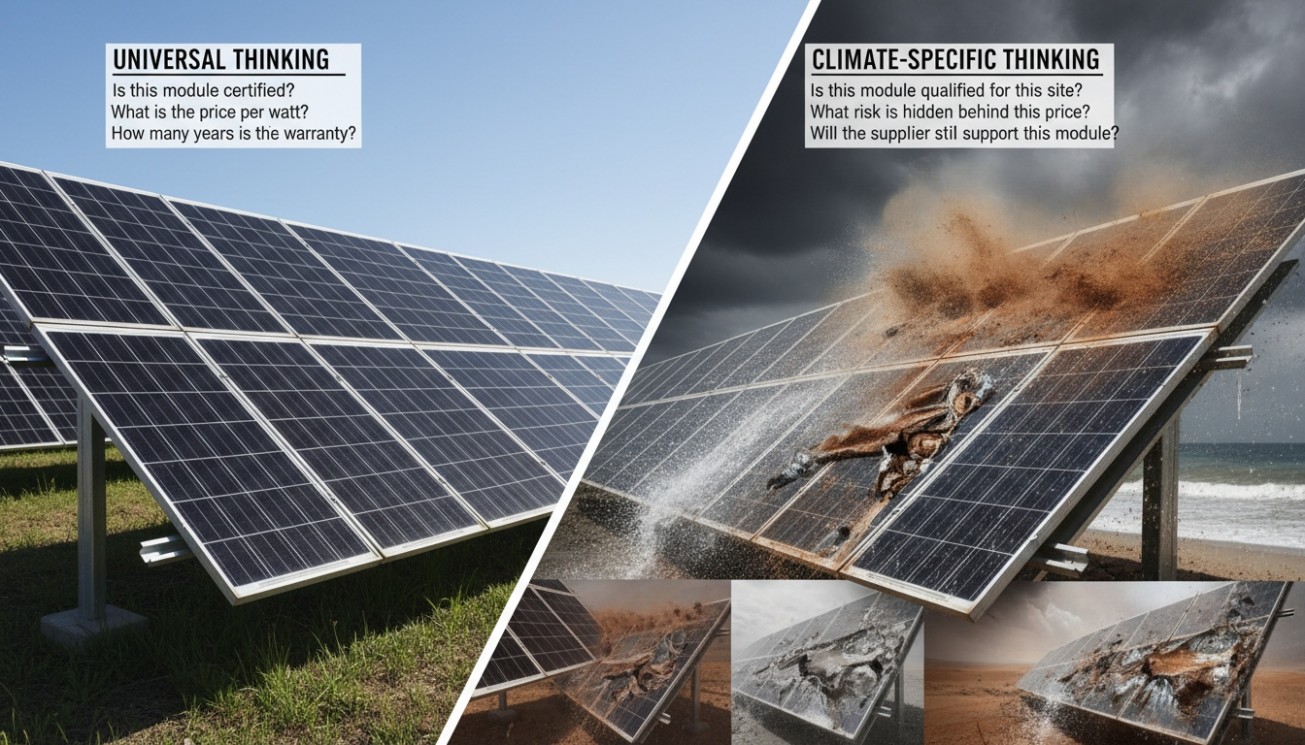
High-Wattage Standard PV Modules Bigger Panels, Lower BOS Cost, or More Installation Risk
Bigger Panels Are Not Just Bigger Products
The solar industry often presents higher wattage as a clear upgrade. A 600 W module sounds stronger than a 500 W module. A 700 W module sounds more advanced than a 600 W module. For buyers comparing product catalogs, higher power can look like a simple path to lower project cost and higher capacity.
But high-wattage standard PV modules are not just bigger versions of older panels. They change the project equation.
A high-power module may reduce the number of panels required for a target system size. That can reduce clamps, rails, wiring points, connectors, installation steps and sometimes foundation or tracker count. In large projects, those savings can support lower BOS cost and better LCOE. This is why high-power PV modules have become attractive in utility-scale and large commercial projects.
However, higher wattage usually comes from larger cells, larger wafers, larger module formats, higher current, or a combination of these factors. That means the module may also be heavier, wider, longer, more difficult to lift, more sensitive to wind loading and more demanding for electrical design.
The professional question is not whether larger panels are better. The real question is whether the project can absorb the larger format without creating new costs elsewhere.
If a larger module reduces panel count but increases labor difficulty, requires special lifting equipment, complicates roof layout, creates inverter mismatch, or fails to fit the tracker table cleanly, the expected savings may disappear. If the project is designed properly, large-format solar panels can improve project economics. If they are selected only by wattage, they can create avoidable risk.
Why High-Wattage Modules Became Attractive
The rise of high-wattage standard PV modules is closely connected to the solar industry’s cost-reduction logic. As module efficiency improved and wafer sizes increased, manufacturers could produce panels with higher power output. For project developers, higher module wattage promised more capacity per installed unit.
The appeal is easy to understand.
Fewer modules may mean fewer installation actions.
Fewer modules may reduce the number of clamps and mounting points.
Fewer electrical connections may reduce labor and fault points.
Higher power per panel may improve land or roof utilization.
Large projects may reduce some balance-of-system quantities per megawatt.
This is why high-power PV modules are often discussed together with BOS cost. BOS, or balance of system, includes the non-module parts of a PV system: mounting structures, foundations, trackers, cables, combiner boxes, labor, logistics, engineering, site preparation and other system-level costs. If a larger module reduces the amount of hardware and labor needed per megawatt, it can improve the economics of the project.
However, the benefit is not automatic. A module can reduce one cost while increasing another. A project may use fewer panels but need stronger mounting, more careful handling, larger crews, revised electrical design or additional logistics planning. That is why the high-wattage conversation must move from product power to project integration.
The BOS Equation: Where Savings May Appear
When large-format solar panels are used correctly, BOS savings can appear in several areas.
Mounting Hardware
If fewer modules are required for the same system capacity, the number of clamps, rails, brackets and mounting interfaces may decrease. This can reduce hardware quantity and simplify some installation steps.
Electrical Connections
Fewer modules can mean fewer connectors, fewer branch points and fewer module-level handling actions. In some system designs, this can reduce installation labor and potential connection errors.
Site Labor
Labor is a major part of total project cost. If the installation team can install more watts per handling action, project speed may improve. This is one reason large modules are attractive in ground-mounted projects where crews have space, tools and organized workflows.
Logistics Per Watt
A higher-power module may improve shipping efficiency per watt if packaging and container loading are optimized. However, this depends on module size, pallet configuration, weight limits and local handling equipment.
Utility Project Scaling
For utility-scale solar modules, even small savings per panel can become meaningful across thousands or millions of panels. This is why large projects often evaluate module size together with mounting strategy, tracker tables, site layout and energy modeling.
The important point is that BOS cost savings are system-dependent. They do not come from wattage alone. They come from the way the higher-wattage module changes the number of parts, the number of actions and the efficiency of the construction process.
The Hidden Cost: Bigger Modules Can Be Harder to Install

The first hidden cost of high-wattage modules is module handling.
A larger module may require two installers instead of one, or three instead of two. It may be harder to carry on a sloped roof. It may be more difficult to maneuver around skylights, parapets, roof edges, vents, HVAC units and narrow walkways. It may need lifting equipment on sites where smaller modules could be handled manually.
In utility projects, handling is more controlled, but the challenge does not disappear. Larger panels may require revised unloading procedures, stronger pallets, wider staging areas and better crew training. If handling is poor, microcracks, frame stress or glass damage can occur before the system is energized.
Module handling is not just a labor issue. It is a reliability issue.
A module that is difficult to lift, rotate or align can be damaged during installation. A small amount of mishandling may not be visible immediately, but it can contribute to long-term performance loss. Larger panels also create more surface area exposed to wind during installation, which can increase safety risk on open sites.
This is why a high-wattage module should be evaluated not only by watts per panel, but also by watts per safe installation action. If the module increases crew fatigue, slows work or increases breakage risk, the project may not achieve the expected savings.
Solar Panel Dimensions Matter More Than Catalog Buyers Expect
Many buyers focus on power rating and efficiency but underestimate solar panel dimensions. This is especially risky with larger modules.
A module’s length and width determine how it fits the roof, the rack, the tracker table, the container, the warehouse and the installation workflow. A small change in dimension can affect row spacing, clamp position, pallet loading, roof layout and structural engineering.
For residential rooftops, larger modules can create layout problems. A roof may have enough total area on paper but still fail to fit large panels efficiently because of roof shape, setbacks, chimneys, vents or dormers. In these cases, a smaller but higher-efficiency module may produce a better practical layout.
For commercial rooftops, solar panel dimensions affect row spacing, wind zones, fire access paths and maintenance corridors. A larger module may reduce panel count, but it may also create more difficult roof movement and require careful structural review.
For ground-mounted projects, larger modules can be advantageous because open space and mechanical installation tools make handling easier. But the module must still match the mounting table, pile layout, tracker design and wind assumptions.
In procurement, dimensions are not secondary specifications. They are design constraints.
High Current Changes Electrical Design
Higher wattage does not come only from higher voltage or larger size. Many modern high-power PV modules also have higher current. This affects string design and inverter compatibility.
A higher-current module may reduce the number of modules that can be safely combined on one input. It may require careful checking of inverter maximum input current, MPPT range, fuse rating, cable sizing, connector rating and combiner box design. If a buyer ignores current, the electrical design may need revision after procurement.
Voltage also matters. Cold-weather open-circuit voltage affects maximum string length. Hot-weather operating voltage affects inverter MPPT behavior. When high-power modules are selected, the electrical team must confirm that the module’s current and voltage fit the inverter architecture.
This is where string design becomes a strategic part of module selection. A module that looks attractive in a price list may create stringing constraints that increase design complexity. In some projects, the module may require different inverter selection, fewer modules per string, more strings, larger cables or revised protection.
A professional buyer should ask:
Does the module current fit the selected inverter?
Does the voltage range support efficient string length?
Will cold-weather Voc exceed limits?
Will high current create clipping or input constraints?
Are connectors and cables rated for the design?
Does the EPC team already have experience with this module class?
These questions prevent wattage-driven procurement from creating electrical redesign later.
Tracker Compatibility: A Utility-Scale Gatekeeper
For ground-mounted projects, especially large plants, tracker compatibility can decide whether high-wattage modules truly create value.
Single-axis trackers are designed around module dimensions, weight, wind load, torque, row length, mounting hole positions and structural behavior. A larger or heavier module may change the forces acting on the tracker. It may require a different table configuration, different clamp method or revised wind analysis.
This is why utility-scale solar modules should never be selected without confirming tracker fit. A module that does not match the tracker properly can create engineering delays, structural concerns or construction changes. The module may be technically strong but commercially inconvenient.
Tracker compatibility also affects bifacial performance. Many large modules are bifacial, and tracker design can influence rear-side irradiance, shading and row spacing. Cable management, torque tube placement and backside obstruction can influence the final energy yield.
A utility project should evaluate modules, trackers and inverters together. Selecting them separately can create mismatch. The best high-wattage module is not simply the one with the highest nameplate power; it is the one that fits the tracker, electrical design, wind model and construction plan cleanly.
LCOE: The Metric That Prevents Oversimplification

The reason project developers care about high-wattage modules is not wattage itself. It is LCOE, or levelized cost of energy. LCOE compares the total lifetime cost of a project with the total energy it produces over time.
A module can improve LCOE if it reduces installed cost, increases energy output, lowers maintenance risk or improves project reliability. But it can also hurt LCOE if it increases installation complexity, causes delays, requires more expensive mounting systems or creates long-term reliability concerns.
This is why LCOE is a better decision metric than price per watt.
A lower module price can be misleading if the module is difficult to install. A higher-wattage module can be misleading if it creates electrical mismatch. A larger panel can be misleading if it reduces flexibility on complex roofs. A premium module can be misleading if the project does not need its extra performance.
The professional approach is to compare the total system outcome:
Installed cost per watt
Expected annual energy yield
Degradation assumptions
Installation labor
Mechanical and electrical compatibility
Downtime risk
Warranty strength
Maintenance complexity
Project schedule risk
Only after these factors are considered can buyers know whether high-wattage modules reduce or increase lifetime cost.
Rooftop Projects: High Wattage Can Be Useful but Not Always Practical

High-wattage modules can be attractive for rooftops, but the rooftop market is not uniform.
On some commercial roofs, larger modules may work well. Flat roofs, large open surfaces, strong structures and organized installation access can support larger formats. If fewer panels reduce installation time and simplify electrical layout, high-wattage standard PV modules may improve project economics.
On residential roofs, the story is more complicated. Roofs are often irregular. Installers must work around vents, skylights, dormers, chimneys, roof edges and fire setbacks. A very large module may be harder to fit and harder to lift safely. If the module is too large for the roof geometry, the system may lose layout flexibility.
For residential projects, the best module may not be the highest-wattage panel. It may be a compact high-efficiency module that fits more cleanly into available roof space. This is different from utility-scale logic, where open land and mechanical installation equipment make larger formats easier to justify.
Commercial rooftops sit between these two extremes. The buyer must evaluate roof load, access, tilt system, ballast design, wind zones, maintenance paths and electrical layout. A higher-power module may reduce panel count, but it may also create larger wind surfaces and heavier lifting requirements.
Rooftop module selection should always connect wattage to real roof geometry.
Utility-Scale Projects: Where Large Modules Often Make the Strongest Case

Utility-scale solar modules are often the best fit for large-format solar panels because the project environment is more controlled. Ground-mounted sites can use organized logistics, mechanical handling, standardized mounting systems and large installation crews. The available space makes it easier to design around module dimensions.
In utility projects, higher wattage can reduce the number of modules needed for a target DC capacity. This may reduce parts, installation steps, wiring points and tracker table count depending on the design. Because utility projects operate at scale, small savings per watt can become significant across the project.
However, utility projects also expose modules to demanding conditions. Wind, dust, thermal cycling, tracker motion, long cable runs and remote maintenance all matter. Larger modules must be tested against these site realities.
The buyer should evaluate:
Tracker fit
Pile and table design
Wind loading
Module current and inverter match
Bifacial gain assumptions
Transport and staging plans
Construction speed
Breakage risk
Warranty and replacement logistics
In large projects, the right high-wattage module can support lower BOS cost and better LCOE. The wrong one can create engineering friction that slows the project or raises hidden costs.
Logistics: The Module Is Already Creating Cost Before It Reaches the Site

A high-wattage module creates logistics impact before installation begins.
Pallet size, pallet weight, container loading, warehouse space, forklift requirements, road transport limits and site unloading all matter. A larger module may improve watts per container, but it may also create handling challenges if the packaging is bulky, heavy or fragile.
Buyers should ask suppliers for packaging details, container loading quantities, pallet dimensions, unloading requirements and breakage protection. If the project is remote, logistics become even more important. A module replacement in a remote utility project may be much more expensive than the module itself.
Module handling also begins at the warehouse. If pallets are stacked incorrectly, moved roughly or stored in poor conditions, hidden damage can occur. Larger panels may need more careful packaging and stricter handling instructions.
A professional procurement team should not separate module cost from logistics cost. The module is not bought when the price is signed. It is bought when it arrives undamaged, documented, traceable and ready for installation.
Structural Risk: Larger Area Means Larger Exposure

A bigger module has more surface area. That can improve power output, but it also increases exposure to mechanical forces.
Wind uplift, snow pressure, hail impact, tracker movement, clamp stress and transport vibration all interact with module size and frame design. A large panel must be stiff enough, supported correctly and mounted according to approved clamp zones.
This is where datasheet review and installation manuals become critical. The module’s load rating is usually valid under specific mounting conditions. If the mounting method is different, the actual stress behavior may not match the rated condition.
For large-format solar panels, the structural conversation should include:
Frame stiffness
Glass thickness
Cell crack resistance
Clamp zones
Mounting rail support
Wind tunnel assumptions
Tracker loading
Snow load
Hail resistance
Transport vibration
Large modules can be reliable, but they require disciplined installation. If the project team treats them like smaller legacy modules, risk increases.
The Procurement Trap: Price Per Watt Can Hide Project Risk

High-wattage modules often look attractive when compared by price per watt. But price per watt can hide project risk.
A lower price may not include higher installation labor. It may not account for special lifting equipment. It may ignore inverter mismatch. It may overlook tracker modifications. It may fail to include higher breakage risk, spare module storage or replacement complexity.
The procurement team should build a total installed cost comparison instead of a module-only comparison.
This comparison should include:
Module price
Freight and insurance
Container loading efficiency
Warehouse handling
Site unloading
Installation labor
Mounting hardware
Electrical redesign
Inverter compatibility
Schedule risk
Warranty support
Replacement strategy
Only then can the buyer understand whether high-wattage standard PV modules actually reduce project cost.
A high-power module is valuable when it reduces total project cost and improves energy value. It is risky when it only improves the product datasheet.
The Right Use Cases for High-Wattage Modules
High-wattage modules are most attractive when project conditions support their size and electrical behavior.
They often make sense in utility-scale projects with open land, standardized trackers, organized logistics and experienced installation teams. They may also work well on large commercial roofs with good access, flat surfaces and strong structural design.
They can be valuable when labor is expensive and reducing module count improves installation productivity. They can also be valuable when mounting hardware reduction is meaningful and the project can handle the larger format safely.
However, they may be less suitable for complex residential roofs, small buildings, restricted access sites, lightweight roof structures or projects where inverter compatibility is already fixed.
In other words, high-power PV modules are not universal. They are project tools. Their value depends on whether the project can convert higher power into lower total cost or higher lifetime output.
How Buyers Should Evaluate High-Wattage Offers

A practical evaluation should begin with project constraints, not product wattage.
Step 1: Define the Installation Environment
Is the system residential rooftop, commercial rooftop, carport, ground mount or utility-scale? The same module may behave differently in each environment.
Step 2: Check Physical Fit
Review solar panel dimensions, weight, roof layout, mounting zones, pallet size and site access. If the module does not fit the installation process, high wattage is not enough.
Step 3: Review Electrical Fit
Check current, voltage, inverter input limits and string design. Confirm that high current does not create redesign costs.
Step 4: Confirm Mounting and Tracker Fit
For ground-mounted systems, confirm tracker compatibility, clamp zones, wind assumptions and table configuration.
Step 5: Compare BOS Impact
Estimate changes in BOS cost. Do not assume savings; calculate hardware, labor, wiring, logistics and engineering effects.
Step 6: Model Lifetime Value
Compare energy yield, degradation, warranty, downtime risk and LCOE.
Step 7: Test Supplier Support
Ask for installation manuals, packaging documents, test reports, flash data, warranty terms and field references.
This process prevents the buyer from selecting modules based on a single headline number.
What Distributors Should Understand
For distributors, high-wattage modules can be attractive because they look modern and competitive. But stocking them without customer segmentation can create problems.
Residential installers may not want very large panels if roof work becomes harder. Small commercial installers may need training and revised lifting methods. EPC companies may want high-wattage products only if they match specific mounting or inverter platforms. Utility buyers may demand documentation, bankability and batch consistency.
A good distributor should create a product ladder:
Compact high-efficiency modules for residential rooftops.
Medium-format modules for commercial rooftops.
Large-format high-power modules for ground-mounted projects.
Bifacial high-wattage modules for utility and tracker systems.
This segmentation helps sales teams explain why one module is right for one project but wrong for another. In solar procurement, credibility comes from matching product to application, not from always recommending the largest panel.
What EPC Companies Should Understand
For EPC companies, high-wattage modules affect engineering, procurement, construction and O&M. The EPC must evaluate more than module cost.
Engineering must check electrical compatibility, structural loading, tracker fit, row spacing and energy modeling. Procurement must check packaging, logistics, supplier consistency and warranty. Construction must check lifting methods, crew training, staging areas and installation speed. O&M must consider access, replacement, cleaning, fault detection and spare inventory.
The EPC proposal should explain why the selected high-wattage module improves the project. It should not simply state that the module has higher power. It should show how the module affects BOS cost, expected yield, schedule, reliability and LCOE.
A strong EPC does not sell wattage. It sells a lower-risk energy asset.
Final Takeaway: High Wattage Creates Opportunity Only When the Project Is Ready
High-wattage standard PV modules represent an important direction in the PV industry. They can reduce module count, support lower BOS cost, improve construction productivity and contribute to better LCOE in the right projects.
But larger modules also introduce real engineering questions. Large-format solar panels affect module handling, solar panel dimensions, string design, tracker compatibility, logistics, structural loading and installation risk. A panel that looks better on paper may not be better on a roof, tracker or remote project site.
The correct decision is not to choose the highest wattage available. The correct decision is to choose the module format that the project can install safely, operate reliably and finance confidently.
For rooftop buyers, that may mean balancing wattage with size and handling. For commercial projects, it may mean checking roof load and installation workflow. For utility developers, it may mean integrating module selection with trackers, inverters, logistics and energy modeling.
High wattage is valuable when it simplifies the total project. It becomes risky when it only increases the number on the datasheet.
That is the industry-level logic behind modern high-power PV modules: bigger panels can lower cost, but only when the system is designed to use them.
Focused FAQ
What are high-wattage standard PV modules?
High-wattage standard PV modules are mainstream solar modules with higher power ratings, often achieved through larger wafers, larger formats, higher efficiency or higher current. They are used to increase capacity per panel and potentially reduce system-level costs.
Are large-format solar panels always better?
No. Large-format solar panels can reduce module count and some hardware needs, but they may also increase handling difficulty, structural load, logistics complexity and installation risk.
How can high-power PV modules reduce BOS cost?
High-power PV modules may reduce BOS cost by lowering the number of modules, clamps, mounting points, connectors and installation actions needed for a target system capacity. However, savings depend on the full project design.
What is the relationship between high-wattage modules and LCOE?
High-wattage modules can improve LCOE if they reduce installed cost or improve energy output without increasing risk. They can hurt LCOE if they create installation delays, redesign costs, reliability issues or maintenance problems.
Why does module handling matter?
Module handling affects labor cost, installation speed, worker safety and module reliability. Larger modules may require more people, special lifting equipment or stricter handling procedures.
Why are solar panel dimensions important?
Solar panel dimensions determine roof layout, tracker fit, container loading, pallet handling, clamp zones and installation workflow. A higher-wattage module may not be useful if its size does not fit the project.
Do high-wattage modules affect string design?
Yes. Higher wattage often comes with higher current or different voltage behavior, which can affect string design, inverter input limits, cable sizing and protection requirements.
Why is tracker compatibility important for utility projects?
Tracker compatibility ensures that the module’s size, weight, mounting points and wind behavior match the tracker structure. Without this fit, large modules can create engineering or construction problems.
Are high-wattage modules suitable for residential rooftops?
Sometimes, but not always. Residential rooftops often have layout constraints, obstacles and manual handling limits. A smaller high-efficiency module may be better than the largest available panel.
Where do high-wattage modules make the most sense?
They often make the most sense in utility-scale solar modules applications, large ground-mounted projects and some commercial rooftops where logistics, mounting, electrical design and installation workflows can support larger formats.