Glass-Glass vs Glass-Backsheet PV Modules: How to Choose for Long-Term Reliability
Reliability Starts Before the Module Is Installed
When buyers compare standard PV modules, the first conversation is usually about wattage, efficiency and price per watt. Those numbers matter, but they do not fully explain whether a module will perform reliably for 25 or 30 years. Long-term field performance depends on something less visible: module structure.
This is where the comparison between glass glass solar modules and glass backsheet solar panels becomes important.
A PV module is not just a layer of solar cells under glass. It is a laminated electrical and mechanical product exposed to heat, humidity, ultraviolet radiation, wind, snow, dust, thermal cycling, mechanical stress, transport vibration and installation handling. The front glass, rear material, encapsulant, frame, junction box, edge sealant and cell interconnection all work together. If one layer fails, the whole module can lose power, suffer safety risks or become difficult to claim under warranty.
That is why buyers should not ask only, “Which structure is better?” A more professional question is: “Which module structure is better for this project’s climate, mounting method, installation process, financial model and operating period?”
Glass glass solar modules and glass backsheet solar panels can both be high-quality products when properly designed and manufactured. They can also both fail when material selection, lamination, edge sealing, packaging or installation is weak. The structure creates potential, but execution determines reliability.
This article explains how buyers should evaluate both module structures without turning the decision into a simple marketing argument.
Why the Rear Side of a Module Matters More Than Many Buyers Think
The rear side of a PV module is often ignored because it is not visible after installation. However, it plays a major role in long-term protection.
In traditional glass backsheet solar panels, the front side uses glass, while the rear side uses a polymer backsheet. The backsheet protects the module from moisture, electrical leakage, mechanical stress and environmental exposure. It also provides electrical insulation and helps protect the encapsulated cells and circuits.
In glass glass solar modules, the rear side is another layer of glass. This creates a different mechanical and environmental protection system. It is especially common in many bifacial PV modules, because a transparent rear side allows light to reach the back of the cells.
The rear material affects multiple project-level issues:
It influences moisture resistance.
It affects weight and handling.
It changes the way the module reacts to mechanical load.
It influences rear-side light transmission in bifacial designs.
It affects electrical insulation and safety considerations.
It can influence long-term module degradation risks.
It may change warranty expectations and installation requirements.
For buyers, the rear side is not a hidden detail. It is part of the reliability equation.
What Is a Glass-Backsheet Module?
Glass backsheet solar panels are the long-established mainstream structure in the PV industry. They typically include front glass, front encapsulant, solar cells, rear encapsulant, polymer backsheet, frame, junction box and cables.
This structure became widely used because it offers a practical balance between cost, weight, protection and manufacturability. It is familiar to module makers, installers, distributors and EPC companies. Many rooftop and commercial projects have used this structure successfully for years.
The main advantage of glass backsheet solar panels is their mature industrial base. The supply chain is broad, product formats are familiar, and installers are accustomed to handling them. In many projects, especially residential and commercial rooftops, this structure remains practical and cost-effective.
Another advantage is weight. A glass-backsheet module is often lighter than a comparable glass-glass module, although exact weight depends on module size, glass thickness, frame design and product generation. Lower weight can matter for rooftop projects, manual installation, structural load review and logistics.
However, the backsheet is also a critical risk point. Not all backsheets are the same. Different materials have different resistance to ultraviolet exposure, humidity, cracking, chalking, delamination and electrical insulation degradation. A low-quality backsheet can become a long-term reliability problem even when the front side of the module still looks acceptable.
This is why buyers should not simply ask whether the module has a backsheet. They should ask what kind of backsheet it uses, how it is tested and how it fits the climate where the project will operate.
What Is a Glass-Glass Module?

Glass glass solar modules replace the polymer backsheet with rear glass. The cells are laminated between two glass layers, usually with encapsulant materials between the glass and the cells. Many designs also include aluminum frames, although frameless glass-glass modules also exist in some applications.
This structure is widely associated with bifacial PV modules, because rear glass allows light to enter the back side of the module. In a bifacial system, the module can capture front-side sunlight and rear-side reflected light, provided that the project design supports rear-side exposure.
The main attraction of glass glass solar modules is long-term environmental protection. Glass is generally highly resistant to ultraviolet exposure and moisture penetration compared with many polymer materials. In theory, a well-designed glass-glass structure can provide strong durability, especially in harsh environments.
However, glass-glass is not automatically superior in every project. It can be heavier. It may require more careful handling during transport and installation. It may behave differently under mechanical stress. Thin glass designs need strong quality control and suitable mounting practices. Edge sealing and lamination quality are also essential because moisture can still enter from module edges if design or manufacturing is weak.
The industry should treat glass-glass as a serious reliability architecture, not as a simple premium label. It is valuable when the design, materials, manufacturing and project application are aligned.
Structure Is Only the First Layer of Reliability

A common mistake is to treat module structure as a single answer. Buyers may hear that glass-glass is more durable and assume every glass-glass module is safer. Others may hear that glass-backsheet is lighter and assume it is always easier to use. Both views are incomplete.
PV module reliability depends on the total bill of materials and manufacturing process.
A module includes cells, interconnection ribbons, soldering, encapsulant, glass, backsheet or rear glass, frame, sealant, junction box, bypass diodes, cables and connectors. The performance of each material depends on how it interacts with the other layers.
For example, the solar panel encapsulant plays a major role in adhesion, optical transmission, moisture control and cell protection. Common encapsulants include EVA and POE-based materials. The right choice depends on module technology, glass structure, bifacial requirements, PID resistance, moisture conditions and supplier design.
A strong rear glass layer cannot compensate for poor lamination. A high-quality backsheet cannot compensate for weak cell interconnection. A long warranty cannot compensate for unclear claim procedures. Real solar module durability is created by the complete module system.
This is especially important in today’s market because module formats are changing quickly. Larger wafers, thinner cells, higher currents, larger module sizes, thinner glass and new N-type technologies all change mechanical and thermal behavior. Buyers need to evaluate structure and execution together.
Moisture, Humidity and Edge Protection
Moisture is one of the most important long-term enemies of PV modules. Humidity can contribute to corrosion, delamination, insulation problems and electrical leakage. The risk is especially relevant in tropical regions, coastal environments, rainy climates, floating PV projects and high-humidity industrial areas.
In glass backsheet solar panels, the backsheet and encapsulant must protect the rear side from moisture ingress. A good backsheet can perform well, but material quality matters. If the backsheet cracks, chalks, discolors, weakens or loses insulation performance, the module may become more vulnerable over time.
In glass glass solar modules, the front and rear glass layers can reduce moisture transmission through the large module surfaces. However, the edges still matter. Moisture can enter through poorly sealed edges, weak lamination zones or damaged module edges. This means edge sealant, lamination quality and frame design are critical.
For humid environments, buyers should ask suppliers about damp heat testing, insulation performance, PID resistance, encapsulant selection and field experience in similar climates. A module that performs well in dry inland conditions may not be the best choice for a coastal site.
The practical lesson is simple: moisture protection is not only about choosing glass-glass or glass-backsheet. It is about how the entire module prevents water, vapor and electrical leakage over decades.
Mechanical Load: Snow, Wind, Handling and Transport

Mechanical stress is another key factor in PV module reliability. Modules face loads from wind, snow, installation handling, tracker movement, transport vibration and thermal expansion.
Glass backsheet solar panels usually have one glass layer and one polymer rear layer. This can make them lighter and easier to handle, especially in rooftop projects. Their mechanical design is familiar to installers, and many mounting systems are built around conventional framed modules.
Glass glass solar modules can offer strong structural rigidity, depending on glass thickness, frame design and module size. However, they may also be heavier or more sensitive to certain handling conditions. Thin glass designs require careful evaluation. If glass thickness is reduced to save weight, the module may require more attention to mounting support, transport protection and installation practices.
Large-format modules make the mechanical question more important. A larger panel can reduce the number of modules needed per megawatt, but it can also increase wind exposure, handling difficulty and stress during lifting. The structure must match the project.
Rooftop Projects
For residential and commercial rooftops, weight and handling are important. Installers often move modules manually. Roof access may be limited. Structural load may need review. In these conditions, glass backsheet solar panels may remain attractive if they are lighter and easier to install.
Utility Projects
For ground-mounted systems, especially those using trackers or fixed-tilt structures, glass glass solar modules may be attractive because the project can better control handling, mounting and rear-side exposure. However, tracker compatibility, clamp zones, wind load and torsional stress must be checked carefully.
Snow and Wind Regions
In snow regions, mechanical load ratings and frame strength matter. In high-wind regions, mounting design, module size and frame stiffness become critical. The best structure depends on the specific load environment, not only the module category.
Bifacial Design Changes the Structure Discussion
The growth of bifacial PV modules has made glass-glass structures more common. A bifacial module needs a rear side that allows light to reach the back of the cells. Rear glass is a natural solution because it is transparent, durable and compatible with many bifacial designs.
This is why many buyers associate glass glass solar modules with advanced N-type bifacial products. In ground-mounted projects, carports, white rooftops and high-albedo environments, bifacial modules can increase energy yield by capturing reflected light from the rear side.
However, bifacial value depends on system design. If the module is installed close to a dark roof surface, rear-side gain may be limited. If cables, rails or torque tubes shade the back side, energy gain can be reduced. If the ground surface has low reflectivity, the additional output may be modest.
Therefore, buyers should not choose glass glass solar modules only because they are bifacial. They should ask whether the project can use bifacial capability. If rear-side gain is not meaningful, the buyer should evaluate whether the glass-glass structure still provides enough reliability or warranty value to justify its cost and handling requirements.
For some projects, glass-glass bifacial modules are clearly logical. For others, high-quality glass backsheet solar panels may be more practical.
Encapsulant Choice: The Layer Buyers Rarely Discuss
The solar panel encapsulant is one of the most important but least discussed materials in a PV module. It surrounds and protects the solar cells, bonds the layers together and influences optical, electrical and moisture performance.
In many conventional modules, EVA has been widely used. For some newer module designs, POE or co-extruded encapsulant structures may be selected to improve moisture resistance, PID resistance or compatibility with bifacial and N-type cells. The exact choice depends on the manufacturer’s product design.
Why does this matter to buyers?
Because structure alone does not tell the full story. Two glass glass solar modules may look similar from the outside but use different encapsulants, cell interconnection materials and edge-sealing systems. Two glass backsheet solar panels may have very different long-term durability because the backsheet and encapsulant combination is different.
Encapsulant quality affects adhesion, yellowing, delamination resistance, electrical insulation and moisture behavior. In hot and humid environments, the wrong material system can increase risk. In bifacial modules, optical transmission and rear-side performance also matter.
Professional buyers should ask suppliers for material logic, not only marketing words. They do not need to know every chemical detail, but they should understand whether the module is designed for the intended climate, voltage class, cell technology and installation condition.
Degradation Is a System Outcome
Many buyers discuss module degradation as if it is only a performance warranty number. In reality, degradation is the result of many interacting factors: cell technology, encapsulant, moisture ingress, thermal cycling, UV exposure, mechanical stress, PID, LeTID, microcracks, corrosion and electrical mismatch.
A module may degrade slowly under one climate and faster under another. A structure that performs well in a dry desert may face different risks in a humid coastal site. A module that works well on a fixed-tilt rack may behave differently on a tracker if mechanical stress is higher.
This is why the comparison between glass glass solar modules and glass backsheet solar panels should include site conditions.
For example, if the project is located in a high-humidity region, moisture resistance may receive more weight. If the project is on a rooftop with strict load limits, weight may receive more weight. If the project is utility-scale and designed for bifacial gain, rear glass may be strongly preferred. If the project is a small residential roof, a lighter and simpler glass-backsheet product may be more suitable.
The right module is the one with the lowest practical risk for the project, not the one with the most impressive structure description.
Warranty: Read the Promise and the Mechanism
A solar module warranty is often used as a selling point. Buyers see 25-year or 30-year language and assume the product is safe. But warranty length alone is not enough.
A good warranty evaluation should separate product warranty and performance warranty.
Product warranty covers defects in materials and workmanship. It is related to structural failures, junction box problems, delamination, frame defects and other manufacturing-related issues.
Performance warranty covers expected output over time. It is related to degradation. The warranty may define first-year degradation, annual degradation and final-year guaranteed output.
When comparing glass glass solar modules and glass backsheet solar panels, buyers should ask several practical questions:
What exactly is covered?
What is excluded?
How is power loss measured?
Who performs testing?
What evidence is required for a claim?
Does the warranty cover labor or only replacement modules?
What happens if the module model is discontinued?
Is local support available?
How strong is the supplier behind the warranty?
A long solar module warranty is useful only when the claim path is realistic. For B2B buyers, warranty is not just legal text. It is part of project risk management.
Weight and Installation: The Practical Side of Reliability

A module that is theoretically durable can still create problems if it is difficult to install correctly. This is why installation practicality must be part of PV module selection.
Glass glass solar modules may require more careful handling, especially in larger formats. If the module is heavier, installers may need additional labor, lifting tools or revised installation procedures. Poor handling can create microcracks, glass stress or hidden damage before the system is even commissioned.
Glass backsheet solar panels may be easier to carry and mount in many rooftop projects. This can reduce installation fatigue and handling risk. However, if the backsheet material is poor or the installation environment is harsh, the long-term risk may shift back toward durability.
The point is not that one structure is easier in every case. The point is that installation context matters.
A utility project with organized logistics, cranes, trained teams and controlled installation processes may handle glass-glass modules very effectively. A small residential project with limited roof access may prefer lighter modules. A commercial rooftop may fall somewhere in between.
The best module structure is the one that can be installed correctly, repeatedly and safely in the actual project environment.
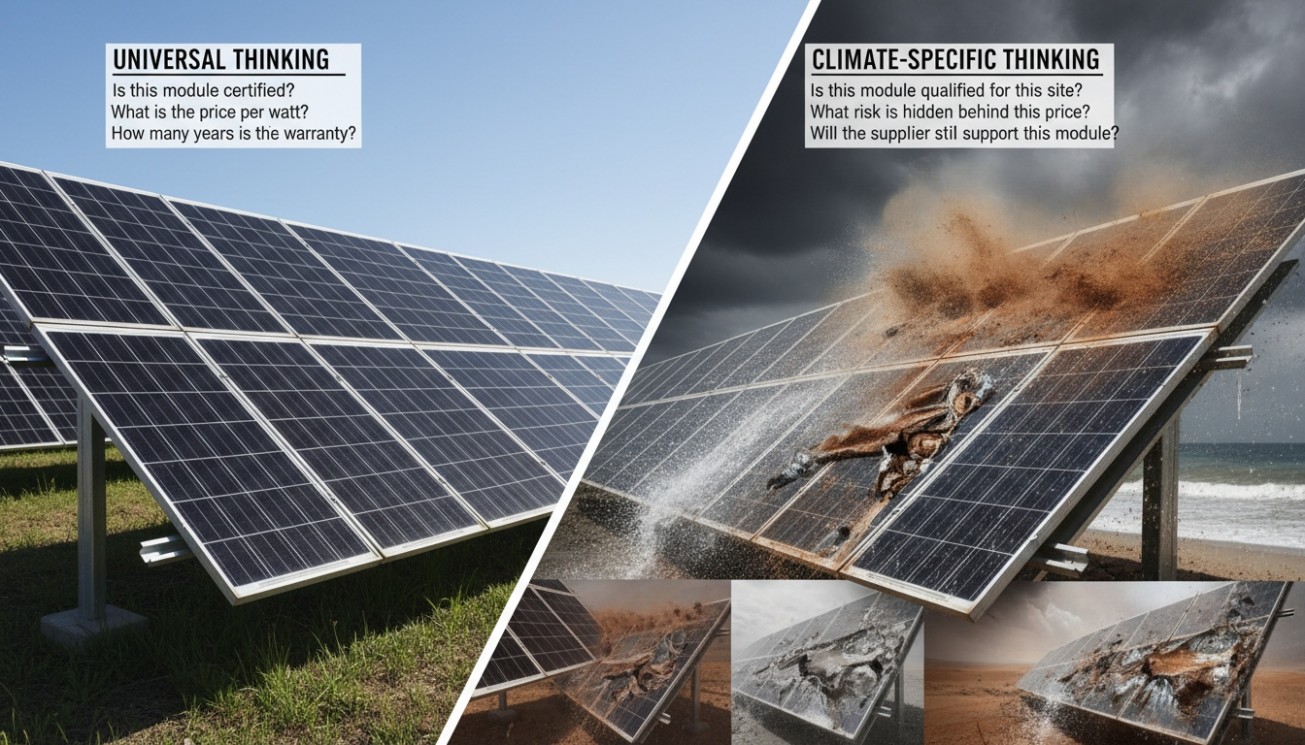
Climate-Specific Selection Logic
Climate should strongly influence module structure decisions. The same module may perform differently in different environments.
Hot and Dry Climates
In desert or dry inland regions, UV exposure, thermal cycling, dust, abrasion and temperature stress are important. Glass surfaces can resist UV exposure well, but module cleaning, soiling and mechanical stress should be evaluated.
Hot and Humid Climates
In tropical and coastal regions, moisture ingress, corrosion, PID risk and insulation resistance become more important. Buyers should review damp heat performance, encapsulant choice, junction box quality and edge sealing.
Snow Regions
Snow creates mechanical load and high seasonal albedo. Glass glass solar modules may be attractive in bifacial ground-mounted systems because snow can reflect light to the rear side. But mechanical load, frame strength and glass durability must be checked carefully.
Coastal and Industrial Areas
Salt mist, humidity and chemical exposure can accelerate corrosion and electrical insulation risks. Module frame, glass coating, junction box, connector and cable quality all matter.
Rooftop Urban Environments
Weight, fire safety, roof load, installation access, aesthetics and maintenance access may be more important than rear-side gain. In these projects, glass backsheet solar panels may remain a practical choice when reliability is supported by strong materials and documentation.
Climate-specific thinking prevents buyers from making generic decisions.
How to Compare Glass-Glass and Glass-Backsheet Offers

When receiving quotations, buyers should not compare only watts and price. They should build a reliability checklist.
Structural Design
Check whether the module is glass-glass or glass-backsheet. Review glass thickness, frame design, module size, weight and mechanical load ratings.
Bill of Materials
Ask about backsheet type, rear glass type, solar panel encapsulant, cell technology, junction box, connectors and cables. Material quality is central to solar module durability.
Certification and Testing
Review IEC certification, damp heat, thermal cycling, mechanical load, PID testing and other relevant test data. For harsh environments, ask whether additional testing is available.
Application Fit
Determine whether the module is for residential rooftop, commercial rooftop, utility project, tracker system, carport, floating PV or special environment. PV module selection must be application-specific.
Installation Method
Check clamp zones, mounting compatibility, handling requirements, module weight, packaging, unloading method and installer training needs.
Warranty and Supplier Support
Read the solar module warranty carefully. Evaluate claim process, local support, supplier bankability and replacement policy.
Long-Term Risk
Compare not only upfront price but also expected module degradation, field reliability, downtime risk and future maintenance complexity.
This comparison turns module buying into asset protection.
When Glass-Backsheet May Be the Better Choice

Glass backsheet solar panels may be the better choice when the project values lighter weight, conventional installation, lower handling complexity and mature product formats.
Residential rooftops are a common example. The roof may have limited load capacity, complex layout, small installation crews and tight access. If rear-side generation is not useful, a high-quality glass-backsheet module can be practical.
Small commercial rooftops may also prefer glass-backsheet modules when installation speed, roof load and simple logistics matter more than bifacial potential.
Price-sensitive projects may choose glass-backsheet modules when the supplier has strong quality control and the backsheet material is suitable for the climate.
Replacement projects may also use glass-backsheet modules to match existing systems, electrical characteristics or mounting layouts.
The key condition is quality. A glass-backsheet module should not be selected only because it is cheaper. It should be selected because its backsheet, encapsulant, warranty and supplier support are good enough for the project environment.
When Glass-Glass May Be the Better Choice
Glass glass solar modules may be the better choice when the project requires stronger environmental protection, bifacial capability, longer operating confidence or better fit with large-scale ground-mounted designs.
Utility-scale projects are a common example. These projects often prioritize long-term energy yield, bankability and durability. If the system is designed for bifacial PV modules, glass-glass structure becomes especially relevant.
Carports, high-albedo sites, snow regions and white-roof commercial systems may also benefit from glass-glass bifacial modules when rear-side generation is meaningful.
Projects in harsh climates may consider glass-glass modules because rear glass can provide strong resistance to UV and moisture through the module surface. However, buyers must still evaluate edge sealing, glass durability, frame design and installation method.
Glass-glass is also attractive when the buyer values a longer performance horizon and the supplier can support the product with strong testing, documentation and warranty credibility.
The best use case for glass-glass is not “any project that wants a premium module.” It is a project where structure, site design and long-term value all point in the same direction.
The Procurement View: Do Not Buy a Structure, Buy a Risk Profile
For B2B buyers, modules are not only products. They are long-term risk profiles.
A low-cost module may look attractive during procurement but become expensive if failures occur after installation. A premium module may look expensive but become economical if it reduces risk, improves energy yield and supports stronger financing. A glass-glass product may be valuable in one project and unnecessary in another. A glass-backsheet product may be practical in one climate and risky in another.
This is why PV module selection should be based on risk alignment.
The buyer should define project risk first:
Is moisture the main risk?
Is weight the main risk?
Is rear-side gain important?
Is installation access difficult?
Is the project financed by strict investors?
Is the site exposed to salt mist, snow, wind or heat?
Is long-term ownership more important than quick payback?
Is replacement difficult after installation?
Once these questions are answered, the module structure becomes easier to evaluate. The right module is not the strongest on paper. It is the strongest fit for the risk profile.
A Practical Selection Framework

A simple decision framework can help buyers choose between glass glass solar modules and glass backsheet solar panels.
Step 1: Define the Project Type
Residential rooftop, commercial rooftop, utility ground mount, tracker system, carport, floating PV and agricultural PV all create different requirements.
Step 2: Identify Climate Stress
Check humidity, heat, UV exposure, snow, wind, salt mist, dust and industrial pollution. Match module structure and materials to those stresses.
Step 3: Evaluate Mechanical Conditions
Review module weight, mounting method, clamp zones, wind load, snow load, transport route and installation handling.
Step 4: Consider Bifacial Value
If rear-side energy is important, bifacial PV modules and glass-glass structures may become more attractive. If rear-side gain is limited, glass-backsheet may remain practical.
Step 5: Review Material Quality
Ask about solar panel encapsulant, backsheet composition, glass thickness, edge sealant, junction box, cables and connectors.
Step 6: Compare Warranty Reality
Read the solar module warranty and evaluate the claim mechanism. A longer warranty is valuable only when it is supported by a credible supplier.
Step 7: Compare Lifetime Cost
Include module price, installation cost, logistics, maintenance, degradation, downtime risk and replacement difficulty.
This framework keeps the decision grounded in project reality.
Common Misunderstandings About Glass-Glass and Glass-Backsheet Modules
One misunderstanding is that glass-glass always means better quality. It does not. Poorly made glass glass solar modules can still fail if lamination, edge sealing, glass handling or materials are weak.
Another misunderstanding is that glass-backsheet is outdated. It is not. High-quality glass backsheet solar panels remain useful in many rooftop and cost-sensitive projects.
A third misunderstanding is that bifacial value automatically justifies glass-glass. It only does so when the project can capture rear-side light effectively.
A fourth misunderstanding is that warranty length proves reliability. Warranty is important, but buyers must read terms, exclusions and claim procedures.
A fifth misunderstanding is that weight is a minor issue. On rooftops and manual installations, weight can affect labor, safety and structural evaluation.
A sixth misunderstanding is that module structure can be separated from climate. In reality, climate is one of the strongest drivers of solar module durability.
A seventh misunderstanding is that datasheets tell the whole story. Datasheets are essential, but serious buyers should also evaluate bill of materials, supplier history, field data and installation requirements.
Final Takeaway: The Best Structure Is the One That Matches the Project
The comparison between glass glass solar modules and glass backsheet solar panels should not be treated as a simple winner-takes-all debate. Both structures have a place in modern standard PV modules. The right choice depends on project type, climate, mounting method, weight limits, bifacial potential, supplier quality, warranty terms and long-term ownership expectations.
Glass-backsheet modules remain practical when light weight, familiar installation and cost-effective deployment are important. They are especially relevant for many residential and commercial rooftops, provided that the backsheet and encapsulant system is reliable.
Glass-glass modules become attractive when long-term environmental protection, bifacial design, harsh-site durability and utility-scale project confidence are more important. They can be especially valuable in ground-mounted systems, high-albedo sites and projects where rear-side energy yield is part of the financial model.
But structure alone does not guarantee performance. Real PV module reliability comes from design, materials, manufacturing control, testing, installation and after-sales support. A well-made glass-backsheet module can be a better choice than a poorly made glass-glass module. A well-designed glass-glass module can be a better long-term asset than a lightweight product that is not suited to the climate.
For buyers, the best approach is to stop asking which structure is universally better. Instead, ask which structure reduces risk and improves value for this specific project.
That is the professional way to choose modules in a market where solar assets are expected to operate for decades.
Focused FAQ
What is the main difference between glass-glass and glass-backsheet PV modules?
Glass glass solar modules use glass on both the front and rear sides, while glass backsheet solar panels use front glass and a polymer backsheet on the rear side. The rear material affects weight, moisture resistance, bifacial capability, handling and long-term reliability.
Are glass-glass solar modules always more reliable?
Not always. Glass glass solar modules can offer strong durability potential, but real reliability depends on glass quality, encapsulant, edge sealing, lamination, frame design, junction box quality and installation method.
Are glass-backsheet solar panels outdated?
No. Glass backsheet solar panels remain widely used and can be highly reliable when the backsheet material, encapsulant and manufacturing quality are suitable for the project environment.
Why are glass-glass modules common in bifacial PV projects?
Many bifacial PV modules use rear glass because it allows reflected light to reach the back side of the cells. This makes glass-glass structure suitable for projects that can benefit from rear-side energy generation.
Does module weight matter in PV module selection?
Yes. Weight affects rooftop load, manual handling, installation safety, logistics and mounting requirements. PV module selection should always consider weight together with structure, project type and installation conditions.
What role does solar panel encapsulant play?
The solar panel encapsulant protects cells, bonds module layers, supports optical transmission and influences moisture resistance, adhesion, PID resistance and long-term durability.
How does module structure affect degradation?
Module structure can influence module degradation through moisture control, mechanical stress, encapsulant stability, UV exposure, electrical insulation and cell protection. However, degradation depends on the full bill of materials, not only rear-side structure.
Which module type is better for residential rooftops?
Many residential rooftops may prefer glass backsheet solar panels because they can be lighter and easier to install. However, the final choice depends on roof load, aesthetics, climate, warranty and supplier quality.
Which module type is better for utility-scale solar farms?
Utility projects often consider glass glass solar modules, especially when using bifacial PV modules and high-albedo ground designs. But tracker compatibility, mechanical load and installation process must be reviewed.
How should buyers compare solar module warranty terms?
A solar module warranty should be reviewed by product warranty, performance warranty, degradation terms, exclusions, claim process, testing method, local support and supplier credibility. Warranty length alone is not enough.
#GlassGlassSolarModules #GlassBacksheetSolarPanels #StandardPVModules #PVModuleReliability #SolarModuleDurability #BifacialPVModules #SolarPanelEncapsulant #ModuleDegradation #SolarModuleWarranty #PVModuleSelection