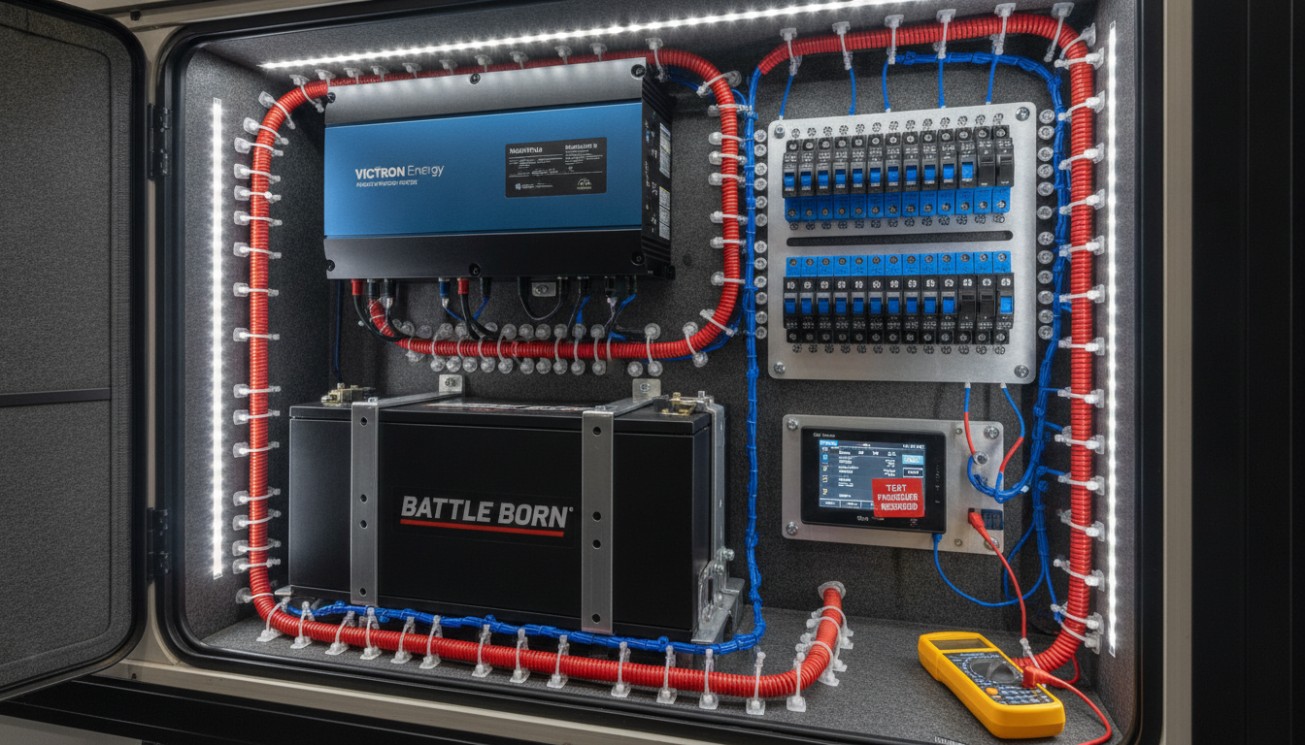
RV Energy Monitoring and Power Management: How Data Makes Off-Grid Systems Easier to Control
RV Energy Monitoring Is the Difference Between Guessing and Managing
A modern RV power system can include solar panels, lithium batteries, inverter chargers, DC-DC charging, shore power input, generator backup, fuse panels, breaker panels and smart distribution. But even a well-built system can feel uncertain if the owner cannot see what is happening. This is why RV energy monitoring has become one of the most important layers in off-grid RV power design. Monitoring does not create energy, but it tells the user how energy is moving, how much reserve remains and when behavior needs to change.
Many RV owners begin with a simple question: “How much battery do I have left?” In older systems, the answer often came from a rough voltage reading or a basic indicator with a few bars. That may be acceptable for simple lead-acid systems, but it is not enough for serious lithium-based off-grid use. LiFePO4 batteries hold voltage differently, inverter loads can change quickly, solar input varies throughout the day, and multiple charging sources may be active at different times. A vague display cannot explain those conditions clearly.
This article belongs in the System category because RV power management is not a standalone accessory topic. It connects to every major system layer. A complete RV power system design explains how energy is produced, stored, converted and distributed. RV load planning explains what the owner actually consumes. Multi-source RV charging explains how the system recovers energy. RV AC/DC power distribution explains how power reaches the circuits. Monitoring is the layer that lets the owner understand all of those decisions in real use.
A strong smart RV power system should answer practical questions every day. Is the battery really full? How much solar is coming in? How much is the inverter using? Are DC loads quietly draining the battery overnight? Is alternator charging actually helping during travel? Did shore power restore the battery completely? Is the refrigerator using more energy in hot weather? Is the inverter being left on when no AC load is needed? Without monitoring, these questions become guesswork. With good data, they become manageable decisions.
Why Voltage Alone Is Not Enough for Modern RV Power

Voltage is useful, but it is not a complete measurement of energy reserve. This is especially true when the RV uses lithium batteries. Many users still think of battery condition through voltage because older RV systems often relied on voltage-based indicators. In a modern lithium setup, voltage can remain relatively stable across much of the usable capacity range. That means the battery may look healthy on a simple voltage display while the actual remaining energy is changing significantly.
This is where battery state of charge becomes a more important concept. State of charge describes how much usable energy remains in the battery compared with its full capacity. It is usually expressed as a percentage. A properly configured monitor can help the owner understand whether the system is at 95%, 65%, 30% or nearing a protection threshold. That information is far more useful than a rough voltage number when planning overnight use, work equipment, cooking loads or cloudy-day reserve.
Lead-Acid Habits Do Not Always Translate to Lithium Systems
Many RV owners learned electrical habits from lead-acid or AGM batteries. In those systems, voltage drop was more closely associated with discharge behavior, although still imperfect. Lithium batteries behave differently. They deliver stable voltage for a long portion of the discharge curve, then can drop more quickly near the lower end. This makes basic voltage-based confidence risky.
A modern LiFePO4 RV battery upgrade should therefore include monitoring review. The battery itself may include a BMS app, but the whole RV system may still need a central monitor that tracks current entering and leaving the battery bank. The goal is not only to protect the battery. The goal is to help the user operate the RV intelligently.
Voltage Cannot Explain Energy Flow
Voltage alone does not tell the owner whether the battery is charging or discharging at a given moment. It does not explain whether solar is covering the refrigerator load, whether the inverter is pulling more than expected, or whether shore power charging has tapered. A good RV battery monitor should show more than voltage. It should show current, consumed energy, charging input, discharge behavior and state of charge.
Voltage Can Mislead During Load and Charge Events
Voltage can shift temporarily when heavy loads start, when chargers activate, or when batteries rest after use. A microwave, coffee maker or inverter surge may create a temporary dip. Solar or shore charging may raise voltage while energy is entering the battery. Without current and history data, the user may misread these moments. Monitoring should make these events easier to interpret.
The Core Data Points Every RV Power System Should Show
Good RV energy monitoring is not about filling the screen with numbers. It is about showing the right data in a way that supports decisions. Too little data leads to guessing. Too much unclear data overwhelms the user. A professional system should present several core data points clearly.
Battery State of Charge
Battery state of charge is the first number most users want to see. It tells the owner how much usable reserve remains. It helps decide whether to keep using the inverter, reduce loads, move solar panels, start driving, connect shore power or run a generator. For full-time RV users, state of charge becomes part of daily rhythm.
Charging Current
Charging current shows how much energy is entering the battery. This may come from solar, shore power, generator input or alternator charging. If the user expects strong charging but sees little current, there may be a shading issue, charger setting issue, wiring problem or battery acceptance limit. Charging current helps confirm whether recovery is actually happening.
Discharge Current
Discharge current shows how much energy is leaving the battery. This is useful when testing appliances. The owner can turn on the inverter, refrigerator, fan, coffee maker or laptop setup and observe how the load changes. This turns appliance behavior into visible data and supports better RV load planning.
Solar Input
RV solar monitoring shows what the solar array is actually producing. This matters because rated solar wattage and real output are very different. Shade, panel temperature, roof angle, season, dirt and charge controller behavior all affect recovery. Solar monitoring helps the owner understand whether the system is performing normally for the conditions.
Inverter Load
RV inverter monitoring shows AC-side demand and can reveal hidden problems. Some users leave the inverter on all day and lose energy to standby draw. Others underestimate how much a coffee maker, microwave or workstation uses. Inverter monitoring helps the owner understand whether AC comfort is aligned with battery reserve.
Historical Energy Use
Instant data is useful, but history is more powerful. A good RV power dashboard may show daily solar harvest, overnight consumption, peak inverter load, charging source contribution or energy trends. History helps the owner plan better trips and improve system habits over time.
The Shunt Monitor: A Small Device with a Big System Role
One of the most valuable tools in serious RV monitoring is the RV shunt monitor. A shunt is installed in the battery negative path so it can measure current flowing into and out of the battery bank. When configured correctly, it can calculate consumed amp-hours and estimate state of charge more accurately than voltage alone.
The shunt is important because it watches the whole battery system rather than only one device. A solar controller may show solar production. An inverter may show AC load. A battery BMS may show cell or battery data. But a shunt-based monitor can show total battery flow across all loads and chargers that pass through the measured path. This makes it a system-level measurement point.
Why Shunt Placement Matters
A RV shunt monitor must be installed so all house loads and charging sources pass through it correctly. If some loads bypass the shunt, the monitor may not see them. If some chargers bypass it, state-of-charge calculations may be wrong. This is why monitoring should be included in the system design early, not added casually after wiring is complete.
Why Calibration Matters
A shunt monitor must know the battery bank capacity and must be synchronized correctly. If the battery capacity setting is wrong, the state-of-charge number can mislead the owner. If the monitor is not synchronized after installation or major changes, its percentage reading may drift. Good RV electrical documentation should record monitor settings as part of the system handover.
What a Shunt Cannot Do Alone
A shunt is powerful, but it is not a full diagnostic system by itself. It can measure total current flow, but it may not identify which specific appliance is responsible unless the user tests loads individually or the system has branch-level monitoring. It also does not replace charger settings, fuse protection or good wiring. It is a measurement tool inside a larger smart RV power system.
Solar Monitoring: Understanding Recovery Instead of Trusting Panel Ratings

Solar panels are often purchased by wattage, but RV solar monitoring reveals what the panels actually deliver. A 400W, 800W or 1200W array will not produce its rated output all day. Real production depends on sunlight, shading, panel temperature, roof layout, wiring, controller efficiency and battery acceptance.
This is why monitoring solar input is especially valuable for RV owners. In fixed home solar, panels usually stay in one location and one orientation. In RV use, the vehicle moves across climates, seasons and parking environments. A system may perform strongly in open desert sun and weakly under trees. Without monitoring, the owner may blame the battery when the real issue is solar recovery.
Daily Solar Harvest Matters More Than Peak Output
Peak solar wattage is exciting, but daily harvest is often more useful. A brief peak does not mean the battery will recover fully. The owner should pay attention to how much energy the panels provide across the day. This helps compare real solar performance against daily consumption.
Readers comparing roof array sizes can review the RV solar panel wattage guide, but monitoring adds the real-world layer: what the array actually produces after weather, shading and travel conditions are included.
Monitoring Helps Detect Shading and Wiring Problems
If solar output is unexpectedly low in good sun, monitoring can help point toward shading, dirty panels, a disconnected string, poor controller settings or wiring issues. The user may not solve every issue alone, but the data helps them describe the problem more accurately to an installer or support team.
Solar Monitoring Changes Parking Behavior
Many RV owners change habits when they see solar data clearly. They may park with the roof array in better sun, deploy portable panels earlier, clean panels more often, reduce midday loads, or plan heavy appliance use around peak production. Good off-grid energy management is not only hardware; it is behavior shaped by data.
Inverter Monitoring: Making AC Comfort Visible

The inverter is one of the most misunderstood parts of RV energy use. It makes AC appliances possible, but it also turns battery power into household-style convenience with efficiency losses and possible standby consumption. RV inverter monitoring helps users understand what AC comfort really costs.
A user may think a small appliance is harmless because it runs briefly. Another user may leave the inverter on continuously for convenience and lose energy overnight. A remote worker may use laptop chargers, monitors and internet hardware for long hours and underestimate the total impact. Inverter data makes these habits visible.
Standby Draw Can Become a Hidden Load
An inverter may consume power even when no major appliance is running. This standby draw can matter during overnight periods or multi-day stays. If monitoring shows steady discharge with no obvious load, inverter standby use may be part of the reason. Turning the inverter off when not needed can preserve reserve.
Heavy AC Loads Should Be Tested, Not Assumed
Microwaves, coffee makers, kettles, induction cooktops and air conditioning loads should be tested with monitoring. The owner can observe how much current the inverter pulls from the battery and how quickly state of charge changes. This is more useful than guessing from product labels alone.
Inverter Monitoring Supports Circuit Planning
The previous guide on RV AC/DC power distribution explained why not every outlet should behave the same way. Inverter monitoring supports that idea. If the system shows certain loads draining the battery too quickly, those loads may need to be treated as shore-only, generator-supported or limited-use circuits.
Battery BMS Data and System-Level Monitoring Are Not the Same

Many lithium batteries include a built-in battery management system, sometimes with Bluetooth data. This can show useful information such as battery voltage, current, temperature, state of charge, protection events or cell balance status. However, BMS data and system-level monitoring should not be confused.
A battery BMS protects the battery and reports information from the battery’s perspective. A central RV battery monitor or RV power dashboard looks at the power system from a broader perspective. It may show solar input, inverter load, shore charging, alternator charging, DC load behavior and total energy flow. Both can be useful, but they serve different roles.
BMS Data Is Battery-Centered
BMS data is useful for battery protection and battery condition. It may show whether the battery is too cold to charge, whether current limits are being reached, or whether the battery has triggered protection. For LiFePO4 RV battery upgrade projects, this data can be very helpful.
System Monitoring Is Use-Centered
System monitoring is useful for daily operation. It answers how the whole RV is using and recovering energy. It helps the owner decide whether to run an appliance, whether to move panels, whether driving recovery was enough, or whether to connect shore power. This is the core of RV power management.
Why Both Views Are Better Together
The best setup often uses both. Battery BMS data helps protect and understand the battery. A shunt or system monitor helps manage the whole RV. Solar controller data explains generation. Inverter data explains AC demand. When these views are combined in a clear RV power dashboard, the system becomes much easier to operate.
Turning Monitoring Data into Daily Energy Decisions

Data is only useful when it changes decisions. A screen that shows numbers without context can become decoration. Real off-grid energy management happens when the user knows what action to take after reading the data.
Morning Decision: Can the System Support the Day?
In the morning, the owner can check overnight consumption and remaining battery state of charge. If the battery used more than expected, the user may adjust loads during the day. If the battery is still strong and sun is expected, normal use may continue. If reserve is low and weather is poor, the owner may reduce inverter use, drive for charging or plan shore power.
Midday Decision: Is Solar Keeping Up?
During midday, RV solar monitoring can show whether solar is producing enough to cover current loads and recharge the battery. If output is weak because of shade, the owner may move portable panels, reposition the RV if practical, or reduce daytime loads. If output is strong, the user may schedule energy-heavy tasks during peak production.
Evening Decision: What Should Run Overnight?
In the evening, monitoring helps decide which loads should remain active. A refrigerator may be essential. A fan may be needed. Internet equipment may be turned off if not required. The inverter may be shut down if no AC load is needed. This protects overnight reserve.
Travel Day Decision: Did Driving Restore Enough Energy?
On travel days, the user can observe whether alternator charging actually contributes meaningful recovery. This connects monitoring with multi-source RV charging. If driving recovery is weaker than expected, the DC-DC charger size, wiring, alternator capacity or driving time may need review.
Campground Decision: Did Shore Power Fully Reset the System?
When connected to shore power, monitoring can confirm whether the battery is charging correctly and whether the system reaches a full or near-full state. This is especially important for lithium systems where charger settings can affect recovery. If shore power is connected but the battery does not recover as expected, the charging pathway should be checked.
User Profiles: Different RV Travelers Need Different Monitoring Depth
Not every user needs the same monitoring system. The right level depends on energy demand, travel style and comfort expectations. A basic weekend camper may need less data than a full-time boondocker, but every user benefits from seeing more than a vague battery indicator.
Weekend Camper
A weekend camper may need a simple RV battery monitor showing state of charge, voltage and basic current flow. This helps prevent overnight surprises and supports modest solar or shore charging. The display should be easy to read because the user may not want to study detailed electrical data.
Remote Worker
A remote worker needs more confidence. Laptops, routers, Starlink terminals, monitors and camera gear can become work-critical loads. This user benefits from RV power management that shows daily energy use, solar recovery, inverter draw and reserve margin. Losing power may mean losing productivity, so monitoring becomes business infrastructure.
Electric Cooking User
An electric cooking user should monitor inverter load closely. Induction cooktops, microwaves, kettles and coffee makers can create strong AC demand. RV inverter monitoring helps this user understand which appliances are practical off-grid and which should be limited to shore power or generator support.
Full-Time Boondocker
A full-time boondocker needs deeper monitoring. This user may depend on solar, alternator charging, shore power resets and lithium battery reserve across changing conditions. A good RV power dashboard can help manage daily routine, detect problems early and reduce power anxiety.
Rental or Occasional RV User
Rental users and occasional travelers need simplified displays. Too much data can confuse them. A clear percentage, input/output direction and basic warnings may be enough. For rental fleets, simple monitoring can reduce misuse and support calls.
Common Monitoring Mistakes That Create False Confidence

Monitoring can improve system confidence, but only when it is installed, configured and interpreted correctly. A bad monitor setup can create false confidence, which may be worse than no data.
Mistake 1: Trusting Voltage as the Only Battery Indicator
Voltage-only monitoring is not enough for modern lithium systems. It may not accurately reflect remaining usable energy during normal discharge. A proper RV battery monitor should provide better state-of-charge information and current flow data.
Mistake 2: Installing a Shunt Where Some Loads Bypass It
If a RV shunt monitor does not see all battery current, its state-of-charge calculation may be wrong. All house loads and charging sources should be wired through the monitored path according to the system design. Bypass wiring creates inaccurate data.
Mistake 3: Not Updating Settings After Battery Expansion
If the owner adds battery capacity but does not update monitor settings, the displayed percentage may become inaccurate. Monitoring configuration should be updated during every battery upgrade or major system change.
Mistake 4: Watching Solar Watts but Ignoring Daily Energy
A momentary solar watt reading does not show whether the system recovered enough energy for the day. RV solar monitoring should include daily harvest or energy history when possible. Daily recovery matters more than a short peak number.
Mistake 5: Ignoring Inverter Standby Consumption
Some owners focus on large appliance use but ignore inverter standby draw. RV inverter monitoring can reveal this hidden load. Turning the inverter off when not needed may improve overnight reserve.
Mistake 6: Treating Monitoring as a Replacement for Protection
Monitoring is not a fuse, breaker, disconnect or safe wiring practice. It can show what is happening, but it does not replace proper RV wiring safety. A system still needs correct protection and serviceable installation.
What a Good RV Power Dashboard Should Communicate

A useful RV power dashboard should not simply display technical numbers. It should communicate system status in a way the owner can act on. The best interface depends on user skill, but several design principles are universal.
Show Direction of Energy Flow
The dashboard should make it clear whether the battery is charging, discharging or idle. A simple flow view can help users understand whether solar is covering current loads, whether the inverter is drawing from the battery, or whether shore power is restoring energy.
Separate Inputs and Outputs
Solar input, alternator input, shore charging and generator charging should not be hidden inside one vague number if the system can show them separately. On the output side, inverter loads and DC loads should be understandable. This improves off-grid energy management.
Use Warnings Carefully
Warnings should be meaningful. Low state of charge, high discharge current, charger fault, battery temperature issue, inverter overload or solar input failure should be easy to understand. Too many unclear alerts can cause users to ignore the system.
Support Historical Review
Daily and weekly trends can help owners improve habits. Historical data can show whether solar is usually enough, whether battery reserve is adequate, whether remote work loads are increasing or whether a system expansion is justified. This connects monitoring with long-term RV power system serviceability and upgrade planning.
How Suppliers and Installers Can Use Monitoring as a Value Proposition
For suppliers, installers and system integrators, RV energy monitoring is more than an accessory upsell. It is a way to reduce confusion, improve customer satisfaction and support after-sales service. Customers who understand their system are less likely to blame the wrong component when power behavior changes.
Explain Monitoring During the Sales Process
Instead of only showing battery capacity and solar wattage, suppliers should show what the user will be able to see after installation. Can the customer see state of charge? Can they see solar input? Can they see inverter load? Can they identify whether the system is charging from shore power or alternator input? This makes the system feel more transparent.
Use Monitoring for Handover Education
Installation handover should include a short monitoring lesson. The customer should know what normal charging looks like, what overnight discharge looks like, how to identify inverter standby draw and when to contact service. A five-minute dashboard explanation can prevent many support questions.
Support Remote Diagnosis When Possible
Some smart systems allow app-based review or remote data sharing. This can help installers diagnose problems before a service visit. Even without remote connectivity, screenshots of the RV power dashboard can help technical support understand whether the issue is solar input, battery reserve, inverter demand or charger behavior.
Package Monitoring by Use Case
A basic camper package may include a simple shunt monitor. A remote-work package may include solar input history and inverter monitoring. A full-time package may include more integrated system data. Use-case-based monitoring packages help buyers choose the right level of visibility.
Monitoring Checklist Before Finalizing an RV Power System
Before buying or installing a serious RV power system, the monitoring plan should be reviewed with the same care as solar panels, batteries and inverters. The following checklist can help.
Battery Monitoring
- Does the system include an accurate RV battery monitor?
- Can the owner see battery state of charge clearly?
- Is the battery capacity setting correct?
- Will the monitor be updated after battery expansion?
- Does the monitor show current entering and leaving the battery?
Shunt Installation
- Is the RV shunt monitor installed where it can measure all house battery current?
- Do all charging sources pass through the measured path?
- Do all house loads pass through the measured path?
- Is the shunt location protected and serviceable?
Solar Monitoring
- Can the owner see real-time solar input?
- Can the owner review daily solar harvest?
- Can the monitoring system reveal low output caused by shade, weather or wiring issues?
- Does the solar controller data match the broader dashboard?
Inverter Monitoring
- Can the owner see inverter load?
- Can the system show inverter standby draw?
- Are overload warnings clear?
- Does the owner know which AC loads are supported off-grid?
Dashboard and User Experience
- Is the RV power dashboard easy to understand?
- Does it show energy flow direction?
- Does it separate input sources when possible?
- Does it provide useful warnings rather than confusing alerts?
- Can the owner use the data to make daily decisions?
Focused FAQ
What is RV energy monitoring?
RV energy monitoring is the process of measuring and displaying how power is stored, used and recovered inside an RV. It can include battery state of charge, solar input, inverter load, charging current, discharge current and historical energy data.
Why do I need an RV battery monitor?
An RV battery monitor helps the owner understand how much usable battery reserve remains and how quickly energy is entering or leaving the battery bank. It is especially useful in lithium systems where voltage alone may not show accurate remaining capacity.
What is battery state of charge?
Battery state of charge is an estimate of how much usable energy remains in the battery compared with full capacity. It is usually shown as a percentage and helps the owner decide how much power can be used before charging is needed.
What does an RV shunt monitor do?
An RV shunt monitor measures current flowing into and out of the battery bank. When configured correctly, it can calculate consumed energy and estimate battery state of charge more accurately than a simple voltage indicator.
Why is RV solar monitoring important?
RV solar monitoring shows what the solar array is actually producing under real conditions. It helps owners understand the effect of shade, weather, season, panel layout and daily recovery rather than relying only on panel wattage ratings.
What should RV inverter monitoring show?
RV inverter monitoring should show how much AC load the inverter is supporting, whether the inverter is in standby, whether an overload occurs and how inverter use affects battery reserve. This helps owners manage AC appliances more intelligently.
What is an RV power dashboard?
An RV power dashboard is a display or app interface that shows key energy information such as state of charge, solar input, inverter load, charging sources and energy flow. A good dashboard turns technical data into practical operating decisions.
How does off-grid energy management improve RV travel?
Off-grid energy management helps RV owners use power according to real conditions. By watching battery reserve, solar recovery, inverter load and charging sources, owners can reduce power anxiety, avoid unnecessary generator use and make better decisions during remote travel.
Conclusion: Smart Monitoring Turns an RV Power System into a Manageable System
A modern RV power system should not leave the owner guessing. Solar panels, lithium batteries, inverter chargers and multiple charging sources can create a capable electrical platform, but capability is not enough. The user must understand what the system is doing. That is the role of RV energy monitoring.
Good monitoring makes battery reserve visible, solar recovery measurable, inverter use understandable and charging behavior easier to diagnose. It helps users see the difference between a real problem and normal system behavior. It shows whether overnight loads are reasonable, whether solar is keeping up, whether alternator charging is useful, whether shore power has restored the battery and whether AC appliance habits need to change.
For RV owners, the lesson is simple: do not treat monitoring as a decorative display. A reliable RV battery monitor, correctly installed RV shunt monitor, clear RV solar monitoring, useful RV inverter monitoring and readable RV power dashboard can make off-grid travel more predictable. They turn stored energy into information, and information into better decisions.
For suppliers and installers, monitoring is a professional value point. It reduces customer confusion, improves handover quality, supports remote diagnosis and helps users understand the real performance of the system. In the System category, this is the key message: a smart RV power system is not only powerful. It is visible, understandable and manageable. The best off-grid systems do not simply store energy. They teach the owner how to use it well.
#RVEnergyMonitoring #RVBatteryMonitor #RVPowerManagement #BatteryStateOfCharge #RVShuntMonitor #RVSolarMonitoring #RVInverterMonitoring #RVPowerDashboard #OffGridEnergyManagement #SmartRVPowerSystem