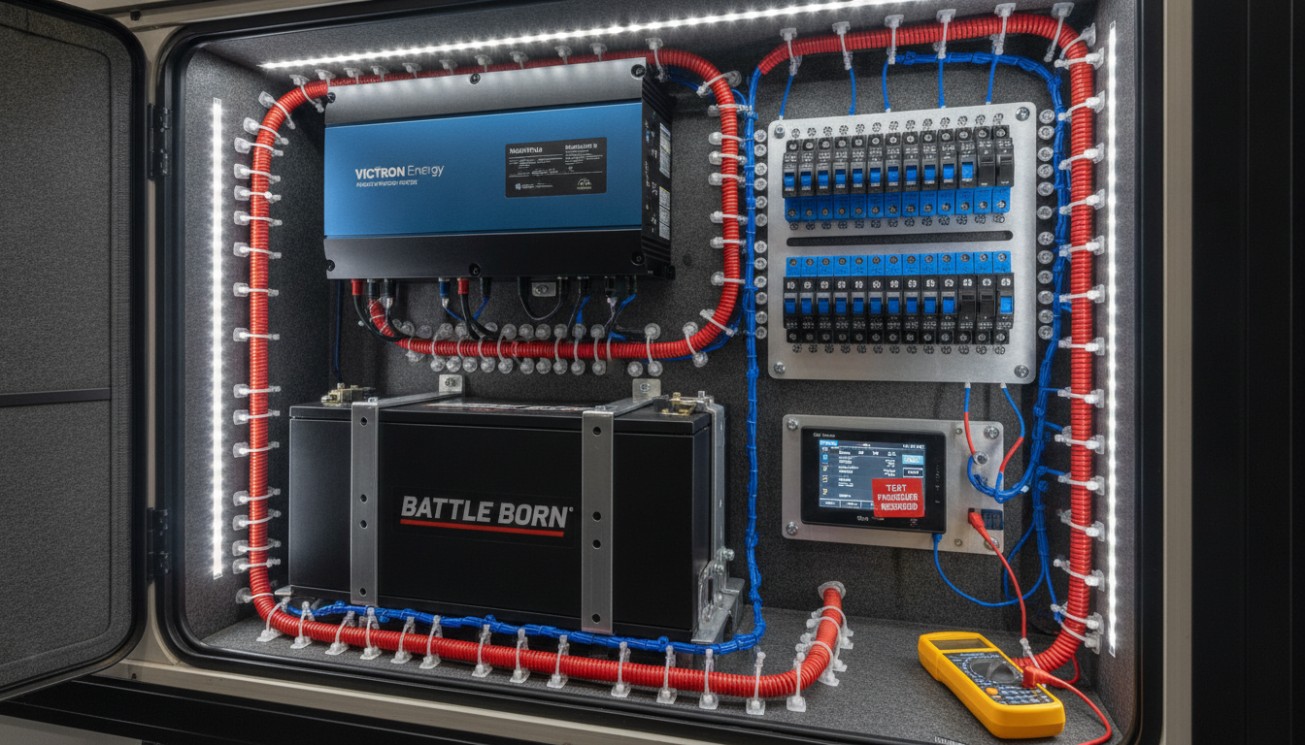
RV AC/DC Power Distribution: How to Separate, Protect and Manage Every Circuit
Why AC/DC Distribution Decides Whether an RV Power System Feels Professional
Many RV owners judge an electrical system by the visible components: solar panels on the roof, lithium batteries in the compartment, a large inverter charger, a clean monitoring display or a complete power kit. These parts matter, but they do not decide the whole experience. The system only becomes useful when power is distributed correctly to the loads inside the vehicle. This is why RV AC DC distribution is one of the most important but least understood layers in a modern RV power system.
A complete RV system must handle two different electrical worlds. The DC side usually supports lights, fans, pumps, control boards, USB outlets, refrigerators, monitoring devices and low-voltage accessories. The AC side supports household-style appliances, outlets, microwave ovens, coffee makers, induction cooktops, entertainment equipment, chargers and sometimes air conditioning circuits. These two sides can interact through an inverter charger, converter charger, transfer switch or distribution panel, but they should not be treated as one simple wire network.
This article belongs in the System category because it is not a product review and not a basic solar sizing guide. Previous articles explained the broader RV power system design, why RV load planning should begin with real appliance behavior, how a multi-source RV charging strategy helps recovery, and why RV power system serviceability matters for long-term ownership. This guide focuses on what happens after energy is produced, stored and converted: how that energy is separated, protected and delivered to actual circuits.
Good RV electrical distribution does three things at the same time. It makes the system safe by protecting wires and devices. It makes the system usable by sending the right type of power to the right circuits. It makes the system serviceable by giving owners and technicians a clear structure for troubleshooting. A powerful system with poor distribution can feel unreliable, confusing and unsafe. A moderate system with clean distribution can feel more professional because every circuit has a purpose.
The Basic Split: DC Loads and AC Loads Are Not the Same Problem
The first rule of RV power distribution design is to understand that DC loads and AC loads behave differently. DC circuits usually run directly from the battery system or from a DC distribution panel. AC circuits usually receive power from shore power, generator input or inverter output. Mixing these concepts leads to poor planning.
DC loads tend to be essential and continuous. Lights, water pumps, fans, furnace blowers, control boards and some refrigerators may run even when the inverter is off. AC loads tend to represent comfort, convenience and higher power use. Microwaves, coffee makers, outlets, laptop chargers and kitchen appliances often depend on AC power. Some appliances may be available in DC or AC versions, and that choice can change the entire system design.
Why DC Loads Matter More Than They Look
Because many DC loads are small, RV owners may underestimate them. A light or fan may not seem important compared with a microwave, but long runtime changes the energy picture. A refrigerator control board, vent fan or router can quietly consume power over many hours. A well-planned 12V RV circuit layout protects these loads and keeps them separate from high-current inverter behavior.
DC circuits also matter during faults. If a minor accessory fails, it should not disable essential lighting or the water pump. If a fuse blows, the owner should be able to identify which branch circuit is affected. This is why a clean RV DC fuse panel is not only a convenience. It is part of system reliability.
Why AC Loads Create Different Design Pressure
AC loads often create higher peak demand. A coffee maker, microwave or induction cooktop may draw more power in minutes than several DC loads consume in hours. These appliances affect inverter sizing, battery discharge current, shore power transfer, breaker selection and outlet planning. A serious RV inverter circuit should not be treated like a normal household extension cord. It is part of a limited mobile energy system.
AC distribution should answer several questions. Which outlets receive inverter power? Which circuits only run on shore power or generator input? Should the air conditioner be included or excluded from inverter output? How does the system prevent backfeeding? How are breakers labeled? How does the owner know what can be used when the RV is off-grid? These questions are central to RV load separation.
The DC Side: Battery Power Must Be Distributed with Discipline
The DC side begins at the battery bank and extends through main protection, busbars, disconnects, shunts, fuse panels and branch circuits. In many RVs, DC power is the foundation of daily operation. Even if the owner does not use the inverter, the DC side may keep the vehicle livable.
Battery Bank to Main Protection
Every serious DC system should have proper overcurrent protection close to the battery positive connection. This protection is not mainly for the device at the end of the wire. It protects the wire itself from carrying unsafe current during a fault. In high-capacity lithium systems, available current can be very high, so protection becomes more important.
A main disconnect also supports maintenance and emergency isolation. It allows the owner or technician to shut off the house battery side before working on downstream equipment. For serviceability, the disconnect should be accessible and labeled. Hidden disconnects reduce real-world usefulness.
Busbars and Current Organization
Busbars provide organized connection points for high-current DC circuits. Instead of stacking many cables on a battery terminal, a busbar allows the system to distribute current more cleanly to the inverter, DC fuse panel, solar controller, DC-DC charger, monitoring shunt and other major components. This improves layout and makes troubleshooting easier.
However, busbars must be selected and installed correctly. Their current rating should match system demand. Connections should be tight, protected and inspectable. A busbar is not a place to hide messy wiring. It is the central traffic point of the DC system.
The Role of the RV DC Fuse Panel
The RV DC fuse panel distributes low-voltage power to branch circuits. Each circuit should have a fuse sized to protect the wire and connected load. The panel should be labeled clearly. A user should be able to identify circuits such as lighting, refrigerator, water pump, vent fan, USB outlets, monitoring, furnace controls or accessory power.
Good fuse panel design avoids unnecessary grouping. If too many loads share one fuse, troubleshooting becomes difficult. If essential loads and optional loads are mixed poorly, one accessory failure may disable important functions. A serviceable DC panel uses labels, logical grouping and reasonable circuit separation.
The AC Side: Shore Power, Generator Power and Inverter Output Need Clear Boundaries

The AC side of an RV can be more confusing because power may come from multiple sources. An RV may receive AC from shore power, a generator, or an inverter. These sources must be coordinated safely. This is where the RV AC breaker panel, transfer equipment and inverter wiring become critical.
Shore Power Input
RV shore power transfer begins when the RV is plugged into an external AC source. Depending on the vehicle, this may be a 30A or 50A service, or a smaller household outlet in limited situations. Shore power can support AC loads and may also recharge the battery through a converter charger or inverter charger.
The important point is that shore power is not the same as inverter power. A campground pedestal may support loads that the battery and inverter cannot support for long. If users assume every AC outlet behaves the same off-grid as it does when plugged in, disappointment or overload can follow.
Generator Input
Generator input may connect into the AC system through a transfer switch or designated input path. Like shore power, generator power can support appliances and battery charging, but output capacity is limited by the generator and charger configuration. A generator should not be treated as an unlimited replacement for shore power unless the ratings and wiring support that use.
Inverter Output
The inverter creates AC from the battery bank. It is useful for off-grid convenience, but it must be managed carefully. A large inverter can power more devices, but it also draws more current from the DC side. If the battery bank, cables, fuses and ventilation do not support the inverter, AC comfort becomes a system risk.
The RV inverter circuit should be planned around real appliance behavior. Readers who need to understand load behavior can review the existing RV load planning article. From a distribution perspective, the key question is which AC circuits should be connected to inverter output and which should remain shore-only.
Load Separation: Not Every Outlet Should Behave the Same Way
RV load separation means organizing circuits according to source, priority, power demand and operating mode. It prevents the system from trying to power everything at once when only limited energy is available. This is one of the most practical ways to make an RV power system feel intuitive.
Essential DC Loads
Essential DC loads should remain stable and protected. These may include lights, water pump, refrigerator controls, furnace blower, safety-related electronics and basic monitoring. If the inverter trips, these loads should not disappear. If an optional accessory fails, essential loads should remain available.
Inverter-Supported AC Loads
Inverter-supported AC loads should be chosen deliberately. Many systems support selected outlets for laptop charging, small appliances, entertainment equipment or kitchen convenience. These circuits should be labeled so the user understands what works off-grid. If the inverter supports only certain outlets, the owner should not need to guess.
Shore-Only or Generator-Only Loads
Some loads may be too large for the inverter or too inefficient for battery operation. Air conditioners, electric water heaters, large heaters, washer/dryer equipment or certain heavy kitchen appliances may be better treated as shore-only or generator-supported loads unless the system is designed specifically for them. This does not mean those appliances cannot ever run from battery. It means they should not be included casually.
Critical Communication Loads
Remote workers may treat internet equipment, routers, Starlink, phones and laptops as critical loads. These may require their own planning layer. They might use DC power directly, selected inverter outlets or a small backup power source. In a modern RV, communication may be more important than entertainment, so distribution should reflect that priority.
Why the Inverter Circuit Should Be Treated as a Managed Subsystem
The inverter is often marketed by wattage, but a real RV inverter circuit is a subsystem. It includes the inverter, battery discharge path, DC cables, DC fuse, disconnect, AC output wiring, breaker protection, transfer behavior and selected loads. If any part is weak, the inverter experience suffers.
DC Input Side
On the DC input side, the inverter can draw high current. A 12V system powering a large AC load may require very heavy current from the battery bank. This affects cable size, fuse rating, voltage drop and heat. Poor DC-side design may cause inverter shutdowns, unstable operation or unsafe wiring conditions.
AC Output Side
On the AC output side, the inverter should feed designated circuits through appropriate protection. The AC output should not be connected in a way that backfeeds shore power or energizes circuits unexpectedly. Labels and breaker organization matter. A technician should be able to understand where inverter power goes.
Transfer Behavior
Some inverter chargers include transfer capability. When shore power is available, they may pass AC through and charge batteries. When shore power is removed, they may supply selected circuits from the battery. This can create a smooth experience, but only when the distribution design is clear. The user should understand which loads are supported in each mode.
AC Breaker Panels and DC Fuse Panels Serve Different Roles
An RV AC breaker panel and an RV DC fuse panel both protect circuits, but they operate in different electrical environments. Confusing them leads to poor system understanding.
AC Breaker Panel
The AC breaker panel protects AC branch circuits and helps organize household-style loads. It may include breakers for outlets, microwave, air conditioner, converter charger, water heater or other AC appliances. In inverter-supported systems, selected AC circuits may be separated into a subpanel so that only appropriate loads receive inverter power.
DC Fuse Panel
The DC fuse panel protects low-voltage circuits. These circuits may be smaller but are often essential. A DC fuse panel should be easy to access, clearly labeled and organized by function. In a lithium system with more electronics, the DC side may include monitoring devices, BMS communication, fans, pumps, lights and control boards.
Why Separate Panels Improve Serviceability
Separate panels improve serviceability because each side has a clear role. If a light fails, the owner checks the DC side. If an outlet is dead, the owner checks the AC side or inverter status. If shore power works but inverter outlets do not, the issue may be in transfer behavior or inverter output. Clear separation reduces confusion.
Shore Power Transfer: Where Many RV Owners Get Confused
RV shore power transfer is the process of moving AC supply between external input, generator input and inverter output. In simple terms, the system must decide which source feeds the AC circuits at a given time. This must be done safely to prevent backfeeding and source conflict.
Manual vs Automatic Transfer
Some systems use manual switching. Others use automatic transfer switches or inverter charger transfer functions. Automatic systems can improve convenience, but they still require understanding. If the owner does not know which source is active, they may overload the inverter or misunderstand why a circuit behaves differently.
Pass-Through Power
Inverter chargers may provide pass-through power when shore power is connected. This means AC input can feed selected circuits while the charger restores the battery. When shore power is disconnected, the inverter may take over. This function is useful but should be matched with the breaker layout and load plan.
Why Some Circuits Should Stay Outside the Inverter
High-demand circuits may be excluded from inverter output to protect battery reserve and prevent overload. For example, an RV may allow outlets and microwave on inverter but exclude air conditioning. Another system may support air conditioning only if it has a very large lithium bank, high-output inverter and carefully designed distribution. The key is intentional design.
Wiring Safety Is Not Only About Wire Size
RV wiring safety includes wire size, but it also includes routing, protection, strain relief, abrasion control, heat management, labeling, access and documentation. RVs move, vibrate and experience temperature swings. A wire that looks fine during installation may rub against a sharp edge over time if routing is poor.
Voltage Drop
Voltage drop matters especially on low-voltage DC circuits. Long cable runs and high current can reduce voltage at the load. This can cause poor device performance, heat and efficiency loss. In large inverter systems, the DC cable run should be as short and direct as practical while maintaining service access and safe layout.
Abrasion and Movement
Wires should be protected where they pass through metal, wood, cabinetry or exterior surfaces. Grommets, conduit, loom, clamps and strain relief can reduce movement damage. An RV is not a stationary building. Road vibration makes cable support important.
Heat and Ventilation
Inverters, chargers, batteries and high-current cables can generate heat. Electrical compartments should allow ventilation where required by equipment manuals. Components should not be packed so tightly that heat cannot escape or service access is impossible.
Labeling and Documentation
Labels are part of RV wiring safety because they reduce mistakes during inspection or future upgrades. A usable wiring diagram and clear labels help prevent accidental disconnection of the wrong circuit. This connects directly with RV electrical documentation and long-term serviceability.
Distribution Planning for Different RV Use Cases
Not every RV needs the same RV power distribution design. The right layout depends on how the vehicle is used, how much inverter power is expected and how much independence the owner wants.
Weekend Camper
A weekend camper may need a simple DC system, modest solar charging and a small inverter for device charging or occasional AC use. The distribution priority is simplicity. Essential DC loads should be protected, and inverter-supported outlets should be clearly identified.
Remote Worker
A remote worker may need dedicated circuits for communication and productivity. Routers, laptops, monitors and internet equipment should be supported reliably. Some of these loads may be better powered through DC adapters to reduce inverter dependence. Others may need selected AC outlets. Good RV load separation protects work-critical devices from unnecessary appliance conflicts.
Electric Cooking User
Electric cooking places heavy demand on the inverter and battery system. The distribution design must support high AC loads safely. A microwave, induction cooktop or electric kettle should not share poorly planned wiring with unrelated circuits. The inverter circuit, breakers and battery discharge path must be designed together.
Full-Time Off-Grid Traveler
A full-time off-grid traveler may need a more complete AC/DC architecture: larger lithium storage, selected inverter subpanel, multiple charging inputs, detailed monitoring, labeled panels and strong service access. For this user, distribution is not a hidden technical detail. It is part of daily living infrastructure.
Common RV Distribution Mistakes
Distribution mistakes often remain invisible until something fails. A system may look impressive from the outside but become frustrating when circuits are mislabeled, overloaded or poorly separated.
Mistake 1: Powering Too Many AC Loads from the Inverter
Not every AC circuit should be inverter-supported. If the inverter feeds heavy appliances casually, the battery may drain quickly or the inverter may trip. Good RV inverter circuit planning selects appropriate loads and excludes others unless the system is designed for them.
Mistake 2: No Clear DC Circuit Labels
An unlabeled RV DC fuse panel creates unnecessary troubleshooting. When a fuse blows, the owner should know which load is affected. Labels should be part of the installation, not an afterthought.
Mistake 3: Treating Shore Power and Inverter Power as Equal
Shore power may support loads that the battery and inverter cannot support for long. If users do not understand the difference, they may expect campground-style comfort while off-grid. RV shore power transfer should be explained clearly in the owner handover.
Mistake 4: Adding Loads Without Rechecking Protection
Adding a new refrigerator, outlet, fan, charger or cooking appliance may require a circuit review. The existing fuse, breaker, cable and distribution path may not be suitable. Expansion should be treated as a system change.
Mistake 5: Poor Access to Breakers, Fuses and Disconnects
Protection devices must be accessible. If a fuse or breaker is hidden behind permanent panels, troubleshooting becomes harder. Serviceable distribution places protection where it can be inspected safely.
How Suppliers and Installers Can Explain AC/DC Distribution Better
For suppliers and installers, RV electrical distribution is a chance to show professional value. Many customers understand batteries and solar panels, but they do not understand why distribution matters. Explaining circuit separation, inverter limits and protection logic can reduce unrealistic expectations.
Use Circuit Maps in Sales Communication
A simple circuit map can show which loads are DC, which loads are inverter-supported AC, and which loads are shore-only. This helps buyers understand what the system will actually do. It is much more useful than only saying “3000W inverter included.”
Offer Use-Case-Based Distribution Packages
A weekend package may support basic DC loads and a few inverter outlets. A remote-work package may include dedicated communication circuits and monitoring. An electric-cooking package may require a stronger inverter circuit and battery discharge design. A full-time package may include a more advanced AC subpanel and multiple recovery paths.
Provide Handover Labels and Operating Notes
After installation, the customer should receive panel labels, a circuit list and simple operating notes. They should know which outlets work off-grid, which loads require shore power, where the main disconnect is located and how to read the monitor. This reduces after-sales confusion.
Focused FAQ
What is RV AC DC distribution?
RV AC DC distribution is the way an RV separates and delivers direct current power and alternating current power to different circuits. DC power usually supports lights, fans, pumps and control boards. AC power usually supports outlets, appliances and inverter-powered loads.
Why is RV electrical distribution important?
RV electrical distribution determines how safely and clearly power reaches the loads inside the vehicle. Good distribution protects wires, separates essential loads, organizes AC and DC circuits, supports troubleshooting and improves user confidence.
What does an RV DC fuse panel do?
An RV DC fuse panel protects low-voltage branch circuits such as lights, fans, water pumps, refrigerators, USB outlets and control devices. Each circuit should have a properly sized fuse and clear label.
What does an RV AC breaker panel do?
An RV AC breaker panel protects AC circuits such as outlets, microwave circuits, air conditioner circuits, converter chargers or other household-style loads. In inverter systems, selected circuits may be separated so only suitable loads receive inverter power.
What is an RV inverter circuit?
An RV inverter circuit includes the inverter, DC input wiring, fuse protection, AC output wiring, breakers, transfer behavior and the loads powered by the inverter. It should be designed as a managed subsystem, not just an outlet connection.
Why does RV load separation matter?
RV load separation helps prevent the system from trying to power inappropriate loads from limited battery energy. It separates essential DC loads, inverter-supported AC loads and shore-only or generator-only loads.
What is RV shore power transfer?
RV shore power transfer is the process of safely managing AC supply between shore power, generator input and inverter output. It prevents source conflict and helps determine which circuits receive power in different operating modes.
How can I improve RV wiring safety?
RV wiring safety improves when wires are properly sized, protected from abrasion, routed cleanly, fused correctly, labeled clearly and documented with a usable wiring diagram. Access to breakers, fuses and disconnects is also important.
Conclusion: Distribution Turns Stored Energy into Usable RV Living
A modern RV power system is not complete when the battery is installed or when solar panels are mounted on the roof. It becomes complete when energy can move safely and logically to the circuits that support daily life. This is the role of RV AC DC distribution.
Good distribution separates DC and AC loads, protects each branch circuit, defines which outlets can run from the inverter, clarifies how shore power and generator input enter the system, and gives the owner a clear operating structure. It also makes maintenance easier. When the DC fuse panel is labeled, the AC breaker panel is organized, the inverter circuit is documented and shore power transfer is understood, the system becomes easier to trust.
For RV owners, the practical lesson is to stop judging electrical systems only by battery capacity, solar wattage or inverter size. Ask how the circuits are separated. Ask which loads are inverter-supported. Ask whether the RV DC fuse panel and RV AC breaker panel are labeled. Ask whether the system has a clear wiring diagram. Ask whether expansion will require reworking the distribution layout.
For suppliers and installers, distribution is a place to demonstrate engineering quality. A clean RV power distribution design shows that the system was built for real use, not only for product photos. It reduces confusion, prevents overloading, supports future service and helps customers understand what their RV can actually do off-grid. In the System category, this is the key message: reliable mobile power is not only about producing and storing energy. It is about delivering the right energy to the right circuit at the right time.
#RVACDCDistribution #RVElectricalDistribution #RVDCFusePanel #RVACBreakerPanel #RVInverterCircuit #RVLoadSeparation #RVShorePowerTransfer #RVWiringSafety #12VRVCircuit #RVPowerDistributionDesign