
Should a Pallet Inverter or Pallet Changer Feed Your AMR Fleet
The pallet arriving at the dock may not be the pallet your robot should carry
A pallet inverter can change the support beneath a complete load by securing and rotating that load. A pallet changer may exchange the support without turning the goods upside down, depending on its mechanism. Neither description, by itself, establishes that the equipment can accept an autonomous mobile robot, preserve the product, or complete an unattended receiving process. The useful purchasing question begins with the incoming load and ends with an accepted load on an approved carrier.
That boundary deserves attention before a heavy-payload AMR project is ordered. A robot can be suitable for the weight of a delivery while the supplier's pallet is unsuitable for its deck, forks, pickup station or downstream equipment. Buying a larger robot does not necessarily solve that mismatch. Conversely, installing an exchange machine for every arrival can add handling where a qualified incoming pallet could have traveled directly to its destination.
There is a timely reason to revisit the choice. On October 8, 2026, IFCO announced Atlas, a reusable North American pallet combining a hollow-steel deck with an HDPE frame. The company positions its 48-by-40-inch design for automated operations and managed pooling. This is a supplier announcement about an additional carrier option, rather than evidence that every warehouse should replace wooden pallets or that demand for exchange machinery has suddenly accelerated. [1]
The practical implication is a decision about standardization. Can the business approve more incoming carriers for direct movement, require selected suppliers to use an agreed carrier, or exchange unsuitable carriers at the receiving boundary? Those choices affect supplier agreements, pallet ownership, labor, floor space and robot interfaces. The following analysis develops a purchasing method around those decisions. Its operating scenarios and calculations are original, hypothetical planning examples, not reported customer results.
Start with three destinations for an incoming load
Before asking vendors for equipment quotations, divide receipts into three routes: direct acceptance, controlled exchange and exception handling. Use actual receiving records to estimate each route's share. A daily total of 200 pallets is insufficient if only 30 require exchange and those 30 arrive together before the morning production shift. Equally, a high exchange percentage may conceal a small group of suppliers whose packaging agreement could be changed.
Route one: keep the incoming carrier
Direct acceptance deserves to be a genuine option. Document the permitted carrier designs, condition limits, load geometry and destination restrictions. Then establish how receiving staff or inspection equipment identify compliance. An approved material name such as wood or plastic is too broad: two carriers made from the same material can present different underside openings, runners and support surfaces. Approval should refer to a usable design and its accepted condition.
This route also needs a custody decision. A pooled pallet, a supplier-owned carrier and a disposable shipping pallet can have different return obligations. Allowing a carrier deep into the facility may make its return harder to control. Logistics and procurement should therefore agree where ownership is recorded, where empties accumulate and who pays when the expected return does not occur. Robot compatibility cannot settle those commercial questions.
Route two: exchange before autonomous transport
Exchange is worth evaluating when incoming carriers cannot be accepted consistently or must remain on the receiving side. In this arrangement, the product moves onto a known internal carrier before the AMR takes responsibility for transport. The cell becomes a boundary between supplier variability and the plant's approved material system. Its output specification should identify the resulting carrier, product orientation, load condition and readable identity.
A staffed exchange point can be a sensible first stage. Operators handle variable arrivals and release approved output to a repeatable robot pickup station. The investment case should count the work that remains at receiving, rather than describing the whole journey as labor-free. This configuration may still be valuable when the avoided work consists mainly of repeated travel between a stable receiving point and dispersed production destinations.
Route three: hold the exception
Some loads should leave the normal flow temporarily. Examples include unidentified product, a damaged bottom layer, uncertain contents, excessive overhang or a carrier that does not match the approved drawing. The exception route needs real space, a responsible person and a disposition rule. It should not be represented by a small rectangle on a layout that becomes a general storage area before commissioning.
These three routes create a more useful inquiry than asking for a universal machine. Tell suppliers which receipts must pass automatically, which may need attended processing and which must be rejected from the normal sequence. The resulting proposal can then be assessed against an explicit coverage target. A design that handles 90 percent of the intended mix predictably may be preferable to a vaguely specified promise to handle everything.
Choose the mechanism from the product outward
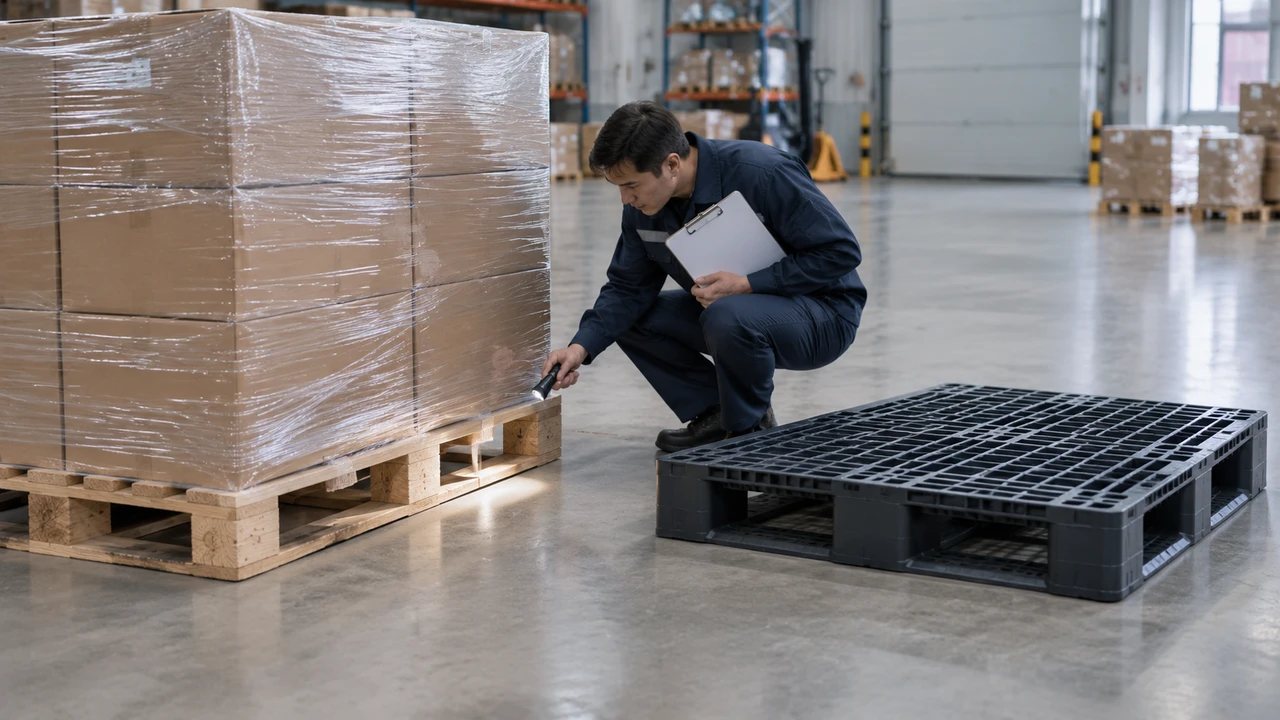
The defining selection question is what can happen to the goods while their original support is removed. Weight matters, but orientation, contact pressure, load cohesion and the continuity of support can decide the method first. Give the supplier representative products, packaging specifications and adverse but permitted load conditions. A demonstration using a neat stack of rigid empty boxes does not answer what happens to the actual shipment.
When rotation is an acceptable operation
For a concrete equipment example, Southworth describes its PalletPal as using an adjustable-pressure clamp and rotating the secured load through 180 degrees. The published application list includes replacing broken carriers and changing between in-house and shipping pallets. Those features establish what that product is designed to do; they do not establish suitability for an untested package or every possible load arrangement. [2]
A buyer evaluating a pallet inverter machine should ask the product owner to define permitted handling conditions before discussing cycle speed. Can the contents change orientation? Can the packaging transmit the required restraint without crushing, leakage or internal displacement? Does the completed load need to emerge in its original orientation? Which surfaces may contact the machine? The answers belong in a documented product approval, rather than an assumption made during equipment selection.
Include the bottom layer and any intermediate material in that review. A slip sheet, separator or uneven base can alter what the equipment actually supports when the original pallet is removed. Record whether those items remain with the goods, are replaced or are collected separately. A successful exchange must leave the required packaging system intact, not merely produce a stack standing on a different pallet.
When the load must remain upright
A non-tilting design offers a different handling proposition. Toppy's Four Fingers product page describes a system intended to exchange carriers beneath fragile products without tilting the load. Its published configuration specifies 800-by-1,200-millimeter pallets, a capacity up to 1,200 kilograms and approximately 20 exchanges per hour. These are model-specific supplier figures, not a general performance promise for upright transfer equipment. [3]
Keeping goods upright does not remove the need for product validation. Ask the supplier to explain where the load is supported throughout the change and what contact or movement the package experiences. An orientation restriction may be satisfied while another requirement, such as protection of a vulnerable lower carton edge, remains unresolved. The purchasing comparison should therefore describe the complete support sequence in words and drawings.
The term pallet exchanger can help describe the required function without prematurely specifying the mechanism. Define that function as moving the approved goods from carrier A to carrier B while meeting an agreed product-condition standard. Then compare mechanisms against that standard. This keeps a compelling equipment demonstration from becoming the acceptance criterion merely because it is the first demonstration the team sees.
When a label hides a different operation
Terminology varies between suppliers. A turner, inverter, changer or transfer system may describe overlapping functions, while a CNC pallet-changing system concerns a different application entirely. Ask for the exact load journey for the quoted configuration. Avoid copying a search term into a specification and assuming that every bidder will interpret it in the same way.
For a fixed pallet inverter, check the permanent working envelope and how loads reach it. For a mobile pallet inverter, establish which equipment moves, who positions it and what changes when it works at another location. Mobile equipment should not be assumed to be autonomous. The mobility of the exchange device and the autonomy of the transport fleet are separate characteristics.
Draw all four flows before drawing an AMR route
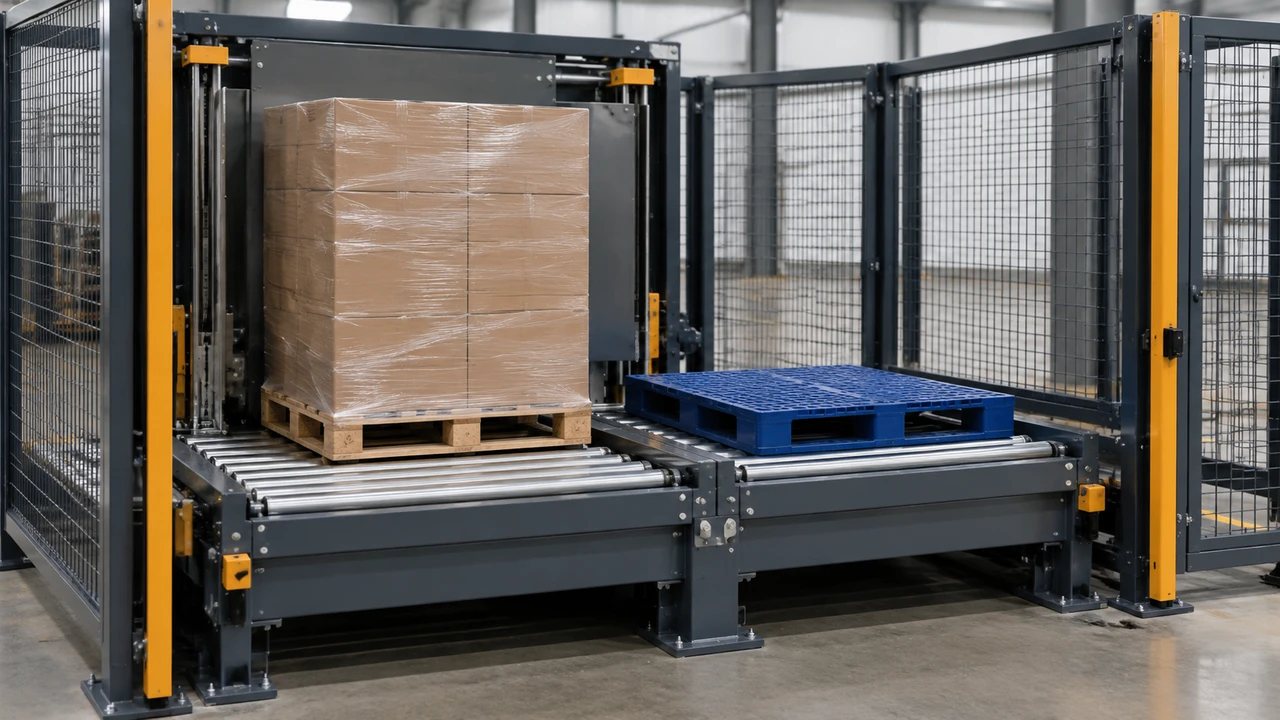
An exchange station has at least four material flows to account for: the incoming loaded carrier, the outgoing loaded carrier, the replacement empty carrier and the removed empty carrier. The same goods connect the first two flows, but the empty carriers create additional movements and storage obligations. A quotation that shows only a loaded pallet entering and another leaving can leave half of the operating problem unspecified.
| Flow | Required destination | Question to settle |
|---|---|---|
| Incoming loaded carrier | Accepted input position or exception area | Who inspects, identifies and places the arrival? |
| Outgoing loaded carrier | Approved AMR pickup or downstream position | Who confirms the output is ready and assigns its next destination? |
| Replacement empty carrier | Available supply for the next exchange | Who replenishes the correct type before the reserve is exhausted? |
| Removed empty carrier | Return, inspection, repair or disposal area | Who clears it without obstructing production or losing ownership records? |
Assign each flow to a named resource. It may be an operator, forklift, conveyor, magazine or mobile robot. Do not assume one AMR mission can cover several flows unless the physical configuration and scheduling logic actually permit it. Empty returns may move in batches, while production deliveries move individually. Those different patterns affect aisle occupancy and the timing of replenishment.
The word automatic deserves the same scrutiny. Toppy's I-Beetle page uses an automated-system description, but its detailed sequence starts with a forklift or pallet jack placing the load into a V-Shape unit. The page then describes automatic movement of old and replacement empty pallets between that unit and magazines. This is a useful reminder to inspect the described cycle rather than infer unattended loaded infeed from the headline. [4]
For an automatic pallet inverter, request a responsibility diagram for the offered configuration: loading, inspection, restraint, exchange, unloading, empty-carrier handling and exception recovery. Mark any human action explicitly. The purpose is to expose the purchased scope, not to insist that every action must be automated. A clear attended process is easier to staff and evaluate than a partially automatic process sold under an ambiguous label.
Also identify what happens when one flow stops. A full removed-pallet magazine can prevent the next exchange even if the AMR fleet is available. A missing replacement carrier can make an empty receiving position useless. A blocked outbound station can hold a completed load inside the exchange equipment. These conditions need explicit operational responses and visible status information for the people coordinating the shift.
Test the shift with a small, explicit operating model
The following example is deliberately hypothetical. It illustrates the questions to ask; it is not a prediction for any named machine. Assume a receiving operation needs to exchange 120 loads during a six-hour processing window. The required average is 20 completed exchanges per hour. Assume the proposed cell has demonstrated 30 completed exchanges per hour for this particular product mix when all required materials and destinations are available.
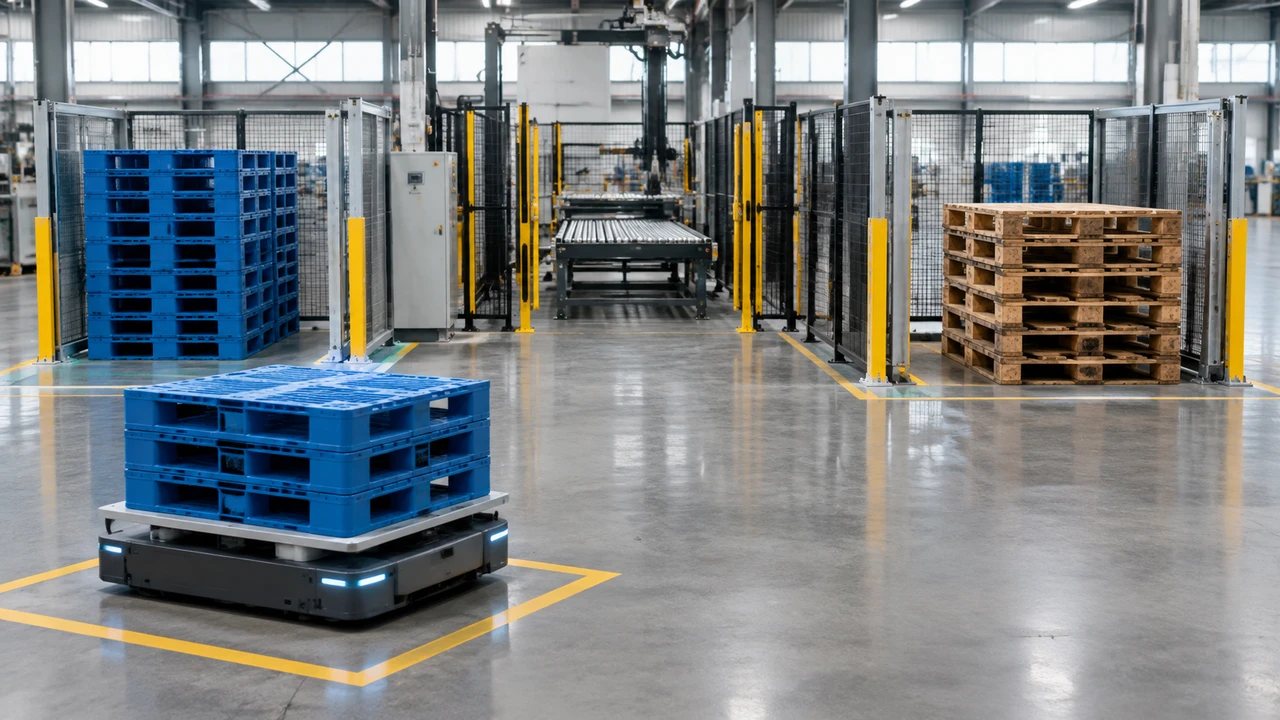
Now add the empty-carrier flows. Suppose the replacement magazine holds 24 usable carriers and the removed-carrier position can hold 18. At the average demand of 20 exchanges per hour, those capacities correspond to 72 minutes of replacement supply and 54 minutes before the removed-carrier position fills. At a sustained processing rate of 30 per hour, the intervals shrink to 48 and 36 minutes. The shorter interval, rather than the more impressive capacity, becomes the first routine service constraint.
Those calculations assume one carrier consumed and one produced per successful exchange, no replenishment or removal during the interval, and no unusable carriers within either count. Real operations must add their own restrictions. A mixed magazine containing the wrong type is not equivalent to an available supply. A partly filled return position at shift start also reduces the time before intervention is needed.
Put transport work in the same clock
Assume next that every incoming load needs a separate robot delivery and every completed load needs a separate robot collection. At 20 exchanges per hour, the cell creates 40 loaded transport missions per hour across those two legs. If the plant uses forklifts for infeed, only the outbound leg belongs to the AMR requirement. This simple scope change can alter the fleet estimate before any vehicle speed is discussed.
For illustration, suppose one configured AMR completes six of the relevant missions per hour under a representative trial, including the associated empty travel and station interaction. Two vehicles provide a nominal 12 missions per hour, which cannot serve a 20-mission outbound requirement. Four provide a nominal 24, but that arithmetic alone does not establish a dependable fleet size: charging, shared passages, uneven arrivals and unavailable destinations still have to be tested.
The useful output of this exercise is a contradiction to investigate, not a final equipment order. If the exchange cell can release material faster than transport can remove it, the design needs a different transport plan, an appropriate buffer or a revised release schedule. If empty-carrier service requires a worker every half hour, an unattended-operation claim needs a clearly bounded time period and a replenishment method.
Use a burst and a stoppage to expose missing space
Suppose 12 exchange-required loads arrive together, and the otherwise available cell processes 30 per hour. Pure processing time is 24 minutes under the stated assumptions. The facility must still have approved positions for loads waiting to enter and for completed loads awaiting collection. The total number of floor positions is not found by dividing 12 by a catalog hourly rate; it depends on the permitted arrival, processing and collection sequence.
Then pause the removed-pallet clearing task in the model. Which loads can finish, which must wait and who sees the approaching limit? Repeat the exercise with an unavailable outbound destination and a rejected incoming carrier. These small scenarios help procurement distinguish a complete operating proposal from a layout containing machines but no credible material-management plan.
If the output feeds dense storage, keep the receiving exchange analysis connected to the separate pallet shuttle system and AMR planning guide. The exchange cell's output may be acceptable at its own pickup point yet require further qualification at the next storage interface. Approval should follow the actual carrier through its intended journey.
Make the exchanged pallet a defined AMR input
Once the handling method is selected, write an output specification that both the exchange-equipment supplier and AMR supplier accept. Include the carrier drawing, permitted condition, load footprint, gross mass, center-of-gravity information where relevant, retained packaging and orientation. State how a compliant output is identified and which observations prevent release. The deliverable is an agreed interface, not two independent assurances that each machine handles pallets.
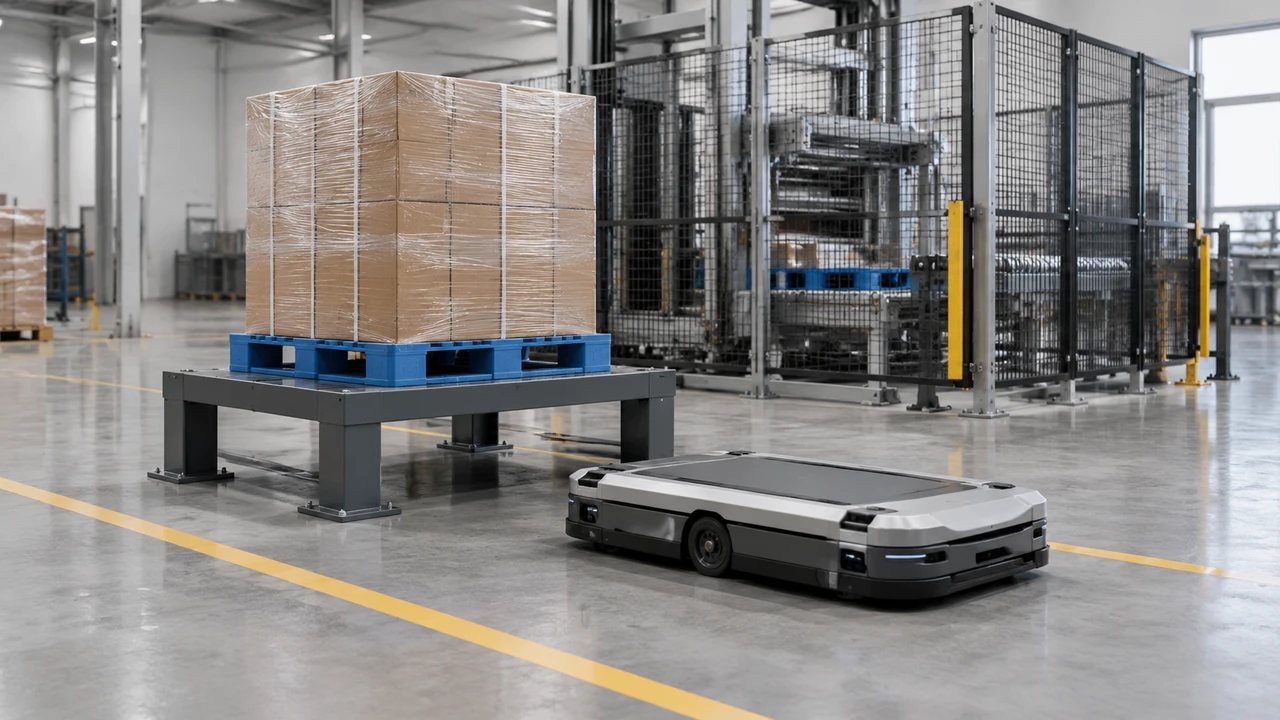
Specify how the outgoing load is presented. Fork pickup, under-pallet lifting and roller transfer can require different geometry and support arrangements. The exchange supplier should know which receiving interface is actually being purchased. A change of top module late in the project may change the required output position, access clearance or carrier support, so interface changes should trigger a joint review.
An inline pallet inverter also needs a clear definition of what the surrounding line does. Establish the upstream accumulation arrangement, downstream acceptance condition and method of stopping new arrivals when the process cannot continue. Being installed in a line does not mean that every connected machine shares one capacity limit or one recovery procedure. The quotation should show the relevant boundaries.
For controls, distinguish “exchange cycle finished” from “load accepted for robot collection.” The latter may require a known carrier identity, completed inspection and an available downstream destination. The site's separate guide to AMR material handoff validation develops the transfer-control questions. Here, procurement should ensure that those questions are assigned to a supplier and included in commissioning.
The physical approach matters as well. Reserve access for normal pickup, planned servicing and removal of a nonconforming load. Check the actual floor and transitions around the cell using the heavy-payload AMR floor requirements guide. A compact equipment footprint can still produce a poor installation if its necessary approach and recovery space are omitted from the layout.
Keep the goods identity separate from the carrier identity. In a proposed receiving record, the product lot may remain unchanged while the carrier reference changes from the supplier's pallet to an internal pallet. The system should record that relationship without treating the exchange as a new receipt of the goods. Ask the warehouse software owner what evidence is required to associate the completed load with the new carrier and how a disputed or unreadable identity is handled.
This distinction also makes investigation more useful. If a downstream station rejects an output, the team should be able to determine which product, incoming carrier, replacement carrier and exchange event were involved. That does not require collecting every possible signal indefinitely. It requires choosing the operational records needed to resolve likely exceptions and assigning responsibility for their retention and review. Include those requirements in the interface scope before software development is priced.
Price the service you will operate
A useful inquiry about pallet inverter cost asks for an installed and accepted service with defined exclusions. No universal purchase-price range is supplied here because machine architecture, product qualification, load interfaces and site work can change the quoted scope substantially. Instead, ask each bidder to price the same operating brief, including the exchange-required share of receipts and the agreed exception route.
Separate the quotation into the exchange equipment, incoming and outgoing interfaces, empty-carrier handling, controls integration, site preparation, testing, training and support. Where the robot fleet is supplied separately, identify which party owns the combined output commitment. A low machine price can lose its apparent advantage when the buyer must separately fund an omitted magazine, conveyor or integration task.
Compare retained operating work in scheduled units. How many attended hours are required on each shift? Who replenishes empties, sorts removed carriers, inspects rejected loads and responds to a stopped cell? Saving several minutes on a load does not automatically remove the worker who must remain available for other receiving duties. The separate heavy-payload AMR cost and ROI guide can support the broader investment model.
Include carrier economics on both sides. An internal pallet pool needs sufficient quantity, return control and an allowance for inspection and withdrawal. The incoming carrier may create a deposit, rental or return obligation. The exchange machine can help enforce a boundary, but it does not make those obligations disappear. Procurement should obtain the carrier terms before finance assigns savings to a proposed change.
A phased proposal should describe the next stage precisely. For example, the plant may initially use staffed infeed and robot outfeed, then consider automated infeed after supplier consistency improves. Ask which equipment and engineering would be reusable and which would require replacement. “Automation-ready” is commercially meaningful only when the proposed future scope, assumptions and upgrade responsibilities are written down.
Use acceptance trials to decide the approved operating envelope
Prepare the trial matrix before purchase. Select representative load families and the limits of their permitted variation, including carrier condition, stack arrangement, packaging and gross load. Include products expected to be difficult, provided they remain within the intended specification. The objective is to establish which combinations can be released to the process and which require another route.
Record output condition as well as completion. The quality team should define what constitutes acceptable packaging and product after exchange, including any checks that occur later in the process. The equipment team should record whether the outgoing carrier is correctly presented for pickup. The operations team should measure intervention and recovery work. A completed machine cycle is only one observation within that broader acceptance record.
| Trial question | Evidence to retain | Decision supported |
|---|---|---|
| Which load and carrier combinations passed? | Identified samples, configuration and observed output condition | Approved product and carrier list |
| Can all four flows be maintained? | Timed replenishment, removal, infeed and outfeed observations | Staffing and material-service plan |
| Does the AMR accept the completed output? | Representative pickup and downstream acceptance records | Interface approval |
| What happens to a load that cannot proceed? | Observed hold, notification and authorized recovery sequence | Exception responsibilities |
| What is the repeatable processing result? | Completed accepted loads over the agreed operating window | Performance acceptance against the purchased scope |
Keep supplier demonstrations and site acceptance distinct. A controlled demonstration can prove a product-handling capability, while the production site introduces its actual delivery pattern, staffing and destination availability. Agree which evidence can be obtained before shipment and which must be demonstrated after installation. Document unresolved conditions explicitly rather than allowing an attractive early trial to stand in for the entire acceptance plan.
Finally, name the authority that can approve changes after commissioning. A new carton, a different pallet supplier or a revised stack pattern can alter the approved process. Purchasing should make change review practical by retaining the tested configurations, drawings and operating assumptions. That record lets the plant expand the approved mix deliberately instead of discovering new boundaries during a busy receiving shift.
Focused FAQ
What is a pallet inverter?
It is equipment that secures and turns a palletized load so its supporting pallet or related material can be changed through an approved handling sequence. Buyers should establish the permitted product orientation, restraint and support conditions for the actual machine. Its suitability depends on the complete load, not only its nominal weight.
Is a non-tilting exchange method always better?
No. Keeping the goods upright may answer an important product requirement, but the proposed mechanism must still be compatible with the packaging and support arrangement. Compare both methods against the same output-condition criteria, operating mix and interface scope. A label alone cannot establish lower damage, higher capacity or a better investment return.
Can an AMR serve an existing exchange machine?
Possibly, but the existing equipment must be assessed as part of a connected process. Check physical pickup and delivery arrangements, permitted access, station control, output verification and recovery responsibilities. A repeatable attended exchange process with a separate robot pickup station may offer a practical integration boundary. Compatibility should be demonstrated before the fleet is ordered.
Does automatic exchange mean the entire receiving process is unattended?
No. Inspect who performs identification, loaded infeed, empty-carrier replenishment, removal of old carriers, output collection and exception handling. An automatic machine cycle can sit inside an attended process. Specify the required unattended duration and load mix, then ask the supplier to show how every necessary material and service task is sustained for that period.
Should every received pallet pass through exchange?
Only if the business and technical requirements justify that rule. Qualified incoming carriers may be suitable for direct acceptance, while others need exchange or an exception route. Compare the cost and reliability of those routes with supplier standardization and carrier-return obligations. Removing unnecessary exchange can be as valuable as making a necessary exchange faster.
What should be established before requesting a final quotation?
Agree on the incoming product mix, approved output carrier, tolerated handling conditions, required processing window, all four material flows and the destination interface. Include the exception route and acceptance evidence. With that brief, bidders can price a defined operating service, and the buyer can compare proposals without assuming that similarly named machines perform the same work.
Sources and evidence boundaries
- IFCO: Atlas hybrid pallet launch, October 8, 2026. A current supplier announcement used as context for carrier standardization.
- Southworth: PalletPal product description. Manufacturer information about the stated inversion mechanism and applications.
- Toppy: Four Fingers product description. Manufacturer information about the stated non-tilting configuration.
- Toppy: I-Beetle with V-Shape operating sequence. Used to distinguish machine automation from the described loaded-infeed method.
Sources were reviewed on October 27, 2026. Supplier statements are identified as such and do not constitute independent performance verification. The route classification, purchasing questions, four-flow worksheet and numerical operating example are original editorial analysis.


