
When a Pallet Conveyor Should Carry the Load and When an AMR Should
Choose the transport duty before choosing the machine
A pallet conveyor is a strong candidate when heavy loads repeatedly follow a defined route and need controlled presentation or accumulation. An autonomous mobile robot, or AMR, is worth evaluating when destinations are distributed, routes change or permanent transport infrastructure would obstruct the operation. Many facilities need both: a fixed interface that receives and buffers loads, connected by mobile transport where flexibility matters.
The useful purchasing question is therefore more precise than “Which technology is better?” Ask which part of the journey should be permanently equipped, which part should remain reconfigurable, and where pallets are allowed to wait. A conveyor can transport and hold several loads along a line. A robot occupied by a waiting pallet is also unavailable for another movement. Neither observation proves an automatic winner, but both change how competing proposals should be compared.
Current supplier activity reinforces the need to examine the whole route. On July 15, 2026, Swisslog announced the FastMove identity for its established electrified monorail technology, emphasizing long-distance pallet movement, high throughput and modernization. This is an updated product proposition, rather than the invention of a new transport category. It adds a useful third option when a project has a substantial, persistent transport backbone. [1]
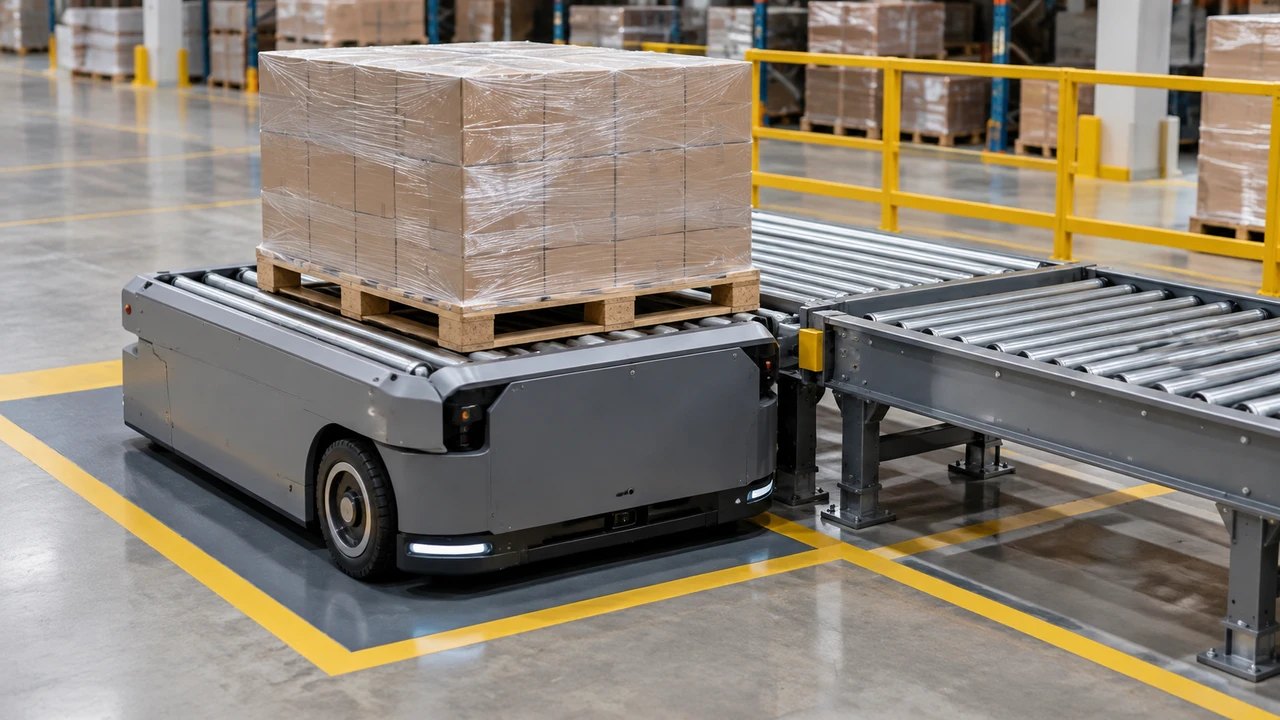
The boundary between mobile and fixed equipment is also becoming less useful as a purchasing shortcut. In its March 2, 2026 IntraLogisteX announcement, Mecalux described an AMR with an integrated chain conveying module and a stated capacity of up to 1,500 kilograms. That is a manufacturer-specific configuration, not a general AMR rating. It demonstrates that conveying equipment can travel with the load instead of remaining entirely fixed to the building. [2]
Another example appeared on January 27, when Nord Modules announced roller-based pallet top modules for KUKA AMRs in variants intended for different pallet formats. The relevant development is the availability of more defined mobile-to-station combinations. It does not establish that every combination is interchangeable or remove the need for joint application approval. [5]
For plant managers, integrators and procurement teams, the implication is to specify the material journey before selecting a product family. The analysis below develops that approach around load support, waiting space, route stability and evidence of completed service. The numerical example is an original planning illustration; it is not a reported installation or a substitute for an engineered system design.
Look underneath the pallet before comparing quotations
Most early specifications describe the top of the load: product, mass, footprint and height. Transport equipment also depends on the underside. A nominally standard pallet can present runners, blocks, deck boards, openings or damage in different positions. A handling method that supports one arrangement correctly may behave differently with another. Establish the accepted carrier designs and their condition limits before asking suppliers to finalize the transport mechanism.
Build a small, controlled sample set from actual receipts and internal carriers. Include the heaviest permitted load, a representative lightweight load and the least favorable acceptable carrier condition. Photograph the underside, record the orientation of travel and retain relevant drawings. Rejectable damage should be identified separately; it should not quietly become part of the design envelope simply because damaged pallets occasionally arrive at the dock.
When rollers provide the right support
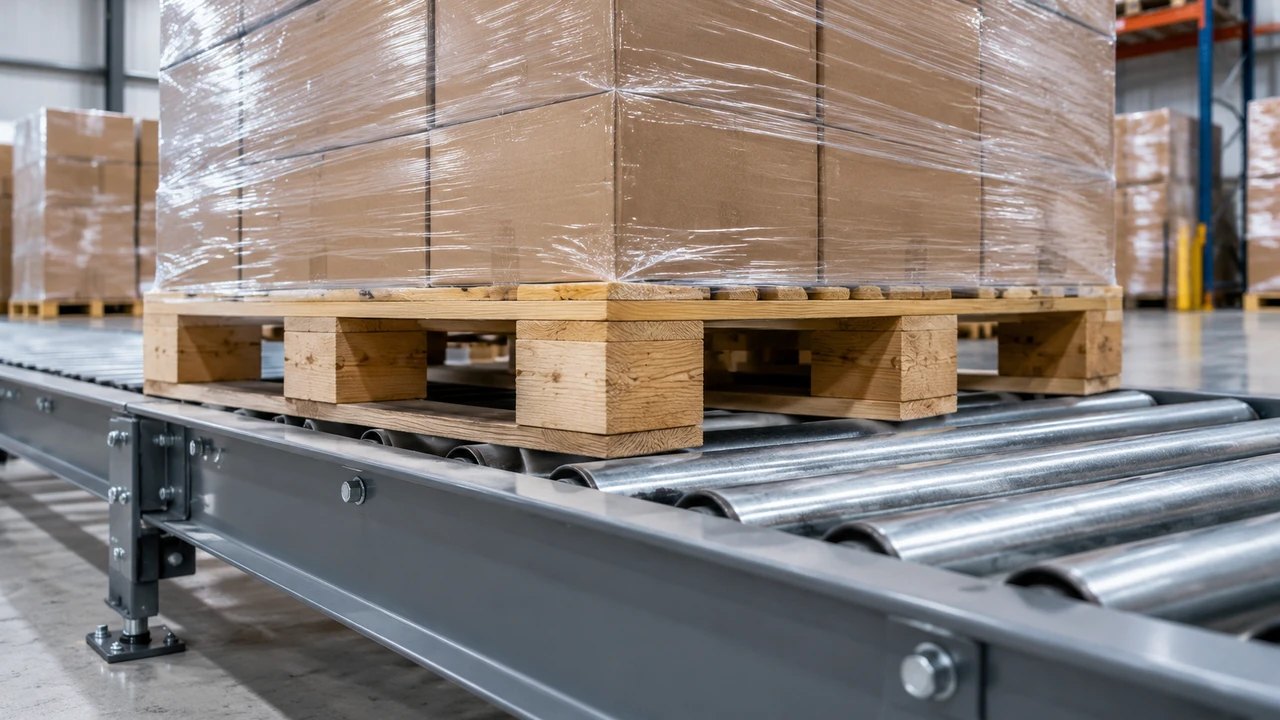
A roller conveyor supports the carrier through a series of rotating elements. For pallet applications, the important question is where the carrier actually contacts those elements throughout movement. Do not divide the gross weight by every visible roller and assume equal sharing. Interroll’s planning guidance specifically notes that an uneven underside may leave some rollers unloaded and that pallet weight is borne through the actual supporting portions. [3]
Ask the bidder to identify the assumed carrier orientation, supporting surfaces, roller arrangement and permissible load distribution. The answer should cover the transition into and out of a module, not only the centered position used in a brochure illustration. A load that is supported satisfactorily halfway along a straight section still needs to enter, stop and leave that section within the approved conditions.
A pallet roller conveyor can be attractive for repeatable movement between established positions, but the word “pallet” does not establish compatibility. Check the actual quoted configuration against every approved carrier family. If a future supplier change could introduce a different underside, include a change-review rule in the operating specification. Replacing a pallet source is then a controlled material change rather than an unexpected commissioning problem.
When chain support deserves a separate evaluation
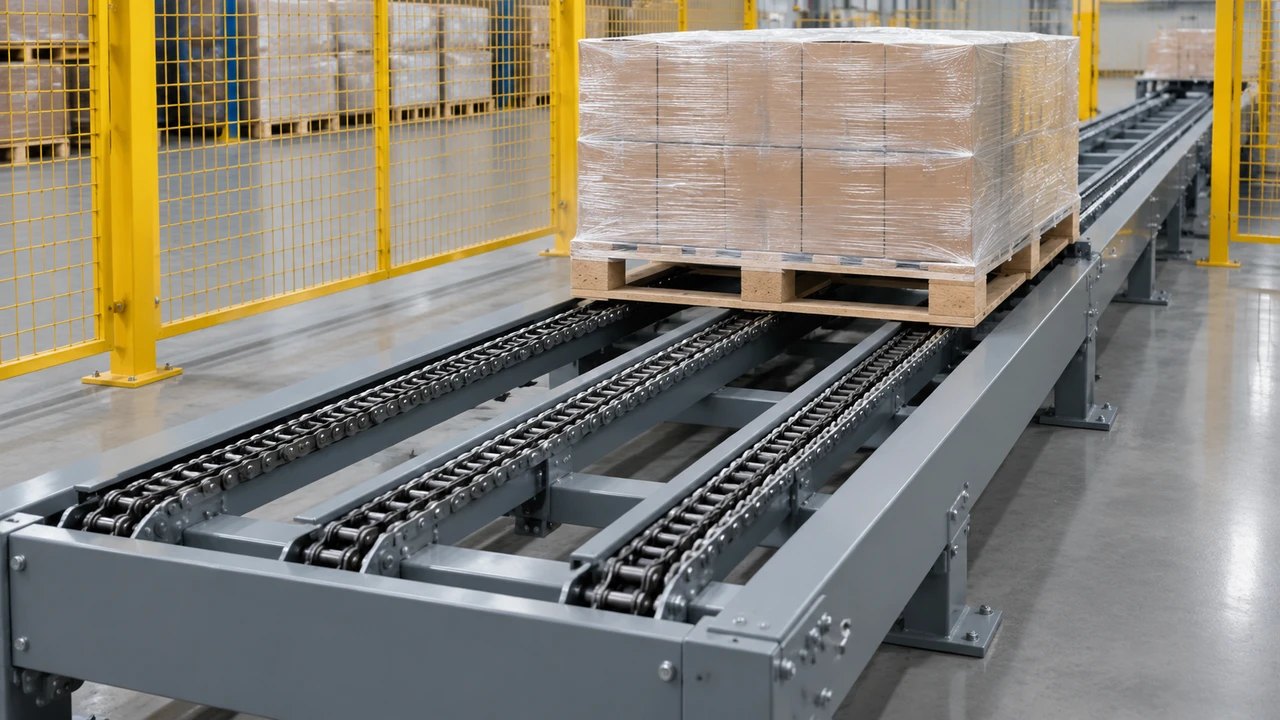
A chain conveyor offers a different support arrangement. The number, spacing and contact geometry of its strands need to match the carrier and its travel direction. Ask the supplier to show which parts of the pallet remain supported while crossing each interface. Chain conveying should not be treated as a universal remedy for poor pallets; a different support mechanism still requires a defined, acceptable carrier.
Interroll’s Modular Pallet Conveyor Platform includes roller and chain modules together with transfer modules, turntables and transfer cars. That range illustrates why a complete route may use several mechanisms rather than one repeated device. The availability of compatible modules is useful, but the selected arrangement still needs to be specified for the application. [4]
For a pallet chain conveyor, include access and servicing in the comparison. Identify the components that need inspection, the space required to reach them and how the affected area will be isolated under the site’s approved maintenance procedures. Procurement does not need to prescribe a maintenance method, but it should ensure that the proposed layout allows the supplier’s method to be carried out.
Keep gravity movement within an explicitly engineered scope
A gravity pallet conveyor may suit a defined movement or buffering duty, but “unpowered” does not mean uncontrolled or universally compatible. The design still needs to address the actual load range, carrier condition, movement control, stopping arrangement and permitted human interaction. Request an application-specific proposal rather than adapting a powered-line specification by simply deleting the drive.
It is especially important to distinguish an attended transfer aid from an unattended automated interface. Who authorizes release? What prevents an unacceptable load from entering? How is the receiving position confirmed? Those questions should be answered by the responsible equipment designer and site risk assessment. A low equipment price cannot be compared fairly with a fully automated proposal until the retained operating work is made explicit.
A waiting pallet consumes capacity somewhere
The major commercial difference between two layouts may be where the queue resides. One proposal may include several accumulation positions while another assumes immediate collection. If both suppliers quote the same nominal transport rate, the second proposal can still depend on substantially more fleet capacity, floor storage or operator attention. Compare the complete waiting arrangement, not just the speed of a moving load.
For a pallet conveyor system, request the number of usable holding positions and the conditions under which each remains available. A transfer position, inspection station or merge may not always function as general storage. A layout with twelve drawn rectangles does not necessarily provide twelve independent buffer positions. The specification should distinguish occupied processing positions, reserved positions and positions available to absorb a surge.
A twenty-minute burst changes the buying question
Consider a hypothetical receiving process that releases 36 approved pallets over twenty minutes. During the same interval, the downstream process accepts 24. If the buffer begins empty and those are the only arrivals and departures, twelve pallets remain waiting at the end of the interval. That is an accounting result, not a complete buffer design: the maximum queue within the interval may be higher if arrivals are concentrated near the beginning.
Suppose a bidder provides only eight usable waiting positions. The missing capacity cannot be eliminated by describing the line as fast. The operating plan must explain whether upstream release pauses, another approved buffer accepts the excess, or downstream service changes. If robots retain the waiting loads, the fleet plan must count their resulting occupation. A proposal should not quietly place the overflow in an aisle that the operating layout needs to keep available.
The next question is how the queue clears. A downstream process that only matches continuing arrivals will not reduce the backlog. Ask for a time-based model covering the burst, the following operating period and realistic interruptions. This can start with a transparent worksheet before advancing to simulation. What matters is that the assumptions and the resulting queue are visible to operations, engineering and finance.
| Observation or assumption | Result | Procurement question |
|---|---|---|
| Empty starting buffer; 36 arrivals and 24 departures | 12 pallets waiting at the end of the interval | Where are those twelve loads permitted to wait? |
| Arrival timing is uneven | The peak queue may exceed the ending queue | Does the analysis use arrival timestamps or only totals? |
| Eight usable holding positions are proposed | The stated buffer cannot contain the ending queue alone | What approved process handles the remaining loads? |
| Loaded robots wait for downstream acceptance | Those vehicles cannot serve other requests while occupied | Is waiting included in fleet sizing and the service commitment? |
| Arrivals continue after the burst | Backlog clearance depends on subsequent net discharge | When does the system return to its planned operating condition? |
Describe accumulation behavior in operating terms. Should loads remain separated? Can one destination’s queue block another? Must every position preserve sequence, or can selected loads bypass? A supplier’s term such as zero-pressure accumulation should be translated into the behavior of the proposed pallet zones. Confirm the particular load and control conditions under which that behavior is provided instead of applying the label to every section of the route.
Buffer ownership also matters. Production may want available space for finished goods while shipping wants the same space reserved for a dispatch wave. A control system cannot resolve conflicting business priorities without an agreed policy. Decide who may allocate the positions and what happens when the permitted limit is reached. The buffer then becomes a planned operating resource rather than an attractive drawing feature.
Compare routes that remain stable with routes that keep changing
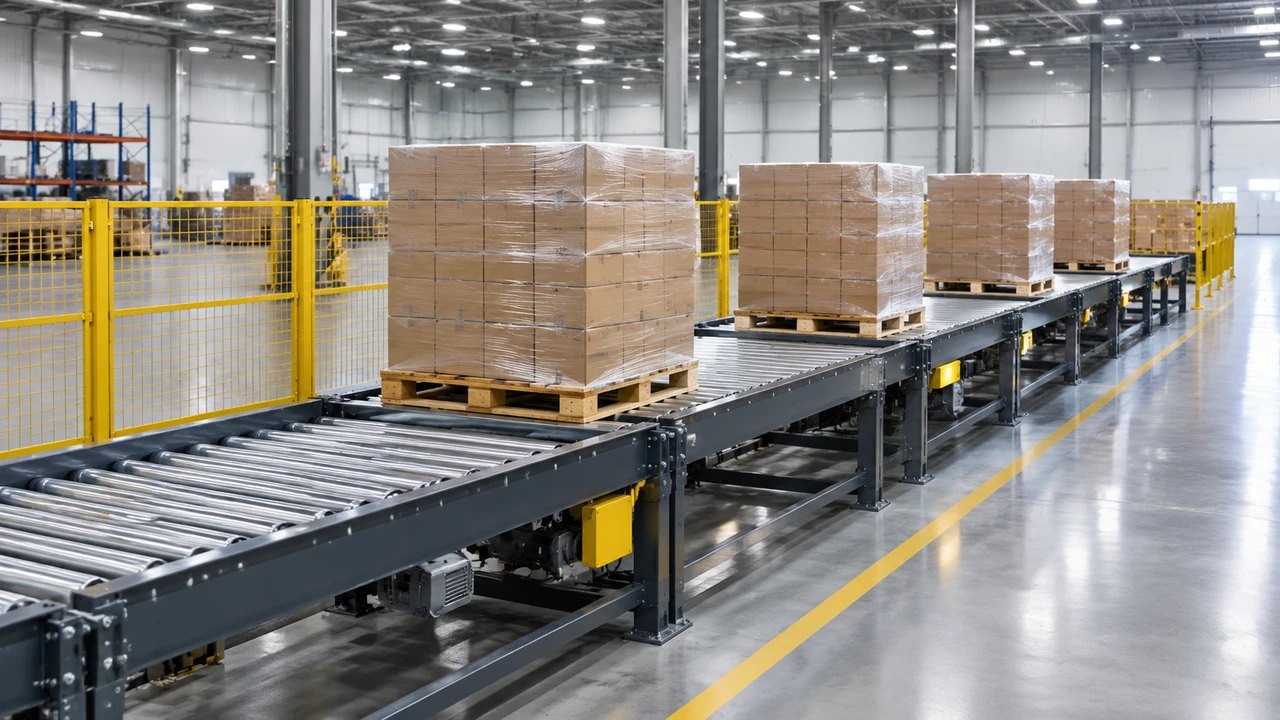
A permanently connected line is easier to justify when the same origins and destinations continue to exchange substantial flow over the investment horizon. Its purpose can be clear: provide repeatable movement and controlled accumulation between defined process points. A mobile fleet becomes more attractive when the journey connects dispersed workstations, changes with production assignments or crosses areas that cannot be occupied by a continuous line.
These are selection conditions, not universal economic rules. A mobile route can still require significant station infrastructure, traffic changes and integration. A fixed line can be modular and modified later. Ask each bidder to price the actual current layout and one plausible future change. The resulting change scope provides better evidence of flexibility than a general promise that a technology is scalable.
Draw the operating footprint around the equipment
Reserve space for people, maintenance, emergency access and material recovery when comparing layouts. The equipment footprint is only one part of the occupied area. A fixed section may require access along its sides and at transfer points. A mobile station may need approach, departure and waiting space beyond the robot's physical dimensions. Ask for these areas to be shown on the same drawing so the alternatives are compared on equal terms.
Invite the building and operations teams to review that drawing before commercial selection. They may identify doors that must remain usable, cleaning tasks, inspection routes or seasonal staging activities that are absent from a production-flow diagram. Resolving those constraints early can change where fixed infrastructure is sensible and where a mobile connection has practical value. Keep the resulting restrictions in the design brief rather than relying on recollection from a site walk.
Make the comparison segment by segment
Break the journey into pickup, transport, waiting and delivery. For each segment, record the destination options, required rate, permitted load condition and expected changes. A pallet handling system may use fixed equipment near a process that needs precise presentation, mobile transport between departments and a separate buffer at the receiving boundary. The purpose of this decomposition is to keep one technology’s strength from being assumed across every duty.
Consider a plant with one stable production exit and several frequently rearranged assembly cells. A short fixed buffer at the exit may absorb production variation, while AMRs serve the changing destinations. In a different plant, two fixed high-volume processes may justify a dedicated connection. These are hypothetical architectures; their suitability depends on the actual layout, safety assessment, material mix and service requirements.
Long, persistent transport routes may deserve another comparison. Swisslog positions FastMove as an alternative for long-distance and high-throughput duties, with manufacturer claims of speeds up to two meters per second and system throughput exceeding 600 pallets per hour. Those figures describe its stated capability, not guaranteed performance for a proposed site. They are a reason to request an application study where the duty matches, not a shortcut to selecting a monorail. [1]
| Operating condition | Architecture to evaluate | Evidence needed before selection |
|---|---|---|
| Persistent flow between stable adjacent processes | Fixed powered conveying with defined accumulation | Accepted carrier mix, usable buffer capacity, access and repeatable completed flow |
| Distributed destinations or frequent route changes | AMRs with appropriately equipped pickup and delivery stations | Complete mission times, traffic effects, waiting, charging and recovery scope |
| Stable process interface with variable travel destinations | Fixed local buffer combined with mobile transport | Agreed station ownership, fleet service and downstream acceptance |
| Long, persistent transport backbone with demanding flow | Dedicated conveying or an electrified monorail study | Application-specific layout, lifecycle quotation and measured performance assumptions |
| Limited attended transfer with a suitable load envelope | An engineered gravity arrangement | Movement control, approved operating method and all retained manual work |
Keep the destination’s capacity in the model. If the route feeds automated storage, the pallet shuttle and AMR planning guide addresses that separate storage interface. Moving a pallet rapidly to a full entry station does not complete the required service. The transport proposal should state where its responsibility ends and what downstream condition it assumes.
Buy the handover as a shared responsibility
A hybrid installation needs a common specification at the point where fixed and mobile equipment meet. The supplier of a pallet transfer system should identify the approved carrier, transfer direction, support arrangement, destination condition and ownership of the complete operation. Separate promises that a robot can carry the weight and a station can receive pallets do not establish that the connection works.
Mechanical review should cover the actual transition between supporting surfaces, including permitted alignment variation and the load’s position during transfer. Keep the detailed tolerance analysis in the appropriate engineering workstream; the separate AMR docking tolerance guide explains that issue. Procurement should require the responsible parties to agree on the interface drawing and acceptance method before equipment is released for manufacture.
For a pallet transfer conveyor, define which party owns the interface hardware, sensors, control coordination and commissioning evidence. Changes to the robot deck or station height may affect more than one supplier. Include a joint change-review process so an apparently local modification does not invalidate the agreed transfer arrangement. This is particularly important when a standard mobile base is combined with an application-specific top module.
The operating contract should distinguish arrival, completed transfer and permission to depart. Those events do not necessarily happen together. The existing AMR PLC handshake validation guide develops the control detail. Here, the purchasing requirement is that someone owns the combined result and demonstrates it with the intended load families, rather than leaving the buyer to reconcile two independent machine tests.
Exceptions belong in that shared responsibility. Define the response to an unavailable destination, an unrecognized carrier, a disputed load identity or an interrupted transfer. The approved recovery plan should identify the responsible staff and required access. Ask how work elsewhere can continue when one interface is unavailable. The AMR failure recovery guide provides a separate basis for examining that resilience.
Include the return journey of the carrier
A loaded delivery can create an empty pallet, a reusable fixture or another carrier that must leave the destination. Decide whether that return uses the same transport route, a separate lane or an attended collection process. The return flow may be lighter, but it still occupies positions and equipment time. Omitting it can make an otherwise balanced outbound design depend on periodic manual clearance.
Record whether empty carriers can be stacked, which stack conditions are approved and where inspection takes place before reuse. Do not assume a vehicle or conveying module approved for a loaded pallet is automatically approved for a stack of empties. If the return system serves several product families, define who controls the carrier pool and which conditions prevent a carrier from being issued again.
Make the quotation pay for the service the plant needs
Compare installed scope on a common basis. Equipment price alone may exclude building preparation, electrical work, safeguarding, controls integration, software licenses, acceptance trials or changes to adjoining processes. A mobile solution may have fewer fixed transport sections while requiring additional interfaces. A fixed solution may include useful buffer positions that another bidder expects the buyer to provide separately.
Use the same service definition for every proposal: approved loads delivered to defined destinations within an agreed operating window, with stated assumptions about availability and retained labor. Then separate initial investment, recurring costs and foreseeable change costs. Avoid a universal price-per-meter or price-per-robot comparison when the proposals provide different services. The unit price can be accurate while the investment comparison remains misleading.
Ask what happens when the layout changes
Give bidders one concrete change scenario, such as adding a delivery point or relocating a production cell. Ask for the likely engineering tasks, reusable equipment, commissioning work and expected production interruption. For a fixed route, this may involve mechanical changes and revised controls. For mobile transport, it may involve new stations, route validation or additional vehicles. Neither proposal should receive full flexibility credit without explaining its work.
Include the operating resources that remain. Who inspects incoming carriers, removes rejected loads, replenishes consumables and responds to exceptions? How does maintenance obtain access during production? What support arrangement applies outside normal hours? A saving in travel time does not automatically remove an entire staffing position. Finance should model the actual labor and service changes that operations can implement.
Ask suppliers to show how they estimated productive capacity. A robot mission includes more than unloaded travel, and a conveying route includes more than straight-line movement. Stopping, waiting, transfers, routing decisions and downstream acceptance can all matter. Require traceable assumptions for the proposed service level. A transparent model that can be challenged is more valuable than a precise-looking throughput number whose operating conditions are unclear.
Use acceptance to establish an operating envelope
Acceptance should answer whether the purchased system handles the approved mix under the agreed conditions. Prepare representative test loads and operating sequences before installation. Include meaningful variation in carrier type, permissible condition, gross mass and arrival timing. Record the actual configuration used for each trial so a successful test can be associated with a specific operating envelope.
Measure accepted deliveries, queue behavior and interventions over the agreed observation period. A continuous run with uniform loads may be useful, but it does not answer how the process handles a burst, a blocked destination or a planned change of product family. Decide which conditions must be demonstrated at the supplier and which require the actual site. Keep unresolved items visible in the release decision.
Specify how the team will interpret interruptions during a performance trial. A planned product change, an operator intervention and an equipment fault should not all disappear into one unexplained average. Keep a timestamped record of arrivals, accepted deliveries and the reason for significant pauses. That record helps distinguish an equipment limitation from an assumption about upstream supply or downstream availability that the trial did not meet.
Make the final decision jointly. Operations should confirm that the demonstrated process fits the shift routine; maintenance should confirm that access and support arrangements are workable; engineering should close the interface evidence; procurement should reconcile the accepted scope with the contract. A single successful demonstration is useful evidence, but it should not erase unresolved exclusions or conditions that were never tested.
Finally, agree on what triggers requalification. A new pallet design, changed packaging, revised station geometry or different load distribution can alter the transport duty. Retain the approved drawings, sample descriptions and test results in a usable operating record. The benefit is practical: procurement can distinguish an ordinary replacement order from a change that requires engineering review before the material enters the system.
Focused FAQ
Should a heavy-load warehouse replace every fixed conveyor with AMRs?
No. Evaluate each duty separately. Stable interfaces and predictable accumulation may justify fixed equipment, while distributed or changing destinations may favor mobile transport. Compare the complete service, including where loads wait, how destinations accept them and what happens during an interruption. A mixed architecture can be a deliberate design choice rather than an incomplete transition.
How do buyers choose between rollers and chains?
Begin with the actual carrier underside, orientation and permitted load distribution. Ask each supplier to demonstrate support throughout the complete movement, including entry, stopping, direction changes and exit. The mechanism name alone is insufficient. Retain the accepted carrier drawings and define how future material changes will be reviewed.
Does a faster transport device solve insufficient buffer capacity?
Only if it changes the actual arrival or departure pattern enough to resolve the queue. Faster travel cannot make a downstream process accept loads when it is unavailable. Use time-based arrivals and accepted departures to establish the waiting requirement, then assign real, usable positions or an approved upstream release policy.
Can gravity equipment be included in an automated installation?
Potentially, when its actual duty and interfaces are engineered for the load range and operating method. Establish movement control, release authority, receiving conditions and the retained human work. The absence of a motor does not remove the need for an application review or make the arrangement automatically suitable for unattended operation.
What is the most useful document to request before a final purchase order?
Request a jointly accepted operating specification covering approved loads, routes, holding positions, required delivery performance, interfaces, exceptions and acceptance evidence. Attach the quoted inclusions and exclusions to that specification. It gives operations, engineering and procurement a common basis for deciding whether the proposed system provides the service the plant intends to buy.
Sources and evidence boundaries
- Swisslog: FastMove announcement, July 15, 2026. Supplier context for long-distance transport and its published performance claims.
- Mecalux: IntraLogisteX announcement, March 2, 2026. Supplier example of a mobile platform with integrated conveying equipment.
- Interroll: Conveyor roller planning basics. Technical context for actual contact, underside condition and load-bearing support.
- Interroll: Modular Pallet Conveyor Platform. Current manufacturer description of available transport and transfer module families.
- Nord Modules: KUKA collaboration announcement, January 27, 2026. Supplier example of roller-based mobile pallet modules.
Sources were reviewed on October 28, 2026. Supplier statements identify available technologies and published claims; they are not independent verification of a proposed installation. The purchasing framework, comparison tables and numerical queue example are original editorial analysis. Final equipment selection requires the application-specific design and acceptance work described above.


