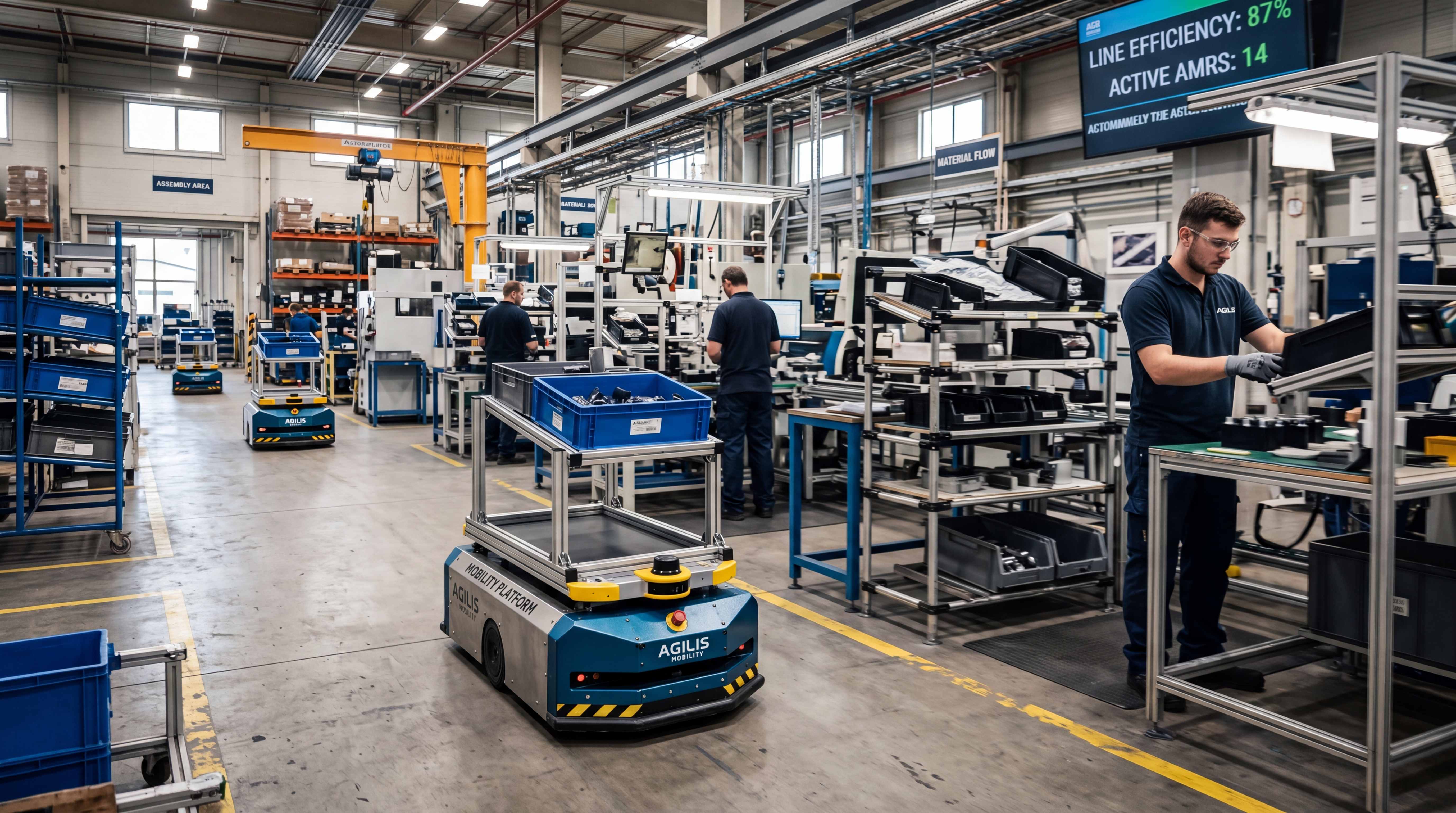
AMR Mobile Base vs AGV Mobile Base: The Real Difference Is Not Navigation Alone
The Most Common Mistake in This Conversation

When companies begin exploring internal transport automation, they often believe they are making a simple equipment choice. The discussion starts with a familiar question: should we buy an AMR mobile base or an AGV mobile base?
At first glance, the comparison seems straightforward. One is described as flexible and intelligent. The other is described as stable and route-based. One appears modern, the other appears traditional. One is associated with software, autonomy, and dynamic routing. The other is associated with fixed paths, repetitive tasks, and predictable environments.
But this framing is too shallow for any serious automation project.
In real operations, the difference between an AMR mobile base and an AGV mobile base is not merely about how a robot moves. It is about how a site thinks. It is about whether the transport layer of a factory is treated as a rigid mechanism or as an adaptive operating capability. It is about whether the site is designed around a fixed process map or around changing workflow conditions. And most importantly, it is about whether the buyer is purchasing a machine or investing in an automation logic that will still make sense three years later.
That is why this comparison should never be reduced to a navigation feature chart alone. The true difference begins much earlier, at the level of operational philosophy, and it becomes much more visible later, at the level of deployment, scaling, maintenance, exception handling, and long-term automation resilience.
Many procurement teams enter the conversation by comparing speed, payload, dimensions, and battery life. These factors matter, but they are not the strategic core. A faster platform is not necessarily a better platform. A heavier payload does not automatically mean better productivity. And a more advanced sensor suite does not guarantee a more successful project.
What actually determines success is whether the chosen platform matches the logic of the site.
An AGV mobile base works best when the environment behaves like a disciplined process machine. An AMR mobile base works best when the environment behaves like a living system with variation, interruptions, congestion, and change. Both can be excellent. Both can fail. The decisive factor is not which technology sounds more advanced. The decisive factor is whether the transport logic fits the operating reality.
This is where many automation decisions quietly go wrong. Buyers compare technologies at the surface level but ignore the deeper question: what kind of transport problem are we really trying to solve?
Until that question is answered clearly, the AMR versus AGV discussion remains incomplete.
Why “Navigation” Became the Wrong Center of the Debate

The market has spent years teaching buyers to think about robots through the lens of mobile robot navigation. Magnetic tape versus SLAM. QR code guidance versus dynamic mapping. Reflector-based routes versus sensor-based path planning. These comparisons are useful, but they are incomplete, because navigation is only one layer of the operating model.
An AGV mobile base is not defined simply by older navigation technology. It is defined by its dependence on a structured process environment. It performs best when routes are known, stops are stable, handoff points are consistent, and exceptions are limited. In such a setting, route discipline is not a weakness. It is a strength. The AGV becomes a transport executor inside a process that already has strong order.
An AMR mobile base, by contrast, is not valuable just because it can avoid an obstacle. Its value comes from reducing the operational cost of change. When layouts evolve, when carts move, when stations shift, when aisles are temporarily blocked, when traffic patterns vary by shift, or when demand peaks create new transport priorities, the autonomous mobile robot base is able to respond without forcing the site to rebuild the transport logic from scratch. That is not simply a navigation benefit. That is an operating flexibility benefit.
The real issue, then, is not whether one robot turns better than the other. The real issue is how expensive change becomes once the system is deployed.
In a stable production environment, change may be rare enough that an AGV system remains economically and operationally sensible for years. In a dynamic environment, every change request can become a hidden cost if the transport layer depends too heavily on fixed routes, fixed assumptions, or fixed infrastructure. In those cases, the apparent simplicity of the original solution becomes a long-term rigidity tax.
This is why the wrong projects often begin with the wrong question. Instead of asking, “Which navigation method is better?” companies should ask, “How often will our transport logic need to adapt, and how costly will that adaptation be?”
That single shift in perspective usually produces a much more accurate answer.
An AGV Mobile Base Is a Process Discipline Tool
There is a reason AGVs have remained relevant for so long. In the right environment, they are not outdated. They are highly rational.
A well-designed AGV mobile base performs exceptionally well when material flow is repetitive, standardized, and tightly controlled. If a site moves the same bins, pallets, or carts along the same routes at the same intervals every day, then deterministic behavior is not a compromise. It is a performance asset.
In these environments, predictability creates efficiency.
The production team knows where the vehicle will travel. The receiving station knows when the load will arrive. The path can be protected, the transfer logic can be standardized, and the human-machine interaction can be simplified. This reduces ambiguity. It can also reduce the burden on operators, supervisors, and maintenance teams.
What AGV Logic Does Well
An AGV-centered transport strategy often performs strongly in environments with five characteristics.
First, the routes are stable. The vehicle does not need to reinterpret the world every few seconds because the world is intentionally kept orderly.
Second, the tasks are repetitive. The transport demand follows a repeatable pattern rather than a variable one.
Third, the pickup and drop-off conditions are highly controlled. Alignment, docking, and handoff logic are engineered in advance.
Fourth, the process values reliability over adaptive rerouting. Consistency matters more than autonomy.
Fifth, the site is willing to engineer the environment in service of transport stability. That may include floor markings, magnetic guidance, QR codes, reflectors, dedicated lanes, or other fixed infrastructure approaches commonly associated with AGV systems.
In these situations, an AGV mobile base can become an extremely effective instrument of process discipline. It does not need to be clever. It needs to be dependable.
The Hidden Strength of Constraint
One of the most misunderstood truths in automation is that constraint is not always a disadvantage. In the right context, constraint is a design choice that creates control.
When a factory wants to lock in best practice, fixed-route transport can reinforce process consistency. It can reduce unplanned variation. It can simplify validation. It can make the movement layer easier to explain and easier to manage.
That matters in sectors where process stability carries more value than operational spontaneity.
In other words, AGV logic is not merely a lower-tech substitute for AMR logic. It is a different management philosophy. It says: if the process can be stabilized, then the transport layer should reinforce that stability rather than reinterpret it.
That is an important distinction, because it explains why some sites continue to prefer AGVs even when AMRs are available.
Where AGV Logic Becomes a Burden
However, the same strengths that make AGVs effective in stable operations can become weaknesses in dynamic ones.
Once the environment changes frequently, the transport system starts paying for every assumption embedded into the original route design. A blocked aisle is no longer a minor disturbance. A changed workstation position is no longer a simple adjustment. A new handoff point is no longer a software tweak. The site must now manage the cost of route redesign, infrastructure modification, validation, retraining, and schedule interruption.
At that point, the problem is no longer about the vehicle. The problem is that the transport system was optimized for a world that no longer exists.
That is when the buyer begins to understand that an AGV mobile base is not just a machine on wheels. It is a commitment to a certain kind of operational order.
An AMR Mobile Base Is a Change Management Tool

The strongest reason to adopt an AMR mobile base is not that it looks more intelligent. It is that it reduces the friction of adaptation.
A modern autonomous mobile robot base allows a site to treat internal transport as a software-shaped capability rather than a route-shaped asset. That changes the economics of automation in important ways.
In a dynamic manufacturing or logistics environment, the challenge is rarely movement alone. The challenge is movement under changing conditions. Temporary obstacles appear. Floor usage shifts. Work cells move. Production priorities change by hour. Congestion patterns vary by shift. Manual forklifts, carts, and people alter the behavior of the site in ways that are not fully predictable. In that kind of reality, adaptability becomes a productivity factor.
An AMR mobile base does not eliminate operational complexity. But it prevents complexity from immediately turning into physical reengineering.
That is the real advantage.
What Autonomy Changes in Practice
Autonomy changes far more than route planning.
It changes the deployment model because major physical guidance infrastructure is reduced. It changes layout economics because modifications can often be handled in software and mapping rather than by altering the floor system. It changes exception handling because the vehicle is designed to interpret dynamic conditions instead of failing whenever reality deviates from a predefined path. It changes expansion logic because additional robots and task zones can often be introduced more flexibly. It changes project risk because the site is not forced to perfect every future condition before deployment begins.
This is why AMRs are frequently better suited for evolving factories and mixed-use logistics spaces.
The value of an AMR mobile base is not “smartness” in an abstract sense. The value is lower adaptation cost across the life of the project.
Flexibility Is Not Just About Obstacle Avoidance
The market loves to describe AMRs as robots that avoid obstacles. That description is not wrong, but it is incomplete and strategically weak.
Obstacle avoidance is only the visible surface.
The deeper value is that the industrial mobile robot platform becomes less dependent on the site remaining frozen in its original design state. That matters enormously in real projects, because transport systems almost never operate in a perfectly static world.
Factories grow. Layouts compress. Temporary storage areas become permanent. Product mix changes. New shifts are introduced. Manual operations coexist longer than expected. Workstations are relocated during improvement programs. Peak season creates new traffic. What looked stable during the pilot phase becomes much less stable in year two.
If the transport platform cannot absorb that reality, the project eventually becomes fragile.
That is why mature buyers do not evaluate AMRs as moving gadgets. They evaluate them as resilience tools.
The Real Decision Is About the Operating Environment
The most practical way to choose between an AMR mobile base and an AGV mobile base is not to compare marketing claims. It is to classify the operating environment.
The wrong way to buy is to begin with the robot.
The right way to buy is to begin with the environment.
Stable Environment: AGV Has a Strong Case
If your site has fixed routes, highly repeatable transport cycles, low layout volatility, clear right-of-way control, and standardized pickup/drop-off interfaces, then an AGV strategy may be the most rational choice.
In this case, the transport layer is supporting a stable process architecture. A route-based system can deliver high predictability and strong process consistency. For some factories, that is exactly what is needed.
Dynamic Environment: AMR Has a Strong Case
If your site has shifting material flows, mixed traffic, frequent exceptions, evolving work zones, seasonal demand swings, or ongoing layout changes, then an AMR strategy usually deserves stronger consideration.
In that environment, the cost of rigidity compounds over time. The more dynamic the site becomes, the more the AMR mobile base behaves like an enabler of business continuity rather than merely a transport device.
Mixed Environment: Hybrid Thinking Matters
Many real facilities are not fully stable or fully dynamic. They are mixed.
A production feeding corridor may be highly repetitive, while the finished goods zone is variable. A hospital-like logistics environment may have some predictable loops and some human-dense, interruption-prone areas. A warehouse may have stable replenishment tasks but variable exception handling around returns, urgent orders, or temporary staging.
In such cases, the right answer may not be ideological. It may be architectural.
Some sites benefit from combining route certainty where it creates value and autonomous flexibility where change is frequent. Increasingly, this leads to deeper interest in interoperability, centralized orchestration, and standardized communication between different robot types and software layers. That is why topics such as VDA 5050 have become more relevant in advanced deployments: not because standardization is fashionable, but because multi-vendor, multi-robot coordination becomes strategically important once transport automation grows beyond a single isolated pilot.
The Infrastructure Question Buyers Often Underestimate
One of the least appreciated parts of this decision is infrastructure dependence.
The industry often frames this as a simple CAPEX question: does the solution require tape, markers, reflectors, wires, or floor modifications?
But the deeper issue is not initial installation cost alone. The deeper issue is what kind of organization you become once that infrastructure is in place.
A route-dependent system creates a transport architecture that is coupled to physical assumptions. That may be perfectly acceptable in a stable site. But in a site that is still evolving, infrastructure dependence can become a drag on operational agility.
An AMR mobile base reduces this dependence by shifting more logic into mapping, sensing, and software control. That does not make it free of complexity. It simply relocates complexity.
Instead of asking, “Which solution requires less work?” buyers should ask, “Where do we want our complexity to live?”
Do we want complexity in physical route maintenance and reengineering?
Or do we want complexity in software governance, sensor calibration, digital mapping, and system integration?
This is a more honest comparison.
There is no universal winner. Some organizations are better at managing physical process discipline. Others are better at managing digital adaptation. The right choice often depends as much on organizational capability as on robot capability.
Why Scaling Changes the Entire Equation
A transport automation pilot can hide a lot of future pain.
At pilot stage, almost any robot can look successful. The routes are short, the stakeholders are attentive, the process exceptions are managed manually, and the traffic density is low. The system appears elegant because the environment is temporarily protected.
But scale reveals truth.
As more vehicles are added, as more workflows are connected, and as more departments begin relying on the same transport layer, the difference between AMR and AGV logic becomes much more consequential.
Single Vehicle Thinking Is Misleading
A single vehicle project is not the same thing as a scalable internal logistics strategy.
Once the fleet grows, questions emerge around dispatch logic, priority handling, charging behavior, congestion management, path conflicts, resource sharing, elevator calls, traffic zones, and coordination with manual operations. At this point, the conversation shifts from vehicle features to orchestration capability.
This is where the quality of the fleet management system becomes central.
The real performance of a mobile robotics project is rarely determined by the vehicle alone. It is shaped by the interaction between vehicle behavior, task allocation, system rules, charging policies, site logic, and exception management.
That is why advanced users increasingly evaluate transport automation through a systems lens rather than a hardware lens.
Multi-Vendor Reality Is Becoming More Important
As deployments mature, many organizations do not want to be permanently locked into a single robot brand for every use case. Different payload classes, attachment types, site constraints, and process tasks may call for different robot categories. This is exactly why the industry has put growing emphasis on standardized communication layers between robots and a master control environment. BlueBotics’ overview of VDA 5050 explains that the standard is intended to address the communication layer between AGVs/AMRs and master control software rather than acting as a full control system itself.
That matters because the transport layer of the future is not necessarily one robot, one vendor, one route logic, or one fixed deployment zone. It is an orchestrated mobility ecosystem.
Any buyer evaluating an industrial mobile robot platform today should already be thinking about that future state.
Safety Is Not an Add-On Topic
Another major difference between shallow buyers and serious buyers is how they approach mobile robot safety.
In surface-level conversations, safety is often reduced to a list of sensors, emergency stop buttons, speed zones, or obstacle detection features. These elements matter, but they are not enough. Safety in mobile robotics is not a feature checklist. It is a deployment discipline.
ISO 3691-4 explicitly covers safety requirements for driverless industrial trucks and states that examples include AGVs, AMRs, bots, automated guided carts, and related systems. The standard also emphasizes that the condition of the operating zone has a significant effect on safe operation. Meanwhile, industry guidance around ANSI/A3 R15.08 continues to expand the framework for deploying industrial mobile robot systems into real industrial environments rather than treating safety as a robot-only property.
That point is critical.
A robot is not “safe” in the abstract. It is safe only within a designed operational context.
Safety in AGV Logic
For an AGV mobile base, safety often benefits from route certainty. If paths are fixed and interactions are controlled, hazard patterns can be easier to define and protect. The transport world is more bounded. Human expectations can also be more stable because the vehicle behaves consistently along known routes.
Safety in AMR Logic
For an AMR mobile base, safety is tied more deeply to dynamic environment assessment, behavior logic, operating rules, and site-level risk analysis. Because the robot is interacting with a more variable environment, the safety strategy must account for more real-world ambiguity. That is why best practice in AMR deployment places strong emphasis on risk assessment, environment evaluation, and the interaction between manufacturer, integrator, and end user.
The important lesson is this: autonomy does not remove the need for discipline. In many cases, it increases the need for disciplined deployment thinking.
A buyer who selects AMR technology because it appears more forgiving must still build a serious governance model around speed zones, pedestrian interaction, congestion behavior, and exception response. Flexibility without control is not maturity. It is exposure.
The Procurement Trap: Buying Features Instead of Fit
One of the most expensive mistakes in material handling automation is feature-driven procurement.
A company sees a sophisticated demo, hears about autonomous rerouting, or is impressed by mapping capability, and concludes that the AMR path is automatically the more future-ready one. Another company sees an AGV system delivering reliable repetitive transport and concludes that autonomy is unnecessary complexity.
Both may be wrong.
Technology choice should not begin with admiration. It should begin with fit.
A procurement team should ask:
How stable are our routes really?
How often do our workflows change?
How structured are our pickup and drop-off conditions?
How much human and forklift interaction exists in the target zones?
How likely is layout change over the next three years?
What is the cost of physical route modification in our environment?
How digitally mature are we in managing maps, tasks, and software-based changes?
Are we buying one vehicle, or are we building a scalable internal transport architecture?
These questions reveal far more than a spec sheet ever will.
The best robot is not the one with the most impressive demo. The best robot is the one whose operating assumptions match the future behavior of the site.
Why This Matters for Warehouse and Factory Strategy
The difference between warehouse mobile robots and factory transport robots is often overstated in the market, but there is one strategic truth worth emphasizing: both environments are becoming less static.
Warehouses face volatile order profiles, labor fluctuations, and seasonal peaks. Factories face product variation, line balancing changes, WIP flow adjustments, and continuous improvement programs. In both cases, the transport layer is under pressure to become more adaptive, more visible, and more integrated with digital operations.
That is why the AMR versus AGV decision now sits inside a bigger question: what kind of factory intralogistics strategy is the company trying to build?
If the ambition is to create a highly standardized transport backbone for mature, repeatable flows, AGV logic still makes strong sense.
If the ambition is to create a more reconfigurable mobility layer that can evolve with the site, AMR logic becomes more compelling.
Either way, the mobile base is no longer just a moving chassis. It is becoming part of the operational architecture of the facility.
And that is exactly why this decision deserves executive-level attention rather than being treated as a small equipment selection exercise.
The Better Way to Think About the Choice
The most useful conclusion is not “AMR is better” or “AGV is more reliable.”
The better conclusion is this:
An AGV mobile base is usually the stronger answer when the process is stable enough that discipline creates value.
An AMR mobile base is usually the stronger answer when change is frequent enough that adaptability creates value.
That is the real dividing line.
Not old versus new.
Not simple versus advanced.
Not cheap versus expensive.
Not even fixed route versus dynamic path in isolation.
The real difference is whether your transport system is meant to reinforce a process that is already stable, or support a process that is still evolving.
Once buyers understand that, the conversation becomes much more intelligent.
And once the conversation becomes more intelligent, the project usually becomes more successful.
Final Perspective
In modern industrial automation, the mobile base is no longer a hidden component under a payload module. It is increasingly the foundation of how transport capacity is designed, scaled, and governed.
Choosing between an AMR mobile base and an AGV mobile base therefore means choosing between two very different models of operational control.
One model says: define the route, protect the route, and let the machine execute with discipline.
The other says: define the task, understand the environment, and let the machine adapt within controlled rules.
Neither model is universally superior. But only one will fit the reality of your site.
The companies that get this right are not the ones chasing the newest terminology. They are the ones honest enough to examine their own operational truth.
If your environment is disciplined, repetitive, and built for stability, the AGV path may be the smartest decision you can make.
If your environment is mixed, changing, people-dense, and under constant pressure to evolve, the AMR path may not simply be more modern. It may be more economically honest.
And that is the point many buyers miss.
The real question is not which robot moves better.
The real question is which transport logic will still make sense after your factory changes.
#AGVMobileBase
#AutonomousMobileRobot
#IndustrialAutomation
#FactoryIntralogistics
#MaterialHandlingAutomation
#MobileRobotNavigation
#FleetManagementSystem
#MobileRobotSafety
#WarehouseMobileRobots
#IndustrialMobileRobotPlatform
#SmartManufacturing