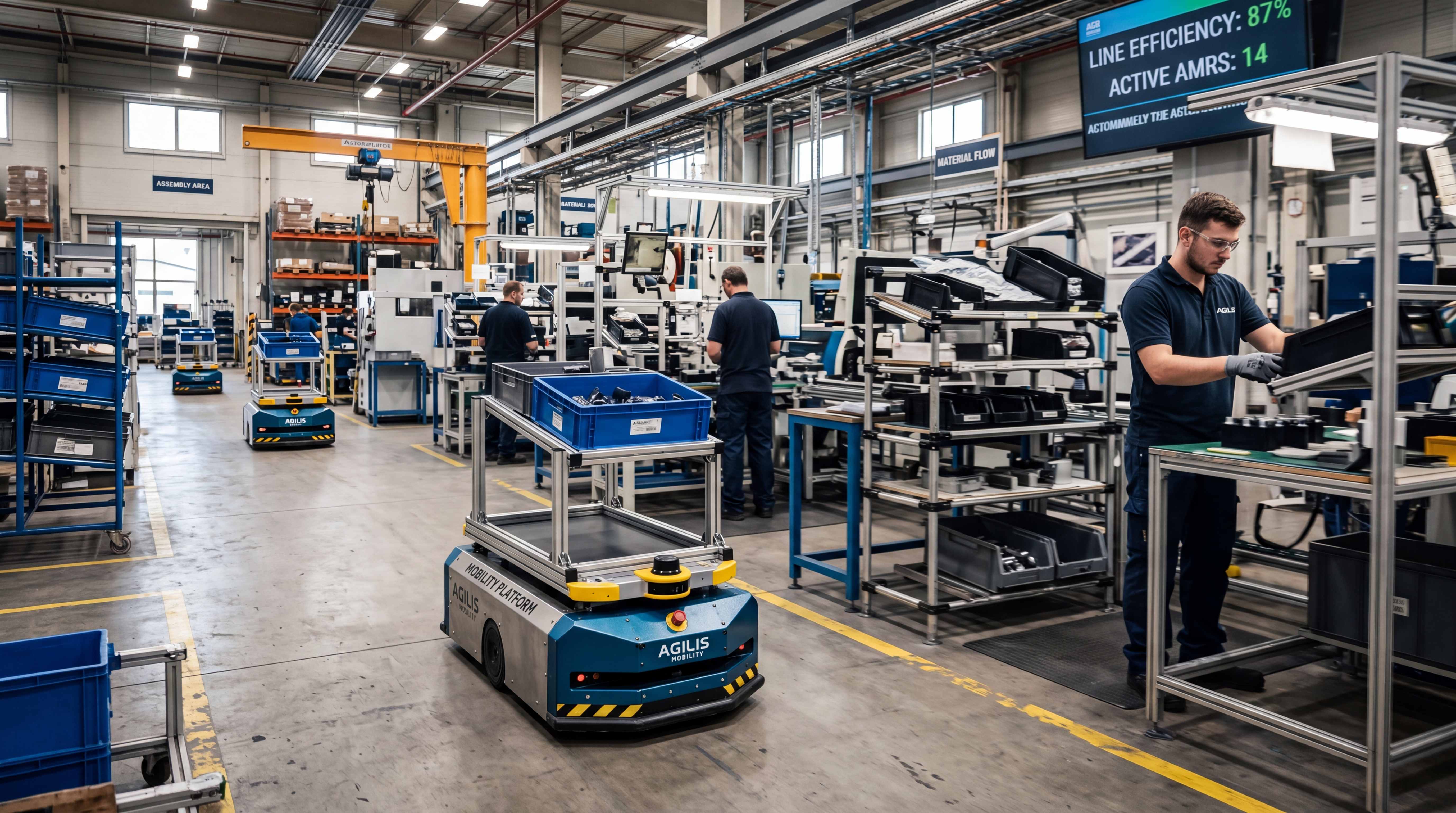
When an AMR/AGV Mobile Base Shares the Aisle With People, Safety Stops Being a Feature and Becomes a System
A Quiet Aisle Can Hide the Biggest Safety Problem

In many factories, the most dangerous moment in a mobile automation project is not the first day a robot moves. It is the day people start treating that movement as normal.
At the beginning, everyone watches carefully. Engineers stand nearby. Supervisors observe crossings. Operators are more disciplined because the project is new. Forklift drivers behave more cautiously because they know the route is under attention. Temporary storage is cleared from the aisle because visitors are present. In that period, the robot often appears safe, predictable, and easy to trust.
Then normal life returns.
The line gets busy. A pallet is staged for “just five minutes” in a space that should stay open. A worker cuts across the lane because the shortest path saves twenty seconds. A hand pallet truck is left at the edge of a turning area. A forklift driver assumes the robot will always stop first. An operator becomes comfortable enough to walk close to the vehicle while checking a screen. A maintenance cart blocks half the corridor because the team is in a hurry. Nothing dramatic happens immediately. The robot still moves. The system still appears functional.
But this is the exact point where safety stops being a feature and becomes a system question.
A mobile robot in a factory is not operating in empty space. It is operating inside habits, shortcuts, blind zones, production pressure, informal behavior, and the invisible politics of movement. That is why the safety of an AMR/AGV Mobile Base cannot be judged by a sensor list alone. A robot may detect an obstacle perfectly and still belong to an unsafe operating model. It may slow down correctly and still generate repeated human confusion. It may avoid collisions while continuously creating near-miss situations, traffic frustration, and unsafe workarounds.
This is the great misunderstanding in the market. Many people still talk about safety as if it were a product function attached to the robot. In reality, safe industrial movement is an architecture. It is built through route design, speed policy, crossing rules, docking discipline, visibility logic, station behavior, exception ownership, and what can best be called industrial traffic orchestration.
That is why a serious buyer should ask a different question.
Not: “Does this robot have obstacle avoidance?”
But: “Can this entire operation support a safe and repeatable pattern of human-robot coexistence under real production pressure?”
Once that question is asked honestly, the conversation becomes more mature. Safety is no longer a checkbox. It becomes a design principle that shapes the whole project.
And that is exactly where real value begins, because a system that is technically mobile but behaviorally unsafe will never become trusted infrastructure. It will remain a supervised experiment. A system that earns trust in live movement, by contrast, becomes part of how the factory works.
That distinction matters enormously in any mixed traffic AMR or AGV deployment, because the real challenge is rarely “can the robot detect something in front of it?” The real challenge is whether people, machines, and vehicles can share motion in a way that stays predictable even when the site is busy, imperfect, and human.
Safety Problems Usually Start Before the Robot Moves

One of the most useful ways to think about industrial robot safety is to recognize that many safety failures are not caused by motion itself. They are caused by assumptions made before motion starts.
A company assumes a lane will stay clear because it is marked.
A team assumes operators will respect the crossing because they were trained once.
A project assumes a workstation will always receive material on time and therefore the robot will never queue in an awkward position.
A layout assumes forklift behavior is stable, when in reality it changes with shift pressure.
An engineering team assumes the robot’s ability to stop is the same thing as the operation’s ability to remain safe.
These are not motion errors. They are design errors. And they are common.
This is why the strongest safety thinking begins earlier than many people expect. It begins when the site is still being defined, routes are still being chosen, and people are still deciding what kind of relationship the robot will have with the surrounding process. In that phase, a proper mobile robot risk assessment should not only study the vehicle. It should study the workflow conditions that will repeatedly shape the vehicle’s behavior.
A robot that crosses a high-traffic intersection every four minutes has a different risk profile from a robot moving inside a dedicated lane every twenty minutes. A unit that docks beside manual operators has different safety implications from a unit feeding an enclosed automated station. A machine-tending mobile base that must pause near people has different exposure from a tugger-like platform serving a low-interaction logistics corridor.
These distinctions matter because the site does not experience “robot safety” in the abstract. It experiences safety through repeated moments of contact, hesitation, proximity, and interpretation. Workers do not judge the platform by the sensor brand. They judge it by what it feels like to stand near it, cross in front of it, share space with it, and trust its behavior when production becomes stressful.
That is why early assumptions are so powerful. If a project defines the wrong route, the wrong interaction zone, or the wrong station behavior, it can spend months trying to compensate with software tuning and still remain fragile. By contrast, when the operation is structured around safe interaction from the beginning, the robot’s capabilities become much easier to use well.
In other words, safety is not merely enforced by the vehicle. It is either enabled or weakened by the decisions wrapped around the vehicle.
Obstacle Avoidance Is Only the Smallest Layer of Safety
The market often uses obstacle avoidance as shorthand for robot safety. It is easy to understand why. It is visible, intuitive, and easy to demonstrate. A robot sees a person, slows down, changes path, or stops. The demonstration looks convincing, and many buyers leave with the impression that the safety question has largely been solved.
But obstacle avoidance is only one layer, and in many projects it is not even the most decisive one.
A robot can avoid contact and still produce unsafe behavior patterns. It can stop too late for comfort, pause in the wrong place, create confusion at crossings, or encourage people to rely on the robot’s caution instead of improving their own route discipline. It can behave safely in the moment while producing unhealthy expectations over time. A human may begin to assume, “the robot will always yield,” and that assumption gradually changes how people move through the workspace.
This is where safety becomes psychological as well as physical.
Safe Systems Reduce Ambiguity, Not Just Contact
A strong safety model does more than prevent impact. It reduces ambiguity.
Workers should understand where the robot belongs.
They should understand when it will slow and when it will continue.
They should understand whether they are allowed to cross freely or whether that crossing creates a workflow problem.
They should know what a stopped robot means.
They should know whether the robot is waiting, yielding, blocked, or in an error state.
When these things are unclear, even a technically advanced vehicle can create an unhealthy environment. People improvise. They guess. They start making local assumptions. And once local assumptions spread, the system becomes harder to govern.
This is why pedestrian aware automation is not just about human detection. It is about designing movement logic that people can intuitively live with. Safety improves when the robot’s behavior becomes legible and socially predictable, not only when its sensors become more sophisticated.
Safety Requires Behavioral Design
A robot that always stops may look safe in a demo, but in a real plant it may create congestion, frustration, and human workarounds. A robot that aggressively maintains priority may preserve cycle time, but it may reduce trust and encourage unsafe human judgment. The correct balance depends on the environment, the traffic culture, the route type, and the consequences of interruption.
That means safety design is not only about detection technology. It is about behavior policy.
Should the robot yield in this zone?
Should it own the route in that corridor?
Should it reduce speed near a blind turn even if nothing is detected?
Should it avoid stopping beside a manual workstation?
Should it wait in a buffer area instead of at the edge of a conveyor interface?
Should a human crossing trigger a delay, a slowdown, or a reroute?
These are not sensor questions. They are operating questions. And the answers shape whether the system becomes a source of confidence or a source of friction.
Mixed Traffic Changes the Meaning of “Safe”
Safety inside a dedicated automation cell is not the same as safety inside a live industrial aisle. The moment a robot enters a zone shared with people, pallet trucks, forklifts, carts, and manual stations, the meaning of safety changes. It becomes less about isolated compliance and more about managed coexistence.
This is why human robot coexistence deserves much more serious treatment in mobile automation than it often receives.
A factory may describe itself as organized, but shared traffic reveals its real behavior. People choose shortcuts. Forklift drivers optimize for speed. Operators step outside marked zones to save motion. Temporary storage slowly invades travel paths. Intersections become informal negotiation spaces. Some routes remain clean all week and then become chaotic during urgent runs. None of this is unusual. It is how factories behave under pressure.
The question is whether the robot strategy has been designed to survive that truth.
Shared Space Is Not a Neutral Space

Many projects talk about “shared environment” as if it were a neutral category. In reality, shared space is highly political. Different forms of motion compete for priority. Different departments define urgency differently. Different people assume different right-of-way rules. What appears orderly on a layout drawing may be contested in practice.
A mixed traffic AMR project therefore needs more than good localization and responsive sensors. It needs a clear philosophy of movement.
Who owns the lane in this area?
When must a person yield, and when must the robot yield?
Where are crossings acceptable?
Where should crossings be discouraged?
Which zones are safe for waiting, and which are unsafe for delay?
How should forklift traffic interact with autonomous movement?
Where should route separation be physical, and where can it remain behavioral?
Without answers to these questions, safety remains reactive. The robot is forced to negotiate every ambiguity one moment at a time. That may work technically, but it rarely creates a healthy operating culture.
The Strongest Safety Model Is the One That People Can Live With
A plant can have perfect policies on paper and still fail in practice if the movement logic feels unnatural to the people using the space. Workers will always optimize behavior around real pressure, not theoretical preference.
This means the best safety solution is not always the strictest one. It is the one that stays usable under normal production rhythm. A design that looks rigorous but constantly interrupts work may encourage informal bypass behavior. A more balanced safety zone strategy may produce stronger real safety because it aligns better with how people actually move and decide.
That is one of the most important lessons in industrial mobility: safe behavior must also be livable behavior.
Safety Zones Must Follow Task States, Not Just Distance
One of the most common weaknesses in mobile robot deployments is the use of simplistic safety zones. The robot is given a protective envelope, and the team assumes that envelope will remain appropriate across all tasks, all speeds, all directions, and all station states.
But industrial movement is more contextual than that.
A robot traveling in a straight logistics corridor is in a different risk state from a robot approaching a docking point. A vehicle turning into a machine-tending position is not in the same safety condition as one leaving an empty buffer zone. A platform carrying a tall rack has different sightline and stability implications from a low-profile deck carrying a shallow tote load.
That is why a serious safety zone strategy must follow task state, not just geometry.
Movement Context Changes the Risk Profile
Speed matters, but speed alone is not enough. Direction matters. Load state matters. Visibility matters. Proximity to manual labor matters. Whether the robot is simply transiting or engaging in a handoff matters. Whether nearby workers are focused on the robot or focused on a machine matters.
This is where too-simple safety logic can create false confidence. A fixed protective behavior may technically work, but it may not match the real task condition. In one moment it may be too aggressive, causing unnecessary inefficiency. In another it may be too permissive, leaving people uncomfortable or forcing them to interpret the robot’s intention themselves.
Better systems align behavior with operational context. They create different expectations for travel, approach, docking, waiting, and recovery states. This makes movement more legible and usually makes safety stronger because people can anticipate what the robot is doing.
Good Safety Feels Consistent Even When Behavior Changes
There is an important distinction here. Behavior may vary by task state, but the experience should still feel coherent. Workers should not feel the robot is acting randomly. They should feel that it behaves differently for understandable reasons.
This is where thoughtful motion policy becomes a major part of factory safety integration. The robot is not simply responding to obstacles. It is participating in a governed movement culture. It has patterns. It has zones. It has interaction logic that matches the process instead of floating above it.
That is how the system moves from “a machine with safety sensors” to “a reliable industrial actor.”
Crossings, Blind Corners, and Docking Areas Are the Real Safety Battlegrounds
Most safety trouble in factories does not emerge in long, clear, low-conflict corridors. It emerges in transition points.
Crossings where people and robots intersect.
Blind corners where sightlines collapse.
Docking zones where the robot must slow, stop, and align while people continue working nearby.
Machine-tending areas where attention is focused on the process instead of the approaching vehicle.
Staging spaces where temporary materials shrink clearance unexpectedly.
These are the areas that determine whether AGV safety in factory aisles is truly mature.
Crossings Need Rules, Not Hope
A surprising number of projects still rely too heavily on local common sense at crossings. The robot will slow. The worker will look. The forklift driver will be cautious. In a calm environment, that may be enough. In a stressed environment, it is not.
Crossings should be designed with the same seriousness as machine interfaces. The question is not simply whether the robot can detect a person there. The question is whether the crossing has a clear movement contract. Is the robot expected to yield? Is the crossing frequent enough to justify physical signaling or speed reduction before arrival? Is there enough visual clarity? Is the crossing placed where people naturally want to cross, or where the engineer preferred to draw it?
These details matter because human behavior gravitates toward convenience. If the safe crossing is inconvenient and the unsafe crossing is faster, the plant will eventually teach itself the wrong lesson.
Docking Areas Need Protection From Informal Behavior
Docking zones are especially sensitive because the robot’s motion changes there. It slows, positions, waits, or repeats alignment behavior. That attracts people because it looks non-threatening, but this is often exactly where process integrity becomes most fragile.
A worker may place something beside the docking point “for a moment.”
A cart may be left too close.
A manual correction may be done while the robot is in a waiting state.
A forklift may temporarily block the exit path without realizing it affects the whole cycle.
This is why a collision avoidance workflow is not enough by itself. The safe system must also protect the operational meaning of the docking area. It must discourage the behaviors that continuously erode reliability and eventually erode safety.
Speed Control Without Workflow Logic Is Not Real Control
People often use speed as the primary language of safety. Slow means safe. Fast means risky. Reduce speed in mixed areas and the problem is solved.
This is only partly true.
Speed matters enormously, but the relationship between speed and safety depends on workflow context. A very slow robot in the wrong place can still create an unsafe or at least unhealthy operating pattern if it blocks a route, frustrates people, or normalizes casual crossing behavior. Likewise, a robot moving briskly in a highly structured dedicated zone may be perfectly acceptable because the workflow around it is controlled.
This is why speed policy must be embedded inside a broader industrial traffic orchestration model.
The Real Question Is Not “How Fast?” but “Under What Conditions?”
Should the robot slow near manual stations? Probably.
Should it maintain stronger pace in a protected logistics corridor? Possibly.
Should it reduce speed before a blind corner even if the lane is nominally clear? Often yes.
Should it pause farther away from a docking point instead of creeping into a crowded edge zone? In many cases, yes again.
These choices are not generic. They belong to the real motion politics of the plant.
A good safety system therefore does not only set speeds. It sets expectations. It tells the operation: here the robot behaves with transit priority; here it behaves with approach caution; here the zone belongs to manual work first; here route discipline is mandatory.
That is what makes speed meaningful. Without that context, speed becomes just a technical variable floating above a messy reality.
Safety That Protects Throughput Is More Likely to Survive
Factories do not abandon safety because they dislike safety. They weaken safety when the chosen model makes the workflow too hard to live with. That is why durable safety is usually safety that also protects throughput logic. When the movement model respects production reality, people are less tempted to undermine it.
This is another reason why autonomous cart safety should be framed as operational design, not only as machine response. A safe autonomous cart in a factory is not just one that stops reliably. It is one that participates in a traffic system the plant can actually sustain.
A Safe Robot That No One Trusts Is Not Fully Safe Yet
Trust is often treated as a soft issue. In reality, it is central to safety.
If workers do not trust the robot’s behavior, they become tense, unpredictable, or resistant. If they trust it too blindly, they become casual and inattentive. Both extremes are risky. The goal is informed trust: people understand what the robot will probably do, what it cannot do, and how they should behave around it.
This is where many projects underestimate communication.
People Need a Readable Movement Language
The robot should not behave like a mystery. Its presence, direction, and intention need to be readable enough that nearby people do not have to guess constantly. If a worker sees the unit slowing near a station, crossing a lane, waiting at a handoff point, or recovering from a blocked route, that behavior should make sense.
This is why systems benefit from consistent signals, route discipline, and predictable interaction patterns. It is also why the broader idea of factory safety integration matters. Safety lives in the whole experience of shared movement, not only in the emergency layer.
Trust Is Built Through Repetition, Not Training Slides
Training matters, but trust is built on repeated experience. If the robot behaves clearly day after day, people begin to understand it properly. If it behaves in ways that feel erratic, overly timid, or occasionally surprising, informal myths develop. People invent their own explanations. Once that happens, the safety culture fragments.
A well-designed system limits that fragmentation by making the robot easier to interpret and the route logic easier to remember. It reduces the gap between official procedure and lived experience.
That is how safe coexistence becomes normal rather than performative.
Safety Maturity Means Owning the Exception
No industrial movement system stays perfectly inside ideal conditions. Routes get blocked. Payloads vary. Workers improvise. Forklifts appear where they should not. Stations are unavailable. The important question is not whether exceptions happen. The important question is whether the system and the organization own those exceptions intelligently.
This is where a mature mobile robot risk assessment extends beyond initial deployment. It informs what the plant will do when reality deviates from plan.
Who responds when the robot repeatedly stops at the same location?
Who decides whether a blocked path is a local issue or a route-design issue?
Who owns the correction when a docking area keeps accumulating temporary material?
Who adjusts policy when human behavior consistently ignores the intended safe pattern?
If nobody owns these decisions, then safety slowly becomes reactive and political. Small issues accumulate until people begin working around the system. At that point the robot may still be technically safe, but the overall operating model is deteriorating.
A mature plant prevents that by treating safety as a living operational discipline. It does not wait for incidents. It studies friction. It notices repeated hesitations, informal behaviors, and weak zones before they become bigger problems.
That is one of the clearest signs of safety maturity: the business pays attention not only to collisions avoided, but also to unsafe habits forming.
Real Safety Is a Form of Industrial Order
At the highest level, the safety of a mobile robot system is really a question of industrial order. Not rigid order for its own sake, but enough order that movement becomes understandable, governable, and repeatable.
When people say a robot system is safe, what they often mean in practice is that it behaves inside a stable social and operational contract. Workers know what it does. Routes make sense. Crossings are not random. Docking areas are protected. Speed changes feel justified. Exceptions are owned. Forklifts, operators, and robots do not spend the whole day renegotiating right of way.
That is real safety.
It is not the absence of movement.
It is not the absence of people.
It is not blind trust in automation.
And it is not a sensor brochure.
It is structured coexistence.
That is why the most advanced safety model is often the one that looks least dramatic. The robot moves, people work, forklifts operate, and the whole system feels understandable. There is no constant theater around the machine. No one has to wonder every minute what it might do next. The plant has absorbed the robot into an intelligible movement culture.
That is the point at which mobile automation stops being fragile and starts becoming infrastructure.
Final Perspective
When an AMR/AGV Mobile Base shares the aisle with people, safety is no longer a feature attached to the machine. It becomes a system built across route design, interaction logic, station behavior, speed policy, exception ownership, and the real psychology of shared movement.
That is why a serious buyer should not reduce safety to obstacle detection, slowdown distance, or emergency stop performance alone. Those layers matter, but they are only the visible surface. The deeper question is whether the factory can support a sustainable model of human robot coexistence under real production pressure.
In a strong deployment, the answer is yes because the project has been designed with a full view of mixed traffic AMR reality. The team has considered crossings, blind corners, docking zones, route priority, station behavior, and how people actually behave when work gets busy. It has built a usable safety zone strategy instead of relying on hope. It has designed pedestrian aware automation as an operating model, not just a sensing capability. It has treated autonomous cart safety and AGV safety in factory aisles as a matter of system architecture rather than machine marketing.
This is where real industrial maturity appears.
A safe mobile system is not the one that merely avoids impact.
It is the one that reduces ambiguity, preserves trust, protects flow, and remains governable after the novelty disappears.
That kind of safety does not come from one component.
It comes from disciplined factory safety integration.
And in the long run, that is what allows a mobile robot to become not just tolerated on the factory floor, but truly accepted as part of how the factory works.
#AGVSafetyInFactoryAisles
#MobileRobotRiskAssessment
#HumanRobotCoexistence
#SafetyZoneStrategy
#PedestrianAwareAutomation
#CollisionAvoidanceWorkflow
#IndustrialTrafficOrchestration
#AutonomousCartSafety
#FactorySafetyIntegration
#AMRAGVMobileBase
#SmartFactorySafety