Why Hot Water Pressure Is Weak in a Non-Pressure Solar Water Heater
Weak Flow Is Usually a System Matching Problem
When a user complains about solar water heater weak water pressure, the first reaction is often to blame the heater. The customer may say the tank is too small, the tubes are not working, the product is low quality, or the installation failed. Sometimes one of these reasons is true. But in many non-pressure solar water heater projects, weak hot water flow is not mainly a heating problem. It is a system matching problem.
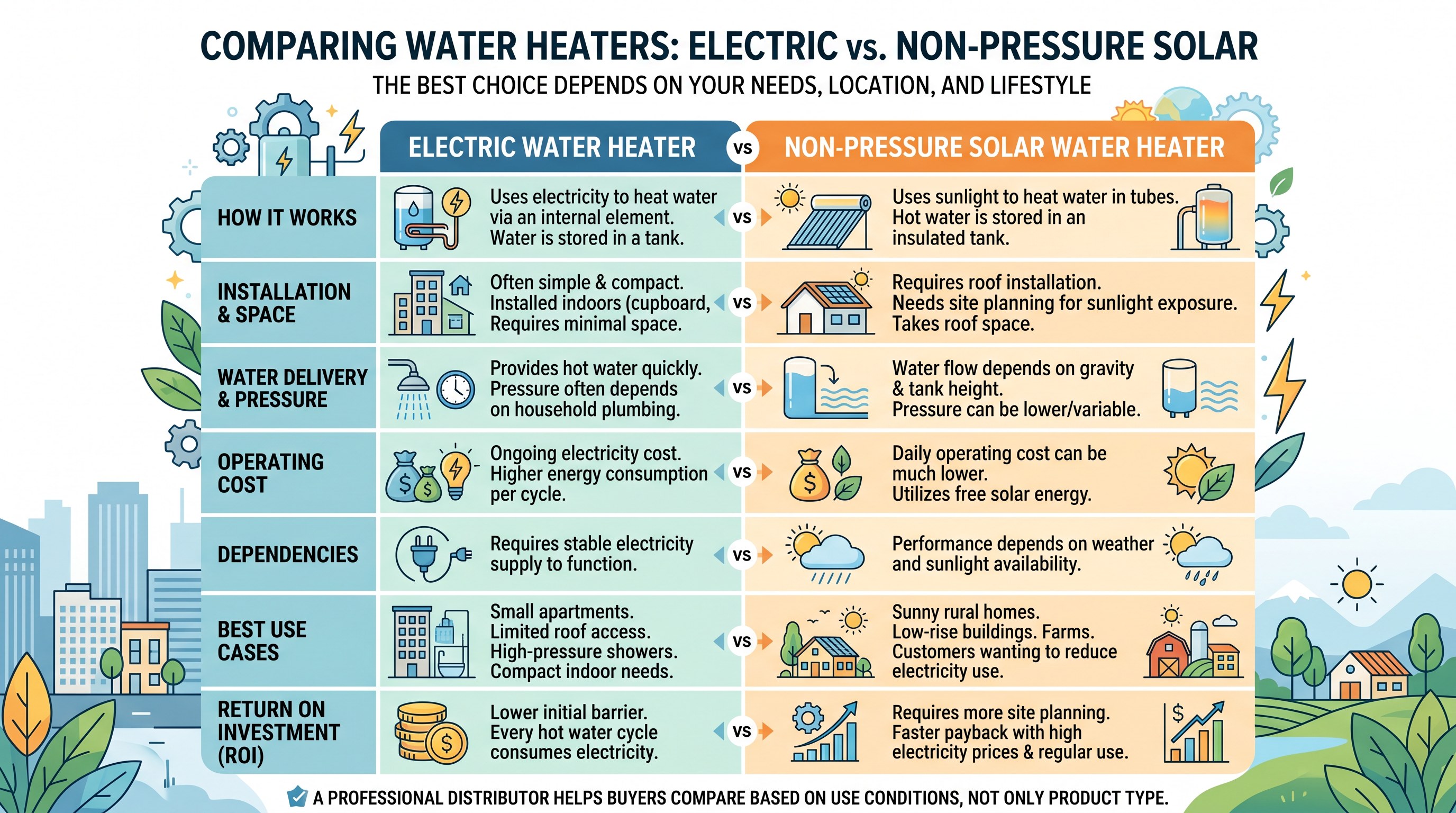
A non pressure solar water heater pressure issue should be understood differently from a temperature issue. The system may produce hot water correctly, but the water may still come out slowly from the shower. This happens because a non-pressure system is not designed to deliver the same outlet pressure as a pressurized solar water heater or an electric water heater connected to mains pressure.
A typical low pressure solar water heater works with an open or vented storage tank. Hot water leaves the tank mainly through gravity. The flow depends on the height difference between the storage tank and the outlet, the pipe layout, pipe diameter, number of bends, fixture resistance, and internal cleanliness of the system. If these factors are not favorable, the user may experience solar geyser weak flow even when the water in the tank is hot enough.
This is why pressure complaints are so common in markets where customers buy a non pressurized solar water heater expecting the same shower experience as a pressurized system. The product can be suitable for rural homes, farms, off-grid houses, and low-pressure buildings, but it must be installed and used under the right conditions.
For B2B distributors, this topic is very important. Weak pressure complaints can damage product reputation even when the real issue is poor system matching. A professional supplier should explain pressure before purchase, not after the customer complains.
Hot Water Temperature and Water Pressure Are Different

The first concept to clarify is the difference between hot water temperature and water pressure.
A solar water heater can heat water effectively and still deliver weak flow. These are two separate performance areas. Temperature depends on sunlight, evacuated tube quality, tank insulation, capacity, water usage, and backup heating. Pressure depends on water head, pipe resistance, fixture design, and plumbing layout.
For example, a user may touch the hot water outlet and find that the water is very hot. But when they connect it to a shower, the spray may be weak. In this situation, the heating system is not necessarily failing. The problem may be that the gravity fed hot water system does not have enough elevation or the shower fixture requires higher pressure.
This misunderstanding creates many wrong solutions. Some users think they need a larger tank. But a larger tank stores more water; it does not automatically increase pressure. Some users think they need more evacuated tubes. More tubes may heat water faster, but they do not solve low flow. Some users replace the shower head with a modern multi-function shower, but that can make the problem worse because many modern fixtures require higher pressure.
A correct diagnosis must separate two questions:
Is the water hot enough?
Is the water flowing strongly enough?
If the water is not hot enough, the issue may be sunlight, capacity, tube quantity, insulation, usage timing, or backup heating. If the water is hot but the flow is weak, the issue is more likely related to solar water heater tank height, pipe routing, fixture resistance, water level, blockage, or scale.
This distinction should appear in every installation guide, product manual, and distributor training program for non-pressure solar water heaters.
How Gravity-Fed Pressure Actually Works

A gravity fed solar water heater pressure system relies on elevation difference. Water stored at a higher point flows downward to a lower outlet. The vertical height between the water level in the tank and the shower outlet creates the pressure.
In simple terms, the higher the tank is above the shower, the stronger the natural flow can be. If the tank is only slightly higher than the shower head, the flow may be weak. If the tank is far above the shower, the flow improves. This is the basic logic behind a gravity fed hot water system.
This is also why rooftop installation is common. By placing the storage tank on the roof, the system can create height above the bathroom. But not every rooftop installation automatically creates enough pressure. If the bathroom is close to roof level, if the tank is mounted on a low roof section, or if the building has poor vertical separation, the outlet flow may still be weak.
A sloped roof can also create confusion. The system may look high from outside, but what matters is the height difference between the tank water level and the actual outlet. A tank placed on the lower side of a roof may not create much pressure for an upstairs bathroom. A tank placed higher or on a stronger raised frame may perform better.
Gravity-fed systems are predictable when planned correctly. They are frustrating when buyers expect pressure that the building layout cannot provide. This is why solar water heater tank height should be checked before installation, not after the user complains.
The Most Common Cause: Tank Installed Too Low
The most common cause of weak pressure in a non-pressure system is that the storage tank is installed too low relative to the hot water outlet.
This mistake often happens for practical reasons. The installer chooses the easiest roof area, the safest working position, or the location closest to the delivery point. But if that position does not provide enough height, the user may experience weak hot water flow every day.
For a low pressure shower solar water heater, the tank should ideally sit high enough above the shower head to create acceptable gravity flow. If the shower is on the same level as the tank outlet, the water may only trickle. If the shower is far below the tank, the pressure becomes much better.
This problem is especially common in single-story homes with high bathroom ceilings, flat roofs, or low roof-mounted systems. It can also happen when the storage tank is placed horizontally on a roof but the shower outlet is almost at the same elevation. In these cases, the system may be suitable for a basin or outdoor washing point but not for a comfortable shower.
A larger tank does not fix this. A 300-liter non-pressure solar water heater installed with poor elevation can still produce weak flow. A smaller 150-liter system installed with better tank height may deliver a more acceptable user experience.
Before installation, the installer should measure or estimate the elevation difference. The buyer should understand that the system depends on height. If the site cannot provide enough height, the installer should recommend a booster pump, a different outlet arrangement, or a pressurized system.
Pipe Resistance Can Destroy Flow
Even when the tank height is acceptable, solar water heater pipe resistance can reduce flow. This is one of the hidden reasons behind weak hot water pressure.
Water moving through a pipe loses pressure because of friction. The longer the pipe, the more resistance it creates. Narrow pipes create more resistance than wider pipes. Every elbow, valve, connector, and flexible hose adds more resistance. In a pressurized plumbing system, stronger pressure may overcome some of this resistance. In a gravity-fed system, the available pressure is limited, so resistance matters much more.
A non-pressure solar water heater should use short, direct, low-resistance pipe routes whenever possible. If the tank is far from the bathroom, the flow may weaken. If the pipe route goes around the roof, down the wall, across the ceiling, and then back to the shower, the pressure loss can become noticeable. If the pipe diameter is too small, the flow becomes worse.
Outdoor hot water pipes also lose heat. A long pipe route not only reduces pressure but also wastes heat before the water reaches the outlet. Users may wait longer for warm water, and the first water from the shower may feel cooler than expected.
This is why good pipe routing is part of system performance. A supplier cannot only sell the heater and ignore plumbing. The installer must design the route with low-pressure flow in mind.
A practical rule is simple: for a non-pressure system, keep hot water pipes short, direct, properly sized, and insulated where needed.
Shower Fixtures Can Be the Wrong Match
Another common cause of weak flow is fixture mismatch. Many modern showers are designed for pressurized systems. They may include small internal passages, thermostatic mixing valves, multi-spray heads, anti-scald mechanisms, or pressure-balanced controls. These features can improve comfort in high-pressure systems, but they may restrict flow in a low pressure solar water heater.
When these fixtures are connected to a non-pressure system, the user may experience weak spray, unstable temperature mixing, or almost no hot water flow. The heater may be working correctly, but the fixture is demanding pressure that the system cannot provide.
This is especially important in upgrade projects. A homeowner may replace an old simple shower head with a modern high-end shower and then complain that the solar heater is not working. In reality, the new fixture may require more pressure than the gravity fed hot water system can provide.
For a low pressure shower solar water heater, low-resistance fixtures are usually better. Simple shower heads, low-pressure mixers, and short pipe routes can improve the experience. If the customer wants a luxury shower, a non-pressure system may not be the right choice unless a booster pump or pressure system is used.
For B2B suppliers, fixture compatibility should be included in sales education. Many distributors lose money on after-sales visits because the product is installed with unsuitable bathroom equipment. A simple warning in the manual can prevent many complaints.
Cold Water Mixing Can Make Flow Feel Worse
Hot water pressure is only one side of the shower experience. Mixing hot and cold water can also create problems.
In many bathrooms, the user mixes hot water from the solar tank with cold water from another source. If the cold water supply has higher pressure than the hot water supply, the cold water can dominate the mixer. This can reduce hot water flow or even push cold water back toward the hot line if there is no proper check valve or pressure balance.
This issue is common when a non-pressure solar water heater is connected to a bathroom where cold water comes from mains pressure or a strong pump, while hot water comes from a gravity-fed tank. The pressure difference can make temperature adjustment difficult. The user may turn the hot side fully open but still receive mostly cold water.
A standard mixer designed for balanced pressure may not work well in this situation. A low-pressure-compatible mixer or proper plumbing arrangement may be needed. Sometimes pressure reduction on the cold side or a suitable check valve arrangement can help, depending on local plumbing practice and safety requirements.
This is another example of why non pressure solar water heater pressure should be understood as part of the whole bathroom system. The solar heater does not operate alone. It interacts with cold water supply, fixtures, pipe layout, valves, and user behavior.
Water Level Inside the Tank Affects Flow

In a non-pressure solar water heater, the water level inside the tank can also affect outlet flow. If the tank is not full or the water level is too low, the available pressure may be reduced. Since gravity-fed flow depends on the height of the water column, a lower water level means less pressure.
This can happen when the water supply is intermittent, when the float valve is not working properly, when the user manually fills the tank irregularly, or when the system has leakage or overflow problems. In some rural and off-grid applications, water supply may not be stable enough to keep the tank full at all times.
If a user reports weak flow only at certain times, the installer should check the water level behavior. Does the tank fill fully? Does the float valve close too early? Is the cold water inlet blocked? Is the overflow functioning correctly? Does the system lose water overnight? Is there air entering the line?
A water-level controller can improve convenience in some systems, but it must be reliable and correctly installed. A simple float valve may be enough in other systems. The right solution depends on the market and application.
For users, the practical message is that the tank should maintain proper water level during operation. For suppliers, the message is that water-level control is not only about preventing overflow; it can also affect the strength and stability of outlet flow.
Air Blockage Can Reduce or Stop Flow
Air can also cause weak or unstable flow in a solar water heater system. Air pockets may form in pipes, elbows, high points, or poorly routed sections. In a low-pressure system, even small air blockages can interrupt flow because the system does not have strong pressure to push air out.
Air blockage can happen after installation, after draining and refilling, after maintenance, or when the water supply is unstable. If pipes rise and fall unnecessarily, air can become trapped at high points. If the venting arrangement is poor, air removal may be slow.
Symptoms may include sputtering flow, intermittent hot water, slow start, noisy pipes, or complete blockage at certain outlets. Users may think the tank is empty or the heater is broken, but the real issue may be trapped air.
Good pipe routing helps prevent this. Pipes should avoid unnecessary high points and loops. The system should have correct venting according to the manufacturer’s design. The installer should follow the proper filling sequence and check flow after installation.
In a gravity fed solar water heater pressure system, air management is especially important because the natural driving force is limited. A pressurized system may push air through more easily, but a low-pressure system may not.
Scale and Sediment Can Slowly Reduce Pressure
Weak pressure is not always an installation-day problem. It can appear gradually over months or years due to scale, sediment, corrosion, or debris.
In hard water areas, mineral scale can build up inside the tank, pipes, fittings, valves, and shower head. This reduces the internal flow area and increases resistance. The user may notice that hot water flow becomes weaker over time. The system may still heat water, but the outlet flow decreases.
Scale can be especially problematic in direct-heating solar systems because water is heated repeatedly inside the system. Hot water accelerates mineral deposition. If maintenance is ignored, the flow path becomes restricted.
Sediment from water tanks, wells, or old pipes can also clog strainers, valves, or shower heads. In rural areas, water quality may be inconsistent. A small filter may help in some installations, but it must be maintained. A clogged filter can also reduce pressure.
Corrosion can create debris and damage fittings. Poor material selection can make the problem worse, especially in coastal, humid, or chemically aggressive environments.
When diagnosing solar geyser weak flow, installers should not only check tank height. They should also inspect shower heads, valves, strainers, pipe ends, and tank outlets. If flow was strong when new but weak after a period of use, blockage or scale should be considered.
For B2B buyers, water quality should influence product selection. Inner tank material, fittings, valves, and maintenance instructions should match the target market’s water conditions.
Pipe Diameter and Valve Selection Matter
Pipe diameter has a strong effect on low-pressure flow. A narrow pipe may be cheaper and easier to install, but it can restrict flow significantly. In a non-pressure system, this restriction can turn acceptable gravity-fed pressure into a weak trickle.
Valves can also create resistance. Some valves have small internal openings or designs better suited to pressurized systems. Flexible hoses, small connectors, and decorative fittings can also restrict flow. The entire hot water route should be reviewed as one flow path.
A common mistake is using leftover plumbing parts without considering pressure. The installer may use whatever is available locally. The system may function, but not comfortably. In low-pressure installations, each fitting should be selected for low resistance.
The pipe diameter should be appropriate for the expected flow and distance. The route should avoid unnecessary reductions. If the system uses a mixer, the mixer should be compatible with low-pressure hot water. If a check valve is required, it should not create excessive resistance for the available pressure.
For suppliers, an installation kit can reduce mistakes. Providing recommended pipe sizes, suitable valves, and clear connection diagrams helps installers avoid random part selection.
Booster Pumps: Useful Solution or Wrong Fix?
When users experience weak hot water pressure, one common idea is to add a booster pump. This can sometimes help, but it is not always the right solution.
A booster pump can increase outlet pressure and improve shower comfort. It may be useful when the system heats water well but the gravity flow is not strong enough. It can also help where tank height is limited.
However, a pump must be selected and installed correctly. A non-pressure storage tank should not be treated like a pressure-rated tank unless the system is designed for it. The pump should be installed in a way that does not create unsafe pressure inside the tank or damage components. Local plumbing standards and manufacturer instructions should be followed.
A pump also adds cost, electricity use, noise, maintenance, and failure points. In off-grid buildings, pump power consumption may matter. In rural markets, pump maintenance may be inconvenient. If the pump runs dry, it may fail. If filters clog, performance may drop.
A booster pump should therefore be seen as a design choice, not a quick fix for every weak-flow problem. Sometimes the better solution is to improve tank height, shorten pipe routes, change fixtures, clean scale, or select a pressurized solar water heater from the beginning.
For B2B sales, the key is honesty. If the customer needs strong shower pressure, it may be better to sell the right system rather than sell a non-pressure system and then add a pump later to correct the mismatch.
When Weak Pressure Means the Wrong Product Was Chosen

Not every pressure problem can be solved with small improvements. Sometimes weak flow is a sign that the wrong product type was selected.
A non pressurized solar water heater is not suitable for every building. If the customer has multiple bathrooms, high-pressure fixtures, long pipe runs, upstairs outlets, luxury shower expectations, or a building layout that cannot provide tank height, a non-pressure system may not be the best choice.
In this situation, trying to force the system to behave like a pressurized system creates dissatisfaction. The customer may keep changing shower heads, adding valves, adjusting pipes, or complaining to the distributor. But the basic mismatch remains.
A pressurized solar water heater or split solar water heater may be more suitable for modern homes with higher comfort requirements. These systems cost more, but they are designed for different pressure conditions. The right product is not always the cheapest product. The right product is the one that matches the building and user expectation.
This is a major point for international distributors. In cost-sensitive markets, there is strong pressure to sell the lower-cost non-pressure model. But if the product is sold into the wrong application, the distributor may lose more money through after-sales claims and damaged reputation.
A professional sales process should include a simple pressure screening:
Does the home already use low-pressure water?
Is the tank above the shower outlet?
Is the pipe route short?
Are the fixtures low-pressure compatible?
Does the user accept moderate flow?
Does the customer expect high-pressure shower comfort?
If the answers are not favorable, the supplier should recommend another system.
Diagnosing Weak Hot Water Pressure Step by Step

A structured diagnosis helps separate product defects from installation and system-matching problems.
First, check whether the water is hot. If the temperature is low, the problem may be heating performance, not pressure. If the water is hot but flow is weak, continue with hydraulic diagnosis.
Second, check the tank height. Is the storage tank clearly above the shower outlet? Is the height difference enough for gravity flow? If not, weak pressure is expected.
Third, check the water level. Is the tank full? Does the inlet valve work correctly? Is water supply stable? A low water level can reduce flow.
Fourth, check pipe routing. Are the pipes too long, too narrow, or full of bends? Are there unnecessary loops where air can collect? Are hot water pipes insulated?
Fifth, check fixtures. Is the shower head suitable for low pressure? Is the mixer designed for balanced pressure? Is cold water pressure overpowering the hot line?
Sixth, check for air blockage. Does the flow sputter? Was the system recently drained or refilled? Are there high points in the pipe route?
Seventh, check for scale and blockage. Remove and inspect shower heads, strainers, valves, and pipe outlets. In hard water areas, scale buildup may be the real cause.
Eighth, check whether the customer expectation is realistic. If the customer wants pressurized shower performance, the solution may require a pump or a different solar water heating system.
This diagnosis process can reduce unnecessary product replacement. It also helps installers explain the problem professionally.
How Installers Can Prevent Weak Pressure Complaints

Installers can prevent many weak-pressure complaints before the system is used.
The first step is site assessment. The installer should identify the main hot water outlet and check whether the tank can be installed high enough. If the building layout is not suitable, the customer should be informed before installation.
The second step is pipe planning. The hot water pipe should be short, direct, and properly sized. Long horizontal runs should be avoided where possible. Low-resistance fittings should be selected.
The third step is fixture matching. The installer should check whether the shower head, mixer, and valves are compatible with low-pressure hot water. If not, suitable alternatives should be recommended.
The fourth step is water-level and venting check. The tank should fill properly, and vent or overflow systems should not be blocked. A system designed for non-pressure operation should not be sealed incorrectly.
The fifth step is user education. The user should understand that this is a low-pressure or gravity-fed system. They should know what flow level to expect and how to identify problems such as blocked shower heads, low water level, or air in pipes.
The best time to prevent a pressure complaint is before the sale and installation, not after the customer is dissatisfied.
B2B Buyers Should Treat Pressure Education as Product Support

For B2B buyers, pressure education is part of product support. A supplier who only provides tanks and tubes is not enough. The distributor needs training materials that explain non pressure solar water heater pressure in practical terms.
Useful support materials include:
A tank-height and pressure relationship diagram.
A low-pressure fixture compatibility guide.
A pipe routing recommendation sheet.
A troubleshooting chart for weak flow.
A comparison between non-pressure and pressurized systems.
A user FAQ explaining gravity-fed hot water.
Installation videos showing correct outlet connections.
Product labels warning against sealing vents or using unsuitable fixtures.
These materials reduce after-sales cost. They also help local dealers sell honestly. When customers understand that a low pressure solar water heater is designed for low-pressure use, they are less likely to expect a high-pressure shower experience.
This kind of support also improves brand reputation. Many solar water heaters look similar in catalogs. A supplier that helps distributors reduce complaints becomes more valuable than a supplier that only competes on price.
How to Explain Weak Pressure to End Users

End users do not always want a technical explanation. They want to know why the shower is weak and what can be done.
A simple explanation can be:
“This system heats water with solar energy and delivers it mainly by gravity. The water temperature depends on sunlight and tank insulation. The water pressure depends on how high the tank is above the shower, how the pipes are routed, and whether the shower fixture is suitable for low pressure.”
This explanation is honest and easy to understand. It avoids blaming the user while also setting realistic expectations.
Then the installer can explain possible solutions:
Raise the tank if the roof structure allows.
Shorten or improve the pipe route.
Use a low-pressure shower head.
Clean scale or blockage.
Check the tank water level.
Remove air from the system.
Add a suitable booster pump if safe and necessary.
Upgrade to a pressurized system if strong pressure is required.
Clear communication turns a complaint into a service opportunity. Poor communication turns a normal system limitation into a product dispute.
Focused FAQ
Why is the hot water pressure weak in a non-pressure solar water heater?
Hot water pressure is weak because a non-pressure solar water heater usually relies on gravity-fed flow. The pressure depends on tank height, pipe layout, pipe diameter, fixture resistance, water level, and blockage. It is not designed to deliver the same pressure as a pressurized system.
Does weak pressure mean the solar water heater is defective?
Not always. If the water is hot but the flow is weak, the issue is often related to installation height, pipe resistance, shower fixture mismatch, air blockage, scale, or wrong system selection.
Can a bigger tank improve hot water pressure?
No. A bigger tank increases stored water volume but does not automatically increase pressure. Gravity-fed pressure mainly depends on the height difference between the tank and the outlet.
Why does tank height matter?
The higher the tank is above the shower or faucet, the more gravity pressure is available. If the tank is too close to the outlet height, water flow may be weak.
Can long pipes reduce water pressure?
Yes. Long pipes, narrow pipes, too many bends, small valves, and restrictive fittings increase resistance. This is especially harmful in low-pressure solar water heater systems.
Why does my shower work poorly with a non-pressure system?
Your shower head or mixing valve may require higher pressure than the solar heater can provide. Low-pressure-compatible fixtures are usually better for gravity-fed systems.
Can cold water pressure affect hot water flow?
Yes. If cold water pressure is much higher than hot water pressure, it can overpower the mixer and reduce hot water flow. Proper fixture selection and plumbing arrangement are important.
Can scale cause weak hot water pressure?
Yes. Hard water scale, sediment, corrosion, or clogged shower heads can slowly reduce flow. If pressure becomes weaker over time, blockage or scale should be checked.
Should I install a booster pump?
A booster pump may help in some cases, but it must be selected and installed safely. It adds cost and maintenance. If strong pressure is required from the beginning, a pressurized solar water heater may be a better choice.
Is a non-pressure solar water heater suitable for modern bathrooms?
It depends on the bathroom. If the fixtures are low-pressure compatible and the tank is installed high enough, it may work. For high-pressure showers, multiple bathrooms, or luxury plumbing, a pressurized or split system may be more suitable.
Conclusion
Weak hot water pressure in a non-pressure solar water heater is one of the most common user complaints, but it is often misunderstood. The problem is not always poor heating or product failure. In many cases, the system heats water correctly, but the gravity-fed delivery conditions are not strong enough to provide the flow the user expects.
A non pressure solar water heater pressure issue should be diagnosed through the full system: tank height, pipe length, pipe diameter, water level, air blockage, scale, fixture compatibility, cold water pressure, and user expectation. A low pressure solar water heater can be a practical and cost-effective solution for rural homes, farms, and off-grid buildings, but it must be installed and sold as a low-pressure system.
The biggest mistake is selling a non-pressure product to a customer who expects pressurized shower comfort. The second biggest mistake is installing the tank too low or using poor pipe routing. The third is connecting the system to unsuitable modern fixtures. These issues can create solar geyser weak flow even when the product itself is working.
For homeowners, the key is to understand that hot water temperature and water pressure are different. For installers, the key is to design around gravity-fed flow. For B2B distributors, the key is to educate dealers and customers before purchase. For manufacturers, the key is to provide clear installation diagrams, pressure guidance, fixture recommendations, and troubleshooting materials.
When the system is matched correctly, a non pressurized solar water heater can provide reliable domestic hot water with simple solar technology and low operating cost. When it is matched incorrectly, weak pressure can become a constant complaint. The solution is not always a bigger tank or more tubes. The solution is better system understanding, better installation planning, and better customer expectation management.
#SolarWaterHeaterWeakWaterPressure #NonPressureSolarWaterHeaterPressure #LowPressureSolarWaterHeater #GravityFedSolarWaterHeaterPressure #SolarGeyserWeakFlow #NonPressurizedSolarWaterHeater #SolarWaterHeaterTankHeight #LowPressureShowerSolarWaterHeater #SolarWaterHeaterPipeResistance #GravityFedHotWaterSystem