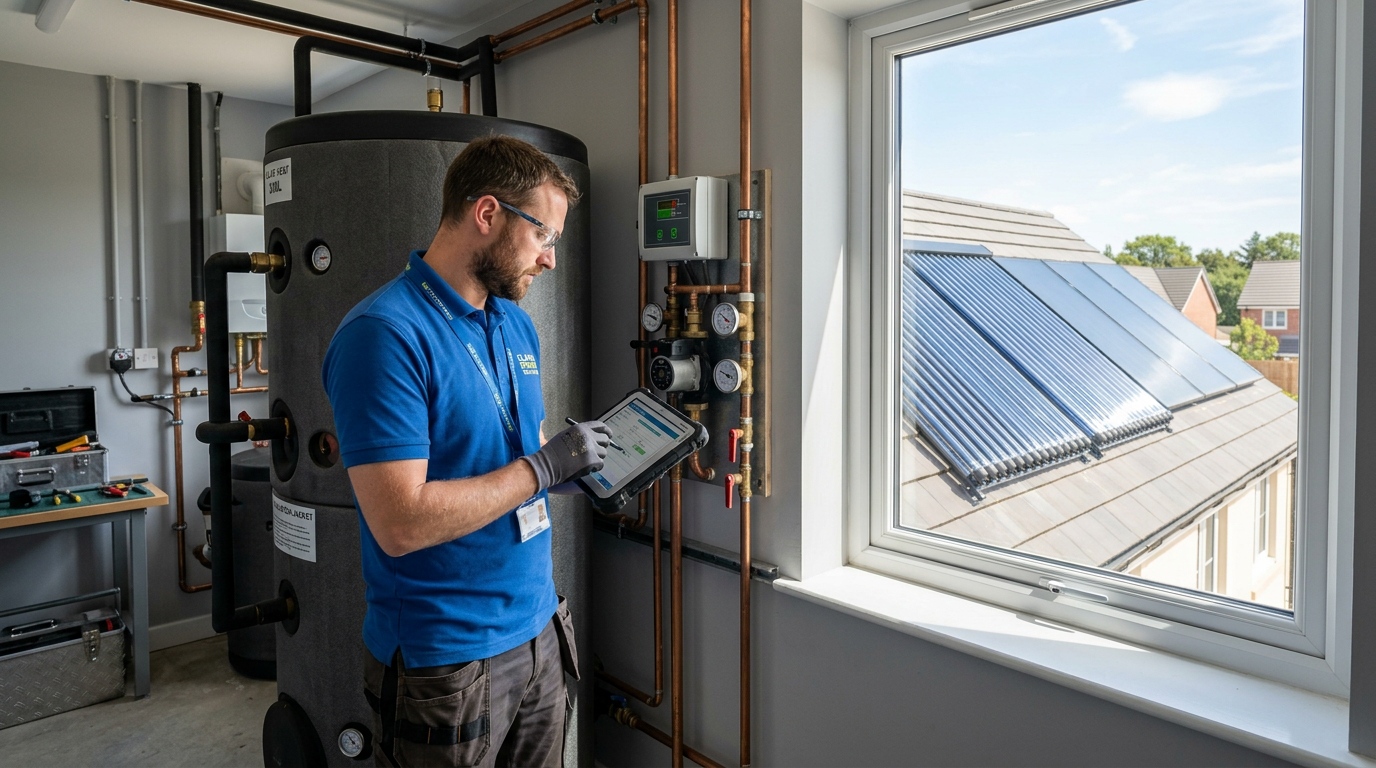
Installation Guide for Split Solar Hot Water Systems: Collector, Tank, Pump, and Pipeline Layout
Installation Is Where a Split Solar Hot Water System Succeeds or Fails
A split solar hot water system is not difficult to understand in theory. Solar collectors absorb heat from sunlight. A storage tank holds hot water. A pump moves heat between the collector and the tank. A controller manages circulation. Pipes, sensors, valves, and insulation connect everything into one operating system.
But in the real world, performance is not decided by the brochure. It is decided by installation.
A good split solar water heater installation can make the system efficient, stable, easy to service, and suitable for long-term use. A poor installation can create weak heating, air lock, heat loss, pump failure, sensor errors, roof leakage, noise, overheating, freezing damage, and customer complaints.
That is why solar hot water installation should not be treated as a simple rooftop job. A split system is more flexible than an integrated rooftop solar water heater, but that flexibility also creates more design responsibility.
The collector may be on the roof. The tank may be indoors, on the ground, in a garage, in a mechanical room, or in a utility area. The pump station may be near the tank or in another service-friendly location. The pipe route may be short and direct, or long and complex. The controller may operate a direct loop, closed-loop glycol system, backup heater, or multiple sensors.
Every decision affects the final result.
For homeowners, correct solar water heater setup means stable hot water and fewer service problems. For installers, it means faster commissioning and fewer callbacks. For distributors, it means fewer warranty claims. For project buyers, it means repeatable quality across multiple buildings.
A split system should be sold as a complete solution, and it should be installed as a complete system.
Start With Site Assessment Before Installing Anything
The first step in solar thermal system installation is not drilling holes or lifting collectors onto the roof. It is site assessment.
Before installation begins, the installer should understand the building, roof, hot water demand, tank location, pipe route, climate, water pressure, electrical supply, backup heating plan, and maintenance access.
The roof must be checked for direction, angle, shading, structure, waterproofing, and safe access. Even a high-quality collector will perform poorly if it is installed in a shaded position. A small shadow from a chimney, tree, roof edge, neighboring building, or antenna can reduce useful solar collection during important hours.
The tank location must also be confirmed early. A solar hot water tank installation should consider floor strength, drainage, service clearance, pipe access, electrical access, safety valve discharge, and future replacement space. A large tank placed in a tight corner may look acceptable on installation day, but it may become difficult to service later.
The pipe route should be planned before mounting components. Bad solar water heater piping can create excessive heat loss, long circulation distance, pressure drop, air pockets, and ugly building penetration points.
The installer should also confirm whether the system is direct circulation or indirect closed-loop circulation. This affects the pump station, expansion tank, heat transfer fluid, filling procedure, pressure testing, and commissioning process.
A professional split solar water heater installation begins with planning because most serious problems are created before the first pipe is connected.
Collector Placement: Sunlight Is Only the First Requirement
Solar collector installation is often described as placing the collector where it receives sunlight. That is correct, but it is not enough.
A collector must face the right direction for the target market, usually toward the strongest solar exposure. It should be installed at a suitable angle to balance seasonal performance. It must avoid shading during peak solar collection hours. It must be mounted securely against wind, snow, and roof movement. It must also allow safe access for inspection and maintenance.
For a split solar hot water system, collector placement also affects piping. A collector located far from the tank may create longer pipe runs and more heat loss. A collector placed too high or with poor pipe slope may trap air in the circuit. A collector placed without considering roof drainage may interfere with rainwater flow or create roof leakage risk.
Flat plate collectors and evacuated tube collectors also require different installation attention.
Flat plate collectors usually need strong mounting rails, correct roof penetration sealing, and good alignment with the roof surface. Their clean appearance can be an advantage, especially for modern homes and villas.
Evacuated tube collectors may require careful handling of glass tubes, manifold alignment, tube angle, frame stability, and transport protection. In windy or snowy regions, tube collector frames must be securely fixed and checked carefully.
For any solar collector installation, the collector should not be treated as decoration on the roof. It is a heat-generating component connected to a hydraulic and control system. Its position must support performance, safety, and serviceability.
Tank Location: Hidden Does Not Mean Inaccessible
One major advantage of a split system is that the storage tank does not need to be installed on the roof. This makes the system more flexible and often more attractive for modern buildings.
However, a hidden tank must still be accessible.
A good solar hot water tank installation should consider installation space, maintenance space, safety discharge, electrical connection, pipe access, floor load, and future replacement. If the tank is installed in a basement, utility room, garage, balcony cabinet, or outdoor service area, the location should remain practical for inspection and repair.
The tank should be close enough to the main hot water distribution points to reduce waiting time and heat loss. If the tank is very far from bathrooms or kitchens, users may experience long delays before hot water arrives. In larger homes or villas, a circulation loop may be needed for comfort, but that also adds design complexity.
The tank should also be close enough to the collector loop to reduce solar water heater piping distance. Long solar loop piping increases heat loss and pump workload. If the collector and tank must be far apart, pipe insulation and pump selection become more important.
For pressurized tanks, safety valves and discharge pipes must be installed properly. For indirect systems, the heat exchanger connections must be accessible. For tanks with electric backup, electrical safety must be considered. For tanks connected with gas or boiler backup, integration must follow local safety requirements.
A solar hot water tank installation should make the tank invisible to the living space but visible to the service technician. That is the correct balance.
Pump Station Position: Service Access Matters

A solar pump station installation should not be an afterthought. In a split system, the pump station is one of the most important service points.
The pump station may include the circulation pump, flow meter, pressure gauge, safety valve, check valve, fill and drain ports, air separator, controller connection, and sometimes insulation casing. It helps the system circulate heat, maintain pressure, support filling, remove air, and simplify maintenance.
A good solar pump station installation should place the pump station where installers can see, reach, adjust, and service it. If the pump station is hidden behind a tank, squeezed into a tight wall gap, or installed too high without access, maintenance becomes difficult.
The pump station should be installed in the correct flow direction. This may sound basic, but incorrect direction is a real installation problem. The pump must match the system loop and manufacturer instructions.
The pump station should also be protected from extreme weather if installed outdoors. Electrical parts, controller wiring, insulation, and valves should not be exposed unnecessarily.
For closed-loop glycol systems, the pump station location should support filling and flushing. Technicians need access to fill ports, pressure gauges, and air removal points. If filling the system is difficult, commissioning quality may suffer.
A split solar hot water system depends on circulation. Poor pump station installation can turn a good design into a weak system.
Pipeline Layout: The Shortest Route Is Not Always the Best Route

Solar water heater piping is one of the most underestimated parts of solar hot water installation.
Installers may try to run pipes by the shortest route, but the shortest route is not always the best route. The correct route must consider heat loss, air removal, building penetration, service access, roof waterproofing, pipe protection, expansion, aesthetics, and insulation.
The solar loop should avoid unnecessary bends and long exposed sections. Every bend increases resistance. Every exposed section increases heat loss. Poorly supported pipes can vibrate, sag, or create noise. Pipes that are not protected may be damaged by weather, UV exposure, animals, or building movement.
Pipe diameter must match the system. If pipes are too small, the pump may struggle and flow rate may be reduced. If pipes are too large, cost increases and fluid volume may increase unnecessarily. For closed-loop systems, fluid volume affects expansion tank sizing and glycol filling volume.
Pipe insulation is critical. A split system may have longer piping than an integrated system. Without proper insulation, useful solar heat can be lost before reaching the tank. This is especially important in cold climates, windy locations, and long pipe runs.
The installer should also avoid creating air traps. Air trapped in high points can reduce circulation and cause noise. Air removal devices should be placed where they can work effectively and be serviced safely.
Good solar water heater piping is not just about connecting A to B. It is about preserving heat, supporting circulation, and protecting long-term reliability.
Insulation Is Part of Performance, Not Decoration
Pipe insulation is often treated as a finishing detail. In reality, insulation is part of system performance.
In a split solar hot water system, heat collected on the roof must travel through piping before reaching the storage tank. If the pipe insulation is weak, damaged, too thin, not UV-resistant, or poorly sealed, the system can lose a significant amount of heat.
This is especially important for long pipe runs, outdoor pipes, cold regions, windy roofs, and high-temperature systems.
Insulation should be suitable for solar thermal temperatures. Ordinary low-temperature insulation may degrade, crack, or lose performance over time. Outdoor insulation should resist UV exposure, rain, temperature change, and mechanical damage. Joints should be sealed carefully because gaps become heat-loss points.
Insulated pipe routes should also look professional. In modern homes and villas, visible piping affects the appearance of the system. A clean pipe route improves customer confidence.
In cold climates, insulation also supports freeze protection. Insulation alone may not protect a direct system from freezing, but it reduces heat loss and helps the system operate more reliably. For glycol systems, insulation helps preserve collected heat and reduces unnecessary stress.
A professional solar thermal system installation treats insulation as a technical component. It is not something to add casually at the end.
Controller and Sensor Placement: Small Parts, Big Consequences

A split system usually depends on a controller and temperature sensors. This is why active solar water heater installation requires careful electrical and sensor work.
The controller compares collector temperature and tank temperature. When the collector is hot enough to provide useful heat, the controller starts the pump. When the temperature difference becomes too small, it stops the pump.
This logic depends on accurate sensor placement.
The collector sensor should measure useful collector temperature, not random roof temperature. If it is poorly attached or exposed incorrectly, it may send misleading data. The tank sensor should represent real tank temperature at the correct level. If it is placed too high, it may show hot water while the lower tank remains cold. If it is placed too low, the controller may operate differently than expected.
Sensor cables should be protected from heat, moisture, UV exposure, sharp edges, and electrical interference. Connections should be secure and labeled clearly. The controller should be installed where users or technicians can read it and operate it safely.
The controller settings should match the system type. Start temperature difference, stop temperature difference, maximum tank temperature, freeze protection, overheating protection, and backup heating logic should not be left as random defaults.
Poor sensor placement is a common reason why a solar water heater setup does not perform as expected. The hardware may be correct, but the system “sees” the wrong temperature.
Direct Loop or Closed Loop: Installation Changes Completely

Not every split solar hot water system is installed the same way. A direct circulation system and an indirect closed-loop system require different installation procedures.
In a direct system, domestic water may circulate through the collectors. This structure can be simpler in warm climates, but it requires attention to water quality, scaling, freeze risk, and pressure control.
In an indirect closed-loop system, a heat transfer fluid circulates through the solar loop and transfers heat through a heat exchanger. This structure is common in cold climates and higher-end installations. It requires a pump station, expansion tank, pressure relief, fill and drain ports, air removal, glycol filling, pressure testing, and more detailed commissioning.
This difference affects solar pump station installation, solar water heater piping, controller settings, and service procedures.
An installer who is comfortable with basic rooftop systems may not automatically understand closed-loop split systems. Training is important.
For B2B buyers, this is a critical point. When purchasing a split system, they should ask whether the supplier provides installation diagrams for the specific circulation type. A generic manual may not be enough.
For project buyers, the circulation method should be confirmed before installation begins. Changing from direct to indirect design later may require different tanks, pumps, heat exchangers, valves, and control logic.
Good solar hot water installation begins with knowing exactly what kind of system is being installed.
Roof Penetration and Waterproofing Should Never Be Rushed
Roof work is one of the highest-risk parts of solar collector installation.
Collectors must be mounted securely, but mounting points and pipe penetrations can create leakage risk if handled poorly. A system that heats water well but causes roof leaks will not be considered successful.
Roof penetration should be minimized where possible and sealed with proper flashing, waterproofing materials, and installation methods suitable for the roof type. Tile roofs, metal roofs, flat roofs, and membrane roofs all require different treatment.
Pipe entry points should be planned carefully. They should avoid unnecessary exposure, sharp bends, and locations where water can collect. Roof penetrations should remain serviceable and inspectable.
Mounting structures should distribute loads properly. Wind uplift should be considered, especially in exposed locations. Snow load may also matter in cold regions.
For sloped roofs, installer safety is also important. Working with collectors, pipes, and tools on a roof requires proper equipment and procedures. Broken tiles, damaged waterproof layers, and unsafe access can increase project risk.
A professional solar thermal system installation protects both the solar system and the building envelope. The roof is not just a mounting surface. It is part of the customer’s property value.
Filling, Flushing, and Air Removal
Commissioning is where many installation problems become visible.
For closed-loop systems, filling and flushing are essential. The solar loop must be filled with the correct fluid, pressurized correctly, and cleared of air. Air inside the system can reduce circulation, create noise, disturb pump operation, and reduce heat transfer.
A good solar pump station installation makes filling and flushing easier because the fill and drain ports are accessible. Flow meters and pressure gauges help installers verify system condition.
For direct systems, flushing may also be needed to remove debris from pipes and ensure clean circulation.
After filling, the installer should check for leaks, pressure stability, pump operation, controller readings, sensor accuracy, flow direction, and valve positions.
Air removal should not be rushed. Some air may collect at high points after initial operation. In some systems, follow-up inspection is useful after the first heating cycle.
Poor commissioning can make the system look installed but not truly ready. A solar water heater setup is not complete until the system has been tested under operating conditions.
Backup Heating Integration
Most split systems include backup heating. This may be electric, gas, boiler-based, or connected to another heating source. Backup heating must be integrated carefully.
If backup heating is installed incorrectly, users may not have enough hot water during cloudy weather. If backup heating is controlled poorly, it may heat the tank too early and reduce solar contribution. If wiring is unsafe, it becomes a serious risk.
In a solar hot water tank installation, electric backup heaters must be installed with correct electrical protection and thermostat control. Gas or boiler backup should follow local safety codes and plumbing standards.
The control strategy should match user behavior. In some homes, backup heating should operate mainly before peak demand. In commercial projects, backup may need to maintain minimum tank temperature throughout the day. In high-efficiency systems, backup should support comfort without replacing solar contribution unnecessarily.
Backup heating is not a sign that solar failed. It is part of a reliable split solar hot water system. The installation should make this relationship clear.
Common Installation Mistakes
Many split system problems can be traced to repeated installation mistakes.
One common mistake is installing collectors in a shaded location. Even partial shading can reduce performance.
Another mistake is placing the tank too far from major hot water use points. This creates long wait times and heat loss.
Poor solar water heater piping is also common. Long pipe runs, weak insulation, too many bends, exposed outdoor sections, and air traps all reduce performance.
Wrong pump direction or poor solar pump station installation can stop circulation or create unstable flow.
Sensor mistakes are frequent. A poorly installed collector sensor or tank sensor can cause the controller to make wrong decisions.
Inadequate roof sealing can lead to leaks.
No pressure testing can allow hidden leaks to appear later.
Poor commissioning can leave air inside the system.
Oversized or undersized expansion tanks can create pressure problems in closed-loop systems.
Weak documentation can make future service difficult.
These mistakes are avoidable. They happen when installation is treated as simple assembly rather than system execution.
What a Professional Installation Checklist Should Include
A professional split solar water heater installation should follow a clear checklist.
Before installation, confirm the project requirements, system type, collector model, tank capacity, roof condition, tank location, pipe route, backup heating, and electrical supply.
During solar collector installation, confirm orientation, tilt angle, shading, mounting strength, roof sealing, pipe entry points, and safe access.
During solar hot water tank installation, confirm floor support, clearance, safety valve discharge, pipe connections, heat exchanger ports, backup heater, and service space.
During solar pump station installation, confirm flow direction, pressure gauge, flow meter, fill and drain ports, air removal, controller wiring, and pump power.
During solar water heater piping, confirm pipe diameter, insulation, slope, support, expansion allowance, outdoor protection, and leak-free joints.
During controller setup, confirm sensor placement, display readings, pump start and stop settings, maximum tank temperature, backup control, and error alarms.
During commissioning, confirm filling, flushing, pressure testing, air removal, pump operation, flow rate, temperature rise, leak inspection, and user handover.
After installation, provide the customer with system drawings, operating instructions, maintenance recommendations, warranty information, and service contact.
This checklist turns installation into a controlled process instead of a risky field improvisation.
B2B Buyers Should Ask for Installation Support
For importers, distributors, and project buyers, installation support is part of product value.
A supplier should provide more than collectors and tanks. A serious supplier should provide installation manuals, hydraulic diagrams, wiring diagrams, component lists, packing lists, commissioning steps, troubleshooting guides, and spare parts recommendations.
This is especially important for active solar water heater installation because pumps, controllers, sensors, valves, and heat exchangers must work together.
If a distributor sells a system without training local installers, after-sales problems may increase. If a project buyer uses different installation teams without standard procedures, system quality may vary from site to site.
For repeat projects, standard installation documentation is essential. It helps different installers follow the same logic. It also helps the buyer compare performance across multiple installations.
A professional solar water heater setup should be repeatable. If every installation depends entirely on one experienced technician, the business model is weak.
For export suppliers, installation support can be a competitive advantage. Buyers often remember the supplier who helped them avoid mistakes more than the supplier who only offered the lowest price.
How Installation Quality Becomes a Marketing Advantage
Many companies promote efficiency, durability, and energy savings. These are important, but they are common claims. Installation quality can be a more convincing differentiator.
A company can explain that its split solar hot water system is designed for easier installation, clearer piping layout, safer pump station access, better tank placement, and more reliable commissioning.
This message is especially useful for distributors and project buyers. They care about installation time, training difficulty, warranty risk, and customer satisfaction.
Content about solar hot water installation can also generate high-quality inquiries because people searching installation topics often have real projects or technical questions. They may be homeowners planning a system, installers comparing solutions, or buyers evaluating suppliers.
A supplier that publishes practical installation guidance shows industry competence. It also helps filter customers. Buyers who understand installation complexity are more likely to value system support instead of only asking for the lowest price.
In this way, installation content supports both SEO and sales conversion.
Focused FAQ
What is the most important part of split solar water heater installation?
The most important part of split solar water heater installation is system matching. Collector placement, tank location, pump station setup, piping, insulation, sensors, and controller settings must work together. A good product can perform poorly if these parts are installed incorrectly.
Where should solar collectors be installed?
Solar collector installation should place collectors in a sun-facing position with minimal shading, suitable tilt angle, strong mounting, safe roof access, and proper waterproofing. The position should also support efficient piping to the storage tank.
Where should the hot water tank be installed?
Solar hot water tank installation should place the tank in a service-friendly location with enough floor support, drainage, safety valve discharge, pipe access, electrical access, and maintenance clearance. The tank should be hidden if needed but not inaccessible.
Why is solar pump station installation important?
Solar pump station installation is important because the pump station controls circulation, pressure observation, filling, flushing, air removal, and service access. If it is installed poorly, the system may suffer from weak circulation or difficult maintenance.
What should be considered in solar water heater piping?
Solar water heater piping should consider pipe length, diameter, insulation, slope, support, air removal, roof penetration, outdoor protection, and heat loss. Poor piping can reduce system performance even when collectors and tanks are good.
Is active solar water heater installation more complex than passive installation?
Yes. Active solar water heater installation is usually more complex because it uses a pump, controller, sensors, and circulation logic. It provides more layout flexibility but requires better installation planning and commissioning.
What is included in a complete solar thermal system installation?
A complete solar thermal system installation includes collector mounting, tank installation, pump station setup, piping, insulation, controller wiring, sensor placement, filling, flushing, pressure testing, commissioning, backup heating integration, and user handover.
How do I know if the solar water heater setup is complete?
A solar water heater setup is complete only after the system has been filled, flushed, pressure-tested, checked for leaks, verified for pump operation, confirmed for sensor readings, adjusted for controller settings, and handed over with operating instructions.
Conclusion: Installation Turns System Design Into Real Performance
A split solar hot water system offers flexibility that traditional integrated rooftop systems cannot always provide. The collector can be placed on the roof. The tank can be installed indoors or at ground level. The pump station can manage circulation. The controller can optimize operation. The system can support pressurized water, backup heating, closed-loop circulation, and modern building integration.
But none of these advantages matter if installation is poor.
A successful split solar water heater installation requires careful site assessment, proper solar collector installation, practical solar hot water tank installation, correct solar pump station installation, well-insulated solar water heater piping, accurate sensor placement, safe electrical work, correct filling and flushing, and complete commissioning.
The system must be designed for the real building, real roof, real climate, real user demand, and real service conditions.
For homeowners, good solar hot water installation means reliable comfort. For installers, it means fewer callbacks. For distributors, it means lower warranty risk. For project buyers, it means consistent performance across multiple sites. For suppliers, it means a stronger product reputation.
Installation should never be treated as a minor final step. In a split system, installation is where product quality becomes user experience.
A professional solar thermal system installation protects performance, safety, appearance, and long-term value. When collector, tank, pump, controller, piping, insulation, and commissioning are handled correctly, the split system becomes more than a set of components. It becomes a reliable solar hot water solution that can be trusted in daily use.
#SplitSolarWaterHeaterInstallation #SolarHotWaterInstallation #SolarPumpStationInstallation #SolarWaterHeaterPiping #SolarCollectorInstallation #SolarHotWaterTankInstallation #ActiveSolarWaterHeaterInstallation #SolarThermalSystemInstallation #SolarWaterHeaterSetup #SplitSolarHotWaterSystem