Why Pressurized Solar Water Heaters Are Better for High-Rise Homes, Booster Pumps, and Multi-Bathroom Families
Some Buildings Do Not Need a Better Product. They Need the Right System Logic
In the solar thermal market, many buyers still begin with the wrong question. They ask which solar water heater is better in general, which one has the bigger tank, which one looks more advanced on the roof, or which one offers the lowest initial price. Those questions are understandable, but they do not go deep enough. In real projects, the quality of the buying decision depends less on generic product ranking and more on whether the system matches the building’s actual hot water behavior.
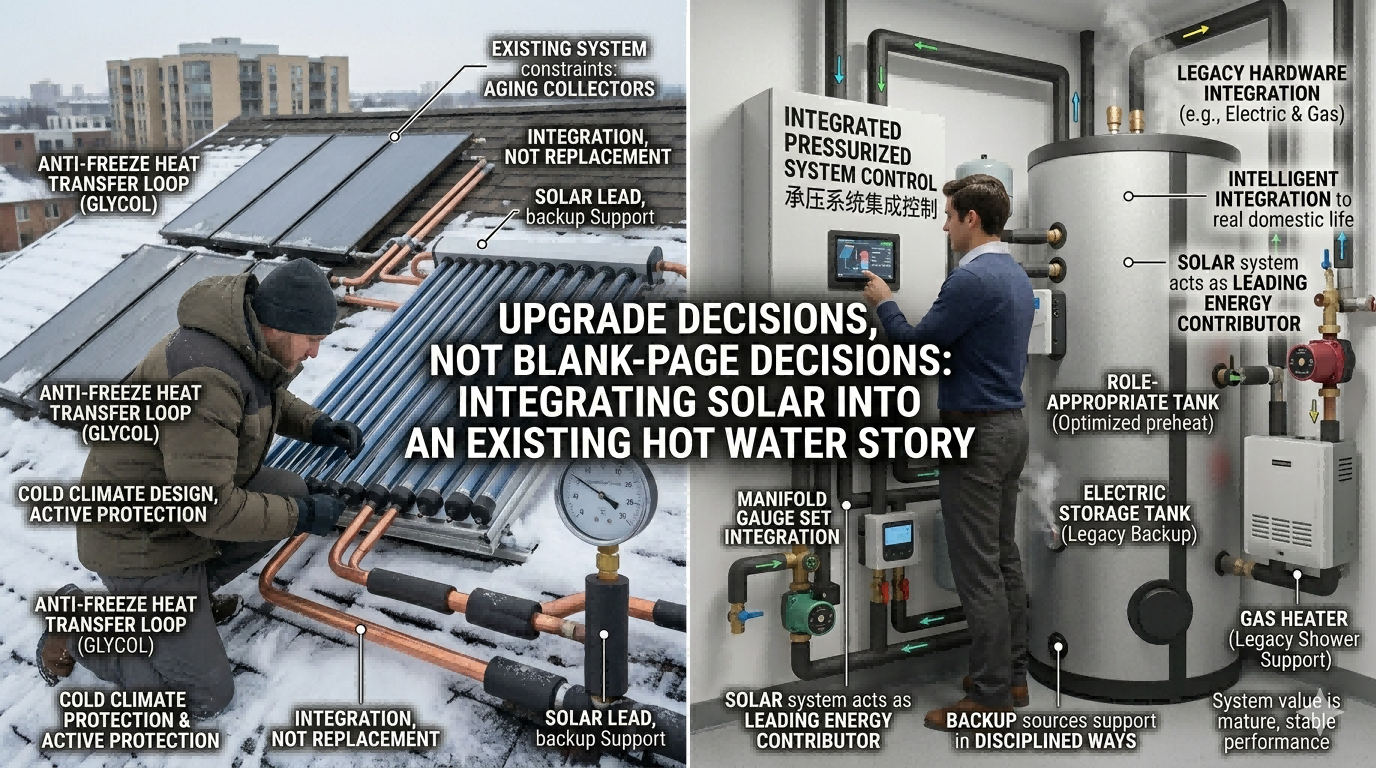
This is exactly why the pressurized solar water heater category deserves its own serious discussion. It is not simply a premium version of a basic solar water heater. It is a system type that becomes increasingly relevant when the building is taller, the plumbing environment is more pressure-dependent, and the user expectation is closer to modern urban comfort than to simple hot water availability. A home that relies on strong shower performance, simultaneous use across different outlets, or a pressure-assisted plumbing network is not just buying hot water storage. It is buying delivery stability.
That distinction matters because the pressure question is rarely isolated. It is usually tied to a broader set of conditions: multi-storey construction, booster pump integration, multiple bathrooms, municipal supply pressure, longer piping runs, and a family lifestyle in which hot water events often overlap. In those settings, a pressurized solar hot water system stops being an optional upgrade and starts looking like the more rational system architecture.
A lot of confusion in the market comes from oversimplified marketing language. Buyers are often told that a high pressure solar water heater provides “better comfort” or “stronger flow,” but the reason behind that statement is not always explained. The truth is that buildings create demand patterns. Some buildings are simple enough that almost any workable hot water solution can serve them. Others are much less forgiving. They expose every weakness in the hot water system, from unstable flow to outlet inconsistency to poor multi-point performance. Those are the buildings that make the value of a solar water heater with stable pressure obvious.
This article is built around one central idea: system suitability is scenario-driven. A solar water heater for high-rise building applications is not selected the same way as a system for a small single-storey house. A solar water heater with booster pump faces different hydraulic conditions from a gravity-friendly layout. A solar water heater for multiple bathrooms must perform differently from a setup serving only one shower and a kitchen sink. When you look at these cases closely, the reason pressure-rated systems matter becomes much clearer.
The Real Decision Starts Where Daily Use Becomes Demanding
The value of a solar hot water system is revealed in repeated daily use, not in brochure language. A building may look ordinary on the outside, yet the daily use pattern inside it can be surprisingly demanding. Morning showers overlap. Someone uses hot water in the kitchen while another bathroom is running. Upper-floor bathrooms need a more reliable delivery experience. A booster pump increases system expectation. An urban family no longer sees hot water as a luxury; it sees it as a basic standard of living.
This is the point where generic solar water heater discussions stop being useful. Once the building behaves like a modern comfort-oriented household, the question becomes more specific: can the system deliver hot water in a way that feels stable, immediate, and dependable across real use points? That is the question that usually leads buyers toward a pressurized solar water heater rather than a simpler low-demand solution.
The mistake many buyers make is assuming that temperature production is the whole story. It is not. A solar thermal system may collect enough energy and store enough heated water, but if the delivery side is not suited to the building, user satisfaction can still be poor. People do not experience hot water in the tank. They experience hot water at the shower, the faucet, the washing area, and the kitchen sink. That is why a multi outlet solar water heater has to be evaluated in terms of delivery performance, not just thermal storage.
High-Rise Buildings Change the Rules of Hot Water Design

One of the clearest cases for a solar water heater for high-rise building is vertical residential architecture. High-rise does not always mean a very tall tower. Even a multi-storey house or a townhouse with upper-floor bathrooms can create a more demanding delivery environment than buyers first realize. Once water has to be distributed vertically across different floors, the system is no longer working in a simple, compact, low-complexity layout.
Vertical distribution changes several things at once. First, the piping path often becomes longer and less forgiving. Second, user expectations at upper-floor outlets usually remain the same as those at lower floors; no one wants a weaker shower simply because the bathroom is upstairs. Third, the overall system must function more like a coordinated plumbing solution than like a standalone heating device. This is why a solar hot water for multi-storey house design often benefits from a pressure-compatible system logic.
In urban projects, the issue becomes even more important. Modern homeowners do not distinguish between “hot water generation” and “hot water experience.” If the home is positioned as modern, comfortable, and fully equipped, then the hot water system is expected to support that lifestyle. A solar water heater for modern homes therefore needs to be judged not only on energy savings, but on whether it can fit into the building’s real pressure and usage environment.
A pressurized system fits this scenario better because it is built to operate within a pressured plumbing context. That makes it more suitable for projects where the user expects the upstairs shower, the guest bathroom, and the kitchen line to all feel like parts of one coherent domestic system rather than disconnected demand points. In other words, the advantage of a high pressure solar water heater is not abstract. It becomes visible when the building itself asks more from the system.
A Booster Pump Does More Than Increase Pressure. It Raises the Performance Standard

Another key scenario is the presence of a booster pump. Many buyers look at a pump as a separate plumbing feature, but in reality it changes the standard the hot water system must meet. Once a building depends on boosted supply conditions, the hot water solution is expected to keep up with that environment rather than behave like a passive add-on.
This is why the phrase solar water heater with booster pump is so important from a content and product-positioning perspective. It does not simply describe a system that can coexist with a pump. It describes a project in which the hot water system has entered a more demanding hydraulic ecosystem. The user has already decided that stronger and more stable water delivery matters. That expectation carries through to hot water performance.
In practical terms, a booster pump tends to eliminate excuses. Once the cold-water side feels strong and immediate, any weakness in the hot-water side becomes more noticeable. The shower that alternates between satisfactory and disappointing flow is no longer tolerated. The kitchen tap that feels weaker when someone else is bathing becomes a visible annoyance. The family notices the difference more quickly because the general pressure environment of the house has already conditioned them to expect consistency.
That is exactly where a pressurized solar water heater gains practical relevance. It is not merely about surviving a higher-pressure environment; it is about belonging in one. The system is better aligned with the overall plumbing logic of the project. This alignment is often more important than buyers realize, because long-term satisfaction in hot water systems is closely tied to how naturally the system fits with the rest of the building’s infrastructure.
A home with a booster pump is rarely aiming for bare-minimum water service. It is aiming for a modern experience. That is why a best solar water heater for urban home decision often ends up being a decision about compatibility with performance expectations rather than about simple cost minimization.
Multiple Bathrooms Are a Delivery Challenge, Not Just a Capacity Question
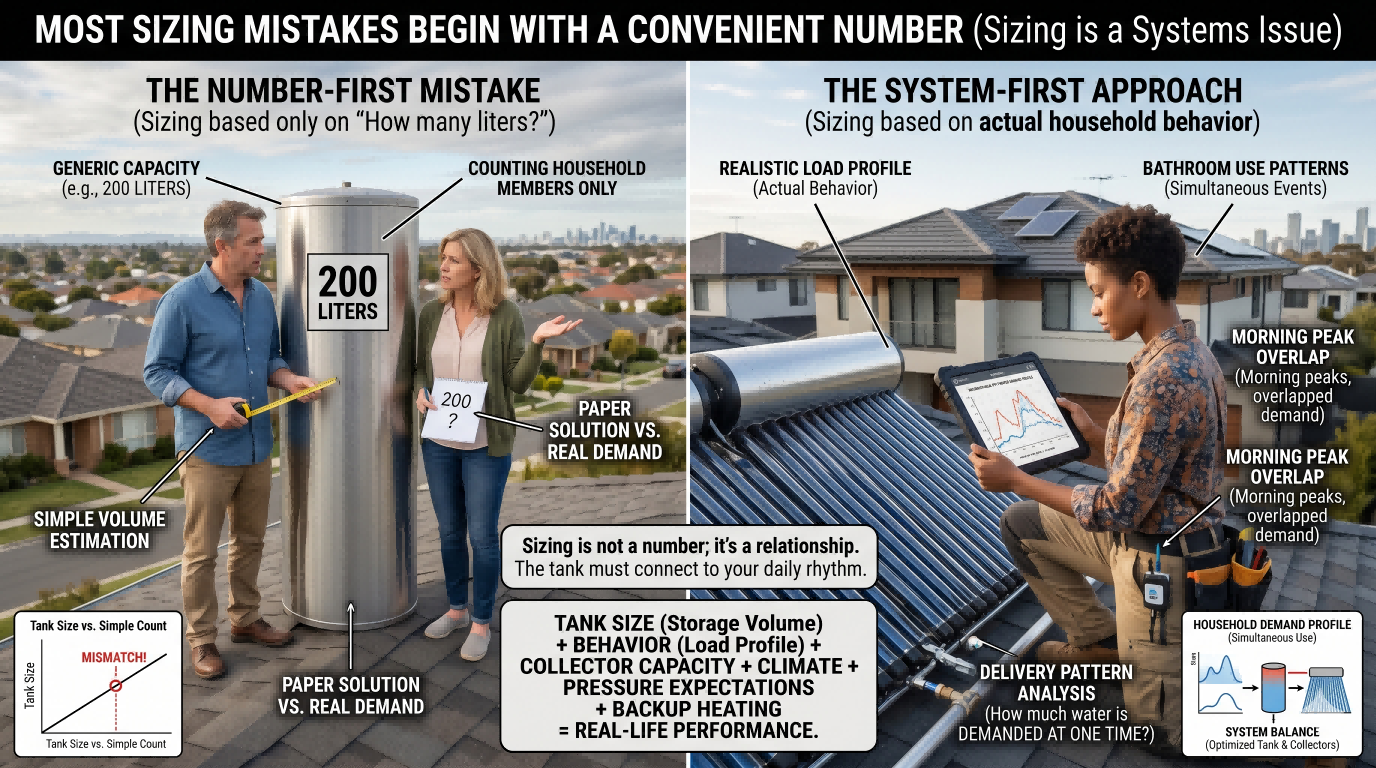
The market often reduces multi-bathroom projects to a sizing issue. People ask whether they need 200 liters, 250 liters, or 300 liters. Tank capacity matters, of course, but it does not fully answer the problem. A solar water heater for multiple bathrooms is not only about how much hot water can be stored. It is also about how that hot water can be delivered when more than one point of use becomes active within the same time window.
This is where a lot of buying decisions go wrong. A family may install a large tank and still feel disappointed because the daily experience does not match the number on the specification sheet. Why? Because hot water satisfaction depends on both quantity and delivery quality. If one bathroom performs well only until another outlet opens, the user does not feel that they bought a capable system. They feel that something about the system logic was wrong from the start.
A multi outlet solar water heater must therefore be evaluated around simultaneous use patterns. Two people showering close together, someone washing dishes while another taps hot water at a basin, or a family moving through different hot water events during the morning rush—these are the patterns that expose whether the system truly fits the home.
For this reason, a solar water heater for strong shower pressure becomes especially relevant in multi-bathroom residences. People do not define comfort by how well the system performs under perfect conditions when only one tap is used. They define it by how stable the experience remains when everyday family behavior makes demand less controlled. This is why pressurized systems are often the better answer for homes that want solar energy without sacrificing the feel of modern hot water delivery.
Modern Homes Have Changed What “Adequate” Means
The solar thermal market sometimes speaks as if hot water expectations have stayed the same for decades. They have not. The standard of “adequate” hot water has moved upward. Today, many households expect consistent flow, stable shower experience, quicker response across outlets, and less compromise when daily routines overlap. These expectations are especially visible in urban housing, new residential developments, and renovation projects targeting better comfort.
That is why a solar water heater for modern homes should not be judged by old definitions of functionality. The question is no longer simply whether the system can provide hot water. The question is whether it can provide hot water in a way that feels aligned with how people now live. In modern households, comfort, convenience, and reliability are not secondary luxuries. They are part of the system’s core value.
This shift matters because it explains why demand for solar water heater with stable pressure solutions continues to make sense even in markets that already understand solar hot water. Buyers are no longer satisfied by the presence of hot water alone. They want renewable energy that integrates naturally into a higher standard of daily living. In that environment, the performance logic of a pressurized solar hot water system becomes easier to defend and easier to sell.
Urban Projects Are Often More Sensitive to Wrong System Selection
Wrong system selection is expensive in any project, but it is especially costly in urban and mid-to-high expectation residential environments. In rural or low-demand settings, people may tolerate more variation in outlet feel or system behavior. In urban settings, tolerance is lower. The building itself, the plumbing system, and the user mindset all push toward a more stable standard.
This is why the best solar water heater for urban home is rarely the one that looks cheapest on day one. Urban buyers are typically more aware of comfort value, more sensitive to system inconsistency, and more likely to compare their hot water experience against modern expectations shaped by other appliances and fixtures in the house. Once the home has contemporary bathrooms, upgraded plumbing, pressure pumps, and multi-point usage, a weakly matched hot water system becomes a visible contradiction.
A pressurized solar water heater fits urban use better because it better reflects the building logic of these projects. Urban homes often combine compact site design, vertical distribution, multiple users, time-sensitive routines, and high comfort standards. These conditions make stable hot water delivery much more important than a simple “it works” benchmark.
The True Cost of Choosing Too Simple a System
Many buyers are understandably attracted to simpler systems because simplicity often sounds safe and economical. In some applications, it is. But simplicity only creates value when it matches the project. If the system is too simple for the building, then the apparent savings at purchase can become a long-term compromise in comfort, perceived quality, and user satisfaction.
This is especially true for a solar water heater for high-rise building or solar water heater with booster pump scenario. In such projects, the cheaper or simpler option may appear reasonable until the building starts using it under normal conditions. Then the mismatch becomes visible. Showers feel less stable than expected. Simultaneous use creates complaints. The buyer begins to focus on workarounds instead of enjoying the energy savings. At that point, the question is no longer whether the system can produce hot water. The question is why the hot water does not feel as usable as the rest of the house suggests it should.
The real cost of choosing too simple a system is therefore not only technical. It is experiential. A poorly matched system can lower the perceived quality of the entire home. That is why experienced project thinking does not begin with “what is the cheapest solar water heater?” It begins with “what kind of daily performance does this building require?”
Why Pressurized Systems Fit Comfort-Critical Projects Better
Some projects are comfort-critical even if they are not obviously large. A mid-sized family home can become comfort-critical if the family is active at the same time every morning, if there are two or more bathrooms, if the owners care strongly about shower feel, or if the house uses pressure-enhancing plumbing features. Under those conditions, even a non-luxury home begins to behave like a performance-sensitive project.
This is where a high pressure solar water heater often makes better sense than a simpler configuration. Its advantage is not that it magically creates more solar energy. Its advantage is that it supports a better match between the heating side and the delivery side of domestic hot water use. In comfort-critical projects, that match is what people actually pay for.
A solar water heater for strong shower pressure is a good example. The buying motivation here is not merely functional access to hot water. It is the desire to preserve a satisfying bathing experience while still benefiting from solar energy. That changes the tone of the decision. The buyer is no longer comparing heat sources alone. They are comparing life experience outcomes.
A Good Solar Water Heater Should Feel Invisible in Daily Life
One of the most useful ways to judge a hot water system is to ask whether the user notices it for good reasons or bad ones. The ideal domestic hot water system is often invisible. It simply works. It delivers what the family expects without making them think about plumbing logic every day.
In low-demand buildings, a simpler solution may achieve this invisibility. In more complex or demanding homes, invisibility requires a better-matched system. That is where a pressurized solar water heater becomes valuable. It helps preserve the feeling that the house is functioning as one integrated environment. The family does not need to plan around weak outlet behavior or think carefully about who should use hot water first. That reduction in friction is part of the system’s value, even if it never appears on a specification label.
A solar water heater with stable pressure therefore has emotional as well as technical value. It supports a sense of normality. The home feels complete. The renewable energy system feels mature. The building behaves the way people expect a well-designed modern home to behave.
How to Recognize a Pressurized-Suitable Project Early

One of the best ways to improve project outcomes is to identify pressure-suitable applications early, before the buying conversation gets stuck on price alone. Several signals usually point in that direction.
The building has more than one active bathroom
If the project includes multiple bathrooms and especially if simultaneous use is likely, the logic of a solar water heater for multiple bathrooms becomes highly relevant. Volume matters, but delivery stability matters just as much.
The house has a booster pump or pressure-enhanced supply
A solar water heater with booster pump is not just a compatibility issue. It is usually a sign that the house already values performance. That makes a pressurized system a more natural fit.
The residence has an urban or modern comfort profile
A solar water heater for modern homes should not undermine the standards created by the rest of the building. If the project targets modern living quality, the hot water system should support that identity.
The building is vertically distributed
A solar hot water for multi-storey house application benefits from system logic that respects the challenges of vertical routing and upper-floor user expectations.
The buyer cares about strong shower feel
If shower experience is frequently mentioned during sales or consultation, then a solar water heater for strong shower pressure is not a minor preference. It is a core decision factor.
Why This Category Creates Better Content Than Generic Solar Articles
From a content strategy point of view, the Pressure category is powerful because it connects directly to lived experience. Generic solar water heater content often becomes repetitive: energy savings, eco-friendliness, payback period, storage tank, collector type. Those topics matter, but they do not always capture buyer urgency.
By contrast, a blog built around pressurized solar water heater use cases can address very practical questions. Why is the upstairs shower weak? Why does a house with a booster pump need a different solar logic? Why does a family with three bathrooms care about more than just tank size? Why does modern home comfort push the project toward a pressure-rated system? These are concrete, decision-shaping topics.
That is why this category is commercially stronger than many general solar articles. It speaks to buyers who already understand the idea of solar hot water and are now trying to avoid the wrong fit. In other words, it targets a more mature stage of decision-making.
The Strongest Sales Message Is Not “More Advanced.” It Is “More Suitable.”
One reason many solar water heater pages fail to convert sophisticated buyers is that they rely too heavily on a premium-positioning tone. They imply that pressurized means advanced, advanced means better, and better means buy now. That line is too shallow. It can work for low-information traffic, but not for serious project buyers, distributors, or technically aware homeowners.
A better message is suitability. A pressurized solar hot water system is the right answer not because it is automatically superior in every case, but because certain buildings make its value more obvious and more necessary. The right sales logic is therefore based on fit: fit with height, fit with pressure environment, fit with outlet count, fit with modern comfort expectations, fit with daily use intensity.
This is a stronger commercial position because it sounds credible. It respects the buyer’s intelligence. It also helps avoid over-selling. Not every building needs a pressure-focused solution. But the buildings that do need it often need it clearly. That clarity is where strong content and good lead quality meet.
What a Better Buying Conversation Looks Like
A weak buying conversation starts with price, tank size, and surface comparisons. A stronger buying conversation starts with building behavior.
How many bathrooms are there?
Does the home use a booster pump?
Is the house multi-storey?
How often do hot water events overlap?
Is stable shower pressure a major expectation?
Is the project positioned as basic, practical, or comfort-oriented?
Once those questions are asked, the recommendation becomes more intelligent. The buyer starts to understand why a pressurized solar water heater may be justified. The product is no longer framed as a more expensive object. It is framed as a more appropriate system for the project’s real conditions.
That shift is important because system selection should reduce regret, not just close a sale. A well-matched solar water heater for high-rise building use, a properly considered solar water heater with booster pump, or a genuinely capable multi outlet solar water heater can improve long-term satisfaction far more than a cheaper but poorly matched alternative.
Final Thought
A pressurized solar water heater becomes the better choice when the project itself becomes more demanding. High-rise layouts, multi-storey residences, booster pump systems, multiple bathrooms, and modern urban comfort expectations all place greater pressure on the hot water system to behave like part of a fully functional plumbing network rather than a basic heating add-on.
That is why a high pressure solar water heater should not be marketed as a generic upgrade. Its value is more precise than that. It is the better fit for buildings that need stronger delivery consistency, better multi-point performance, and a more confident integration with modern domestic water use. A solar water heater for high-rise building must think vertically. A solar water heater with booster pump must think hydraulically. A solar water heater for multiple bathrooms must think in terms of simultaneous demand. A solar water heater for modern homes must think in terms of comfort as well as energy.
When those realities are taken seriously, the choice becomes clearer. The most successful solar hot water projects are not built on generic claims. They are built on correct system logic. And in many of today’s more demanding residential environments, that logic points directly toward a pressurized solar hot water system.
#HighPressureSolarWaterHeater
#SolarWaterHeaterForHighRiseBuilding
#SolarWaterHeaterWithBoosterPump
#SolarWaterHeaterForMultipleBathrooms
#PressurizedSolarHotWaterSystem
#SolarHotWaterSystem
#ModernHomeHotWater
#MultiStoreyHouseSolutions
#UrbanHomeEnergy
#RenewableEnergy
#SolarThermal
#DomesticHotWater
#StrongShowerPressure
#MultiOutletHotWater