Soda Makers and Sustainability The Real Story Is Not Just About Fewer Plastic Bottles
Most Sustainability Conversations in This Category Start Too Small
When people talk about soda makers and sustainability, the discussion usually begins with a very familiar claim: fewer plastic bottles. That statement is not wrong, but it is incomplete. In fact, it is so incomplete that it often prevents consumers from understanding the category’s real environmental significance.
A soda maker does not matter only because it can replace some single-use beverage packaging. It matters because it changes where beverage value is created. That is a much bigger idea.
In the traditional beverage model, the consumer purchases a finished drink. Water or flavored liquid is processed, packaged, transported, merchandised, chilled, stored, carried home, opened, consumed, and discarded. Every step adds material, energy, logistics, and repetition. The consumer experiences the product as convenience, but the system behind that convenience is resource-heavy by design. It depends on the constant movement of completed beverages through a packaging and distribution chain.
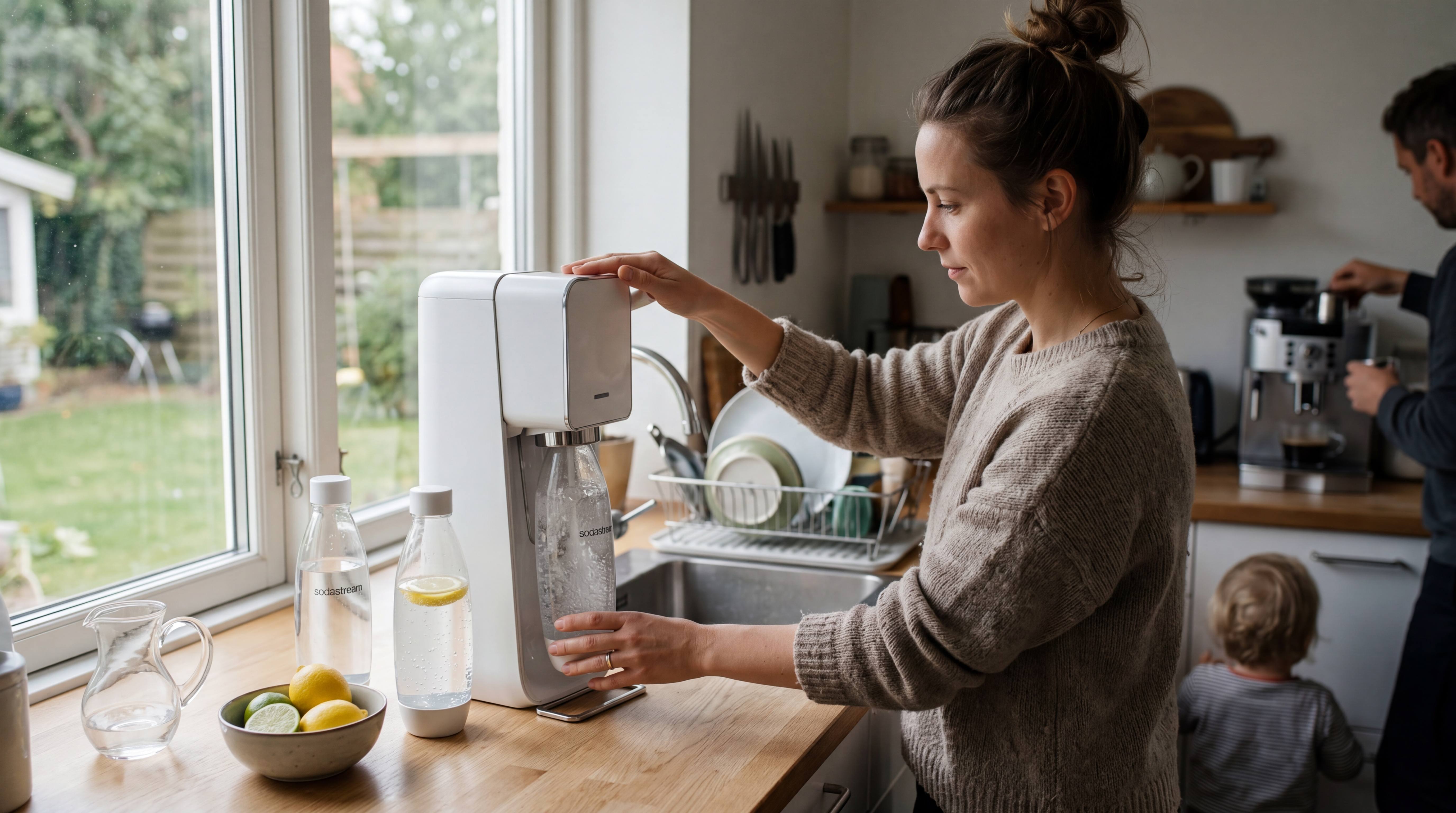
A sustainable soda maker introduces a different model. Instead of buying finished sparkling beverages over and over, the household begins with water and uses a refillable carbonation system to create the final drink much closer to the moment of consumption. This shift sounds simple, but systemically it is profound. It changes the beverage from something repeatedly transported and repeatedly packaged into something partially assembled at home through reuse and refill logic.
That is why the real story is not just about fewer discarded bottles. It is about a different kind of beverage system.
A soda maker changes how ingredients, packaging, storage, and waste are distributed across the home and the supply chain. It pushes the category toward reuse instead of repeat disposal. It encourages households to think less in terms of buying drinks and more in terms of maintaining a beverage routine. Once that shift happens, the environmental conversation becomes much more interesting.
Because sustainability is not simply about removing one visible waste item. It is about redesigning repeated behavior.
That is where soda makers begin to matter in a serious way. Not because they create a perfect waste-free world, and not because every machine automatically delivers environmental virtue, but because they can support a structure of consumption that is more circular, more local to the home, and less dependent on the constant turnover of finished beverage packaging.
The Real Environmental Shift Is From Finished Product Consumption to At-Home Beverage Assembly

Most people are used to thinking about drinks as finished goods. A bottle or can is purchased already complete. Flavor, sweetness, carbonation, portion, and packaging have all been decided before the product enters the home. The consumer’s role is mostly to choose, store, chill, and consume.
That model feels normal because it has been the dominant one for decades. But from a sustainability perspective, it is highly repetitive. Every liter of sparkling beverage purchased this way tends to carry a new packaging event, a new transportation event, and a new disposal event. The system is built on constant physical turnover.
A soda maker changes that by moving the final stage of beverage creation into the home. The household stops repeatedly buying a finished carbonated drink and starts repeatedly using a reuse bottle beverage system. That difference matters because reuse changes the environmental math of repetition.
Repetition is the key word here.
A drink purchased once in disposable packaging is not the core sustainability problem. The problem is the frequency of the behavior. Sparkling water, soft drinks, flavored waters, and light refreshment beverages are often consumed in high volume and with high regularity. That means even small packaging units can create large cumulative waste and large cumulative logistics over time.
The soda maker matters because it addresses repeated beverage demand with repeated-use infrastructure. The bottle is used again. The carbonation system is refilled. The water is already local to the home. The act of preparing the drink moves closer to the moment of drinking instead of being outsourced to a distant packaging chain every single time.
This is where home beverage waste reduction becomes much more than a recycling issue. Recycling manages waste after it is created. A soda maker can help reduce how often certain waste enters the household in the first place. That is a more structural form of change.
This distinction is important because environmentally mature consumers are increasingly skeptical of shallow green claims. They do not just want a product that feels recyclable. They want a product that changes the repeated pattern that created the waste problem in the first place. Soda makers can do that when they are used as real beverage systems rather than as occasional novelty gadgets.
So the real environmental shift is not “this machine uses a reusable bottle.” The real shift is “this household has changed how finished beverages are produced and consumed.”
That is a much bigger sustainability story.
Fewer Plastic Bottles Matter, but Packaging Reduction Is Only the Surface Layer
The visible sustainability story is usually the first one people notice. A household that uses a soda maker regularly often buys fewer bottled sparkling beverages. Less finished beverage packaging comes into the home. Fewer empty containers need to be collected, sorted, or discarded. In a narrow sense, that is already meaningful.
But to stop the analysis there would be a mistake.
When consumers say they want to reduce beverage packaging waste, they often imagine that the issue is mainly the waste bin. What they see is the empty bottle, the stack of recyclables, the clutter, or the guilt associated with repeated packaging disposal. That visibility matters because it makes the problem real. However, waste at the household level is only the final stage of a longer packaging lifecycle.
Before the package becomes an empty bottle in a recycling bin, it has already been manufactured, labeled, filled, transported, shelved, sold, stored, and carried home. The waste issue is not merely the object after consumption. It is the whole material cycle required to bring a finished drink into the home again and again.
This is why soda makers deserve a broader reading. They do not simply reduce a visible output. They can reduce the frequency with which the full packaging cycle is triggered.
That is also why the most intelligent sustainability messaging in this category should not rely only on anti-plastic language. Plastic is the visible symbol, but the deeper issue is repeated packaging dependency. A household using a bottled drink replacement system is not only reducing a certain type of discarded container. It is participating less often in a full finished-product packaging loop.
That loop exists regardless of whether the original beverage was sold in plastic, metal, or glass. Packaging materials differ in properties and recovery pathways, but all of them involve production, handling, and transport. From a systems perspective, reducing the frequency of packaged beverage turnover can be more meaningful than simply switching from one package type to another while preserving the same repetition pattern.
So yes, fewer plastic bottles matter. They matter visually, practically, and symbolically. But they are only the surface layer of the sustainability argument. The deeper layer is that soda makers can reduce the household’s dependence on repeated beverage packaging as a category behavior.
That is a much more important environmental contribution.
The Category Becomes More Relevant When We Talk About Logistics, Not Just Materials
Environmental discussions often become trapped in material comparisons. People ask whether plastic is better or worse than glass, whether recyclable packaging is sufficient, or whether reusable systems offset manufacturing impact quickly enough. These are valid questions, but they are often asked in a way that misses the logistics dimension.
Beverage sustainability is not only about what the container is made of. It is also about how often finished beverages need to be moved.
A standard bottled sparkling water system involves repeated transportation of liquid weight. Water is packaged away from the home, shipped through distribution networks, placed in retail systems, carried to the household, refrigerated, consumed, and then the empty container goes through some form of disposal or recovery path. This process is normalized because it feels convenient. But at scale, it is a distribution-heavy way to satisfy a recurring beverage need.
A soda maker changes that by collapsing part of the logistics chain into the home. The household still relies on broader systems for carbonation refills and possibly flavor products, but the repeated transportation of finished sparkling water is reduced. The drink’s final form is created where it will be consumed.
This matters because environmental burden is not only hidden in waste. It is also hidden in repetition of movement.
That is one reason eco friendly sparkling water at home is more than a lifestyle phrase. When the home becomes the place where carbonation happens, the beverage system becomes less dependent on the constant transport of already-completed liquid products. The home is no longer just the end point of beverage logistics. It becomes part of beverage production.
This also helps explain why the sustainability relevance of soda makers grows with frequency of use. The more a household relies on a reusable carbonation routine instead of packaged beverage purchasing, the more meaningful the logistics shift becomes. A machine that is used once in a while tells a small environmental story. A machine that becomes central to daily sparkling water or light beverage consumption tells a much larger one.
That is why the category’s true environmental promise is not located only in the object. It is located in the change in logistics behavior the object can support.
The Strongest Sustainability Benefit Appears Only When the Machine Becomes a Habit
A soda maker is not inherently sustainable in the abstract. It becomes environmentally meaningful when it supports stable repeated use.
This point is crucial, because many people confuse eco-positioning with eco-performance. A product can be marketed with sustainability language, use reusable components, and still fail to create real environmental value if it does not become part of actual daily life. Sustainability is not a visual identity. It is a behavioral outcome.
That is why soda maker sustainability benefits are directly tied to routine. The machine has to replace something. It has to move the household away from repeated finished-drink purchases and into a low waste drink routine that is practical enough to maintain. If the product is used rarely, if bottles sit idle, if the household falls back to buying packaged beverages most of the time, then the system’s theoretical environmental logic remains under-realized.
The strongest sustainability performance therefore depends on habit architecture.
Are bottles kept ready in the fridge?
Is the carbonation process easy enough that people actually use it?
Does the system reduce the temptation to buy bottled sparkling drinks?
Do household members trust it enough to rely on it?
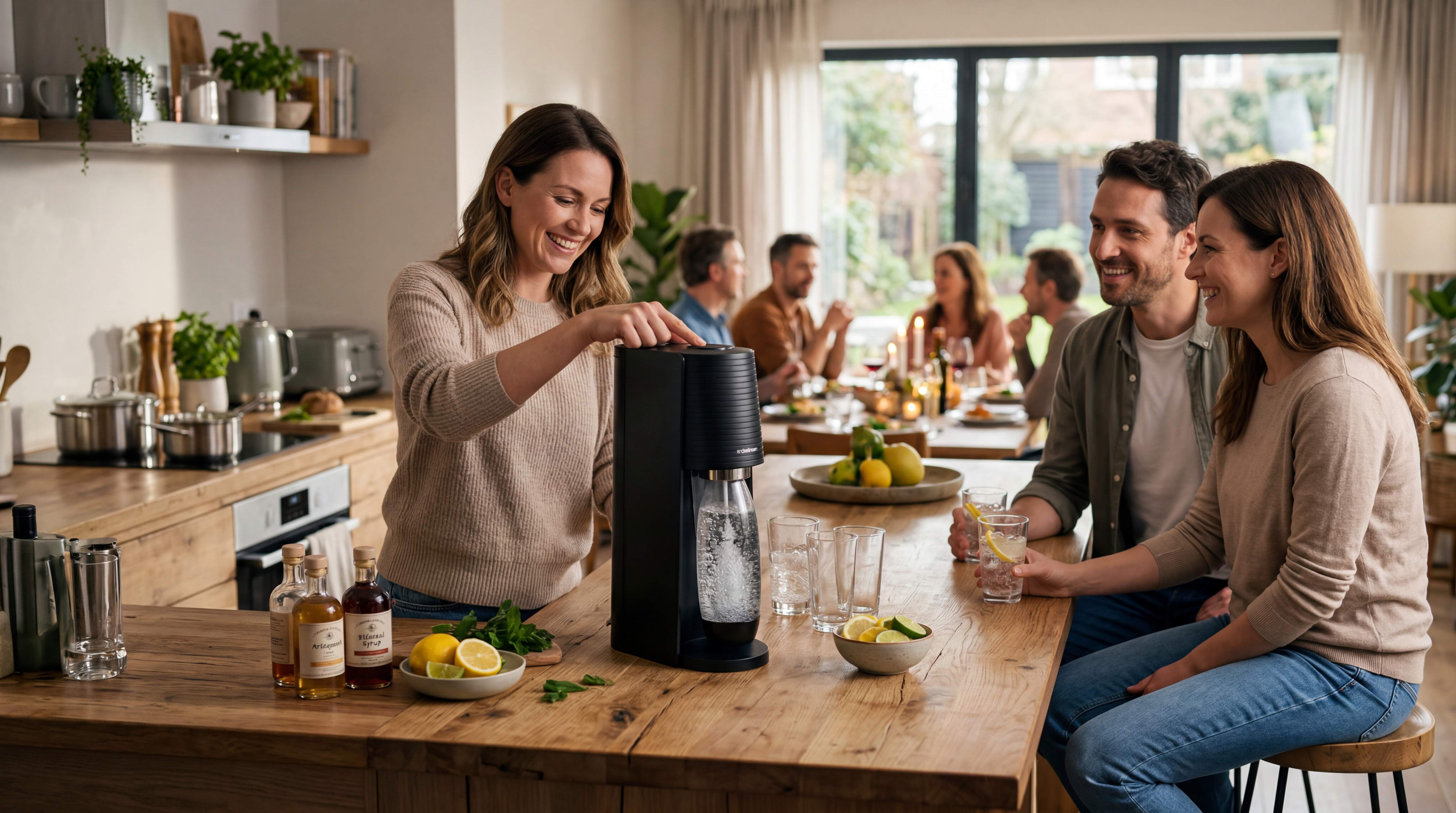
Does it integrate into meals, daily hydration, and entertaining?
These questions matter because environmental value accumulates through repetition. A reusable bottle does not become meaningful because it exists. It becomes meaningful because it keeps replacing disposable or repeatedly packaged alternatives over time.
This is why the category often works best in households that treat the soda maker not as a gadget, but as a core beverage utility. When that happens, the sustainability logic becomes much stronger. The machine is no longer making occasional novelty drinks. It is helping run a home beverage system with lower packaging turnover and more circular behavior.
So the key environmental threshold is not purchase. It is adoption. A soda maker becomes sustainable when it is woven into repeated real behavior.
Reuse Is More Powerful Than Recycling When the Routine Actually Holds

Recycling is important, but it is often overburdened in consumer sustainability narratives. People talk as though recycling were the primary answer to beverage waste. In reality, recycling is downstream management. It deals with materials after the waste event has already occurred.
Reuse works differently.
A soda maker matters because it enables reuse at the level of everyday beverage delivery. The bottle is not just technically recyclable. It is physically reused. The carbonation process is not built on the creation of a new container for every drink. It is built on repeated use of the same vessel within the household. That is environmentally powerful because it reduces the number of new packaging events required to satisfy repeated drinking needs.
This is where the reuse bottle beverage system becomes much more interesting than a generic recycling claim. Reuse reduces the need for material turnover. Recycling still depends on turnover.
That does not mean soda maker systems are free from all environmental burden. They still involve machine production, bottle production, refill logistics, and cleaning. But they operate on a fundamentally different logic from finished beverage packaging. They ask the household to maintain a durable drinking infrastructure rather than constantly process beverage containers through a use-once-and-sort-later model.
That shift can support stronger circular beverage habits. The household starts to think in terms of maintaining the system rather than discarding outputs. Bottles are washed and rotated. Carbonation is refilled. The drink routine becomes anchored in repetition without disposal at every single use event.
This is one of the biggest reasons the category deserves a higher level of discussion. It sits at the intersection of convenience and circularity. That is unusual, because many sustainable consumer systems fail precisely because they feel less convenient than the disposable norm. Soda makers can succeed where other systems struggle because they can make reuse feel normal, not burdensome, when the routine is well established.
And when reuse becomes normal, sustainability becomes much more durable than when it depends mainly on correct sorting behavior after consumption.
Sustainability in This Category Is Also About Household Mental Shift
There is a visible side to sustainability and a psychological side. The visible side is easier to photograph: fewer bottles, reusable containers, less packaging waste on the counter. The psychological side is harder to see, but often more important in the long run.
A soda maker can change how the household thinks about drinks.
Instead of seeing beverages primarily as items to be bought, stored, and finished, the household begins to see them as something that can be created, adjusted, and maintained within the home. That shift matters because it breaks the assumption that every satisfying drink must arrive as a fully packaged retail product.
Once that assumption weakens, consumer behavior can change in surprising ways.
People may begin to buy fewer impulse beverages.
They may become more selective about which packaged drinks are truly worth bringing home.
They may separate everyday hydration from special-occasion indulgence more clearly.
They may become more comfortable using simple ingredients to create satisfying drinks rather than relying on packaged convenience every time.
This is why a bottled drink replacement system has cultural significance beyond the object itself. It encourages a different mental model of refreshment. It tells the household that repeated beverage satisfaction does not have to be packaged in advance by default.
That is a quiet but meaningful form of sustainability because long-term environmental change depends partly on what consumers believe is normal. If households believe packaged beverage turnover is the natural baseline, then even small improvements remain limited. If households begin to believe that repeated drinks can be created with reusable systems at home, then the category has helped shift a norm.
Norm shifts matter because they outlast product novelty. They turn a single purchase into a broader change in expectations.
The Home Is Becoming a More Important Sustainability Site Than Many Brands Realize
Many sustainability strategies are still designed from the perspective of product manufacturing and packaging alone. Those things matter, but they do not fully explain how consumption habits evolve. Increasingly, the home itself is becoming a critical site of sustainability design.
This is because the home is where repetition happens.
It is where drinks are opened, bottles accumulate, packaging is sorted, routines are formed, children observe norms, and convenience patterns either strengthen or weaken. A product that changes behavior at the household level can therefore have influence beyond its physical size.
A soda maker is a very strong example of this principle. It changes not only what is bought, but how often something needs to be bought, how drinks are mentally categorized, and how refreshment is produced inside domestic life. That makes it relevant to home beverage waste reduction in a way that goes beyond product marketing.
The home dimension also matters because sustainability succeeds best when it becomes ordinary. Big environmental claims often fail when they require consumers to behave heroically. Soda makers can succeed precisely because they do not ask people to give up refreshment. They ask them to change the system through which refreshment is delivered.
That is a more realistic path.
A household can still enjoy sparkling drinks.
It can still enjoy flavor.
It can still enjoy convenience.
But it may do so with fewer repeated packages and more reuse.
That is why the home matters so much. It is where convenience and sustainability either collide or finally become compatible. When they become compatible, habits change faster.
The Sustainability Story Is Strongest When We Talk About Circularity, Not Moral Purity
One mistake in sustainable consumer communication is the pursuit of purity. Brands sometimes try to sound as though their products eliminate environmental compromise entirely. Consumers are becoming less receptive to that tone because they know real products always operate within imperfect systems.
A smarter and more credible way to frame soda makers is through circularity.
A soda maker is not environmentally meaningful because it is pure. It is meaningful because it can support more circular beverage habits than the standard single-package beverage model. It relies on reused bottles, recurring carbonation supply, and repeated home preparation rather than repeated finished-drink disposal. That is a much more honest and robust sustainability story.
Circularity is a better concept here because it acknowledges that the system still involves inputs, maintenance, and infrastructure. Bottles must be cleaned. Carbonation must be replenished. Machines must be made and used. Nothing disappears from the environmental equation. What changes is the pattern of repetition.
Instead of every drink creating a fresh packaging cycle, a more circular routine uses durable elements repeatedly. That is the real advantage.
This is also why the strongest soda maker sustainability benefits are cumulative. They do not appear as one dramatic eco-gesture. They appear through months and years of use. The household buys fewer finished sparkling beverages. It creates fewer repeat packaging events. It normalizes bottle reuse. It treats beverage making as a maintainable home system rather than a stream of consumable units.
That is the kind of environmental logic that tends to endure. It is less dependent on guilt, less dependent on symbolic virtue, and more dependent on a system that actually works.
A Soda Maker Does Not Just Replace Bottles. It Can Reposition What Counts as a Default Drink
Sustainability and health sometimes overlap in this category, but they do so through structure rather than through slogans. When a soda maker becomes central to the home, it can shift what the household treats as the default drink.
That shift has environmental implications.
If sparkling water, lightly flavored carbonated water, or homemade refreshment becomes the easiest interesting beverage in the home, then packaged alternatives become less necessary as everyday staples. That means sustainability is no longer only about recycling decisions after purchase. It is about what no longer needs to be purchased with the same frequency in the first place.
This is a powerful form of change because defaults govern more behavior than ideals do. Households do not make every beverage decision through deep ethical reflection. They follow whatever feels available, satisfying, and normal. A soda maker helps make a lower-packaging beverage pathway more normal.
That is why a low waste drink routine is so important in this discussion. Sustainability here is not achieved by dramatic sacrifice. It is achieved when the household’s most ordinary choices become less material-intensive over time.
A drink default built around a reusable carbonation setup can support that change very effectively.
The Best Sustainability Outcome Comes When the Product Replaces Volume, Not Just Occasional Purchases

Some consumers buy a soda maker because they are curious. Others buy one because they want to reduce specific waste streams or change how the household handles beverages. These motivations are different, and they lead to different environmental outcomes.
The strongest sustainability case appears when the machine replaces real volume.
If a household previously bought large amounts of packaged sparkling water or lightly flavored fizzy drinks, then moving that recurring demand into a reusable home system can be highly meaningful. The key is volume replacement. The product does not need to eliminate every packaged drink from the home to matter, but it should meaningfully reduce the number of repeated finished beverage purchases.
This is where the category becomes more than symbolic. A bottled drink replacement system that actually replaces regular volume is doing real work. It is not just sitting on the counter as an eco-styled appliance. It is actively shifting consumption.
This also explains why category success and environmental success are closely linked. The more the product is used, the stronger its sustainability profile becomes. That is rare and valuable. In many categories, increased product use can increase environmental burden. In soda makers, increased use can actually strengthen the core environmental logic, because it means the reusable system is displacing more packaging cycles.
That is one reason the category deserves serious attention from sustainability-minded consumers and brands alike. Its environmental potential is not abstract. It improves with meaningful adoption.
Final Perspective: The Future of Sustainable Beverage Consumption Looks More Like Refill and Reuse Than Recycle and Repeat
The most important lesson in this category is that sustainability is rarely created by one visible gesture. It is created when systems of repetition change.
A soda maker matters not just because it reduces some plastic waste, but because it helps move beverage life away from a pattern of buy, carry, chill, consume, discard, repeat. It introduces a different rhythm: refill, reuse, carbonate, drink, repeat.
That difference is the real story.
A sustainable soda maker is valuable because it can help households reduce beverage packaging waste, rely on a refillable carbonation system, support eco friendly sparkling water at home, encourage home beverage waste reduction, operate as a reuse bottle beverage system, reinforce a low waste drink routine, function as a bottled drink replacement system, deliver real soda maker sustainability benefits, and build stronger circular beverage habits over time.
That is far more significant than simply saying “you throw away fewer bottles.”
The real environmental contribution of the category is that it relocates beverage value creation from constant finished-product packaging to a more reusable, more circular, more home-centered model.
And in a world where sustainability increasingly depends on systems that can survive ordinary life, that may be exactly the kind of change that matters most.
#ReduceBeveragePackagingWaste
#RefillableCarbonationSystem
#EcoFriendlySparklingWaterAtHome
#HomeBeverageWasteReduction
#ReuseBottleBeverageSystem
#LowWasteDrinkRoutine
#BottledDrinkReplacementSystem
#SodaMakerSustainabilityBenefits
#CircularBeverageHabits
#KitchenAppliances
#HomeBeverageSystem
#SustainableLiving
#LowWasteLifestyle
#SparklingWaterLifestyle