Engineering Exterior Stability: Mastering Thermal Expansion and Buckling in PU Faux Stone Panels
The Hidden Threat in Exterior Cladding: The Thermodynamics of Polyurethane
When sourcing lightweight architectural facades for large-scale commercial, industrial, or residential projects, procurement managers and architects often focus heavily on weight-to-volume ratios, aesthetic fidelity, and initial capital expenditure. However, the most critical engineering challenge facing high-density polymer materials is environmental thermodynamics. PU faux stone thermal expansion is a fundamental physical reality that, if ignored during the specification, procurement, and installation phases, leads directly to catastrophic aesthetic and structural failures.
Unlike natural stone, masonry, or heavy precast concrete, which possess immense thermal mass and virtually negligible coefficients of expansion, high-density polyurethane (PU) foam reacts dynamically and aggressively to temperature swings. When a building facade undergoes rapid heating from intense direct solar radiation during the day, followed by abrupt nighttime cooling, the internal polymer matrix expands and contracts continuously. Without properly engineered tolerances and scientifically calculated joints, this relentless movement translates directly into PU stone wall panel buckling, severe delamination from the substrate, and the total compromise of the building's exterior weather barrier.
This exhaustive technical guide provides architects, facade engineers, construction project managers, and B2B sourcing professionals with the rigorous empirical data required to master polyurethane thermal stress. By understanding the underlying polymer physics, applying standardized ASTM testing metrics, calculating precise mechanical tolerances, and enforcing strict adhesive protocols, you can ensure that your exterior envelope remains pristine and structurally sound for decades, regardless of the climate zone.
For a broader macroeconomic and material comparison perspective before diving into thermodynamics, we highly recommend reviewing our comprehensive wall panel guides, which contrast various synthetic and natural cladding systems to help you choose the right baseline material for your specific architectural needs.
1. The Polymer Physics Behind Expansion

To truly understand why polyurethane panels move, we must examine the material at a molecular level. Polyurethane is formed through the exothermic reaction of isocyanates (such as MDI or TDI) and polyols. The resulting polymer consists of alternating hard and soft segments. The hard segments provide rigidity and impact resistance, while the soft segments provide flexibility and elasticity.
When kinetic energy (heat) is introduced into this system via solar radiation or high ambient temperatures, the molecular chains vibrate more intensely. The soft segments, in particular, uncoil and push against one another, causing the macroscopic volume of the panel to increase. Because the PU foam used in architectural faux stone is a closed-cell, high-density structure (typically ranging from 200 kg/m³ to 300 kg/m³), the trapped blowing agents within the microscopic cells also undergo thermal expansion, exerting internal outward pressure on the cell walls.
The Role of Glass Transition Temperature (Tg)
Every polymer has a Glass Transition Temperature (Tg)—the critical point at which the material transitions from a hard, glassy state to a softer, more rubbery state. For exterior-grade rigid polyurethane, the Tg is engineered to be well above maximum anticipated ambient temperatures, usually exceeding 100°C (212°F). As long as the panel remains below its Tg, it will expand linearly. However, if the panel approaches this temperature due to extreme solar gain, its mechanical strength drops significantly, making it highly susceptible to permanent faux stone panel deformation if it encounters resistance (such as being butted too tightly against an adjacent panel).
2. Decoding CLTE and Standardized Testing Protocols

To predict how a building material will behave in real-world environmental conditions, engineers rely on the Coefficient of Linear Thermal Expansion (CLTE or CTE). CLTE measures the fractional change in the length of a material per degree of temperature change. It is the absolute mathematical foundation of exterior panel buckling prevention.
Polyurethane inherently possesses a much higher CLTE than traditional building substrates like structural steel, poured concrete, or oriented strand board (OSB). When a PU panel is rigidly affixed to a concrete wall, the two materials expand at drastically different rates. This differential movement creates massive, invisible shear stress at the bonding interface.
ASTM D696: The Gold Standard for Plastics
In global supply chain procurement and commercial engineering, unverified factory claims are insufficient and legally risky. High-quality manufacturers validate their products using standardized, third-party laboratory testing, most notably utilizing ASTM D696 PU panels testing criteria. The ASTM D696 standard strictly dictates the methodology for determining the coefficient of linear thermal expansion of plastics between -30°C and 30°C (-22°F to 86°F) using a highly sensitive vitreous silica dilatometer.
During this test, a precisely machined sample of the PU foam is placed inside the dilatometer. The temperature is controlled within a liquid bath or environmental chamber, and an LVDT (Linear Variable Differential Transformer) measures the microscopic dimensional changes as the temperature cycles. A premium architectural-grade PU faux stone panel typically exhibits a CLTE ranging from 4.0 x 10^-5 to 8.0 x 10^-5 in/in/°F (which roughly translates to 70 to 140 µm/m·°C).
By demanding the specific ASTM D696 or ISO 11359 laboratory reports from your OEM partners, procurement teams gain the empirical baseline data required for accurate polyurethane CLTE calculation in localized environmental contexts. Without this data, facade engineering is reduced to mere guesswork.
3. Micro-Climates and the Solar Reflectance Index (SRI)

The severity of thermal movement is entirely dependent on the geographical location of the construction project and the specific micro-climate of the building's orientation. Ambient air temperature (what the weather forecast reports) is only a fraction of the thermal equation. The true driver of expansion is the localized surface temperature of the panel.
Infrared Radiation and Surface Heating
When dealing with exterior cladding, direct solar radiation causes the surface temperature of the panel to spike significantly higher than the surrounding air. This phenomenon is governed by the panel's Solar Reflectance Index (SRI) and Light Reflectance Value (LRV). Darker-colored PU faux stone panels—such as those mimicking dark charcoal basalt, deep brown slate, or rich iron-oxide ledgestone—possess very low LRV ratings. This means they absorb immense amounts of infrared radiation rather than reflecting it back into the atmosphere.
In regions such as the American Southwest (Arizona, Nevada), the Middle East (Dubai, Riyadh), or parts of Australia, ambient temperatures frequently exceed 45°C (113°F). However, surface temperatures on a dark brown PU panel facing directly South or West can easily reach an astonishing 85°C to 95°C (185°F to 203°F) in direct afternoon sunlight. At these extreme temperatures, the polymer structure reaches its maximum volumetric expansion.
The Freezing Paradox and Embrittlement
Conversely, in environments like the Canadian Prairies, Scandinavia, or Northern Russia, the engineering challenge shifts from managing extreme expansion to mitigating severe contraction and material embrittlement. During PU stone cold weather installation, contractors must account for the reality that panels installed at -10°C (14°F) will expand drastically when summer arrives.
Furthermore, if a panel was installed tightly during peak summer heat (e.g., 35°C), the arrival of a -30°C winter will cause severe volumetric contraction. This contraction pulls violently against mechanical fasteners and structural adhesives. If rigid adhesives were utilized during installation, the shear force can physically tear the back layer of the PU panel away, or sheer the steel heads off the mounting screws. The severe cold also lowers the impact resistance of the polymer matrix, making it brittle and more susceptible to fracturing under mechanical stress. Therefore, material acclimation and precise gap calculation are absolutely non-negotiable for extreme climate exterior cladding.
4. The Mathematics of Exterior Expansion Gaps

The cornerstone of a successful, defect-free PU facade installation is the rigorous mathematical calculation of the expansion gap. Leaving a generic "few millimeters" of space or relying on visual intuition is an unscientific approach that guarantees failure. Facade engineers must calculate the maximum anticipated thermal delta (ΔT) the panel will experience over its lifetime.
The Linear Expansion Formula
The total linear expansion (ΔL) can be calculated using the fundamental thermodynamic formula:
ΔL = L × α × ΔT
Where:
- ΔL (Delta L): The total change in length (the expansion or contraction value).
- L: The original length of the PU panel at the time of installation (e.g., 1200mm or 48 inches).
- α (Alpha): The Coefficient of Linear Thermal Expansion (derived from the manufacturer's ASTM D696 test data).
- ΔT (Delta T): The maximum temperature fluctuation (Maximum anticipated surface temperature minus Minimum anticipated surface temperature).
Real-World Engineering Calculation Example
Let us assume a commercial architect is specifying a 1200mm (1.2 meter) long PU faux stone panel for a high-end retail facade in Denver, Colorado—a city known for wild temperature swings. The historical winter low surface temperature is estimated at -25°C. The peak summer surface temperature, accounting for intense solar gain on a dark-colored panel at high altitude, is estimated at 75°C. Therefore, the total ΔT (temperature swing) the panel will endure across the year is 100°C.
The procurement team has obtained the lab report from the PU manufacturer, which states the CLTE (α) of this specific high-density panel is 80 µm/m·°C (which translates to 0.00008 m/m·°C).
Plugging these figures into our formula:
ΔL = 1200mm × 0.00008 × 100°C
ΔL = 9.6 mm
In this scenario, the panel will change size by nearly 1 centimeter (9.6mm) across the calendar year. Therefore, a minimum expansion gap of 4.8mm must be engineered on each side of the panel (where it meets the next panel) to accommodate this movement without initiating structural buckling. These calculated exterior faux stone expansion gaps are subsequently filled with a high-grade, UV-resistant elastomeric sealant (such as a premium polyurethane mastic or architectural silicone caulking) that can compress and stretch seamlessly with the panel's movement, maintaining the waterproof integrity of the facade while disguising the joint.
5. Managing Substrate Differential Movement
Calculating the expansion of the PU panel is only half the battle; engineers must also account for the movement of the substrate to which the panel is attached. This interaction is known as Differential Movement.
Consider a PU panel mounted to a poured concrete tilt-up wall. Concrete has a CLTE of roughly 10 µm/m·°C. Our PU panel has a CLTE of 80 µm/m·°C. For every degree of temperature change, the polyurethane wants to move eight times faster and further than the concrete beneath it. If the PU panel is bonded to the concrete with an inflexible, high-modulus adhesive, the resulting shear stress will destroy the bond line. Either the adhesive will fail, the face of the concrete will spall, or the back of the PU panel will tear.
The situation changes when mounting to steel frames or timber battens. Steel has a higher expansion rate than concrete, but still far lower than PU. Timber expands very little with temperature but expands significantly with moisture content (humidity), adding another variable to the equation. The installation system must be explicitly designed to act as a mechanical buffer between the highly dynamic PU skin and the relatively static building structure.
6. Advanced Fastening and Adhesive Mechanics

The physical methodology of affixing the panel to the substrate must allow the panel to "float" with the thermal cycle rather than fight it. Attempting to restrict thermal expansion with brute force always results in material failure.
Fastener Dynamics: Sliding vs. Fixed Anchors
When driving screws through the integrated nailing flange of a PU panel, or directly through the decorative face (which is later concealed with colored touch-up putty), contractors must avoid over-torquing. If a steel screw is driven with excessive compressive force, it acts as a rigid anchor, permanently pinning that section of the thermoplastic matrix to the substrate.
As the rest of the panel attempts to expand outward from that pinned location, the rigid anchor point creates immense localized stress. This typically manifests as spider-web micro-cracking radiating outward from the fastener head, or localized outward bowing (pillow effect). Best practice in facade engineering dictates utilizing pan-head or washer-head screws and leaving a microscopic tolerance (a fraction of a millimeter) that allows the panel's flange to slide laterally behind the screw head. Furthermore, pre-drilling slightly oversized pilot holes for face-driven screws allows the fastener shaft to shift left or right within the hole as the panel expands and contracts, drastically reducing the risk of catastrophic material fracture.
Adhesive Chemistry: The Criticality of Elastomeric Polymers
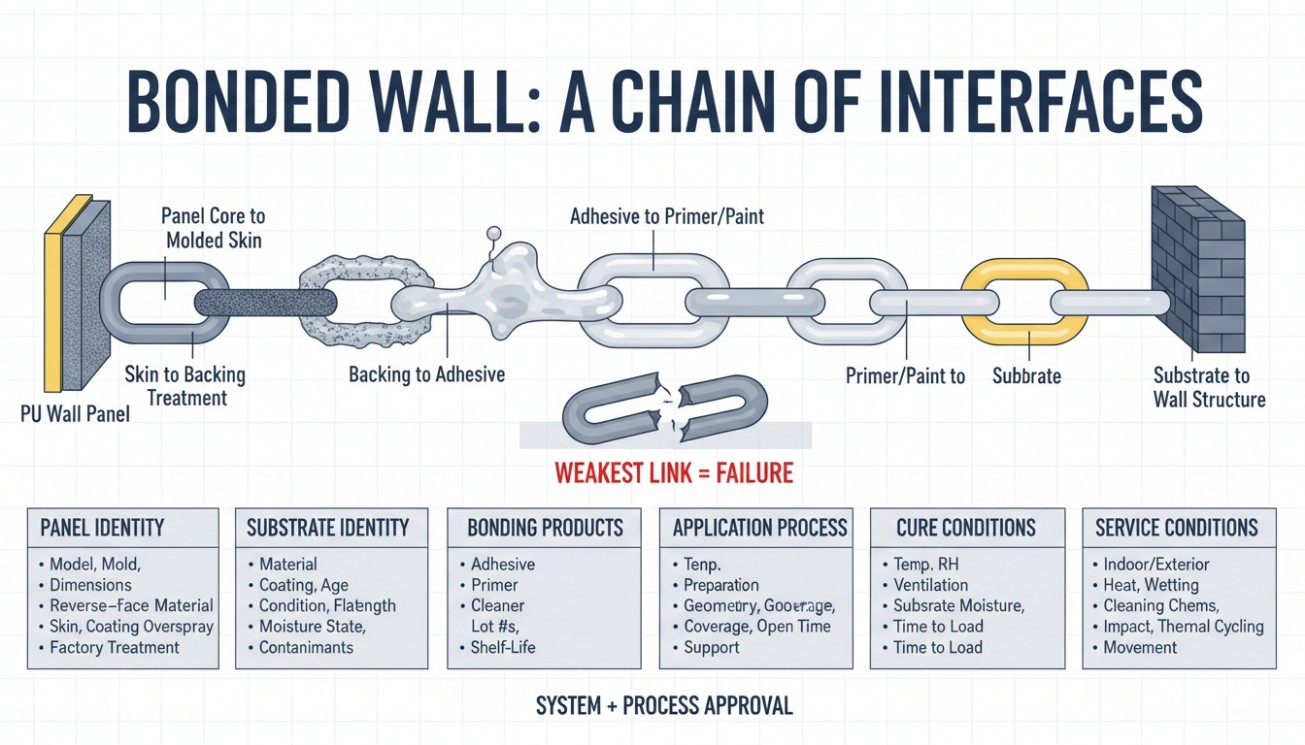
A prevalent and costly error in exterior facade installation is utilizing rigid construction adhesives—such as cheap epoxies, standard liquid nails, or low-grade mastics—to bond PU panels. Rigid adhesives possess very high shear strength but extremely low elongation at break (often less than 5%). When the PU panel expands 5mm but the substrate expands only 0.5mm, a rigid adhesive cannot stretch; it simply snaps.
Engineers must specify Elastomeric Adhesives, particularly Silane-Terminated Polymers (STP), Modified Silicone (MS) polymers, or high-grade Polyurethane structural adhesives. These advanced chemical compounds boast an elongation capacity ranging from 300% to over 600%. They act as a microscopic, flexible shock absorber between the rigid substrate and the dynamic panel. During the extreme heat of the day, the adhesive layer stretches to accommodate the PU panel's expansion. At night, it elastically returns to its original shape. This chemical flexibility safely disperses the thermal shear stress across the entire surface area of the panel, preventing localized bond failure.
7. Factory-Level QA: Designing Stability into the Polymer Matrix

Not all PU faux stone panels are engineered equally. The macro-behavior of the panel under extreme thermal load is largely dictated by the chemical formulation and structural engineering applied at the factory level. B2B procurement teams and supply chain auditors must rigorously evaluate manufacturers based on their internal structural integrations designed to mitigate CLTE.
High-Density Closed-Cell Foaming
Low-density PU foam (e.g., under 120 kg/m³) is highly porous, predominantly filled with air, and lacks the internal tensile strength to resist deformation. Premium exterior-grade faux stone requires high-density foaming (typically 200 to 300 kg/m³ or higher). Higher density creates a much tighter, more robust internal cellular matrix. The thicker cell walls provide significant mechanical resistance against the thermal expansion of the blowing agents trapped within, effectively restricting the overall physical expansion footprint of the panel.
Embedded Fiberglass Reinforcement Grids
To combat thermal bowing—a specific type of catastrophic deformation where the sun-facing side of the panel expands faster and further than the shaded back side against the wall, causing the panel to curve outward in the center—leading manufacturers embed a high-tensile fiberglass mesh layer immediately behind the decorative surface layer during the reaction injection molding (RIM) process.
Fiberglass has a near-zero coefficient of thermal expansion. By chemically integrating this rigid mesh into the thermoplastic matrix while the foam is expanding and curing, it acts as an internal structural skeleton. This skeleton forces the panel to remain dimensionally stable, distributing localized heat stress evenly across the panel's geometry and significantly lowering the overall CLTE of the final composite product.
In-Mold Barrier Coatings and UV Reflectivity
Applying a specialized aliphatic barrier coat inside the mold before injecting the polyurethane serves a dual purpose. Aesthetically, it creates the highly realistic, multi-tonal stone texture. Engineering-wise, it provides a vital layer of UV deflection and infrared heat reflection. High-performance barrier coats, often fortified with UV inhibitors and heat-reflective pigments, reduce the amount of solar energy absorbed deep into the core foam. By minimizing heat absorption at the surface, the coating effectively lowers the maximum ΔT the panel will experience in the field, thereby reducing the total expansion delta.
8. The Commercial Liability of Failing to Address Thermodynamics
For B2B buyers, commercial general contractors, and facade installers, the financial liability of ignoring thermal dynamics is massive. Aesthetic buckling leads to immediate client rejection, project handover delays, and withheld final payments. Worse, when panels buckle and pull away from the wall, they compromise the building's exterior weather barrier.
Water infiltration behind the compromised cladding can lead to black mold proliferation, severe rot in timber framing, and spalling or rebar corrosion in concrete substrates. The cost of remediating a failed commercial facade easily exceeds the initial cost of the cladding material itself by a factor of three or four.
Furthermore, warranties from reputable PU faux stone manufacturers strictly outline installation requirements in their technical data sheets, explicitly stating the necessary expansion gaps based on their proprietary laboratory CLTE data. Failure to calculate and implement these precise tolerances immediately and legally voids the manufacturer's warranty. This shifts 100% of the financial liability for facade remediation, tear-down, and replacement onto the installing contractor or the sourcing firm.
Conclusion
Polyurethane faux stone is an undeniable marvel of modern building materials, offering incredible speed of installation, striking authentic aesthetics, structural weight reduction, and massive logistical freight savings across the global supply chain. However, successfully specifying and deploying this material requires a fundamental mindset shift from traditional masonry. It is not static rock; it is a dynamic, moving, thermodynamically active building skin.
By demanding proper ASTM D696 testing data from OEM suppliers, rigorously calculating expansion gaps based on localized temperature extremes, utilizing advanced elastomeric fastening systems, and ensuring factory-level fiberglass reinforcement, engineering teams can entirely neutralize the threat of thermal buckling. Mastering these thermodynamic principles ensures a flawless, enduring commercial facade that performs perfectly in the freezing winters of the Arctic or the blistering summers of the desert.
Focused FAQ
1. At what specific surface temperature does a high-density PU faux stone panel risk permanent thermal deformation?
Standard architectural high-density PU foam remains structurally stable and retains its shape memory up to approximately 80°C to 85°C (176°F - 185°F). Beyond this critical threshold, the thermoplastic matrix approaches its glass transition phase. Prolonged exposure above this temperature while under mechanical stress (such as being pinned tightly to a wall) will lead to irreversible plastic deformation, warping, and cell collapse. Utilizing lighter-colored panels with a higher Light Reflectance Value (LRV) in notoriously hot climates is a critical engineering strategy to mitigate this risk by actively reflecting infrared heat away from the facade.
2. Can I install PU wall panels tightly together (hard butt joint) to achieve a completely seamless, natural stone look?
Absolutely not. Installing polymer panels with a "hard butt joint" (zero millimeter gap) on an exterior facade guarantees structural buckling when ambient temperatures and solar radiation rise. The material must expand; if it cannot expand laterally, it will expand outward, ripping fasteners from the wall. You must leave a mathematically calculated expansion gap based on the CLTE formula. This necessary gap is typically disguised using color-matched, sand-textured elastomeric caulking that mimics mortar, or by utilizing proprietary shiplap and interlocking finger-joint designs engineered by the manufacturer that hide the expansion space behind an overlapping polyurethane flange.
3. How does the choice of building substrate (Concrete vs. Wood vs. Steel) affect the PU panel's thermal expansion behavior?
The substrate itself does not change how the PU panel expands, but it dictates the severity of the "Differential Movement" shear stress. A PU panel expands much faster and to a much greater degree than concrete, wood, or steel. Therefore, the connection interface between the two materials must be highly flexible. If you rigidly bond a rapidly expanding PU panel to a static concrete wall using a low-elongation adhesive like epoxy, the differential movement will cause the adhesive bond to shear and fail catastrophically over time. The substrate dictates that the adhesive must act as a flexible shock absorber.
4. What are the strict job-site storage and acclimation requirements for PU panels prior to cold weather installation?
Thermal shock and failure to acclimate are leading causes of winter installation failures. PU panels must be unpacked and acclimated to the actual ambient installation temperature of the job site for a minimum of 24 to 48 hours prior to mounting. If panels are stored in a heated indoor warehouse at 20°C (68°F) and then immediately taken outside to be installed on a facade at -10°C (14°F), they will rapidly contract immediately after being fastened. This rapid shrinkage places immense tensile stress on the cold, embrittled fasteners, risking immediate micro-cracking around the screw heads and compromising the waterproof integrity of the installation.
5. From an engineering standpoint, is there a physical difference between PU panels formulated for interior decorative use versus those engineered for exterior facades?
Yes, there is a massive chemical and structural difference. Interior PU panels do not face UV radiation, driving rain, or extreme thermal deltas. Consequently, they are often manufactured using lower foam densities (to save on chemical costs) and completely lack internal fiberglass reinforcement matrices. Exterior panels are engineered with high-density polyurethane, UV-resistant aliphatic barrier topcoats, and internal stabilization fiberglass mesh specifically designed to combat environmental stress, wind load, and CLTE forces. Using an interior-grade panel on an exterior facade will result in rapid color fading and guaranteed thermal buckling.
#PUWallPanels #ThermalExpansion #ExteriorCladding #FauxStone #EngineeringMaterials #B2BSourcing #ASTMStandards #ConstructionTech #BuildingMaterials #FacadeEngineering