Where Non-Pressure Solar Water Heaters Make the Most Sense: Rural Homes, Farms and Off-Grid Buildings
The Best Market for Non-Pressure Solar Water Heaters Is Not “Everywhere”
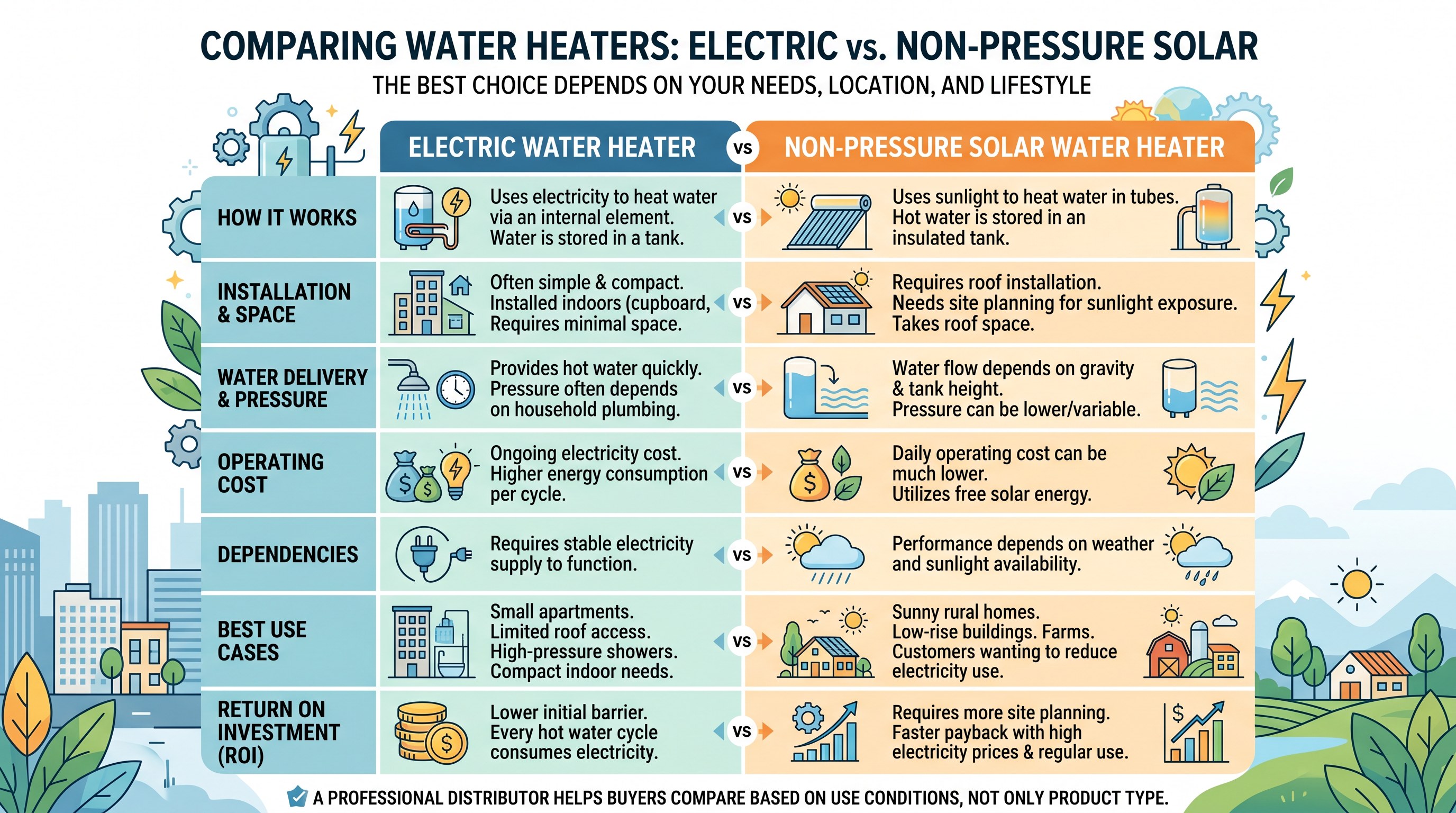
A non pressure solar water heater should not be positioned as a universal hot water solution for every building. Its real strength appears when it is matched with the right environment: low-pressure water supply, simple roof structures, strong sunlight, moderate domestic hot water demand, limited installation budgets, and users who value practical performance more than high-pressure shower comfort.
This is why the product remains relevant in many international markets. In modern urban homes, users may prefer pressurized or split solar water heating systems because they expect stable water pressure, concealed piping, multiple bathrooms, automatic backup heating, and a more integrated indoor experience. But in rural homes, farms, off-grid buildings, small staff houses, and low-infrastructure areas, the requirements are different.
In these applications, the buyer is usually not asking for a luxury hot water system. The buyer is asking for a reliable, understandable, and cost effective solar water heater that can reduce electricity or gas use, work with existing water supply conditions, and be maintained by local installers. This is where the non-pressure system can be very competitive.
The most important point is system fit. A low pressure solar water heater works best when the building does not require high mains pressure. A gravity fed solar water heater works best when the tank can be installed high enough to deliver usable hot water flow. An evacuated tube solar water heater works best when sunlight is strong enough to heat water efficiently during the day. A thermosiphon solar water heater works best when the tank and collector are positioned correctly to support natural circulation.
When these conditions are present, a non-pressure system is not a compromise. It becomes the right solution.
Why Rural Homes Are a Natural Application

Rural homes are one of the strongest application scenarios for non-pressure solar water heaters. Many rural households have very different water and energy conditions compared with urban houses. They may rely on rooftop tanks, wells, boreholes, gravity-fed water, intermittent municipal supply, or small pumps. The plumbing system may be simple, and hot water demand may be concentrated around bathing, washing, and household cleaning.
In this type of building, a solar water heater for rural homes must be practical before it is sophisticated. It should be easy to install, easy to explain, easy to repair, and affordable for the household. A non-pressure solar water heater fits this need because it usually has a compact structure: storage tank, evacuated tubes, frame, inlet, outlet, overflow, and basic accessories. The user can see how it works, and the installer can understand the system without complicated design software or advanced commissioning tools.
A rural home may also have more available roof space than an urban apartment. The system can often be installed on a sloped roof, flat roof, or simple support platform. If the tank is positioned above the bathroom outlet, the hot water can flow by gravity. This reduces the need for complex pressure equipment.
Another reason rural homes are suitable is energy economics. In many rural areas, electricity may be expensive, unstable, or limited. Gas supply may be unavailable or inconvenient. Firewood or other traditional heating methods may require labor and create safety or environmental concerns. A rural solar hot water system can reduce daily energy dependence by using sunlight for water heating.
For families, this can improve daily comfort without requiring a large infrastructure upgrade. For distributors, this creates a product category that can be sold through hardware stores, plumbing shops, rural construction suppliers, and local installer networks.
However, rural application does not mean every rural home is suitable. The roof must be strong enough. The installation height must be reasonable. The local climate should support solar heating. The user must understand that water pressure will not be the same as a pressurized system. If these points are explained clearly, rural homes can be one of the most successful markets for non-pressure systems.
Farms Need Simple Hot Water Solutions, Not Always Complex Systems

Farms are another strong application area for a non pressure solar water heater. A farm may need hot water for worker accommodation, residential buildings, washing areas, small processing rooms, animal care support, or basic cleaning tasks. The hot water demand may not always be luxurious, but it is often practical and recurring.
A solar water heater for farms should usually be durable, easy to maintain, and suitable for local water conditions. Farms often have open outdoor space, strong sunlight exposure, and buildings with accessible roof or ground-mounted installation areas. These conditions can make solar thermal systems attractive.
The non-pressure system is especially useful when the farm already uses a storage tank or low-pressure water supply. In many farm environments, water is pumped into a tank and then distributed by gravity. A gravity fed solar water heater can fit this water logic without requiring full pressure integration.
For example, a worker house on a farm may need hot water mainly in the evening. During the day, the evacuated tube solar water heater collects solar heat and stores hot water in the tank. If the tank insulation is good and the system is sized correctly, the water can be used later for bathing or washing. The system does not need to run a boiler all day, and it does not depend on a complex pump-controlled solar loop.
Farms also value repairability. A system with too many electronic components, sensors, pumps, and special parts may become difficult to maintain in remote areas. A non-pressure solar water heater has fewer complicated components. If a tube breaks, it can often be replaced. If a fitting leaks, it can be repaired by a local technician. If scale builds up, maintenance can be planned. This simplicity is a business advantage.
For B2B buyers serving agricultural regions, the farm market should not be ignored. It may not always demand high-end products, but it values practical reliability. A supplier that can provide strong frames, corrosion-resistant materials, clear installation manuals, spare tubes, and packaging suitable for long-distance transport can build a stronger position in farm-related channels.
Off-Grid Buildings Need Energy Independence
An off grid solar water heater serves a different type of need. In off-grid buildings, the key issue is not only cost. It is independence. The building may not have reliable grid electricity. It may use solar PV, batteries, generators, gas cylinders, or hybrid energy systems. Every daily load matters, and water heating can be one of the largest energy demands.
A non-pressure solar water heater can reduce the burden on the electrical system because basic solar heating does not require electric power. The sun heats the water through the evacuated tubes, and thermosiphon circulation moves water naturally between the collector and the storage tank. This makes the system attractive for cabins, remote houses, eco-lodges, rural clinics, field stations, small camps, and temporary living facilities.
In an off-grid context, simplicity is not a weakness. It is a key advantage. A system that can heat water with minimal electrical dependence is valuable because it protects limited battery capacity. Instead of using electricity to heat water every day, the building can use solar thermal energy directly.
However, off-grid buildings also require careful design. The hot water demand must be realistic. The tank capacity should match the number of users. The system should be protected from freezing if the region is cold. The water source must be reliable enough to keep the tank filled. The installation must prevent damage from wind, animals, dust, or long periods of non-use.
In some off-grid buildings, an electric backup heater may still be needed. This does not reduce the value of the system. It simply means the solar water heater handles the daily base load, while backup heating supports cloudy days or high-demand periods. The best off-grid solution is often not one energy source alone, but a practical combination.
For content marketing, this is an important point. Users searching for off grid solar water heater solutions are usually looking for reliability, not only a low price. They want to know whether the system can work without a pump, how much hot water it can provide, what happens on cloudy days, whether it can connect to a storage tank, and how difficult it is to maintain. These questions should be answered clearly in product pages and blogs.
Low-Pressure Water Supply Areas Are the Core Fit
The phrase “low pressure solar water heater” is not only a product keyword. It describes the real condition where the system makes sense.
In many buildings, especially outside dense urban areas, water pressure is not stable or not strong. The user may have a rooftop water tank, a manual filling system, a small pump, or a gravity-fed pipeline. Installing a pressurized solar water heater into this environment may not always be necessary or economical. The building itself may not be designed for high-pressure water distribution.
A non-pressure solar water heater can fit these conditions because it does not depend on mains pressure in the same way. The hot water outlet is usually driven by height difference. If the tank is installed high enough above the outlet, the system can deliver usable flow for basic domestic hot water.
This makes it suitable for single-story homes, rural bathrooms, outdoor washing points, simple accommodation units, and places where the hot water outlet is not far from the tank. The more direct the pipe route, the better the experience usually is.
But this is also where many mistakes happen. Some buyers assume that if the water is hot, the system will automatically provide good shower pressure. This is not true. Temperature and pressure are different performance indicators. A non-pressure system may heat water well but still produce weak flow if the tank is too low, the pipe is too long, or the shower head requires higher pressure.
For suppliers and distributors, the sales process should include basic water pressure education. Customers should know that a gravity fed solar water heater is best suited for simple, low-pressure use. If the customer wants strong water flow, a booster pump or a different system may be required. Honest explanation prevents complaints.
In low-pressure regions, the right product message is not “same comfort at lower price.” The right message is “a practical solar hot water system designed for low-pressure water supply.”
Cost-Sensitive Markets Need Clear Value, Not Only Low Price
A cost effective solar water heater is not the same as the cheapest product. This distinction is important in B2B markets.
Many non-pressure solar water heaters are sold into cost-sensitive regions. Buyers compare prices closely, and distributors may compete heavily on tank capacity, tube quantity, and unit cost. But if the market focuses only on low price, product quality can decline. Thin tanks, weak frames, poor insulation, fragile tubes, bad packaging, and incomplete accessories can all create problems after installation.
A truly cost-effective system should reduce total ownership cost. It should be affordable to purchase, but also reliable enough to avoid frequent complaints. It should be simple to install, but not unsafe. It should use accessible components, but not fail after one season. It should be easy to ship, but protected well enough to prevent broken tubes and damaged tanks.
For rural and off-grid buyers, a failed product is expensive even if the original price was low. If the household is far from the installer, one service visit can be difficult. If spare tubes are not available, the whole system may lose performance. If the tank leaks, the customer loses trust in the distributor. If the frame corrodes quickly, the brand reputation suffers.
This is why B2B buyers should evaluate non-pressure products through a value lens. The important questions include: Is the inner tank material suitable for the target water quality? Is the insulation thick enough for evening use? Is the frame strong enough for local roof and wind conditions? Are the evacuated tubes packaged safely? Are spare parts available? Is the installation manual clear? Are accessories complete?
In cost-sensitive markets, professional product selection matters more, not less. The buyer has less tolerance for after-sales complexity. A low-cost system must still be dependable.
Small Institutions and Staff Housing Can Be Good Applications
Non-pressure solar water heaters are not limited to individual households. They can also be used in small institutional or semi-commercial applications if the demand is predictable and the system design is appropriate.
Examples include small schools, rural clinics, staff dormitories, worker accommodation, farm housing, small workshops, roadside facilities, and community buildings. These places may need hot water for washing, bathing, cleaning, or basic hygiene. The budget may be limited, and the installation environment may not support a complex central hot water system.
A non-pressure system can work well when hot water demand is moderate and distributed across simple use points. Multiple units may be installed instead of one large central system. This can reduce plumbing complexity and make maintenance easier. If one unit needs service, the entire building may not lose hot water.
For example, a small staff housing block may install several 200L or 300L non-pressure systems on the roof, each serving a defined bathroom area. A rural school may use solar hot water for staff accommodation or hygiene rooms. A small clinic may use solar-heated water for basic washing needs, with backup heating when required.
The key is not to overpromise. Large hotels, high-demand dormitories, hospitals, and commercial laundries usually need more engineered hot water solutions. But small institutions with simple usage patterns can be suitable.
For distributors, this application category can open project opportunities beyond household retail. The message should focus on low operating cost, simple maintenance, scalable installation, and suitability for buildings with modest hot water demand.
Why Strong Sunlight Markets Respond Well to Non-Pressure Systems
Solar thermal performance depends on local sunlight. Non-pressure solar water heaters are especially attractive in regions with strong solar radiation, long sunny seasons, and mild climates. In these markets, the system can heat water effectively for much of the year, and the need for backup heating may be reduced.
Strong sunlight markets also often overlap with rural and cost-sensitive markets. In many sunny regions, households may still lack reliable hot water infrastructure. This creates a clear opportunity: the natural resource is available, the demand is real, and the system does not need to be overly complex.
An evacuated tube solar water heater is useful in this context because evacuated tubes can collect heat efficiently. The system can be installed visibly on rooftops, which also helps sales. When neighbors see the product working, it can create local awareness and word-of-mouth demand.
However, strong sunlight also creates risks if the system is not used or maintained properly. Overheating can occur when hot water is not drawn for long periods. If the tank runs dry under strong sun, tube stress and system damage may happen. In hot climates, users should understand water-level management and safe operation during long absences.
This is another reason why market education matters. Selling a non-pressure system is not only about telling customers that it saves energy. It is also about teaching correct usage: keep the tank filled, check overflow, inspect tubes, avoid blocking vents, and follow instructions if the system will not be used for a long time.
Where Non-Pressure Systems Are Not the Best Choice

Understanding where the system fits also means understanding where it does not fit.
A non-pressure solar water heater is usually not the best choice for high-rise apartments. These buildings often require pressure-rated plumbing, centralized systems, or more advanced hot water distribution. A rooftop tank-and-tube system may not match the building design or water pressure requirements.
It is also not ideal for luxury homes where users expect strong shower pressure, concealed installation, smart control, multiple bathrooms, and stable hot water under all conditions. In such cases, a pressurized or split solar water heater may be more suitable.
Cold regions with freezing risk require careful evaluation. A basic direct non-pressure system may face freeze damage if water remains in exposed tubes or pipes. In these markets, split systems, antifreeze loops, heat exchangers, or other protected designs may be required.
Buildings with poor roof structure are also risky. A full storage tank is heavy. The frame, tubes, and water load must be supported safely. If the roof is old, weak, or poorly constructed, installation may require reinforcement or an alternative location.
Customers with very high hot water demand may need a more engineered solution. A non-pressure household unit is not automatically suitable for hotels, large dormitories, commercial kitchens, or industrial washing. These applications need proper load calculation, storage planning, backup heating, and professional system design.
The best suppliers do not hide these limits. They explain them. This builds trust and helps the buyer choose the right system.
How B2B Buyers Should Identify the Right Target Market

For B2B buyers, the non-pressure category should be evaluated through market segmentation.
The first target market is rural retail. This includes households, small contractors, local plumbers, hardware stores, and regional distributors. Product selection should emphasize common capacities, durable packaging, easy installation, and visible price-performance value.
The second target market is agricultural and farm supply. In this channel, products should be positioned around practical hot water for farm homes, worker housing, washing areas, and remote buildings. Strong frames, corrosion resistance, and simple maintenance are important.
The third target market is off-grid and eco-building suppliers. These buyers care about energy independence, low electricity use, and compatibility with simple infrastructure. Product content should explain passive heating, thermosiphon circulation, gravity-fed delivery, and backup options.
The fourth target market is small institutional projects. These include small schools, clinics, dormitories, staff housing, and rural public facilities. The sales message should focus on operating cost reduction, easy deployment, and scalable units.
The fifth target market is developing housing programs. In some regions, builders and local governments may look for affordable hot water solutions for residential communities. A non-pressure solar water heater can be considered if the housing design supports rooftop installation and low-pressure use.
For each target market, the supplier should adapt the message. A farmer does not buy for the same reason as a rural household. A hardware store does not evaluate the product like a project contractor. An off-grid homeowner cares about different risks than a city homeowner. Strong content should reflect these differences.
The Role of Capacity in Application Matching
Capacity selection is a major part of application fit. A non-pressure system may be suitable for a building, but the wrong capacity can still cause dissatisfaction.
A small household may use a 100L or 150L system if daily hot water demand is limited. A larger family may need 200L or 300L. A farm worker house or small dormitory may need multiple systems or larger models depending on the number of users and bathing schedule.
But capacity should not be selected by user count alone. Climate matters. In sunny climates, the system may recover heat more effectively. In cloudy or cooler regions, a larger tank does not automatically solve the problem because the system may not heat all the water to the desired temperature. Usage timing also matters. If everyone bathes at night, the storage tank must retain enough heat until evening. If users spread hot water use across the day, the demand pattern changes.
The number and quality of evacuated tubes also matter. A 200L tank with too few tubes may heat slowly. A large tank with poor insulation may lose heat quickly. A small tank with strong sunlight may overheat if water is not used regularly. The product must be balanced.
For B2B product lines, it is better to build a clear capacity matrix. For example, small household, standard family, large family, farm staff room, and small institutional use can each be linked to recommended capacities and tube configurations. This helps distributors sell with confidence and reduces random model selection.
Installation Conditions Decide Real Performance
A non-pressure solar water heater often looks simple, but installation determines whether the system performs well.
The tank should be installed at a suitable height above the hot water outlet. This is important for gravity-fed flow. The system should face strong sunlight and avoid shading from trees, buildings, antennas, walls, or other roof equipment. The frame should be fixed securely. Pipes should be as short and direct as possible. The roof should be strong enough to support the full load.
The hot water outlet should use low-resistance fittings where possible. Some modern shower heads and thermostatic mixers are not suitable for low-pressure systems. If these are used, the user may experience weak flow or unstable mixing. In rural applications, simple fixtures often work better than high-pressure bathroom fittings.
The water supply should also be stable. If the tank runs dry, the system can be damaged under strong sunlight. If water quality is hard, scale maintenance should be considered. If the area has dust, storms, or strong wind, the system should be inspected periodically.
For off-grid buildings, installation should include planning for periods when the building is not occupied. If the system will sit unused under strong sun, users may need instructions for safe operation or partial shading. For farms, animals, tools, or roof access activities should not damage pipes or frames.
A well-installed non-pressure system can perform reliably. A poorly installed one can create complaints even if the product quality is acceptable. This is why suppliers should provide installation diagrams, videos, manuals, and basic training.
Content Strategy for This Application Category
For a website building authority around non-pressure solar water heaters, application-based content is very valuable. Many buyers do not begin by searching for product names. They search by situation.
They may search “solar water heater for rural homes,” “off grid solar water heater,” “solar water heater for farms,” “low pressure solar water heater,” “solar hot water for remote house,” or “gravity fed solar water heater.” These searches show real use intent. The user already has a problem and wants to know what type of system fits.
This is why application blogs can perform better than generic product introductions. A good article should not only say that the system is affordable. It should explain why affordability matters in that specific use case. It should not only mention evacuated tubes. It should explain why evacuated tubes are practical for sunny rural rooftops. It should not only say “easy installation.” It should explain what installation conditions are still required.
For GEO and AI search visibility, the content should answer direct questions clearly: where is a non-pressure solar water heater best used? Is it suitable for farms? Can it work off-grid? Does it need electricity? Is it good for low water pressure? What type of building should avoid it? What should B2B buyers check?
The more clearly the content maps product type to real application, the more useful it becomes for both users and search systems.
Focused FAQ
Where is a non-pressure solar water heater most suitable?
A non-pressure solar water heater is most suitable for rural homes, farms, off-grid buildings, low-pressure water supply areas, small staff housing, and cost-sensitive domestic hot water applications. It works best when the building can support rooftop installation and gravity-fed hot water delivery.
Is a non-pressure solar water heater good for rural homes?
Yes, it can be a strong choice for rural homes because many rural buildings use simple plumbing, rooftop tanks, low-pressure water supply, and accessible roof space. The system is practical when users need affordable hot water rather than high-pressure luxury shower performance.
Can a non-pressure system be used on a farm?
Yes. A solar water heater for farms can provide hot water for worker housing, washing areas, residential buildings, and basic cleaning needs. It is especially useful when the farm has strong sunlight, open installation space, and low-pressure or tank-based water supply.
Is it suitable for off-grid buildings?
A non-pressure solar water heater can be suitable for off-grid buildings because basic solar heating does not require electricity. It can reduce the load on batteries or generators. However, backup heating may still be needed during cloudy weather or high-demand periods.
Does a non-pressure solar water heater need strong water pressure?
No. It is designed for low-pressure or gravity-fed conditions. However, the tank must be installed high enough above the outlet to create usable water flow. If strong shower pressure is required, a pressurized or split system may be better.
What type of climate is best for this system?
It performs best in sunny and mild climates with low freezing risk. Strong sunlight improves heating performance. In freezing climates, a basic direct non-pressure system may not be suitable without special protection.
Can it be used for hotels or large dormitories?
A standard household non-pressure system is usually not the best solution for large hotels or high-demand dormitories. Small staff housing or simple dormitory blocks may use multiple units, but large projects require proper hot water system design.
Why is it popular in cost-sensitive markets?
It is popular because the structure is simple, the installation cost can be lower, and the system can reduce electricity or gas use. However, buyers should still check tank quality, insulation, tube strength, frame durability, and packaging.
What is the biggest limitation in rural applications?
The biggest limitation is usually hot water pressure. Since the system depends on gravity, poor tank height or long pipe routes can reduce outlet flow. Correct installation is essential.
What should B2B buyers consider before selling this product?
B2B buyers should evaluate target market water pressure, building type, climate, roof structure, user budget, installer skill level, spare parts availability, packaging strength, and after-sales service capability.
Conclusion
A non-pressure solar water heater makes the most sense when it is treated as an application-specific solution rather than a universal product. Its strongest markets are rural homes, farms, off-grid buildings, low-pressure water supply areas, and cost-sensitive regions where practical hot water matters more than high-pressure comfort.
Its value comes from a clear system logic. Evacuated tubes collect solar heat. The tank stores hot water. Thermosiphon circulation works without a pump. Gravity-fed delivery fits simple water supply conditions. The structure is understandable, the installation is relatively straightforward, and the operating cost can be low.
But success depends on correct matching. The building must have suitable roof space and structure. The tank must be high enough for usable flow. The local climate should support solar heating. The capacity must match real demand. The user must understand the difference between hot water temperature and water pressure.
For B2B buyers, this category should be positioned carefully. It is not just a cheap solar water heater. It is a practical solar hot water solution for markets where simplicity, affordability, local repairability, and low-pressure compatibility are important. Distributors, importers, and suppliers who understand these applications can build stronger product strategies, reduce after-sales problems, and serve customer groups that are often overlooked by high-end solar water heating systems.
When sold into the right market with the right expectations, a non-pressure solar water heater remains one of the most practical solutions in the global solar hot water industry.
#NonPressureSolarWaterHeater #SolarWaterHeaterForRuralHomes #OffGridSolarWaterHeater #LowPressureSolarWaterHeater #GravityFedSolarWaterHeater #SolarWaterHeaterForFarms #EvacuatedTubeSolarWaterHeater #ThermosiphonSolarWaterHeater #RuralSolarHotWaterSystem #CostEffectiveSolarWaterHeater