Why Hydrocarbon Solvent Trials Succeed in the Lab but Fail on the Production Floor
The trial passed, but the process still failed
One of the most frustrating moments in industrial solvent work happens after what looks like success. The laboratory team has finished the comparison. The target contamination was removed. The panel looked clean. The evaporation profile seemed acceptable. Internal stakeholders saw the photos, reviewed the notes and concluded that the solvent had passed. A recommendation was made. Procurement moved forward. The plant prepared for implementation.
Then production started, and confidence began to collapse.
The cleaning cycle became inconsistent. Operators reported that the part did not “feel” as clean as it had in the lab. Some residues were removed quickly, while others seemed to smear or return. The process required more wiping than expected. Drying looked fine on a flat coupon but less convincing on real equipment geometry. A product that seemed acceptable in a controlled trial became harder to trust in repetitive use. The same solvent that had performed well on the bench now felt less stable, less efficient or less clear when exposed to real production conditions.
This pattern is common, and it is often misunderstood.
When a solvent trial succeeds in the laboratory but fails on the production floor, many teams blame the wrong thing. Procurement may suspect the supplier. Production may say the lab test was unrealistic. Technical teams may conclude that the solvent was never good enough. Management may decide that plant staff resisted change. In reality, the most common failure is not dishonesty, incompetence or bad chemistry. The most common failure is translation.
A laboratory trial answers a smaller question than most organizations think it answers. It may confirm that certain hydrocarbon solvents can remove a target material under controlled conditions. It may show that a certain formulation behaves acceptably in a defined setup. It may demonstrate a useful direction. But it does not automatically prove that the same result will survive time pressure, equipment geometry, operator variability, refill cycles, ambient variation, contamination diversity, inspection standards or repeated production use. The laboratory proves possibility. Production demands reliability.
That difference is where many solvent projects break.
This is especially true in the world of industrial solvents, because solvents do not merely act on chemistry. They act inside systems. They interact with parts, surfaces, residues, tools, workers, schedules, ventilation, inspection logic and habits. A laboratory can isolate a variable. A factory cannot. The factory exposes every hidden dependency the trial did not fully capture.
So when a company says a solvent worked in the lab but failed in production, the most useful response is not to argue about whether the lab was wrong. The better question is: what part of industrial reality never made it into the validation model?
That is the question this article explores. Because the gap between a successful laboratory trial and a stable manufacturing outcome is not a mystery. It is a pattern. And once the pattern is understood, solvent validation becomes far more intelligent.
A bench test proves capability, not readiness
The first mistake in many projects is philosophical. Teams treat a bench result as if it were a scaled-down version of the final process. It is not. It is a filtered experiment.
In a controlled setting, the solvent is usually being asked to solve a narrow problem. A known residue is placed on a known surface. The contact time is controlled. The sample size is limited. The test operator is attentive. The solvent is fresh. The container is close by. The wiping material or circulation setup is clean. The environment is relatively stable. Most importantly, the purpose of the test is to determine whether the solvent can work, not whether the process can live with it all day.
This is why a laboratory trial should be understood as proof of capability rather than proof of readiness. It confirms that the chemistry deserves more attention. It does not yet confirm that the operation deserves full confidence.
That distinction matters because organizations frequently overread early results. A good-looking trial creates momentum. People want progress. Suppliers want approval. Procurement wants closure. Technical teams want to avoid endless testing. Production wants practical answers. All of that is understandable. But the more a bench test is treated as final truth, the more likely the scale-up will expose unpleasant surprises.
In reality, solvent scale-up should be treated as a second discipline, not a formality. The scale-up question is not “Does the solvent work?” It is “Does the solvent still work when the process becomes human, repetitive, geometrically messy, time-limited and operationally imperfect?” That is a very different test.
A plant that understands this difference behaves differently from the beginning. It documents not only removal strength, but also where uncertainty might enter once the part becomes larger, the contamination becomes older, the wiping becomes less careful, the air movement changes or the operator is handling ten parts per hour instead of one. This mindset does not slow progress. It prevents false certainty.
A bench test is a gate. It is not the destination.
The first translation error: the contamination in production is never as uniform as the contamination in the trial

One of the most common reasons a successful solvent trial fails later is contamination diversity. In the laboratory, residues tend to be simplified. They are prepared on purpose, selected carefully or sampled in a way that represents a preferred case rather than a full production reality. Even when real plant contamination is brought into the lab, it is often tested in a cleaner and more isolated form than it appears during daily manufacturing.
On the production floor, contamination is rarely so obedient. It varies by age, thickness, exposure time, heat history, substrate texture, previous cleaning attempts, oils mixed with dust, residues layered over other residues, partial curing, operator delay and process interruptions. What looked like one type of soil in the lab becomes several different cleaning problems in the plant.
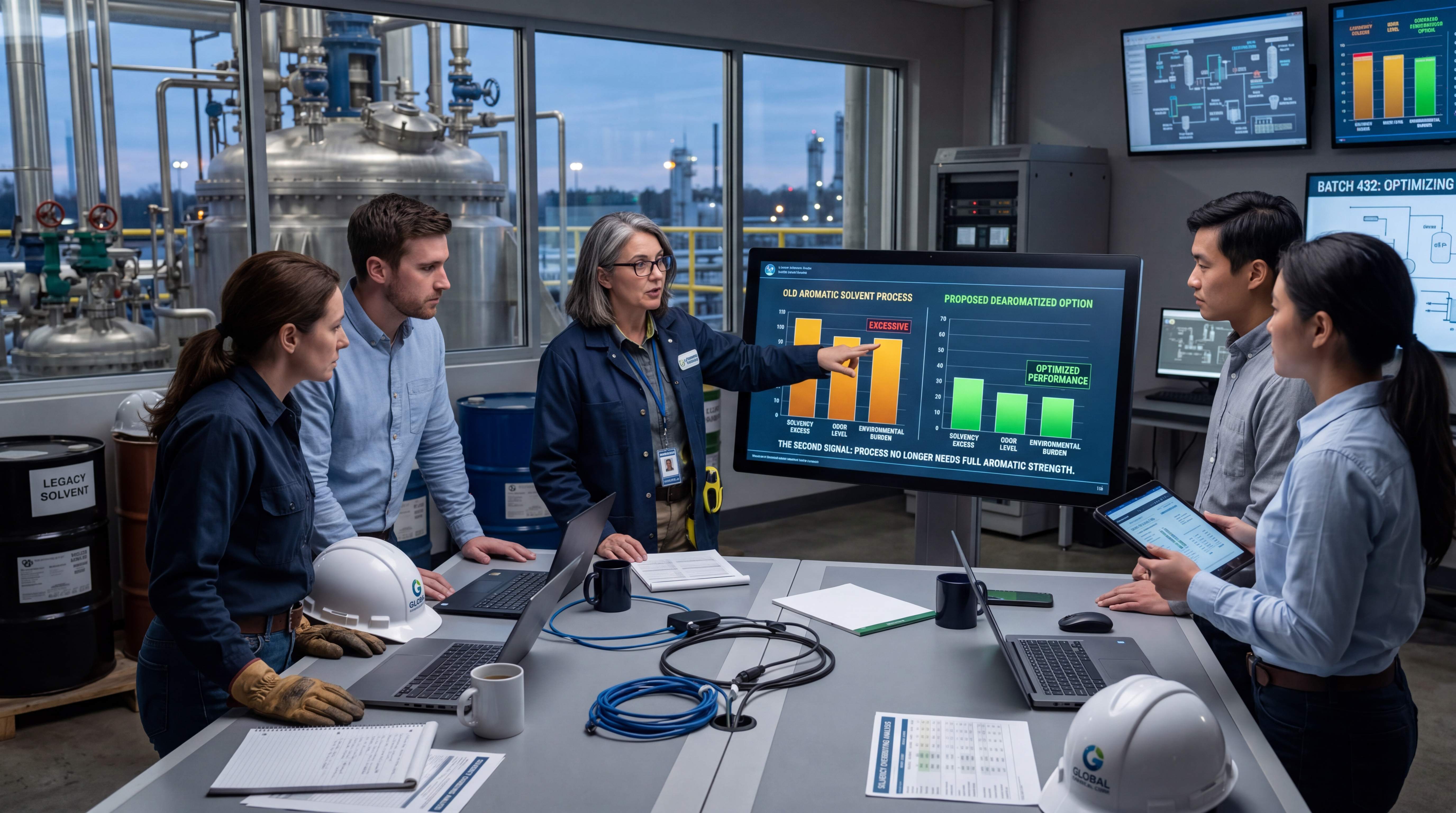
This is especially important for industrial cleaning solvents. A solvent that removes fresh oil beautifully may behave less convincingly when that oil has mixed with fines, oxidized over time or partially baked onto a surface. A product that clears a flat test coupon may struggle when the same contamination sits inside recesses, around fasteners or on thermally stressed equipment. A dearomatized or low odor solvents route may feel excellent under controlled residue conditions, yet lose some of its apparent advantage once the contamination becomes older or more irregular.
The lesson is not that laboratory work is misleading. The lesson is that contamination should be sampled as a range, not as a single case. Strong solvent validation does not ask whether the product can clean the target residue. It asks whether the product can clean the worst believable version of that residue often enough to protect process reliability.
That shift is critical. Production does not fail because the average case works. Production fails because the difficult cases arrive often enough to erode trust. Once operators begin to suspect that the solvent only works on “good days,” they change behavior. They over-wipe, over-rinse, overuse, escalate complaints or quietly seek an older material they trust more. At that point, the trial has not merely failed technically. It has failed culturally.
A mature validation protocol therefore classifies contamination by severity, age, geometry and process origin before scale-up approval. That extra work is not excessive. It is the only way to stop the plant from discovering after implementation that the trial tested the easiest version of the problem.
The second translation error: flat test panels do not behave like real parts

Another major gap between laboratory success and plant failure is geometry. Industrial processes rarely happen on perfect coupons. They happen on parts.
Real parts have corners, blind zones, fastener areas, cavities, weld lines, edges, internal passages, narrow channels, variable surface energies, machining marks and orientation effects that change how a solvent wets, drains, dwells and leaves. A panel that looks clean under laboratory lighting may tell only a fraction of the story.
This matters because hydrocarbon solvents do not operate in a vacuum. Their effectiveness depends not only on chemistry, but on contact. Geometry controls contact. Geometry affects whether the solvent reaches the residue, stays on it long enough, carries it away or redeposits it elsewhere. It affects whether wiping pressure is consistent, whether circulation reaches the same zones each cycle, whether drying happens evenly and whether visual inspection is trustworthy afterward.
A laboratory can partly simulate this, but many projects still rely too heavily on flat comparisons because they are easy to standardize. Standardization is useful, yet it also hides risk. A solvent that appears powerful on a coupon may lose confidence value once it is applied to a part with internal complexity. Conversely, a solvent that looks only average on a coupon may perform quite well in a process where geometry and dwell strategy support it intelligently. That is why geometry must be part of the evaluation, not an afterthought.
In scale-up work, geometry is often the first thing production notices and the last thing the lab anticipated. Operators start saying the same product behaves differently on certain parts. Quality notices that residue concerns cluster around certain features. Maintenance says the solvent seems to work except in “those difficult zones.” These comments are not resistance. They are signals that the trial geometry was too generous.
The correct response is not to dismiss such feedback as anecdotal. It is to treat geometry as a missing variable in the original solvent scale-up model. Once that is done, the project can be re-evaluated more honestly. Sometimes the solvent remains valid but the process needs a modified application method. Sometimes the solvent itself is less suited than the coupon suggested. In both cases, the real issue is the same: the part was more complex than the test.
The third translation error: time on the production floor is not laboratory time

Time is another variable that quietly breaks solvent projects. In the laboratory, time belongs to the test. On the production floor, time belongs to the schedule.
This difference sounds simple, but it changes everything. In a trial, the technician can wait longer, wipe more carefully, repeat a pass, observe the surface closely and extend dwell time if curiosity requires it. The goal is to learn. In production, the goal is to keep moving. Dwell time competes with output. Wiping competes with labor efficiency. Repetition competes with throughput. The process must not only work; it must work at a pace the plant can absorb.
That is why many industrial solvents appear stronger in testing than in operation. The solvent itself may not be weaker. The available time is. A cleaning result achieved with generous dwell in the lab may never be recreated on the line where the operator is managing dozens of parts, multiple tasks or a cleaning station with limited cycle allowance. A formulation that feels stable in a careful test may become fragile once real line tempo compresses the working window.
This is also where solvent performance and labor design become inseparable. If a solvent requires a calmer pace than the production floor naturally allows, the plant must decide whether to redesign the task, accept lower throughput or choose a different solvent strategy. Too many organizations avoid this decision by assuming operators will “adjust.” In practice, they do adjust—by shortening the effective process, which then makes the solvent appear less reliable than it looked in validation.
A mature scale-up trial therefore includes production-relevant timing, not only best-case chemistry timing. It asks whether the solvent can achieve the required outcome inside the real work rhythm. It also asks what happens when the rhythm is slightly broken, because real plants are not metronomes. The solvent that works only when everything is perfect is not yet ready for production.
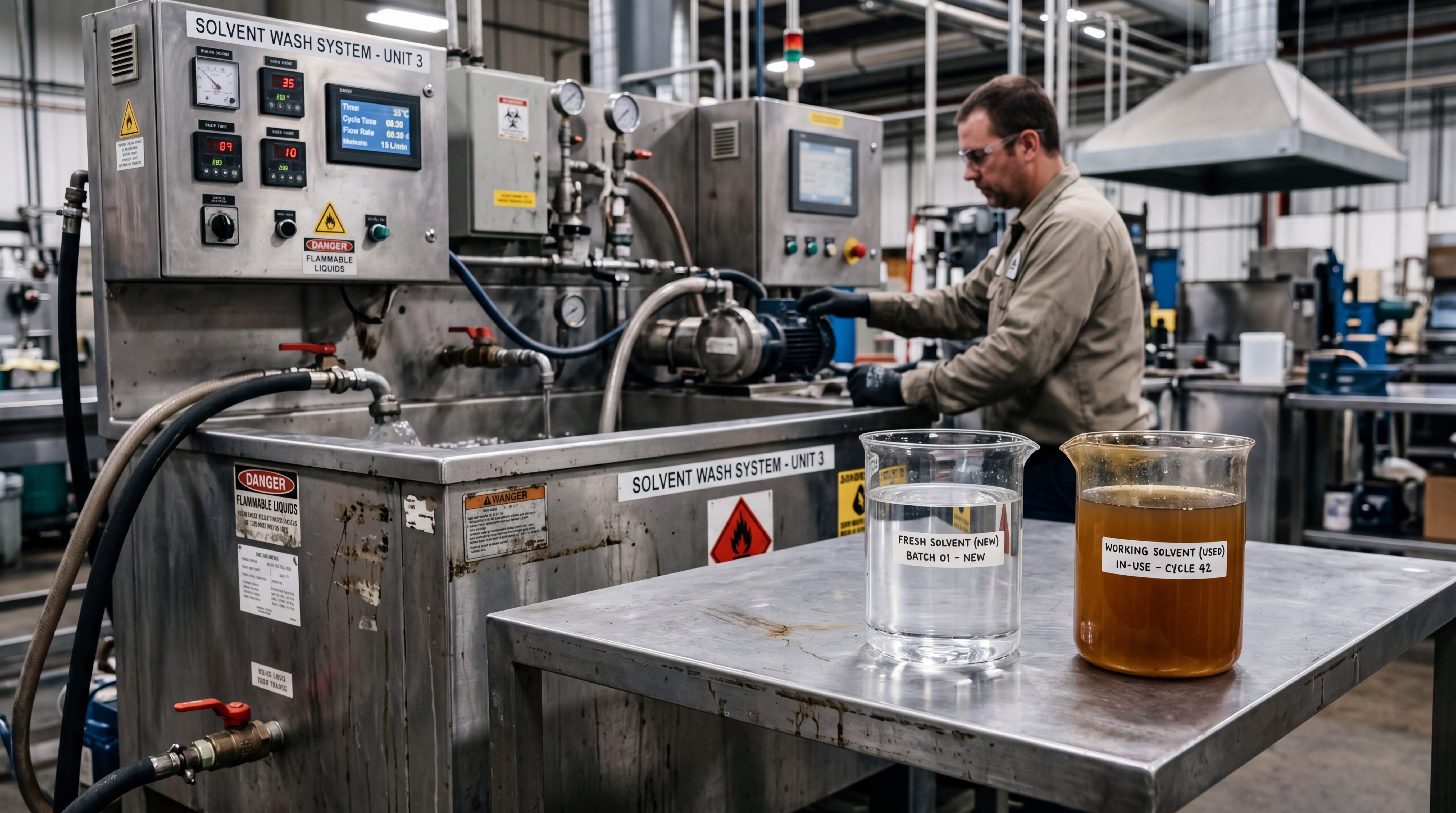
The fourth translation error: fresh solvent behaves differently from working solvent

Another gap appears once the solvent stops being pristine. Most trials begin with fresh material. Production often runs with working material.
This distinction matters across cleaning, process and formulation uses. A fresh solvent has full clarity, minimal contamination load, stable starting composition and predictable response. A working solvent may already contain extracted residues, absorbed fines, carryover material, moisture, dilution effects or other burdens that change how it behaves. Sometimes these changes are small. Sometimes they are large enough to affect confidence, cycle time or inspection quality.
In industrial cleaning solvents, this is one of the most overlooked reasons for disappointment. A solvent that performs very well when new may lose apparent force or leave a less clear finish as it accumulates contamination. The lab trial may have proven the chemistry, while production needed a broader answer that included bath life, refresh strategy, carryover management and operator rules for recognizing decline. Without those controls, the plant ends up blaming the solvent for a process-maintenance problem it never formally designed.
This same issue affects solvent consistency thinking. Companies often focus on batch-to-batch supply variation, which is important, but forget in-use variation. A perfectly consistent delivered product can still create inconsistent results if the process does not define how the solvent degrades, when it is refreshed, what contamination load is acceptable and how that threshold is recognized in real work. A scale-up that ignores working-life behavior is incomplete by design.
The best validation programs therefore include staged solvent condition testing. They test fresh performance, loaded performance and end-of-cycle performance. They ask whether the result is stable enough across those conditions to protect production confidence. That is what real process thinking looks like. It recognizes that a plant does not buy only a new solvent. It buys a solvent life cycle.
The fifth translation error: the plant inspects differently than the lab evaluates

A solvent may succeed chemically and still fail operationally if the plant cannot inspect the result with confidence. This is one of the most subtle but most important reasons projects collapse after implementation.
Laboratory evaluations often rely on controlled observation, instruments, photographs or detailed review by people who know exactly what they are looking for. Production inspection is rarely so patient. It must be fast, repeatable, trainable and credible across shifts. A surface that looks acceptable to a skilled technician in the lab may still feel ambiguous to an operator or inspector on the line. If ambiguity enters, confidence falls.
This is especially relevant in cleaning and residue-sensitive operations. A solvent may remove the bulk contamination but leave a surface that feels visually uncertain because of drying marks, smeared residues, tonal changes or borderline pass/fail appearance. The chemistry may be doing most of the job, yet the process still loses trust because the inspection logic was not part of the original solvent trial.
That is why successful solvent validation must ask not only “Was the contamination removed?” but also “Can the plant verify that removal quickly and repeatedly under normal conditions?” If the answer is unclear, the solvent is not truly ready. Production depends on decision speed. If every cleaned part invites hesitation, then the cleaning chemistry has already created waste even before a formal quality failure occurs.
This issue becomes even sharper when a plant is moving toward low odor solvents or more refined hydrocarbon routes. A product may improve user comfort but change the visible finish in ways the line was never trained to interpret. Once again, the solvent itself is not necessarily the problem. The problem is that the validation model ended at chemistry and never included inspection culture.
The sixth translation error: operators do not behave like laboratory technicians

Perhaps the most human reason scale-up fails is that production is run by people with real workloads, not by test personnel devoted to one experiment.
This should not be read as criticism. It is a fact of industrial life. Laboratory technicians are focused on a defined question. Operators are balancing speed, repetition, ergonomics, fatigue, competing instructions, local habits and what the task feels like after the first twenty cycles of the shift. A solvent that seems manageable in expert hands may be less forgiving in repeated use by a broader operator population. A procedure that looks simple in a validation report may feel cumbersome in real workflow. An odor profile that seems acceptable in a short trial may become fatiguing after continuous exposure. A wipe sequence that worked well on day one may quietly drift by day ten.
This is where process reliability becomes inseparable from human factors. A solvent should not only be technically effective. It should be executable. It should survive normal variation in how people work without losing its core value. If it cannot, then the scale-up question was never truly answered.
This is why advanced companies include operator-centered evaluation before final approval. They observe not only results, but behavior. Do people shorten dwell? Do they over-apply? Do they skip a step? Do they trust the result? Do they complain about smell, pace or awkwardness? Do they confuse the endpoint? These signals matter because processes do not fail only when chemistry fails. They also fail when chemistry asks too much discipline from routine work.
A solvent that depends on perfect behavior is still a laboratory success, not a manufacturing success.
The seventh translation error: supplier readiness was never part of the validation

Another common blind spot is supplier readiness. Many organizations validate the solvent but not the supply relationship that must sustain it.
This matters because a solvent that works in one carefully prepared trial may still become problematic if the supplier cannot support scale-up documentation, batch transparency, technical troubleshooting or stable delivery expectations. A plant may pass the chemistry and then struggle with questions it never asked early enough: how will incoming quality be checked, what will happen if the batch feels different, who supports the line when the process drifts, how are changes communicated, and what evidence can the supplier provide when the plant needs reassurance beyond a sales promise?
In other words, solvent scale-up is not only product scale-up. It is support scale-up. Once the material enters regular use, the supplier becomes part of the operating model. If that model is weak, production confidence weakens with it.
This is why mature organizations build solvent validation around three layers: chemistry, process and support. Chemistry asks whether the solvent can do the job. Process asks whether the plant can live with it repeatedly. Support asks whether the supplier can help the plant keep that result stable over time. When any one of those layers is missing, the project may still launch, but it will do so with hidden fragility.
What a real scale-up protocol should look like

A better approach to validation is not simply “more testing.” It is better-sequenced testing. The sequence matters because each stage should answer a different question.
At the bench level, the task is to prove directional capability. Can the solvent remove, dissolve, carry or control what it needs to under defined conditions? This stage screens chemistry efficiently.
At the pilot level, the task is to stress the application model. Does the solvent still perform when contamination variety, geometry, partial loading, repeated cycles and production-relevant timing are introduced? This stage exposes translation risk.
At the production-readiness level, the task is to test behavior in context. Can normal operators use the solvent correctly? Can the result be inspected confidently? Does the solvent fit the line rhythm? Can in-use condition be managed? Does the supplier support the process with the required consistency and communication? This stage validates survivability, not merely chemistry.
This three-step logic is especially useful for hydrocarbon solvents because their industrial role is so often broader than a single lab function. They touch performance, handling, rhythm, cleanliness, user response and commercial credibility. A validation method that respects that complexity is not bureaucratic. It is realistic.
Strong organizations also document failure triggers during scale-up. They define what would count as an unacceptable drop in cleaning confidence, repeatability, inspection clarity or operator usability. That matters because projects often drift when teams do not know what constitutes failure until after they are already arguing about it. Predefined thresholds turn scale-up into a technical exercise rather than a political one.
Why the lab and the plant should stop arguing and start co-designing validation
One of the most wasteful patterns in industrial solvent projects is the conflict between laboratory teams and production teams after a difficult implementation. The lab says the solvent worked. Production says the solvent does not work. Both statements may be partly true, which is exactly why the argument persists.
The way out of this conflict is not to choose one side. It is to redesign the validation model so that both kinds of knowledge matter from the beginning.
The laboratory understands chemistry, control, repeatability of method and comparative clarity. Production understands rhythm, geometry, inspection behavior, fatigue, cleaning reality and what conditions the process can actually sustain. When these perspectives are combined early, solvent trial work becomes stronger. When they remain separated, the organization almost guarantees a later dispute in which each side believes the other ignored something obvious.
This is why successful scale-up projects often involve co-designed trials. The lab helps define what to test and how to measure it. Production helps define which conditions are representative and what type of evidence will actually build floor-level trust. Procurement and supplier teams can then enter later with a much stronger decision framework, because the test has already been built around industrial reality rather than hopeful extrapolation.
A solvent that scales well is not the one with the prettiest test result
This may be the most important lesson in the entire topic. The best solvent for production is not always the one that looked most impressive in the laboratory. It is the one that keeps enough of its value when reality becomes messy.
A highly aggressive solvent may dominate a small test and still create too much burden in real work. A milder solvent may look only adequate in a controlled comparison and yet produce better long-term process reliability because operators trust it, geometry supports it, contamination range stays within its comfort zone and the inspection result is easier to read. A product with an attractive odor profile may improve usability, but only if the core result remains strong enough to keep the line confident. A technically elegant route may still fail if the supplier cannot support the plant once variation enters.
In other words, the real winner is not the solvent that wins the cleanest bench comparison. It is the solvent whose performance survives translation.
Conclusion: the real failure is not that the solvent changed, but that the validation model stayed too small
When a hydrocarbon solvent passes in the lab and disappoints on the production floor, the instinct is often to say the solvent failed. Sometimes that is true. But very often the deeper failure is smaller and more structural: the validation model never became large enough for the factory.
It tested removal, but not contamination diversity.
It tested coupons, but not geometry.
It tested chemistry time, but not production time.
It tested fresh solvent, but not working solvent.
It tested visual success, but not plant inspection logic.
It tested skilled technique, but not routine operator behavior.
It tested product capability, but not supplier-supported stability.
That is why better solvent validation is one of the most valuable disciplines in industrial chemistry. It prevents organizations from treating a promising bench result as if it were a fully earned production answer. It respects the fact that factories are not laboratories with larger parts. They are systems of people, pressure, contamination, repetition and consequence.
A solvent that scales well is not simply “strong.” It is durable across context. It preserves enough of its laboratory promise when time shortens, parts become more complex, residues become less cooperative and the process becomes truly industrial. That is the real standard.
So the next time a team says a solvent worked in the lab, the right response is not immediate approval. The right response is a more serious question: what has not been tested yet that production will absolutely force us to learn?
That question may feel slower in the moment. In reality, it is what saves time, trust and money later.
#HydrocarbonSolvents
#IndustrialSolvents
#SolventScaleUp
#SolventTrial
#SolventValidation
#IndustrialCleaningSolvents
#SolventPerformance
#SolventConsistency
#LowOdorSolvents
#ProcessReliability
#ProcessScaleUp
#ManufacturingValidation
#IndustrialCleaning
#ProductionEfficiency
#ChemicalProcessControl