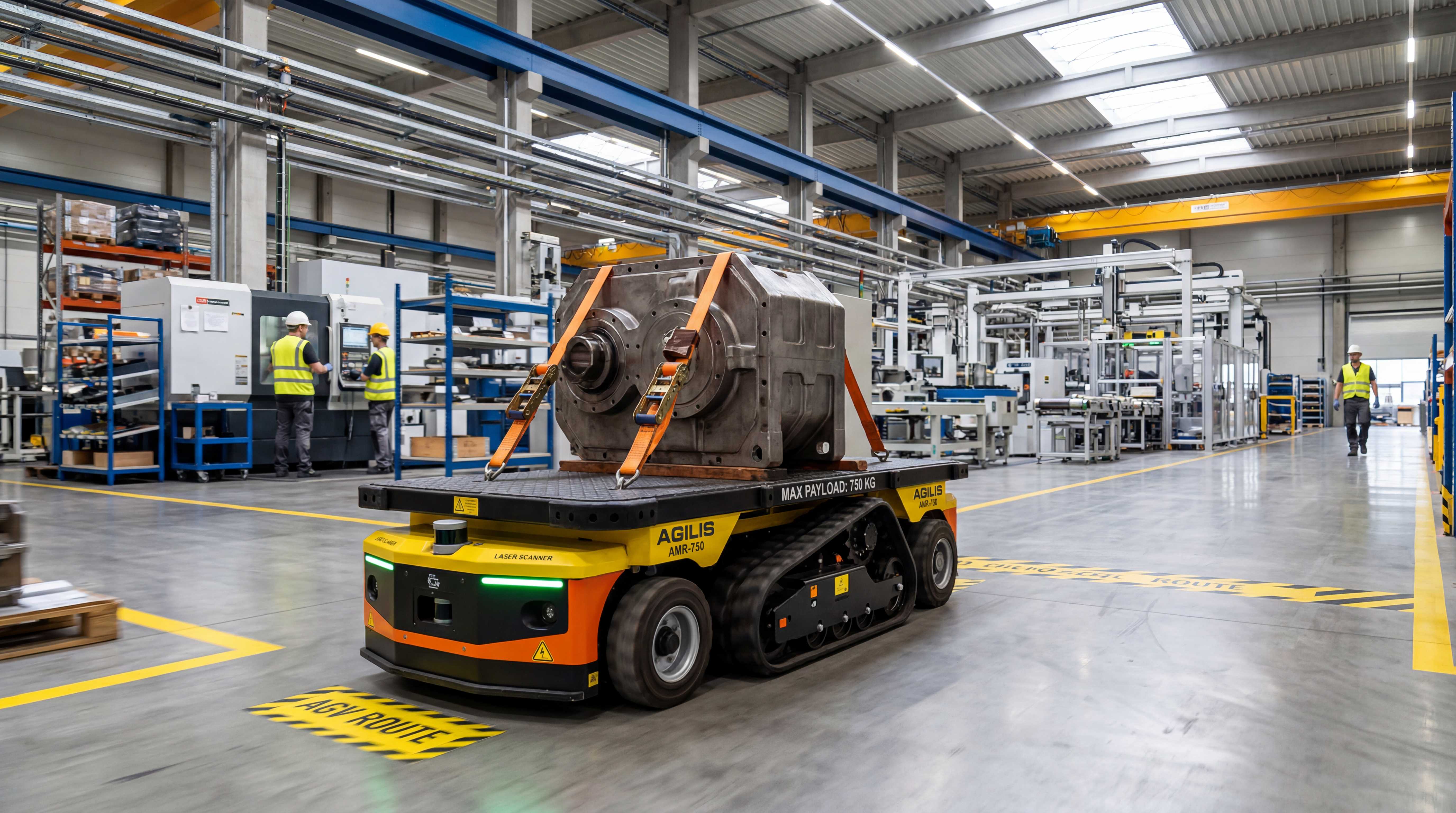
Heavy-Payload Chassis Is Not Just a Bigger AMR: What Industrial Buyers Should Know
Heavy-Payload Chassis Is Not Just a Bigger AMR
In industrial automation, it is easy to describe a heavy-payload chassis as a larger version of a standard autonomous mobile robot. At first glance, the difference seems simple: a standard AMR carries light bins, cartons, tools or components, while a heavy-duty AMR carries pallets, racks, assemblies, engines, molds, fixtures or oversized materials. But this surface-level explanation misses the real engineering and business value of the category.
A heavy-payload chassis is not just a mobile robot base with stronger motors and a larger battery. It is an industrial motion platform designed to move high-mass loads safely, repeatedly and predictably in complex production and logistics environments. When the payload becomes heavier, every part of the system changes. The robot must manage higher inertia, longer braking distance, larger turning forces, more demanding load stability, stricter safety requirements, stronger structural design and deeper integration with warehouse or factory systems.
This is why industrial buyers should not evaluate a heavy-payload chassis only by the maximum payload number printed on a specification sheet. A 1000 kg or 1500 kg payload capacity may look impressive, but the real question is whether the robot can move that load under real facility conditions. Can it turn safely in the available aisle width? Can it dock accurately at transfer stations? Can it stop predictably when people, forklifts or other robots enter the path? Can the chassis support different top modules such as lift tables, conveyors, forks, rollers or custom fixtures? Can it connect with WMS, MES, PLCs, elevators, automatic doors and fleet management software?
For manufacturers, warehouse operators and automation integrators, a heavy-payload chassis should be understood as the foundation of autonomous material handling. It is the physical layer that connects load movement, navigation, safety, control, workflow and long-term operational efficiency. In other words, heavy-payload chassis is not only a product category. It is a decision about how a facility wants to move materials in the future.
What Is a Heavy-Payload Chassis?
A heavy-payload chassis is an industrial mobile robot platform designed to carry, lift, tow or transfer heavy materials across factories, warehouses, production lines and logistics centers. It can be used as the base of a heavy-duty AMR, a high-payload AMR, a heavy-load AGV, an autonomous pallet mover, a mobile conveyor robot, a rack-moving robot or a customized material handling robot.
Unlike a light-duty AMR that may be used for cartons, small totes or simple intralogistics tasks, a heavy-payload chassis is built around demanding industrial loads. These loads may include pallets, large metal parts, automotive components, battery modules, production fixtures, tool carts, molds, paper rolls, machine frames, engines or heavy work-in-process materials. In many facilities, these tasks are still handled by forklifts, manual pallet trucks, overhead cranes, tugger trains or fixed conveyors.
The purpose of a heavy-payload chassis is not only to move heavy objects from one location to another. Its deeper value is to make heavy material flow more predictable, safer and easier to scale. A well-designed industrial AMR chassis can reduce manual driving, lower mixed-traffic risks, support lean production, improve delivery consistency and connect isolated workstations into a more flexible automation system.
Depending on the application, a heavy-payload chassis may use differential drive, steering wheel drive, dual-wheel drive, omnidirectional drive or other motion architectures. It may navigate through laser SLAM, QR code guidance, magnetic guidance, natural feature navigation or hybrid navigation. It may carry a fixed platform, lifting module, roller conveyor, fork mechanism, rotating table, cart towing interface or custom fixture. These design choices make the chassis more than a mechanical base. They define how the robot behaves in real operations.
Why Standard AMR Thinking Does Not Work for Heavy Loads
Many companies begin their automation journey with light-duty AMRs. These robots are often used for moving small materials, delivering components to workstations or transporting totes in warehouses. They are flexible, easy to deploy and suitable for many low-risk tasks. However, the logic changes when the payload becomes heavy.
A heavy load creates higher inertia. This means the robot requires more distance and more control authority to accelerate, decelerate and stop. A sharp turn that is acceptable for a light robot may become risky for a heavy-payload mobile robot. A slightly uneven floor that causes minor vibration for a small AMR may create stability problems for a robot carrying a tall rack, a loaded pallet or an expensive assembly.
Heavy loads also change the risk profile of the entire facility. If a light robot stops suddenly, the impact may be limited. If a heavy-duty AMR carrying hundreds or thousands of kilograms stops, turns or docks incorrectly, the consequences can affect people, equipment, materials and production continuity. Therefore, the chassis must be evaluated through a broader industrial safety and reliability lens.
Another difference is that heavy-payload chassis applications often involve more complex interfaces. A small AMR may simply carry a tote on its top surface. A heavy-payload AMR may need to lift a pallet, align with a conveyor, enter a production cell, dock under a rack, exchange materials with a machine, or position a fixture within a narrow tolerance. These tasks require mechanical design, control precision, navigation reliability and system coordination to work together.
This is why buyers should avoid treating heavy-payload chassis as a simple upgrade from standard AMRs. It is a different category with different design priorities, different risks and different success factors.
Payload Capacity Is Only One Part of the Decision

The most visible specification for a heavy-payload chassis is payload capacity. It is usually the first number buyers notice. A product may be described as a 500 kg AMR, 1000 kg AMR, 1500 kg AMR or even a higher-capacity heavy-load AGV platform. Payload capacity is important, but it should never be the only basis for selection.
A professional evaluation should begin with the real load, not only the maximum load. The buyer should understand the weight range, load dimensions, center of gravity, contact surface, packaging method, load stability and handling frequency. A compact 1000 kg metal block and a tall 1000 kg rack do not create the same challenge. The total weight may be identical, but the stability, turning behavior, braking requirement and safety risk can be completely different.
The footprint of the load also matters. If the material extends beyond the robot body, the effective safety zone changes. Overhanging loads may require larger protective fields, wider aisles, lower operating speed and more careful path planning. If the load is tall, the robot must manage tipping risk during acceleration, braking and turning. If the load is sensitive, such as a precision component or battery module, vibration and impact control become part of the selection criteria.
Buyers should also evaluate speed under load. Some robots can move quickly when empty but must slow significantly when fully loaded. In real production, average speed, acceleration, deceleration, route congestion, docking time, charging time and task scheduling have more impact than maximum speed alone. A heavy-payload chassis that looks powerful on paper may fail to deliver value if it cannot maintain stable throughput in the actual workflow.
Battery performance is another key factor. A heavy-duty AMR consumes more energy when accelerating heavy loads, climbing small slopes, turning frequently or operating with active top modules. The buyer should understand operating time under realistic load, charging strategy, opportunity charging options, battery replacement requirements and charging station placement. A robot with high payload but poor duty-cycle planning may create unexpected downtime.
In short, payload capacity answers only one question: how much can the chassis carry under defined conditions? Industrial buyers must ask a more important question: can the heavy-payload chassis carry the right load, at the right speed, through the right environment, with the right safety margin, for the required number of shifts?
The Real Value Is Stable Industrial Material Flow
A heavy-payload chassis creates value when it improves the movement of materials across the facility. In many factories and warehouses, heavy materials are still transported through forklifts, manual handling equipment or fixed conveyors. Each method has advantages, but each also creates limitations.
Forklifts are flexible, but they require trained operators and can create safety risks in mixed pedestrian environments. Manual pallet trucks are simple, but they depend on labor availability and may not support high-frequency or long-distance movement. Fixed conveyors provide stable flow, but they reduce layout flexibility and can be expensive to modify when production changes. Tugger routes can be efficient, but they may not support dynamic point-to-point movement.
A heavy-duty AMR or heavy-load AGV platform can fill the gap between these traditional methods. It can move heavy materials autonomously while still supporting flexible routes, adjustable workflows and digital task management. Instead of depending on manual drivers for every movement, the facility can assign transport tasks automatically based on production demand, warehouse orders or line-side replenishment needs.
The real value is not simply replacing one forklift with one robot. A better way to think about heavy-payload chassis is to redesign material flow. For example, pallets can be moved from receiving areas to staging zones without waiting for an operator. Work-in-process materials can be transferred between production cells according to actual process status. Heavy racks can be delivered to assembly lines at planned intervals. Empty containers can be returned automatically. Finished goods can be moved from production to outbound staging with less manual coordination.
When these movements become predictable, the whole operation becomes easier to manage. Production teams can reduce waiting time. Warehouse teams can reduce traffic conflicts. Managers can track transport tasks digitally. Safety teams can define robot routes, speed zones and interaction areas. Maintenance teams can monitor robot status before failure occurs. This is why a heavy-payload chassis should be evaluated as part of a material flow system, not as an isolated machine.
A Heavy-Payload Chassis Must Match the Facility, Not Only the Load
One of the most common mistakes in heavy-payload AMR selection is starting with the robot specification instead of the facility condition. A strong chassis may still be the wrong choice if it does not match the actual operating environment.
Floor quality is a basic but critical factor. Heavy-payload robots need stable contact with the ground. Uneven floors, expansion joints, ramps, wet areas, metal debris, dust or damaged surfaces can affect motion, safety and load stability. The heavier the load, the more important the floor becomes. A facility that works well for manual forklifts may still need assessment before deploying autonomous mobile robots because robots depend on predictable sensor readings, traction and path control.
Aisle width is another key factor. Heavy-payload chassis often require larger turning envelopes and wider safety fields. The robot body, load footprint and protective field must be considered together. A robot that can physically pass through an aisle may still be unsuitable if it must slow down too much, stop frequently, or create traffic conflicts with workers and other vehicles.
Doorways, elevators, charging areas, staging zones and docking stations also influence the project. Heavy materials are usually transferred at specific points. The chassis must align with racks, conveyors, machines, pallets or fixtures. If the facility lacks enough space for docking, turning or load exchange, the robot may not achieve stable operation even if its basic navigation is reliable.
Environmental conditions should also be reviewed. Some factories have reflective surfaces, narrow passages, changing layouts, dust, vibration, temperature differences or areas with strong light variation. These conditions may affect sensors and navigation. For a high-payload AMR, navigation reliability is not only a convenience issue. It directly affects safety, throughput and trust in the automation system.
Therefore, buyers should not ask only, “Can this chassis carry our load?” They should ask, “Can this chassis operate safely and efficiently in our building, with our routes, our floors, our people, our machines and our material flow?”
Drive Architecture Defines How the Robot Behaves
The drive system is one of the most important design choices in a heavy-payload chassis. It determines how the robot turns, how much space it needs, how stable it feels under load, how it behaves on different floors and how easy it is to maintain.
Differential drive is common in many autonomous mobile robot base designs. It is relatively simple, stable and suitable for many intralogistics tasks. A differential drive AMR can rotate by controlling the speed difference between wheels. For heavy-payload applications, the advantages may include simpler structure and predictable control. However, buyers must evaluate turning behavior, tire wear and load stability, especially when the robot carries tall or unevenly distributed loads.
Steering wheel drive or steering-based AGV architecture may be better for long-distance transport, smoother curves and routes that resemble vehicle movement. This type of design can be useful when the robot mainly travels along longer paths between warehouse areas and production zones. The limitation is that it may require more turning space than an omnidirectional platform.
Omnidirectional drive can be valuable in tight industrial spaces. It allows the robot to move sideways, rotate in place or align with stations more flexibly. This can be helpful for heavy loads that must be positioned precisely near machines, racks or conveyors. However, omnidirectional systems may involve higher mechanical complexity, higher cost or stricter floor requirements, depending on the wheel and drive design.
Mecanum wheel chassis designs are also used in some mobile robot platforms, especially when sideways movement is required. They can offer high maneuverability, but buyers should consider floor quality, wheel wear, vibration, load capacity and maintenance. For heavy loads, not every flexible motion concept is automatically suitable. The drive system must be matched with load characteristics and operating environment.
The key point is that drive architecture should not be selected only by looking at a feature list. It should be selected according to route shape, aisle width, docking requirement, load height, floor condition, maintenance capability and the required motion pattern. A heavy-payload chassis is successful when its movement behavior fits the real material flow.
Navigation Must Be Reliable Under Load
Navigation is often marketed as a software capability, but in heavy-payload applications it is deeply connected to physical safety and process reliability. A robot carrying a light bin can recover from small route changes more easily. A heavy-payload mobile robot needs more predictable movement because the cost of sudden stops, unstable turns or docking errors is much higher.
Laser SLAM is widely used because it allows autonomous mobile robots to navigate by recognizing natural features in the environment. It supports flexible routing and can reduce the need for physical guidance infrastructure. For facilities with changing layouts, SLAM navigation can provide strong flexibility. However, buyers should confirm whether the environment has enough stable features and whether layout changes, reflective surfaces or moving objects may affect navigation confidence.
QR code navigation can support high repeatability in structured routes and docking points. It may be useful when the facility requires precise alignment, predictable routes or controlled transfer stations. The trade-off is that QR-based navigation may require floor markers and maintenance of the code layout. In some applications, this is acceptable because the process values repeatability more than route flexibility.
Hybrid navigation combines the strengths of different methods. A heavy-duty AMR may use SLAM for flexible route movement while using QR codes, reflectors, visual markers or local positioning methods near docking points. This can help balance flexibility and precision. In heavy-payload applications, hybrid navigation often makes sense because the robot may need both dynamic movement through the facility and accurate positioning for load transfer.
Buyers should also consider obstacle detection and dynamic path planning. Heavy-payload AMRs often operate in areas with people, forklifts, carts and other robots. The robot must detect obstacles, slow down, stop or reroute without creating unnecessary disruption. However, because heavy loads have higher inertia, the robot cannot behave like a small service robot. Protective fields, speed zones and braking logic must be designed with the payload in mind.
The best navigation system is not simply the most advanced one. It is the one that works reliably in the facility, supports safe movement under load and maintains task efficiency across many shifts.
Safety Is Built Into the Whole System
For heavy-payload chassis applications, safety cannot be treated as an accessory. It must be built into the robot architecture, the route design, the control logic, the load interface and the operating process. A safety laser scanner alone does not make a heavy-duty AMR safe. A complete safety concept must consider the robot, the load, the environment and human behavior.
Safety starts with risk assessment. The buyer and integrator should identify where the robot will travel, where people may cross its path, where forklifts or manual carts may interact, where the robot will dock, where the load may overhang, and what happens if communication, power, navigation or mechanical systems fail. The heavier the payload, the more important it is to define predictable behavior in abnormal situations.
Sensor selection is only one layer. Heavy-payload robots may use safety laser scanners, 3D cameras, bumpers, emergency stop buttons, warning lights, audible signals and speed monitoring. These devices must work together with certified safety functions and properly designed protective fields. In high-traffic areas, the robot may need to slow down before entering shared zones. In narrow areas, route rules may need to prevent human-robot conflict. Near transfer stations, safety logic must coordinate with machines, conveyors or doors.
Load safety is another important layer. A heavy-payload AMR may be safe when empty but risky when carrying an unstable load. The load may shift, slide, tilt or extend beyond the chassis footprint. Buyers should consider load securing, fixture design, pallet quality, rack condition, center of gravity and maximum allowed acceleration. In some projects, the custom fixture is just as important as the robot body.
Operational safety also depends on people. Workers must understand robot routes, warning signals, emergency procedures and interaction rules. Managers must define who can change routes, who can release blocked robots, who maintains sensors, and who reviews incidents or near misses. Without clear operational responsibility, even a technically strong industrial mobile robot platform may create avoidable risks.
In heavy-payload automation, safety is not the final checkbox before installation. It is a design principle that should guide every decision from chassis selection to daily operation.
Top Modules Turn the Chassis into a Real Application
A heavy-payload chassis by itself is only the foundation. The real application is created when the chassis is combined with the right top module or load handling interface. This is why buyers should evaluate not only the mobile robot base but also the mechanical interface between the robot and the material.
A lift module can allow the robot to pick up pallets, racks or carts from underneath. This is useful for line-side delivery, rack movement and flexible storage tasks. The design must consider lifting height, load stability, positioning accuracy and compatibility with the existing rack or pallet structure.
A roller conveyor module can help the robot exchange materials with fixed conveyors, production lines or automated storage systems. This type of solution is common when materials must move between different automation islands. The challenge is synchronization. The robot, conveyor, sensors and control system must agree on timing, direction, transfer confirmation and fault handling.
A fork module or autonomous pallet handling mechanism can support pallet movement without requiring special racks. This may be attractive for warehouses or factories that already use standard pallets. However, fork-type applications require careful attention to pallet quality, floor condition, entry angle, load height and traffic safety.
A custom fixture may be required for engines, molds, battery trays, metal frames, aerospace components or other special loads. In these cases, the value of the heavy-payload chassis depends heavily on custom engineering. The fixture must secure the load, protect the product, support ergonomic loading and unloading, and allow the robot to move without creating instability.
This is one of the most important lessons in heavy-payload chassis projects: the robot base does not solve the application alone. The load interface defines whether the solution can actually work in the customer’s process.
System Integration Determines Long-Term Success

A single heavy-duty AMR can demonstrate movement. A fleet of heavy-payload robots must operate as part of a larger system. This is where many projects become more complex than expected.
In a real facility, transport tasks do not happen in isolation. A material request may begin in a WMS, MES, ERP or production scheduling system. A robot may need to wait for a machine to finish, communicate with a PLC, open an automatic door, use an elevator, align with a conveyor, enter a safety zone, charge between tasks or avoid traffic with other robots. Each of these interactions requires integration planning.
Fleet management is especially important for heavy-payload AMRs. When multiple robots share routes, the system must manage traffic, priority, task assignment, charging, blocking recovery and deadlock prevention. Heavy-load robots cannot be treated like small robots moving freely in open space. Their routes, speeds and interaction points must be planned according to safety and process requirements.
Buyers should ask how the robot platform connects with existing systems. Does it provide open APIs? Can it receive tasks from WMS or MES? Can it send status data back to the customer system? Can it integrate with PLC-controlled equipment? Can the fleet manager support multiple robot types? Can traffic rules be adjusted without rebuilding the whole project?
Another long-term issue is scalability. A pilot project may use only one or two robots. A full deployment may require many robots across multiple zones. The heavy-payload chassis should support future expansion, not only the first use case. This includes software architecture, charging strategy, route management, maintenance planning and spare parts availability.
The most successful heavy-payload automation projects are not the ones with the strongest robot on paper. They are the ones where the chassis, top module, navigation, safety system and facility software work together as one operational system.
How Industrial Buyers Should Evaluate a Heavy-Payload Chassis
A structured evaluation process can help buyers avoid costly mistakes. Instead of comparing only payload and price, buyers should build a decision framework around application fit, safety, performance, integration and lifecycle support.
Start with the Material Flow
The first question should be about the movement task. What materials need to move? From where to where? How often? At what time of day? Under what production conditions? Is the task point-to-point, loop-based, line-side replenishment, warehouse staging, work-in-process transfer or machine-to-machine movement? A clear material flow map is more useful than a simple payload requirement.
Define the Real Load Profile
Buyers should document load weight, size, center of gravity, container type, pallet type, rack design, stability and sensitivity. If the load changes by product model or production batch, the chassis and top module must support the full range of conditions.
Review the Facility Conditions
A facility survey should include floor quality, aisle width, turning areas, doorways, ramps, elevators, lighting, dust, reflective surfaces, traffic density and docking locations. A heavy-payload mobile robot may require changes to routes, staging areas or transfer points before deployment.
Evaluate Safety from the Beginning
Safety should not be added after product selection. Buyers should ask about safety-rated sensors, emergency stops, speed zones, protective fields, braking behavior, load overhang, risk assessment, operator training and compliance with relevant industrial mobile robot safety practices.
Check Integration Capability
A heavy-payload chassis should support the required level of digital integration. Some projects need only manual task calling through tablets or buttons. Others require full integration with WMS, MES, PLCs, conveyors, doors, elevators and fleet management systems. The buyer should know this before selecting the platform.
Consider the Lifecycle
Maintenance, spare parts, battery replacement, software updates, sensor cleaning, wheel wear, service response and future expansion all affect total cost of ownership. A low purchase price may not be the best value if the system is difficult to maintain or scale.
Common Mistakes When Choosing Heavy-Payload Chassis
The first common mistake is choosing the highest payload number without understanding the application. A higher payload rating does not automatically mean better performance. It may increase cost, size, turning requirements and energy consumption. The best heavy-payload chassis is the one that fits the task with the right safety margin.
The second mistake is ignoring the load interface. Many projects fail not because the robot cannot move, but because it cannot pick up, support, align or transfer the material reliably. The top module, fixture or docking station should be part of the project design from the beginning.
The third mistake is underestimating traffic complexity. Heavy-load robots often share space with people, forklifts, manual carts and machines. Without route planning, speed zones and clear interaction rules, the robot may stop too often or create frustration for workers.
The fourth mistake is treating navigation as a universal feature. SLAM, QR code, magnetic guidance and hybrid navigation each have strengths and limitations. The best method depends on the facility environment, precision requirements, route flexibility and docking needs.
The fifth mistake is thinking only about the pilot project. A pilot may work with manual task assignment and limited integration. But if the company wants to scale across lines, zones or plants, system architecture becomes much more important. Buyers should choose a platform that can grow from a single robot to a connected fleet.
Where Heavy-Payload Chassis Creates the Strongest Value

Heavy-payload chassis solutions are especially valuable in facilities where heavy materials move frequently and predictably. The more repetitive the transport task, the easier it is to justify automation. However, the route does not need to be completely fixed. Modern high-payload AMR systems can support flexible task assignment while still operating within controlled safety rules.
Automotive manufacturing is a strong application area because large components, engines, battery packs, frames and work-in-process materials must move between production stages. A heavy-duty AMR can support line-side delivery, kitting, assembly support and finished component movement.
New energy manufacturing is another important field. Battery modules, trays, packs and related fixtures can be heavy, sensitive and process-critical. A stable industrial AMR chassis can help reduce manual handling and improve process consistency when combined with proper fixtures and safety design.
Warehousing and distribution facilities can use heavy-payload AMRs for pallet movement, inbound staging, outbound staging, cross-docking support and internal replenishment. In these environments, the robot may not replace every forklift, but it can reduce repetitive travel and free operators for more complex tasks.
Heavy manufacturing, metal processing, machinery production, aerospace, appliance manufacturing and industrial equipment assembly can also benefit from heavy-payload chassis systems. These facilities often handle large components that require safe, repeatable movement across long distances or between specialized process areas.
The common feature across these industries is not only load weight. It is the need for controlled, repeatable and integrated material movement.
Focused FAQ
What is the difference between a heavy-payload chassis and a standard AMR?
A standard AMR is usually designed for lighter materials such as totes, cartons or small parts. A heavy-payload chassis is built for industrial loads such as pallets, racks, large components, fixtures or work-in-process materials. The difference is not only payload capacity. Heavy-payload chassis design must consider inertia, braking distance, load stability, structural strength, safety zones, navigation reliability and integration with material handling equipment.
Is a heavy-duty AMR better than a forklift?
A heavy-duty AMR is not always a direct replacement for every forklift task. Forklifts are still useful for flexible manual handling and special operations. However, a heavy-duty AMR can be better for repetitive, predictable and high-frequency transport tasks. It can reduce manual driving, improve safety planning and create more consistent material flow when the application is properly designed.
What payload capacity should buyers choose?
Buyers should choose payload capacity based on the real load profile, not only the heaviest possible load. The evaluation should include weight, size, center of gravity, stability, handling frequency, route distance, floor condition and safety margin. A properly matched 1000 kg platform may be more effective than an oversized robot if it better fits the facility and workflow.
Why is the top module important?
The top module turns the mobile robot base into a real application. Lift modules, roller conveyors, fork modules, towing interfaces and custom fixtures define how the robot interacts with the load. Without the right top module, even a strong heavy-payload chassis may not be able to pick up, transfer or position materials reliably.
Which navigation method is best for heavy-payload AMRs?
There is no single best navigation method for every project. Laser SLAM is useful for flexible environments, QR code navigation can support repeatable positioning, and hybrid navigation may combine flexibility with docking accuracy. The best choice depends on facility layout, route stability, docking precision, environmental conditions and safety requirements.
What should buyers check before starting a heavy-payload chassis project?
Buyers should check material flow, load profile, floor condition, aisle width, docking points, safety requirements, system integration needs, charging strategy, maintenance capability and future expansion plans. A successful heavy-payload chassis project is not only about selecting a robot. It is about designing a complete autonomous material handling process.
Conclusion: Think Platform, Not Bigger Robot
The most important way to understand heavy-payload chassis is to stop thinking of it as a larger AMR. A heavy-payload chassis is an industrial mobile robot platform that must combine mechanical strength, stable motion, reliable navigation, safe interaction, load handling, software integration and lifecycle support.
For industrial buyers, the best decision is not always the robot with the highest payload or the longest feature list. The best decision is the platform that matches the real material flow, facility conditions, safety requirements and future automation roadmap. A well-selected heavy-duty AMR or heavy-load AGV platform can reduce repetitive manual transport, improve production rhythm, support safer material movement and create a stronger foundation for flexible intralogistics automation.
As factories and warehouses move toward more flexible, connected and data-driven operations, the role of heavy-payload chassis will continue to expand. It will no longer be seen only as a vehicle for moving heavy objects. It will become a modular foundation for autonomous material flow, connecting people, machines, materials and digital systems into a more efficient industrial environment.
#HeavyPayloadChassis
#HeavyDutyAMR
#HighPayloadAMR
#MobileRobotPlatform
#IndustrialAMRChassis
#HeavyLoadAGV
#MaterialHandlingAutomation
#AutonomousMobileRobot
#FactoryLogisticsAutomation
#IndustrialRobotPlatform