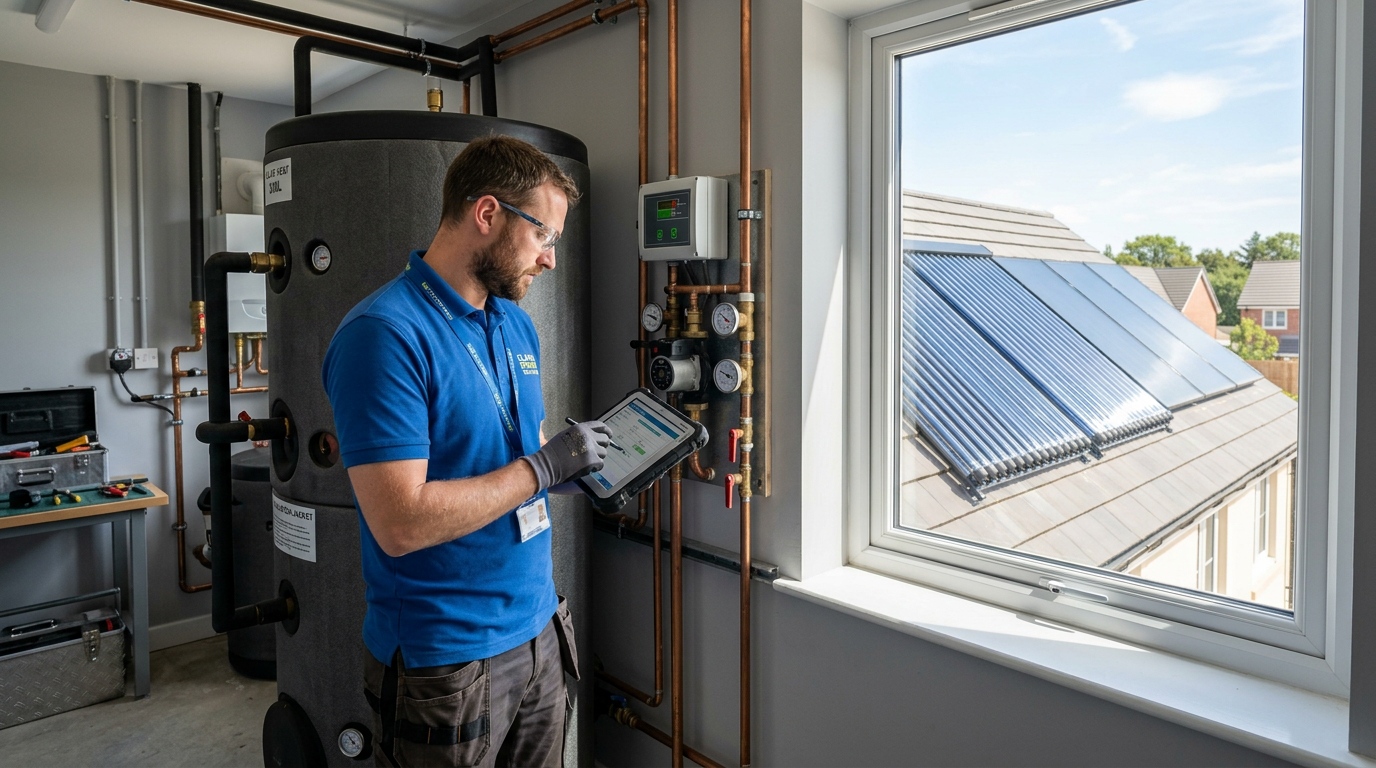
Flat Plate or Evacuated Tube Collectors for Split Solar Water Heaters?
Collector Choice Is a System Decision, Not a Product Preference
When buyers compare a flat plate solar collector with an evacuated tube solar collector, the discussion often becomes too simple. Some people say flat plate collectors are stronger and better looking. Others say evacuated tubes are more efficient and better for cold weather. Both statements can be true in certain situations, but neither is enough for a serious buying decision.
For a split solar water heater, the collector is not just a visible roof component. It is the heat input side of a complete system. It must work with the storage tank, pump station, controller, heat exchanger, pipe length, roof structure, local climate, water demand, and service capability.
That is why solar collector selection should not begin with the question, “Which collector is better?” It should begin with a more practical question: “Which collector fits this system, this building, this climate, and this customer group?”
A solar thermal collector that performs well in one market may not be the best choice in another. A collector that is ideal for a villa roof may not be ideal for a rural home. A collector that works well in a mild climate may need more protection in a freezing or high-wind region. A collector that looks premium may not match a price-sensitive market.
This article compares flat plate and evacuated tube collectors from the perspective of split solar water heater applications. The goal is not to declare one universal winner. The goal is to help homeowners, distributors, installers, and project buyers understand the real decision logic behind collector choice.
Why Split Systems Make Collector Selection More Important

In a basic rooftop integrated system, the collector and tank are often sold as one product package. The buyer may choose mainly by capacity, tube number, tank material, or price. But in a split solar water heater, the system architecture is more flexible and more complex.
The tank is separated from the collector. The pump controls circulation. The controller decides when heat should move from the roof to the tank. The pipework may be longer. The tank may include a heat exchanger. The system may support pressurized hot water or backup heating.
This makes the solar hot water collector more important because its performance affects the entire system.
If the collector does not match the tank size, the system may produce too little hot water or waste roof space.
If the collector output is too high for the storage volume and user demand, overheating and stagnation may become a problem.
If the collector type does not match the climate, the system may lose efficiency or require more maintenance.
If the collector is difficult to install on the roof, labor cost and after-sales risk increase.
If the collector does not match local market expectations, the product may be harder to sell even if the technical design is acceptable.
This is why solar collector selection for Split systems must consider both engineering performance and market positioning.
A solar collector for hot water is not only a heat absorber. It is part of the product’s value story.
What Is a Flat Plate Solar Collector?

A flat plate solar collector is one of the most widely used collector types in solar thermal systems. It usually has a dark absorber plate inside an insulated box. The absorber collects solar radiation and transfers heat to fluid channels or tubes inside the collector. A transparent cover, often glass, helps reduce heat loss while allowing sunlight to reach the absorber.
The structure is simple and clean. From the outside, a flat plate solar collector often looks like a flat rectangular panel installed on the roof. This makes it attractive for modern homes, villas, and buildings where appearance matters.
Flat plate collectors are often chosen because they are robust, visually neat, and suitable for many residential and commercial hot water applications. Their frame structure can be strong, and their appearance can blend better with rooflines than some tube-based designs.
In a split solar water heater, flat plate collectors are commonly used when the buyer wants a more architectural look, stable performance, and easier roof integration. They are especially suitable for projects where the roof design is part of the building’s value.
However, flat plate collectors are not automatically the best choice for every market. Their performance depends on sunlight, ambient temperature, wind, insulation quality, absorber coating, and installation angle. In very cold or low-temperature environments, heat loss can become more important. In very hot regions, overheating management may also be necessary.
A flat plate solar collector should be evaluated as part of a system, not as a standalone panel.
What Is an Evacuated Tube Solar Collector?

An evacuated tube solar collector uses glass tubes with a vacuum layer to reduce heat loss. The vacuum acts as insulation, helping the tube retain heat even when outdoor air is cold. This is one reason evacuated tube collectors are often associated with strong performance in colder or variable climates.
There are different evacuated tube structures, including heat pipe tubes and U-pipe tubes. In many residential solar hot water systems, evacuated tubes are used because they can collect heat efficiently and are modular. If one tube is damaged, it may be possible to replace the tube without replacing the entire collector assembly, depending on the system design.
A vacuum tube solar water heater is familiar in many markets, especially where tube-style solar water heaters are already widely accepted. Customers may recognize the appearance and understand the basic idea quickly.
In a split solar water heater, an evacuated tube solar collector can be attractive when higher thermal performance is needed, especially in colder seasons or regions with larger temperature differences. It can also be useful where roof space is limited and the buyer wants strong heat collection from a relatively compact collector area.
However, evacuated tube systems also require careful evaluation. Tube quality, manifold design, mounting strength, wind resistance, hail risk, snow conditions, installation skill, and service availability all matter. Some tube systems may look efficient on paper but create service challenges if local installers are not familiar with them.
Like flat plate systems, an evacuated tube solar collector is not a universal answer. It is a strong option when its performance and service profile match the market.
Flat Plate vs Evacuated Tube: The Wrong Way to Compare

Many buyers search for flat plate vs evacuated tube and expect a simple answer. They want to know which collector is more efficient, cheaper, stronger, or better for all conditions.
This is the wrong way to compare.
Efficiency is not a single number that decides everything. Collector performance changes with sunlight intensity, outdoor temperature, wind, operating temperature, fluid temperature, and system design. A collector that performs well under one test condition may not produce the best real-world value in every building.
Price is also not simple. A cheaper collector may require more roof area, more mounting work, or more after-sales support. A more expensive collector may reduce roof space needs or improve cold-weather performance. The total value depends on the system.
Durability also depends on context. Flat plate collectors may be seen as strong and clean, but glass cover quality, frame design, sealing, and absorber coating matter. Evacuated tubes may offer strong insulation, but tube breakage, replacement availability, and mounting stability must be considered.
Appearance is market-dependent. Some customers prefer the clean look of flat plate panels. Others are already familiar with tube systems and accept them easily.
So the better comparison is not “which is better?” The better comparison is:
Which collector matches the roof?
Which collector matches the climate?
Which collector matches the tank and pump system?
Which collector matches the customer’s budget?
Which collector matches the installer’s skill?
Which collector matches the distributor’s service model?
That is the correct foundation for solar collector selection.
Climate: Warm, Cold, Windy, Snowy, or High-Sun Markets
Climate is one of the strongest factors in choosing a solar thermal collector.
In warm and sunny markets, both flat plate and evacuated tube collectors can work well. The decision may depend more on cost, appearance, roof structure, and customer expectations. A flat plate solar collector may be attractive for modern homes because it looks clean and integrates well with the roof. An evacuated tube solar collector may be attractive when customers are familiar with tube-style systems or when high heat output is needed.
In cold climates, heat loss becomes more important. Evacuated tubes can have an advantage because the vacuum layer reduces heat loss. This can help the system maintain useful heat collection when outdoor temperature is low. For cold-climate split solar water heater systems, evacuated tubes are often considered when winter performance is a major concern.
However, cold climates also bring snow, ice, wind, and roof access issues. Snow may cover collectors. Wind loads may stress mounting structures. Freeze protection must be designed properly. The collector choice must work with the entire system, especially if the system uses glycol, a heat exchanger, and controlled circulation.
In windy regions, mounting strength and collector profile matter. Flat plate collectors may provide a more uniform panel structure, but they still need strong mounting. Evacuated tube collectors also require secure frames and proper installation.
In high-sun and hot climates, overheating can become a concern. A collector that captures too much heat without enough hot water demand can create stagnation risk. This is especially important for vacation homes, seasonal houses, or oversized systems.
So climate does not automatically choose the collector. It defines the risks that the collector must manage.
Roof Design and Building Appearance
Roof appearance is one of the clearest reasons some buyers prefer a flat plate solar collector for Split systems.
Flat plate collectors can look similar to solar panels from a distance. Their rectangular shape, dark surface, and low-profile installation often match modern architecture. For villas, premium homes, resorts, and urban buildings, this can be a major advantage.
A split solar water heater already improves appearance by moving the tank away from the roof. Pairing that split layout with flat plate collectors can create a clean and discreet roof design. This is useful when the customer wants solar hot water without making the roof look crowded or industrial.
An evacuated tube solar collector has a more technical and visible appearance. In many markets, this is not a problem. Tube systems are common and recognizable. But for some premium buildings, the tube structure may not match the desired roofline.
Roof type also matters.
Flat concrete roofs may allow flexible collector placement. Sloped tiled roofs may require special mounting. Metal roofs may need different attachment methods. Roof angle, orientation, shading, wind exposure, and available space all influence the final decision.
For B2B buyers, this is important because product images and real roof conditions must match. A collector that looks good in a catalog may be difficult to install neatly on the target market’s common roof types.
A good solar collector for hot water should not only collect heat. It should also fit the building.
Efficiency Should Be Evaluated Through System Output
The word efficiency is often used too casually in solar water heater marketing. Many suppliers say their collector is high efficiency, but buyers need to ask: high efficiency under what condition, and for which system?
A solar hot water collector does not deliver value by itself. It delivers value when it heats water in a real system. That means collector efficiency should be evaluated through actual hot water output, storage temperature, user demand, and system losses.
For a split solar water heater, efficiency depends on several linked factors:
Collector performance.
Pipe insulation.
Pump flow rate.
Controller settings.
Heat exchanger capacity.
Tank insulation.
Collector angle and orientation.
Climate and sunlight.
User hot water demand.
A strong collector can still perform poorly if the pump flow is wrong, the pipe insulation is weak, or the tank heat exchanger is undersized. A moderate collector can perform well if the system is properly designed and installed.
This is why active solar water heating logic matters. In Split systems, the pump and controller decide when heat is transferred. If circulation starts too early or stops too late, useful energy may be reduced. If the flow rate is wrong, the collector may operate outside its ideal range.
So when comparing flat plate vs evacuated tube, professional buyers should not look only at collector data. They should ask how the collector works with the whole Split system.
Heat Output and Storage Tank Matching
A common mistake in solar collector selection is choosing collector area without matching the storage tank.
If the collector area is too small for the tank and user demand, the water temperature may remain lower than expected. Customers may complain that the system does not provide enough hot water.
If the collector area is too large for the tank and demand, the system may reach high temperatures too often. This can increase overheating, stagnation, pressure stress, and fluid degradation risk in closed-loop systems.
A split solar water heater should be sized as a complete package. The collector area, tank capacity, heat exchanger, pump station, and backup heater should all match.
For residential homes, sizing may depend on number of users, daily hot water volume, shower habits, climate, and backup heating availability.
For villas, the system may need to support multiple bathrooms, irregular occupancy, and higher comfort expectations.
For small hotels or guesthouses, peak demand may be more important than average daily demand.
For commercial applications, collector choice should be connected to load profiles, not only tank volume.
A flat plate solar collector and an evacuated tube solar collector may require different sizing approaches because their heat output and operating behavior can differ by climate and system temperature.
The safest approach is to treat collector selection as part of system design, not as a simple product substitution.
Maintenance and Service Considerations
Maintenance is often ignored during the buying stage, but it becomes very important after installation.
A flat plate solar collector generally has a simple panel structure. The surface may need cleaning depending on dust, pollution, pollen, bird droppings, or local weather. Glass condition, frame sealing, mounting points, and pipe connections should be checked over time.
An evacuated tube solar collector may allow individual tube replacement in some designs. This can be useful if a tube is damaged. However, the buyer must confirm whether replacement tubes are available, whether local installers know how to replace them, and whether the manifold design is service-friendly.
In areas with hail risk, impact resistance matters. In snowy areas, snow behavior and roof access matter. In dusty regions, cleaning access matters. In coastal regions, corrosion resistance of frames and fasteners matters.
For a split solar water heater, maintenance is not limited to the collector. The pump station, controller, sensors, tank, valves, heat exchanger, and piping also need attention. Collector choice should reduce service risk, not create new problems.
For distributors, service capability may decide which collector is more profitable. A technically attractive collector can become a business problem if spare parts are hard to supply or installers are not trained.
A professional solar water heater supplier should explain maintenance requirements honestly and provide spare parts support.
Durability Is More Than Material Thickness
Buyers often ask about material thickness, glass strength, frame material, and coating quality. These are important, but durability is broader than individual specifications.
For a solar thermal collector, durability includes how the collector handles heat, cold, moisture, wind, pressure, UV exposure, installation stress, and long-term sealing.
For flat plate collectors, important details may include absorber coating stability, insulation quality, glass strength, frame sealing, back plate quality, and resistance to condensation.
For evacuated tube collectors, important details may include vacuum quality, tube glass strength, heat pipe performance, manifold insulation, sealing, and mounting structure.
A solar hot water collector also needs durable connections. Poor fittings, weak seals, or bad installation can cause leaks even when the collector itself is acceptable.
For export markets, packaging durability is also important. Collectors must survive transportation, handling, and storage. Evacuated tubes may require careful packing because glass tubes can be fragile. Flat plate collectors also need protection against frame damage and glass breakage.
Durability should be evaluated from factory to installation, not only after installation.
This is especially important for B2B buyers because damage during transport, storage, or installation can create hidden costs.
Cost Comparison Should Include More Than Collector Price

A direct price comparison between a flat plate solar collector and an evacuated tube solar collector may be misleading.
The collector purchase price is only one part of total cost.
Installation labor matters.
Mounting structure matters.
Packaging and shipping costs matter.
Breakage risk matters.
Spare parts matter.
System sizing matters.
Maintenance cost matters.
Customer acceptance matters.
Warranty risk matters.
For example, an evacuated tube system may have attractive heat performance, but if tube breakage during shipping or installation is common, the actual business cost may increase. A flat plate system may have a higher panel cost in some markets, but if it installs cleanly and reduces after-sales issues, the total value may be better.
In another market, customers may already trust tube systems and accept their appearance. In that case, an evacuated tube solar collector may be easier to sell than a premium-looking flat plate collector.
A strong solar collector selection process considers landed cost, installed cost, service cost, and sales value.
This is why the lowest collector price is not always the best purchasing decision.
Which Collector Fits Residential Homes?

For standard residential homes, both collector types can work. The choice depends on local climate, roof type, water demand, budget, and market expectation.
A flat plate solar collector may be a strong choice for urban homes where appearance matters and the roof design is clean. It can also work well in warm and moderate climates where heat loss is less of a concern.
An evacuated tube solar collector may be attractive for homeowners who want strong thermal performance or live in colder regions. It may also be easier to sell in markets where tube-based solar systems are already familiar.
For a split solar water heater, residential selection should also consider tank location. If the tank is indoors and the roof only carries collectors, the homeowner may care more about how the collector looks. This can favor flat plate collectors in premium urban housing.
However, if the customer prioritizes output and is less concerned about appearance, evacuated tubes may remain competitive.
The key is to match collector type with the homeowner’s real value priority: price, performance, appearance, comfort, or serviceability.
Which Collector Fits Villas and Premium Homes?

Villas and premium homes usually place more value on appearance, comfort, and integration. In this market, the flat plate solar collector often has a strong advantage because it creates a cleaner roofline.
A split solar water heater is already well-suited for villas because the tank can be hidden in a utility room, garage, basement, or service area. When this split layout is paired with flat plate collectors, the whole system can look more architectural and less mechanical.
This does not mean evacuated tubes cannot be used for villas. In cold regions, high-performance tube collectors may still be suitable. Some villa owners may prioritize winter output over appearance. Others may have roof areas where tubes can be installed discreetly.
But from a marketing perspective, flat plate collectors are often easier to position as premium building-integrated equipment. They look modern, organized, and less visually busy.
For villa projects, solar collector selection should also consider noise, pump location, maintenance access, backup heating, and multi-bathroom hot water demand. The collector is only one part of the comfort experience.
A premium customer expects the system to work quietly, reliably, and invisibly. The collector should support that expectation.
Which Collector Fits Cold-Climate Markets?

Cold-climate markets require careful evaluation. Many buyers assume that an evacuated tube solar collector is always the better choice for cold weather because the vacuum insulation reduces heat loss.
In many cases, evacuated tubes can be a strong option for cold climates. They can maintain useful heat collection when outdoor temperatures are low, especially when the system is properly designed.
However, cold-climate performance is not only about collector type. Snow cover, collector angle, freeze protection, glycol loop design, pump control, roof access, and maintenance also matter.
A flat plate solar collector can also be used in cold climates when the system is designed correctly. Some flat plate systems may perform well in certain conditions, especially when durability, snow shedding, and roof integration are important.
For a split solar water heater in freezing regions, the collector must work with an indirect closed-loop system, heat exchanger, glycol fluid, expansion tank, and controller logic. Choosing an evacuated tube solar collector does not remove the need for proper freeze protection.
A buyer should not ask only, “Which collector performs better in cold weather?” The better question is, “Which complete system can operate reliably through winter?”
Which Collector Fits Hot and Tropical Markets?

In hot and tropical markets, freeze protection is usually not the main concern. The main issues may be cost, overheating, water quality, scaling, pressure safety, and maintenance.
A flat plate solar collector can be suitable for many tropical and warm-climate Split systems, especially when the buyer wants a clean roof appearance and stable performance.
An evacuated tube solar collector can also work well, but buyers should be careful about oversizing. In very sunny climates with low hot water usage, excessive heat collection can increase overheating risk.
For a split solar water heater, tropical markets may also have long pipe runs, high roof temperatures, and strong UV exposure. Pipe insulation, controller settings, and tank sizing become important.
In hot regions, the best collector is not always the one with the highest peak output. It may be the one that provides enough useful heat without creating unnecessary overheating problems.
This is an important point for B2B buyers. Selling a high-output collector into a market with low daily hot water consumption may create after-sales issues unless the system is properly sized and protected.
B2B Procurement: What Buyers Should Ask Suppliers

Before purchasing collectors for a split solar water heater product line, B2B buyers should ask specific questions.
What climate is the collector designed for?
What roof types can it support?
What is the recommended tank capacity and collector area matching?
What pump flow rate is recommended?
Can the collector work with glycol systems?
What is the recommended installation angle?
What mounting system is included?
What is the packaging method?
What spare parts are available?
How should the collector be maintained?
For a flat plate solar collector, buyers should ask about absorber coating, glass type, insulation, frame material, sealing, pressure rating, and mounting design.
For an evacuated tube solar collector, buyers should ask about tube type, manifold design, heat pipe quality, vacuum performance, tube replacement, frame strength, and packing protection.
For any solar collector for hot water, buyers should ask whether the supplier can provide system drawings, installation manuals, sizing guidance, and after-sales training.
A supplier who only says “high efficiency” without explaining system matching may not be suitable for serious B2B cooperation.
Marketing Strategy: How to Position Each Collector Type

For marketing, the two collector types should not be described with the same message.
A flat plate solar collector can be positioned around clean roof design, modern appearance, robust panel structure, building integration, and premium residential suitability. It fits well with messages about villas, modern homes, resorts, and architectural projects.
An evacuated tube solar collector can be positioned around strong thermal performance, cold-weather suitability, modular tube replacement, and familiar solar water heater technology in many markets. It fits well with messages about performance, winter output, and practical residential use.
For flat plate vs evacuated tube content, the message should remain balanced. A credible supplier should explain that both options can be correct depending on climate, building, budget, and service needs.
For a split solar water heater, the strongest marketing strategy is to present collector choice as part of system customization. Instead of forcing one collector type on every customer, the supplier can show that it understands different market conditions.
This builds trust and helps the buyer feel guided rather than sold.
Focused FAQ
Which is better for a split solar water heater, flat plate or evacuated tube?
There is no universal winner. A flat plate solar collector is often better for clean roof design, modern homes, villas, and building-integrated projects. An evacuated tube solar collector can be better for strong thermal performance, colder climates, and markets familiar with tube systems. The right choice depends on system design and market fit.
Is a flat plate solar collector good for modern homes?
Yes. A flat plate solar collector is often suitable for modern homes because it has a clean rectangular appearance and can integrate well with roof design. It pairs well with a split solar water heater where the tank is hidden indoors or at ground level.
Is an evacuated tube solar collector better in cold climates?
An evacuated tube solar collector can perform well in cold climates because the vacuum layer helps reduce heat loss. However, cold-climate performance also depends on freeze protection, glycol loop design, pipe insulation, pump control, and system maintenance.
What is the difference between a solar thermal collector and a solar hot water collector?
A solar thermal collector is a device that collects solar heat. A solar hot water collector refers to a collector used specifically for heating domestic or commercial hot water. In solar water heater systems, the two terms often overlap.
Can both collector types work with active solar water heating?
Yes. Both flat plate and evacuated tube collectors can be used in active solar water heating systems. The pump, controller, sensors, pipework, and tank heat exchanger must be matched to the selected collector type.
Is a vacuum tube solar water heater the same as an evacuated tube system?
A vacuum tube solar water heater usually refers to a solar water heater using evacuated glass tubes. In Split systems, the evacuated tube collector may be connected to a separate storage tank through a pump and controller.
What should B2B buyers consider before choosing a solar collector for hot water?
B2B buyers should consider climate, roof type, system capacity, collector area, tank matching, pump flow, installation skill, packaging, spare parts, maintenance, and customer expectations before choosing a solar collector for hot water.
Does higher collector efficiency always mean a better system?
No. Higher collector efficiency does not always mean better real-world performance. A split solar water heater also depends on tank size, pipe insulation, pump operation, controller settings, heat exchanger design, and user demand.
Conclusion: The Right Collector Is the One That Fits the Whole System
Choosing between a flat plate solar collector and an evacuated tube solar collector is not a simple product preference. It is a system decision.
A flat plate solar collector often fits modern homes, villas, and projects where clean appearance, roof integration, and durable panel structure are important. It supports a premium positioning for Split systems and can help the roof look more organized.
An evacuated tube solar collector often fits markets where strong heat collection, cold-weather performance, modular tube replacement, or familiar tube-style solar water heating is important. It can be a practical and powerful choice when the system is designed correctly.
But neither collector works alone. A split solar water heater depends on collector area, tank capacity, pump station, controller, heat exchanger, pipe insulation, backup heating, and installation quality. That is why solar collector selection should always be connected to the whole system.
For homeowners, the right choice depends on comfort, appearance, roof type, climate, and budget. For villas, the right choice may emphasize design integration and hidden tank placement. For cold climates, the right choice must consider freeze protection and winter reliability. For hot climates, the right choice must consider overheating and proper sizing. For distributors, the right choice must also consider packaging, spare parts, installer training, and after-sales cost.
The best solar collector for hot water is not always the one with the highest claimed efficiency. It is the one that can deliver reliable hot water under real operating conditions.
A professional buyer should compare flat plate vs evacuated tube through climate, building design, customer expectations, installation capability, system matching, and long-term service. When the collector fits the system, the building, and the market, the split solar water heater becomes more than a product. It becomes a complete solar thermal solution that can be sold, installed, serviced, and trusted.
#FlatPlateSolarCollector #EvacuatedTubeSolarCollector #SplitSolarWaterHeater #SolarThermalCollector #SolarHotWaterCollector #FlatPlateVsEvacuatedTube #VacuumTubeSolarWaterHeater #SolarCollectorForHotWater #ActiveSolarWaterHeating #SolarCollectorSelection