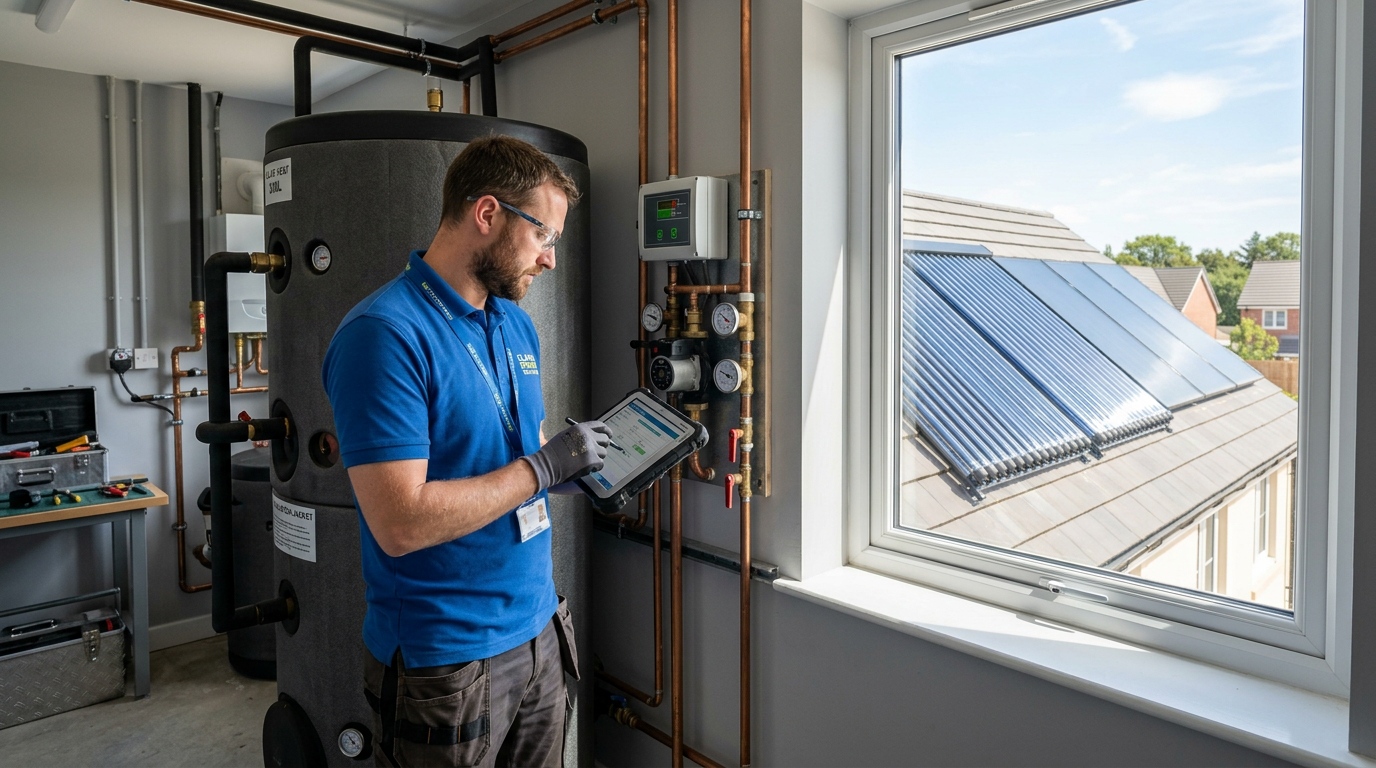
Closed-Loop Glycol Solar Water Heating: A Practical Guide for Cold Climates
Cold Climate Changes the Meaning of Solar Water Heating
Solar water heating looks simple in warm climates. The collector absorbs sunlight, the system transfers heat, and the storage tank provides hot water for daily use. In markets with mild winters, this logic can work with relatively simple system structures.
Cold climates are different.
When outdoor temperature drops below freezing, solar water heating is no longer only about collecting heat. It is also about protecting the system from ice, pressure stress, fluid expansion, pipe damage, heat exchanger failure, and long-term service risk. A product that works well in a warm region may fail quickly if it is installed in a freezing environment without proper protection.
This is where a closed loop solar water heater becomes important.
A closed loop solar water heater does not send domestic water directly through the outdoor collector loop. Instead, it uses a separate sealed circuit to carry heat from the collector to the tank. This circuit usually contains a heat transfer fluid such as solar thermal glycol, which can help protect the collector loop from freezing when properly selected, mixed, filled, and maintained.
For a split solar water heater, this design is especially relevant. Because the collector and tank are separated, the system already depends on piping, circulation, pump control, and heat transfer design. In cold regions, the split structure often needs a more professional thermal loop. That is why glycol solar water heating is one of the most important technical directions for cold-climate split systems.
A serious buyer should not ask only, “Can this solar water heater heat water?” In a freezing market, the better question is, “Can this system survive winter, maintain performance, protect users, and reduce after-sales risk?”
Why Direct Circulation Becomes Risky in Freezing Conditions

In a direct solar water heating system, the water used by the household can circulate through the solar collector. This may be simple and efficient in warm regions, but it becomes risky when freezing is possible.
Water expands when it freezes. If water remains inside exposed collector channels, outdoor pipes, or fittings during a freeze, it can create pressure that damages the system. The result may be cracked collectors, burst pipes, leaking joints, damaged valves, or complete system failure.
Even one severe freeze event can cause expensive damage.
This is why solar water heater freeze protection must be treated as a core design requirement, not as an optional accessory. In cold regions, a system should be designed from the beginning around freeze risk.
Some systems use drainback designs, where water drains out of the collectors when the pump stops. Other systems use electric freeze protection, pipe heating, or special valves. But for many professional split solar hot water applications, the most common solution is an antifreeze solar hot water system using a sealed glycol loop.
The logic is straightforward: keep domestic water inside the tank and household plumbing, while a protected heat transfer fluid circulates through the outdoor collector loop.
This is the foundation of glycol solar water heating.
The Basic Structure of a Closed-Loop Glycol System

A closed loop solar hot water system separates the solar collector loop from the domestic hot water circuit.
The solar loop usually includes collectors, insulated piping, a circulation pump, expansion tank, pressure relief protection, fill and drain ports, air removal components, controller, sensors, and heat transfer fluid. The domestic side includes the storage tank, cold water inlet, hot water outlet, backup heater, and user plumbing.
The key connection between the two sides is the solar heat exchanger.
The glycol mixture absorbs heat in the collector. The pump circulates this heated fluid through the loop. When it reaches the solar heat exchanger, heat moves from the glycol loop into the domestic water stored in the tank. The glycol and domestic water do not mix.
This is why the system is often called an indirect solar water heater. Heat is transferred indirectly through a heat exchanger rather than by sending domestic water directly through the collectors.
This separation creates several advantages.
It improves freeze protection because the outdoor loop can use an antifreeze mixture.
It protects domestic water quality because the heat transfer fluid does not enter household water.
It allows the collector loop to be designed as a sealed pressure circuit.
It gives installers more flexibility in placing the tank indoors or in protected areas.
It supports the typical layout of a split solar water heater, where the roof collector and storage tank are physically separated.
However, this structure is also more complex. It requires proper fluid selection, pressure design, heat exchanger sizing, pump selection, control settings, expansion capacity, and maintenance planning.
A closed loop solar water heater is not only a product. It is a designed thermal system.
Glycol Is Not Just Antifreeze

Many buyers hear the word glycol and immediately think of antifreeze. That is partly correct, but incomplete.
In glycol solar water heating, glycol is used as part of a heat transfer fluid. Its role is to reduce freeze risk while still carrying heat from the collector to the tank. In solar thermal systems, propylene glycol is commonly preferred in many domestic hot water applications because it is more suitable for systems connected near potable water equipment when compared with more industrial fluids.
But glycol is not magic. It must be selected, mixed, and maintained correctly.
If the glycol concentration is too weak, solar water heater freeze protection may be insufficient. If the glycol concentration is too strong, the fluid may become more viscous, which can reduce circulation efficiency and increase pump workload. If the glycol is exposed to excessive heat for too long, it can degrade. Degraded glycol may become acidic, darker, thicker, or less effective.
This is why solar thermal glycol should be treated as a performance material, not as a one-time filling liquid.
A good antifreeze solar hot water system should define the correct glycol type, concentration range, system pressure, expansion volume, maximum temperature, maintenance interval, and replacement guideline. Without these details, the system may look complete but still carry long-term risk.
For B2B buyers, glycol quality and documentation are important. A supplier should be able to explain what type of fluid is recommended, what temperature range it supports, how the system should be filled, and how installers should check fluid condition during service.
The Solar Heat Exchanger Is the Bridge Between Two Worlds

The solar heat exchanger is one of the most important parts of an indirect solar water heater.
Its job is to transfer heat from the glycol loop to domestic water without mixing the two fluids. This may happen through an internal coil inside the storage tank, an external plate heat exchanger, or another heat transfer design depending on system configuration.
If the heat exchanger is too small, the system cannot transfer collected heat efficiently. The collector loop may become hot, but the tank may not gain enough useful heat. This can reduce system efficiency and increase overheating risk.
If the heat exchanger is properly sized, heat transfer is smoother. The pump, collector, tank, and controller can work together more effectively.
For a closed loop solar hot water system, heat exchanger design affects several practical outcomes:
How quickly the tank heats.
How much useful solar energy is delivered.
How high the collector loop temperature becomes.
How hard the pump must work.
How stable the system performs during variable sunlight.
How well the system supports backup heating.
For residential systems, internal coil tanks are common because they simplify installation. For larger projects, external heat exchangers may offer more design flexibility and service access.
A buyer should never evaluate a closed loop solar water heater only by tank capacity. A 300L tank with a poorly matched heat exchanger may perform worse than a better-designed system with the same storage volume.
Why Split Systems Are Naturally Suited to Closed-Loop Design

A split solar water heater separates the collector and storage tank. This layout already requires controlled circulation, insulated piping, and careful heat transfer. For this reason, Split systems are naturally suited to closed loop solar hot water design in cold climates.
In an integrated rooftop system, the collector and tank are close together. In a split system, the collector may be on the roof while the tank is in a utility room, basement, garage, balcony area, or ground-level equipment space. The distance between collector and tank creates the need for proper circulation.
Once circulation is pump-driven, it becomes practical to use a sealed glycol loop.
This is why many cold-climate split solar water heater systems are also indirect solar water heater systems. They use the collector loop to collect energy and the tank heat exchanger to deliver that energy to domestic water.
This design can also protect the storage tank from outdoor exposure. Instead of placing a large water tank on a cold roof, the tank can stay indoors or in a protected area. That improves service access and reduces weather exposure.
For villas, modern homes, and high-comfort residential projects, this is a strong selling point. The roof can carry collectors only. The tank can be hidden and protected. The glycol loop can handle outdoor freeze risk. The domestic hot water side can remain pressurized and comfortable.
This is where the cold climate solar water heater becomes more than a basic renewable energy product. It becomes a building-integrated hot water system.
Freeze Protection Is a System Design, Not a Single Component

Some suppliers promote glycol as if adding it automatically solves all freezing problems. That is a dangerous oversimplification.
Solar water heater freeze protection is a system design. It involves fluid concentration, pipe routing, insulation, pump control, expansion design, pressure relief, sensor placement, heat exchanger performance, and installer discipline.
A glycol mixture helps reduce freeze risk, but the rest of the system must support it.
Pipes must be insulated properly. Poor insulation increases heat loss and can expose sections of the loop to lower temperatures.
The system must be filled correctly. Air pockets can reduce circulation, create noise, and increase overheating risk.
The expansion tank must be sized properly. Glycol expands when heated. If expansion capacity is insufficient, pressure can rise too much.
The pressure relief valve must be suitable for the system. It protects against excessive pressure.
The controller must understand temperature conditions. In some systems, freeze protection logic may still be needed.
The heat exchanger must transfer heat efficiently. If heat transfer is weak, the collector loop may remain hotter than necessary.
The pump must be suitable for the fluid and pressure drop. Glycol mixtures are not always as easy to pump as water.
This is why a closed loop solar water heater should be installed by trained technicians. It is not a casual plug-and-play product.
For B2B buyers, this also means the supplier must provide installation diagrams, filling procedures, pressure settings, glycol guidelines, maintenance recommendations, and spare part support.
Closed-Loop Does Not Mean Maintenance-Free

A common misunderstanding is that a closed loop solar water heater can be filled once and ignored forever. That is not how professional systems should be managed.
A closed-loop system is more protected than a direct system in freezing conditions, but it still requires inspection.
The solar thermal glycol should be checked periodically. Over time, heat exposure can affect fluid quality. If the system experiences repeated high-temperature stagnation, fluid degradation may happen faster.
Pressure should also be checked. Low pressure may indicate leakage, air release, or service issues. Excessive pressure may indicate expansion or control problems.
The pump should be inspected for proper operation. If the pump fails, heat transfer stops.
The controller and sensors should be checked. Incorrect readings can cause poor operation.
Air in the system should be removed. Air reduces circulation and can create noise.
Safety valves, expansion tanks, insulation, and pipe connections should be inspected.
This does not mean glycol solar water heating is unreliable. It means it is a professional system that deserves professional maintenance.
For distributors, this can be turned into a service advantage. Instead of selling only equipment, they can provide maintenance guidance, annual inspection packages, replacement fluid support, and installer training.
For project buyers, planned maintenance is not a weakness. It is part of lifecycle cost control.
How Cold Climate Buyers Should Evaluate a System

A buyer looking for a cold climate solar water heater should ask more detailed questions than a buyer in a tropical market.
The first question is climate range. What is the lowest expected outdoor temperature? How often does freezing occur? Is it occasional or continuous? Are there long periods without sunlight?
The second question is system type. Is the product a true closed loop solar water heater, or is it a direct system with basic freeze accessories?
The third question is fluid strategy. What type of solar thermal glycol is recommended? What concentration is required? What freeze point is expected? How often should it be checked?
The fourth question is heat exchanger design. Does the tank include an internal coil? Is there an external solar heat exchanger? Is the heat transfer capacity suitable for the collector area?
The fifth question is expansion and safety. Is there an expansion tank? Is it sized for the fluid volume? Are pressure relief devices included?
The sixth question is control logic. Does the controller include temperature monitoring, pump control, maximum tank temperature, and fault alerts?
The seventh question is documentation. Does the supplier provide a complete installation and commissioning guide?
The eighth question is service support. Are pumps, sensors, controllers, valves, and recommended fluid available as spare parts?
These questions help buyers avoid a common mistake: buying a system that is marketed as cold-climate suitable but lacks the engineering details needed for real winter operation.
Tropical Buyers May Not Need Glycol, but They Still Need System Logic

Not every market needs glycol solar water heating. In warm regions without freezing risk, a simpler system may be more cost-effective. Direct circulation or other solar water heating structures may be suitable.
However, even tropical markets can learn from closed-loop thinking.
A system should still be designed around water quality, scaling risk, overheating, pressure safety, pump reliability, and maintenance access. The fact that freezing is not a problem does not mean the system has no design challenges.
In hot regions, the bigger issue may be overheating rather than freezing. If users do not consume enough hot water during strong sunlight, the collector loop can reach high temperatures. In some cases, glycol systems in hot climates may need especially careful stagnation management because degraded glycol can become a maintenance problem.
This is why the correct choice depends on climate.
A closed loop solar water heater is excellent when freeze risk justifies its complexity. But a simpler system may be better when the market does not need antifreeze protection and customers are highly price-sensitive.
Professional solar water heater supplier positioning should not push one design everywhere. It should match system architecture with local climate and customer expectations.
The Business Value of Closed-Loop Glycol Systems

From a B2B perspective, an antifreeze solar hot water system creates a different product position from a basic solar water heater.
It allows suppliers and distributors to serve colder markets that simple rooftop systems may not handle well. This includes parts of Europe, North America, northern Asia, mountain regions, and other areas with winter freeze risk.
It also supports higher-value customers. Buyers who need a cold climate solar water heater are often more concerned about reliability, warranty, professional installation, and long-term service than only the lowest price.
For distributors, this can improve market segmentation. Basic systems can serve warm-climate or entry-level users. Closed loop solar hot water systems can serve premium residential, villa, and project customers in colder regions.
For installers, closed-loop systems create service opportunities. Proper commissioning, glycol testing, pressure inspection, and maintenance can become part of a professional service model.
For project buyers, closed-loop design can reduce winter damage risk. This matters because a failed system in a hotel, apartment building, or housing project creates not only repair cost but also user complaints.
For manufacturers, the challenge is to package the system clearly. A closed loop solar water heater should not be presented only as a tank plus collector. It should be presented as a complete engineered package with collector, tank, heat exchanger, pump station, controller, glycol guidance, expansion protection, and installation documentation.
Common Mistakes in Closed-Loop System Selection

One common mistake is choosing only by tank size. Tank capacity is important, but it does not define system performance by itself. Collector area, heat exchanger capacity, pump flow, pipe length, insulation, and control settings all affect real output.
Another mistake is using glycol without understanding concentration. Too little glycol may not protect against freezing. Too much glycol may reduce heat transfer and increase pumping difficulty.
A third mistake is ignoring expansion volume. A closed glycol loop experiences temperature changes. Without proper expansion capacity, pressure problems can occur.
A fourth mistake is poor pipe insulation. Even the best solar thermal glycol cannot fully compensate for bad installation.
A fifth mistake is weak commissioning. If the system is not properly filled, pressurized, and air-purged, circulation problems may appear.
A sixth mistake is assuming all split systems are cold-climate systems. A split solar water heater can be designed for warm climates or cold climates. The split structure alone does not guarantee freeze protection.
A seventh mistake is ignoring maintenance. Glycol condition should be checked over time, especially in systems exposed to high temperatures.
A professional buyer should look beyond the product brochure and ask whether the system has been designed for real operating conditions.
How to Explain Closed-Loop Glycol Systems to End Customers

End customers may not understand terms such as heat exchanger, glycol concentration, or differential control. The message should be simplified without becoming inaccurate.
A clear explanation is:
A closed loop solar water heater uses a protected solar loop to collect heat from the roof. This loop carries heat to the tank through a solar heat exchanger. The heat transfer fluid stays separate from household water, helping the system work more safely in cold conditions.
For homeowners, the key benefits are easier winter protection, better system durability, and stable hot water design.
For villa owners, the message can include hidden tank placement, cleaner roof appearance, and professional-grade hot water performance.
For project customers, the message should focus on winter reliability, reduced freeze-damage risk, maintenance planning, and system documentation.
For distributors, the message should avoid overpromising. It is better to say that glycol solar water heating helps protect the solar loop from freezing when correctly designed and maintained. That is more credible than saying it “never freezes” or “requires no maintenance.”
Trust is built by explaining the system honestly.
Focused FAQ
What is a closed loop solar water heater?
A closed loop solar water heater is a solar hot water system that uses a separate sealed collector loop to transfer heat to domestic water. The heat transfer fluid circulates through the collectors and passes heat to the storage tank through a solar heat exchanger.
Why is glycol used in solar water heating?
Glycol solar water heating uses a glycol-based heat transfer fluid to help protect the outdoor solar loop from freezing. Proper fluid type, concentration, filling, and maintenance are important for reliable operation.
Is a closed-loop system the same as an indirect solar water heater?
A closed loop solar water heater is often an indirect solar water heater because the solar loop and domestic water do not mix. Heat is transferred indirectly through a heat exchanger.
Does every split solar water heater need glycol?
No. A split solar water heater does not always need glycol. In warm climates without freeze risk, other system designs may be suitable. Glycol is more important when the system must operate as a cold climate solar water heater.
What is solar water heater freeze protection?
Solar water heater freeze protection refers to the system design used to prevent freezing damage in collectors, pipes, and outdoor components. It may involve glycol, drainback design, insulation, control logic, and safety components.
Is an antifreeze solar hot water system maintenance-free?
No. An antifreeze solar hot water system still needs periodic inspection. The solar thermal glycol, pressure, pump, controller, sensors, valves, and insulation should be checked to maintain system reliability.
What does a solar heat exchanger do?
A solar heat exchanger transfers heat from the solar loop to domestic water without mixing the two fluids. It is one of the most important components in an indirect solar water heater.
What should buyers check before choosing closed-loop solar hot water?
Buyers should check glycol type, freeze protection range, heat exchanger capacity, pump station design, expansion tank sizing, controller functions, installation documentation, and spare parts support before choosing a closed loop solar hot water system.
Conclusion: Cold-Climate Solar Water Heating Requires System Thinking
A closed loop solar water heater is not simply a more expensive version of a basic solar water heater. It is a different system architecture designed to handle real cold-climate challenges.
In freezing regions, the question is not only how much heat the collector can capture. The question is whether the system can protect itself, transfer heat efficiently, maintain pressure safely, support service access, and operate reliably over time.
That is why glycol solar water heating matters. By using a protected solar loop and a solar heat exchanger, the system can separate outdoor heat collection from domestic hot water storage. This supports better solar water heater freeze protection and makes the system more suitable for cold regions when properly designed.
For a split solar water heater, closed-loop design is especially valuable because the collector and tank are already separated. The tank can be placed indoors or in a protected area, while the collector loop handles outdoor conditions with suitable fluid, insulation, pump control, and safety components.
However, an antifreeze solar hot water system must be treated as a professional system. Glycol concentration, heat exchanger sizing, pump selection, expansion capacity, controller logic, installation quality, and maintenance planning all matter.
For homeowners, this means better winter reliability. For distributors, it means a stronger product category for colder and higher-value markets. For project buyers, it means lower freeze-damage risk and better long-term system control. For suppliers, it means the need to provide complete documentation, training, and technical support.
The real value of a cold climate solar water heater is not only that it heats water with the sun. Its value is that it does so while respecting the demands of winter, pressure, fluid behavior, building design, and long-term service.
In markets where freezing is a real risk, closed loop solar hot water is not a luxury feature. It is often the difference between a system that survives winter and a system that becomes an after-sales problem.
#ClosedLoopSolarWaterHeater #GlycolSolarWaterHeating #IndirectSolarWaterHeater #SolarWaterHeaterFreezeProtection #AntifreezeSolarHotWaterSystem #SplitSolarWaterHeater #SolarHeatExchanger #SolarThermalGlycol #ColdClimateSolarWaterHeater #ClosedLoopSolarHotWater