上传

RJXA's Christmas approaches, it's time to refresh your fashion collections! Explore our high-quality lace, perfect for festive attire. Inquire now to enjoy holiday specials!

Member Center
Exit
Data is empty
0
qr Code Url

Scan the QR code to visit the mobile website

  • Home
  • Industrial
  • Renewable
  • Building & Home
  • Water Treatment
  • Automation
  • Kitchen
Home -News -
Chemicals & Water Treatment
-
Cutaway industrial furnace with hydrogen flames, steam-rich gas and refractory-lined combustion chamber
2026-08-04

Hydrogen-Fired Furnaces: How to Qualify Refractories Before the Fuel Switch

Hydrogen conversion changes more than fuel carbon: it can alter water-vapor loading, local oxygen potential, flame behavior, heat flux, product oxidation and cold-zone condensation. This guide shows how industrial plants can qualify refractory linings through exposure mapping, laboratory scenarios, instrumented test panels and controlled commissioning.
Learn more
Cutaway cement kiln showing how alternative fuels change deposits, chemical stress and refractory wear
2026-08-04

Alternative Fuels in Cement Kilns: How Chemistry Redraws the Refractory Wear Map

Alternative fuels do more than replace heat: their moisture, ash, chlorine, sulfur, alkalis, particle size and feed point can change combustion, volatile circulation, coating behavior and zone-specific refractory wear. This guide gives cement plants a fuel-to-lining causal map, monitoring plan and controlled trial protocol for safer thermal substitution.

Learn more
Engineer reviewing carbon and performance data beside a high-temperature refractory-lined industrial furnace
2026-08-04

Low-Carbon Refractories How to Buy a Smaller Footprint Without Buying a Shorter Campaign

A buyer-focused framework for comparing cradle-to-gate refractory carbon data, supplier evidence, recycled-content claims and service-life outcomes without allowing a lower PCF number to weaken lining safety, process stability or campaign value.
Learn more
Circular refractory recovery chain from selective demolition and material processing to qualified manufacturing reuse
2026-08-04

From Spent Lining to Qualified Feedstock: How Circular Refractory Materials Are Recovered and Reused

A technical guide to converting dismantled furnace linings into traceable secondary raw materials through selective demolition, sorting, contamination control, beneficiation, lot testing and application-specific qualification—not by crushing mixed waste and calling it circular.
Learn more
Cutaway refractory lining showing the evidence chain from repeatable measurements to maintenance actions
2026-08-04

From Visual Inspection to Predictive Refractory Lining Management

A practical framework for turning visual inspections, thermal surveys, 3D point clouds and operating history into location-based wear trends, repair scopes and remaining-life decisions—without confusing a dashboard, digital twin or AI model with validated engineering evidence.
Learn more
Control-room operators monitor steam release and temperature trends during industrial refractory dry-out
2026-08-04

Refractory Dry-Out Explained: Moisture Migration, Spalling Risk, and Faster Furnace Start-Up

A field-oriented guide to controlling moisture release from monolithic refractory linings. It explains water inventories, pressure buildup, thermal instrumentation, venting, hold logic, fast-dry materials, acceptance records, and the decisions that protect safety without extending an outage unnecessarily.
Learn more
Workers document failed refractory bricks and location-coded debris inside an industrial furnace during a failure investigation
2026-08-04

Why Refractory Linings Fail Early: Diagnosing Corrosion, Thermal Shock, and Wear

Premature lining loss is rarely explained by one photograph or one test result. This field-to-laboratory guide separates symptoms from mechanisms and root causes, showing how to investigate corrosion, thermal shock, abrasion, erosion, installation defects and operating excursions—and convert evidence into corrective actions that prevent recurrence.
Learn more
Diagram showing a refractory binder lifecycle from mixing and drying through heating, service, and residual chemistry
2026-08-04

Beyond Calcium Aluminate Cement: Choosing Binder Systems for Modern Monolithic Refractories

Binder choice controls far more than room-temperature set. This guide compares hydraulic, hydratable-alumina, sol-gel and phosphate systems across mixing, placement, curing, dryout, intermediate-temperature strength, ceramic bonding and process compatibility—helping formulators and installation teams select the bond for its complete lifecycle.
Learn more
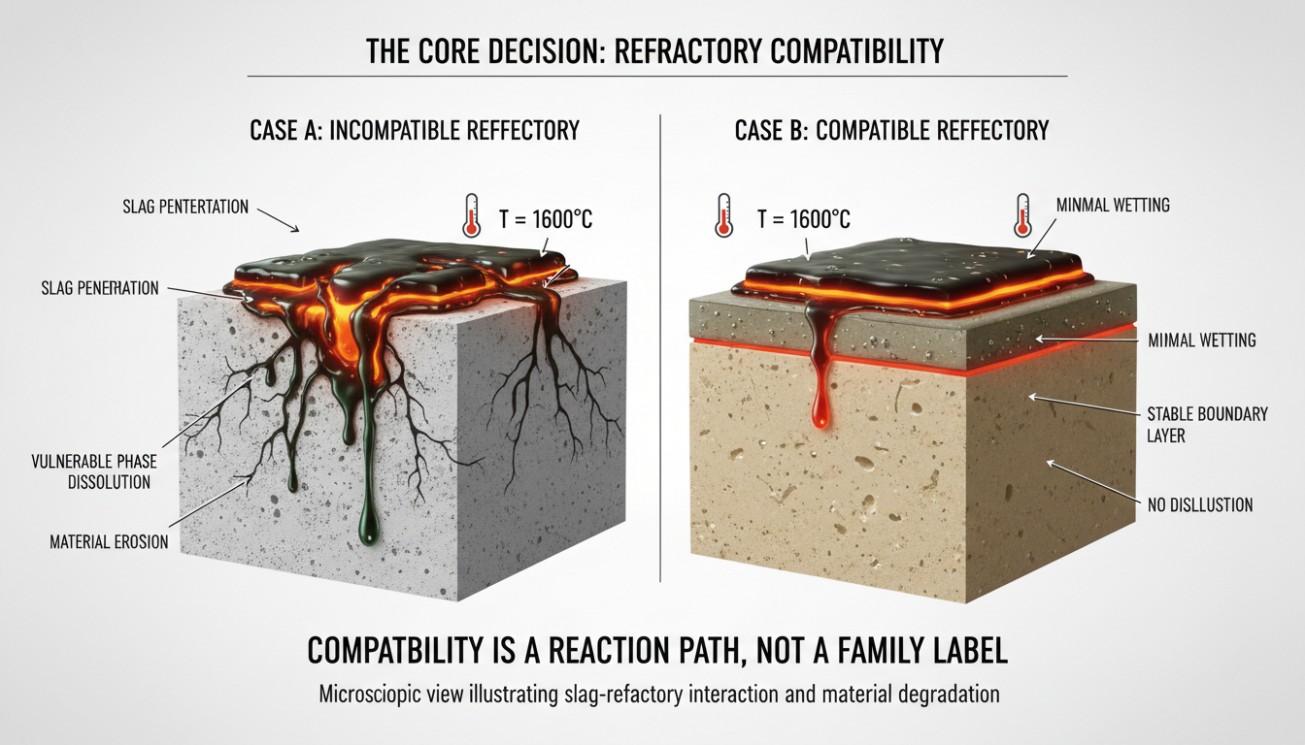
Cross-section comparing slag penetration and dissolution in incompatible and compatible refractory materials at 1600°C
2026-08-04

Slag–Refractory Reactions: Why Basicity Alone Cannot Predict Lining Life

A refractory may survive the temperature and still fail through wetting, penetration, dissolution or an unstable reaction layer. This guide explains how slag composition, redox conditions, viscosity and microstructure control attack—and how buyers and engineers can build laboratory and post-mortem evidence that predicts the real service reaction path.
Learn more
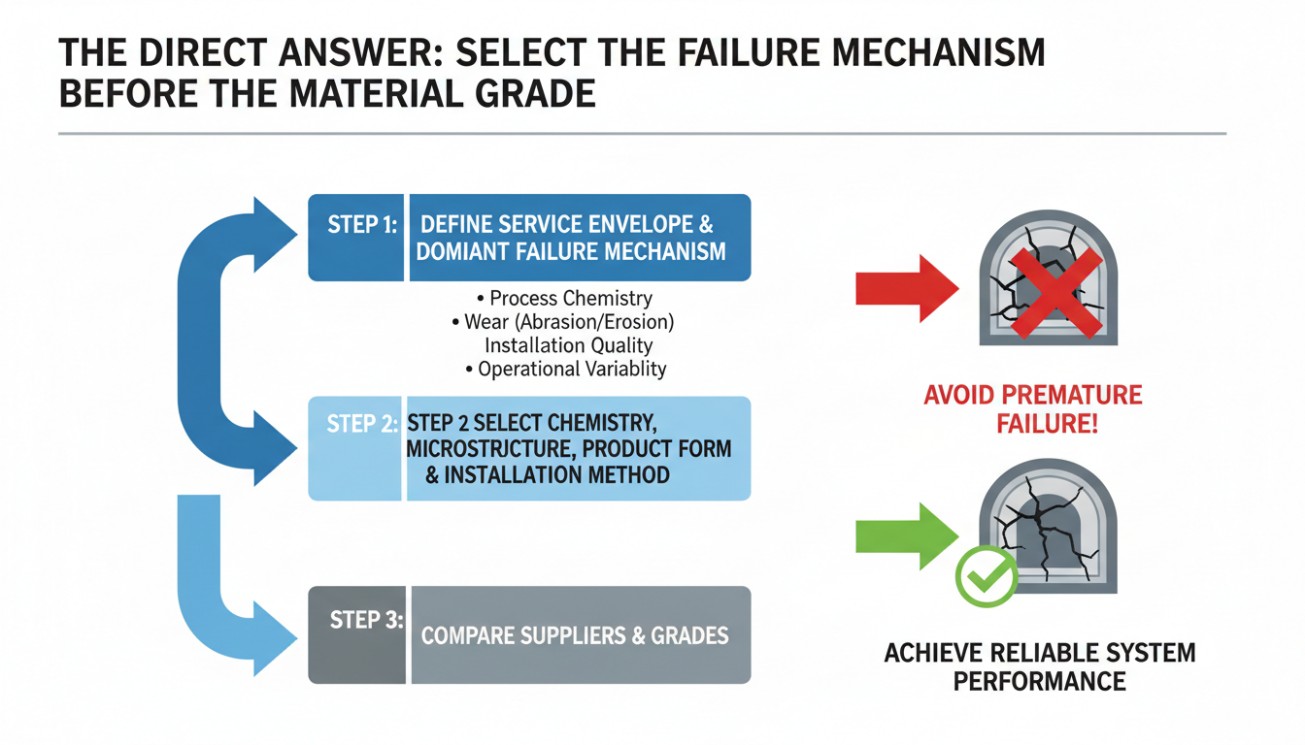
Three-step refractory selection framework based on service environment, failure mechanism, material design and supplier comparison
2026-08-03

Refractory Selection Starts with Process Chemistry, Not Maximum Temperature

A high-temperature rating does not prove that a refractory will survive a real furnace. This guide builds a failure-first selection method around slag and feed chemistry, atmosphere, thermal cycling, mechanical wear, lining geometry, installation and field validation—helping engineers and buyers specify materials for the actual service envelope rather than a single catalog number.
Learn more
Operator reviewing an industrial boiler water treatment system during supplier qualification.
2026-08-03

How to Qualify a Boiler Water Treatment Supplier: Evidence, Service and Lifecycle Risk

Chemical price reveals very little about whether a boiler water-treatment supplier can protect a steam system. This procurement guide shows how industrial plants can define the service boundary, test treatment claims, audit monitoring evidence, compare lifecycle cost and contract for measurable performance without outsourcing technical ownership.
Learn more
Cutaway of an offline industrial boiler showing retained water and oxygen exposure during shutdown.
2026-08-03

Boiler Layup Is Water Treatment Choosing Wet, Dry or Film-Forming Shutdown Protection

An offline boiler does not stop being a water-treatment asset. This guide shows how operators should choose and verify wet, dry, nitrogen-assisted or film-forming layup by corrosion mechanism, equipment boundary, shutdown uncertainty and restart requirements—not by outage duration alone.
Learn more
Laboratory forensic analysis of deposits inside a failed boiler tube
2026-07-31

Boiler Deposits Remember What Water Samples Forget: A Forensic Guide to Tube Risk

A normal boiler-water report only describes the present sample; deposits preserve the history of hardness leakage, corrosion products, contamination, heat flux and chemistry upsets. This forensic guide shows how to map deposit location, analyze tube samples, interpret under-deposit risk and decide whether to correct operation, clean chemically or replace damaged tubing.
Learn more
Boiler deaerator diagram showing five proofs for oxygen removal
2026-07-31

A Hot Deaerator Can Still Fail: How to Prove Oxygen Removal Across Boiler Loads

A deaerator can display the expected temperature and pressure yet still deliver oxygen-rich feedwater during startup, low load or sudden condensate changes. This guide builds a five-proof verification method for saturation, contact, venting, hydraulics and analytical response—helping plants separate mechanical failure from bad sampling or excess scavenger use.
Learn more
Industrial boiler condensate recovery system with return piping, analyzers and centralized monitoring controls.
2026-07-31

Condensate Return Is Not Distilled Water: Recover Heat Without Returning Contamination

Hot condensate carries valuable water and heat, but it can also return oxygen, corrosion products, oil, process chemicals and heat-exchanger leakage to the boiler. This guide shows how to classify each return branch, build monitoring and diversion gates, control condensate corrosion, and prove recovery value without turning the feedwater tank into a contamination collector.
Learn more
Boiler carryover transport paths showing high water level, stable foam, selective vaporization and downstream contamination.
2026-07-31

Boiler Carryover Is Not One Failure: Diagnose Priming, Foaming and Steam Contamination

Boiler carryover cannot be solved by one TDS result or valve adjustment. This guide separates priming, foaming, droplet entrainment, vaporous transport and downstream contamination, then shows how to preserve evidence, calculate carryover, map load-level-pressure risk, protect steam users and specify a defensible monitoring program.
Learn more
Boiler blowdown operating corridor balancing steam purity and solids control against excessive water and energy loss.
2026-07-31

Boiler Blowdown Is a Control Loop: Cut Water, Energy and Chemical Losses

Boiler blowdown should protect steam purity without sending treated, pressurized hot water to drain unnecessarily. This guide turns feedwater TDS, steam load, conductivity, bottom sludge removal and heat recovery into one operating control loop, with calculations, commissioning tests and buyer specifications for industrial boiler plants.
Learn more
Industrial boiler water treatment system with pretreatment vessels, chemical-feed equipment and boiler controls.
2026-07-31

One Boiler, Many Chemistries: How to Build the Right Chemical Treatment Program

Boiler treatment is not a universal product bundle. A workable program must match feedwater purity, boiler pressure, heat flux, metallurgy, condensate risk and operating state. This guide compares phosphate, polymer, chelant, oxygen-control, alkalinity and condensate-treatment strategies—and shows how to validate chemistry without creating a new failure mechanism.
Learn more
Dynamic boiler feedwater quality envelope linking makeup treatment, condensate integrity and operating-state limits
2026-07-31

Boiler Feedwater Quality: Set Limits from Source Water, Pressure and Condensate Return

Boiler feedwater is not a fixed utility specification. Its risk changes with source-water variability, pretreatment performance, condensate-return integrity, boiler pressure and operating state. This guide shows how plants can define a defensible feedwater envelope, detect contamination and select controls from measured system conditions.
Learn more
Industrial boiler water treatment plant integrating pretreatment, feedwater, steam use and condensate recovery
2026-07-31

Boiler Water Treatment Is a System, Not a Chemical: A Whole-Cycle Framework

Reliable boiler water treatment starts long before chemicals enter the boiler. This guide shows how makeup water, pretreatment, feedwater, internal chemistry, blowdown, steam purity, condensate return, monitoring, and operating discipline work together as one treatment system.
Learn more
Electrodialysis and reverse osmosis comparison showing ion transport versus water transport
2026-07-30

When Electrodialysis Beats RO: A Decision Framework for Industrial Water Reuse

Electrodialysis is not a low-pressure version of RO. This guide shows how charge, ion selectivity, current density, recovery, scaling, product quality and residual value determine whether ED, EDR, BMED, RO or a hybrid train is the stronger industrial water-reuse choice.
Learn more
Engineers reviewing membrane integrity testing on a multi-unit MF and UF filtration system
2026-07-30

Membrane Integrity Testing: Proving MF, UF and MBR Barrier Performance

A membrane barrier is only credible when its removal claim can be challenged, monitored, localized and restored. This guide explains direct and indirect integrity testing, control limits, breach response, repair verification and procurement requirements for MF, UF and MBR systems.
Learn more
Large municipal membrane bioreactor plant with biological basins, membrane trains and operations building
2026-07-30

MBR for Water Reuse: Why Membrane Flux Is Not the Starting Point

An MBR succeeds only when biological treatment, solids separation, aeration, cleaning and the reuse-water duty are designed as one system. This guide explains sustainable flux, fouling controls, configuration choices, commissioning evidence and procurement guarantees for municipal and industrial reuse projects.
Learn more
PFAS membrane treatment diagram showing compliant permeate and a concentrated residual stream that still requires responsible management.
2026-07-30

PFAS Removal by NF and RO: Why Rejection Is Only Half the Treatment Decision

NF and RO can create a strong PFAS barrier, but rejection alone does not complete the treatment decision. This guide shows how to define the PFAS target list, compare membrane options, pilot under representative conditions, monitor performance and manage the PFAS mass transferred into concentrate.
Learn more
Technicians installing replacement RO membrane elements in an industrial reverse osmosis system
2026-07-30

RO Membrane Replacement: How to Qualify Elements and Prove Startup Performance

Replacing an RO membrane is not a like-for-like purchasing exercise. The new element must match the system’s hydraulic, chemical, mechanical and regulatory envelope, while installation and startup must create a defensible new baseline. This guide explains how to choose the replacement scope, qualify alternatives and prove that the change succeeded.
Learn more
Industrial RO clean-in-place system with cleaning tank, circulation pump, cartridge filter and membrane vessels
2026-07-29

RO Membrane Cleaning: Design a CIP That Restores Performance Without Causing Damage

A successful RO clean-in-place cycle is not defined by stronger chemicals. It begins with normalized evidence, identifies the foulant, matches chemistry and hydraulics to the membrane, and proves recovery afterward. This guide shows operators, engineers and buyers how to build a defensible CIP strategy—and recognize when cleaning should stop.
Learn more
Operator monitoring an industrial batch and high-recovery RO system with multiple membrane trains
2026-07-29

Beyond Conventional RO: When Batch and High-Recovery Designs Make Sense

High recovery is not a percentage to maximize in isolation. This engineering guide compares conventional multistage RO, batch RO, CCRO and flow-reversal designs through concentration factor, cycle behavior, energy, permeate quality, scaling risk, automation, concentrate disposal and lifecycle economics.
Learn more
RO membrane fouling diagnosis workflow from measurement validation to cleaning, repair or continued operation
2026-07-29

Diagnose Before CIP: Reading RO Membrane Fouling Through Plant Performance Data

A falling permeate flow does not identify a foulant. This field guide shows how normalized trends, stage location, pressure drop, salt passage, vessel checks and laboratory evidence separate fouling, scaling, damage and false alarms before an RO plant commits to CIP.
Learn more
RO pretreatment flow showing clarification, multimedia filtration, cartridge filtration and membrane protection
2026-07-29

Why Good RO Membranes Fail: Pretreatment Decisions That Control Plant Reliability

RO elements rarely fail in isolation. This engineering guide traces how feed variability, clarification, filtration, oxidant control, metals, organics, microbiology and commissioning determine membrane reliability before water reaches the pressure vessel.
Learn more
Cooling tower makeup and high-pressure boiler feed compared by industrial water quality requirements
2026-07-29

MF, UF, NF or RO? Selecting the Right Membrane Barrier for Industrial Water

Choosing a membrane is not a contest for the tightest barrier. This engineering guide compares MF, UF, NF and RO through contaminant targets, feed variability, recovery, pretreatment, concentrate management, pilot evidence and lifecycle cost.
Learn more
  • 1
  • 2
  • 3
    Sitemap

    Industrial Components

    Kitchen Appliances

    Renewable Energy

    Building & Home Improvement

    Chemicals & Water Treatment

    Robotics & Automation

    Email:robertkileyman@gmail.com

    (508676)
    0
    Service

    Email
    comment