
Can AMRs Speed Up Warehouse Returns While People Inspect the Items
Where Do AMRs Fit in Warehouse Returns Automation?
Autonomous mobile robots can accelerate warehouse returns while people continue to inspect products. They can move identified containers between work areas, sort handling-compatible packages to assigned destinations, and support the putaway of approved stock. The benefit depends on whether movement and routing are constraining the operation. A faster robot cannot clear a queue whose limiting step is an unresolved inspection decision.
The purchasing question is therefore specific: where does a return wait after someone knows what should happen to it? An approved item may sit beside an inspection bench until a worker has enough stock to justify a long putaway trip. A scanned return bag may need to reach one of many merchant destinations. These are different opportunities from asking a machine to recognize damage or decide whether a product can be resold.
This guide examines AMR returns processing for retailers, fulfillment operators and third-party logistics providers. It focuses on physical handling inside the warehouse, with a worked capacity example and a practical way to specify the boundary between inspection, transport and inventory release.
Why Returns Robotics Is a Timely Question in October 2026
Two recent announcements give the subject immediate relevance. On October 20, Locus Robotics published research on consumer purchasing and returns behavior. Its survey of 1,000 U.S. adults reported that 61% of Gen Z apparel shoppers had bought multiple sizes or styles intending to keep only some, compared with 15% of Baby Boomers. These are reported behaviors among surveyed groups, not warehouse return rates or a forecast for every retailer.
On October 21, Universal Robots announced Teradyne Robotics' partnership with Sereact. The release describes robot-arm systems processing returned fashion items in CEVA Logistics operations for Zalando in Germany and Poland. This is evidence of an expanding returns-automation application. It does not establish that an ordinary mobile base can inspect merchandise, or that every condition-grading task has been automated.

For buyers, the useful connection is between changing incoming work and more specialized automation choices. Reverse logistics automation can combine software, human inspection, mobile transport, sortation and robotic manipulation. A proposal should identify which of those capabilities is included. The word “robotic” alone leaves too much of the process unspecified.
Locate the Delay Before Selecting the Robot
Follow a sample of returns from warehouse receipt to their actual next outcome. Record when the item arrives, when its identity becomes known, when inspection starts and finishes, when a disposition is authorized, and when the destination receives it. For goods approved for resale, also record when the inventory system makes them available for allocation.
Separate active work from waiting. Ten minutes of inspection followed by six hours waiting for a transport batch presents a different opportunity from six hours waiting for a specialist and ten minutes of movement. Both can look like a slow returns department in an end-of-day report. Only one is primarily a transport problem.
Count items as well as containers. A tote carrying twelve returns may require twelve product decisions even though the robot performs one journey. A supplier quoting container moves per hour has not yet established how many returned items the complete process will finish.
| Observed delay | Potential mobile-robot contribution | What still needs its own solution |
|---|---|---|
| Identified stock waits for transport to an inspection bench. | Deliver identified containers that meet the handling requirements when a receiving position is available. | Inspection staffing, bench capacity and workload assignment. |
| Approved goods wait for a person to make a long restocking trip. | Support transport and directed putaway. | Item placement, confirmation and inventory-release rules. |
| Return packages must be separated across many merchants. | Route identified, handling-compatible packages through a configured sorting system. | Induction, identity checks, destination availability and container changes. |
| Items have unclear identity or disputed condition. | Move them to a designated exception area if the handling process permits. | Investigation and the decision about their next permitted use. |
| Stock is physically stored but unavailable in the WMS. | Provide movement evidence for reconciliation. | Correct transaction processing and authorized status changes. |
Use this review to name the first automated task narrowly. “Move approved apparel totes from inspection to the putaway zone” is a scope that operations and suppliers can examine. “Automate returns” can conceal incompatible assumptions about unpacking, inspection, movement and refunds.
Choose Between Transport, Sorting and Assisted Putaway
Transport between processing stations
A transport AMR can carry a suitable tote, shelf or cart between receiving, inspection, repacking and storage areas. Specify who loads it, who unloads it, and whether it can leave the carrier behind. If a robot must remain parked while a worker inspects the entire load, its transport capacity becomes tied to the inspection cycle.
A drop-off arrangement can separate these resources, but it needs enough approved carriers and controlled buffer positions. Count those positions in the layout. Replacing a worker's walking time with a row of unidentified totes beside the bench would weaken the process even if travel becomes faster.
Sorting returns to assigned destinations
Returns sorting robots address another task: distributing identified items or packages among destinations. The customer account from Happy Returns explains its hub workflow: people open consolidated boxes and place individual return bags onto Geek+ S20C robots, which transport them to retailer-specific shipping containers. The workflow automates a routing movement while retaining human induction. It is not evidence that hub sorting makes the goods immediately available for resale.
The associated Geekplus case study, dated October 31, 2024, describes 150 sorting robots at the Pennsylvania return hub. This established deployment is useful operating context, rather than a new October 2026 launch.
Returning approved inventory to storage
Automated returns putaway may combine mobile robots with workers who place items at their assigned locations. Locus Robotics' nGroup case study describes a reverse-logistics putaway operation integrated with Optoro, replacing substantial manual cart movement. The relevant lesson is the task boundary: the deployment addressed returned-goods movement and putaway. It should not be presented as proof that the same system autonomously judged every product's condition.
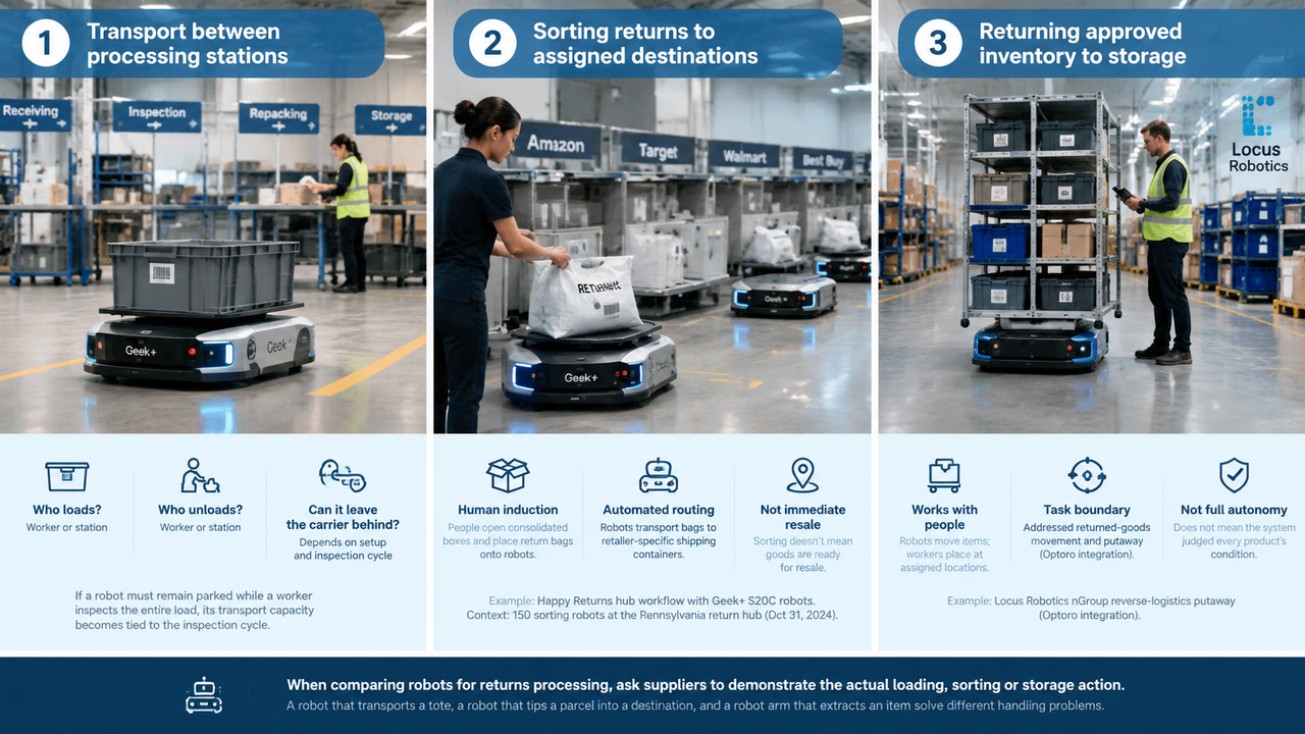
When comparing robots for returns processing, ask suppliers to demonstrate the actual loading, sorting or storage action. A robot that transports a tote, a robot that tips a parcel into a destination, and a robot arm that extracts an item solve different handling problems.
Keep Product Identity Separate from Its Return Status
A barcode can identify a SKU without proving that the particular returned unit is saleable. Two units of the same SKU may have different conditions, packaging and permitted destinations. For a multi-client warehouse, merchant ownership introduces another distinction. The routing record needs enough detail to prevent visually similar goods from entering the wrong inventory pool.
For the proposed pilot, define the data needed to move each load: the return reference, product or unit identity where required, quantity, merchant or owner, carrier identifier, current processing state, authorized destination and relevant timestamps. Add serial or batch tracking where the product and business process require it. These are fields to agree with the existing systems team, not a requirement to create a new database for every project.
Make the meaning of “complete” explicit. A robot mission can finish while a return is still waiting for inspection. A physical putaway can finish while a business transaction is pending. Neither event should silently overwrite the product's inspection outcome.
There are established software mechanisms for this separation. Microsoft's Dynamics 365 documentation explains how a received item's disposition code can determine inventory status, work templates and location directives. Its returned-item inspection workflow also distinguishes examination, disposition and release. Those are examples from a particular platform; another WMS may implement the controls differently.

For WMS returns integration, require a demonstration of three ordinary exceptions: the wrong item is scanned into a carrier, the destination becomes unavailable, and the completion message is delayed after physical delivery. The process should preserve a traceable location and status while the discrepancy is resolved. Sending the same completed movement again is not a sensible substitute for reconciling its record.
Where the load crosses an automated station interface, the site's guide to AMR material-handoff confirmation addresses physical transfer evidence in more detail.
Calculate Return-to-Stock Output Across the Whole Process
A capacity comparison needs a shared unit of measure. The example below uses individual returned items per hour, with a separate count for items approved for resale. It does not compare robot missions with inspection decisions as though they were interchangeable.
Illustrative planning example: the following figures are original assumptions for this guide. They are not customer results, supplier specifications or recommended operating targets. This is a fixed-rate flow comparison after startup, with a stable product mix and sufficient buffers for the modeled interval. The operation is not in a balanced steady state because arrivals exceed inspection capacity.
Suppose a warehouse receives 600 returned items per hour. Six inspection stations each complete 80 items per hour, producing a combined inspection capacity of 480. Assume 75% of inspected items qualify for resale and can move directly into the approved-stock putaway process. The remaining 25% take other adequately resourced paths.
The inspection stage therefore supplies 480 × 75% = 360 approved items per hour. The existing putaway arrangement can handle only 300 approved items per hour. A proposed AMR-assisted arrangement is assumed to raise that putaway capacity to 500. These are effective capacities for the complete putaway process, including placement and inventory release, with no additional downstream constraint.
The comparison excludes temporary output gained by clearing an existing approved-stock backlog. Other disposition paths have sufficient resources, do not block inspection and do not feed repaired items back into the resale path during this interval. Those assumptions keep the calculation focused on newly inspected returns.
| Measure | Before the change | With the proposed AMR-assisted putaway |
|---|---|---|
| Incoming returns | 600 items/hour | 600 items/hour |
| Inspection capacity | 480 items/hour | 480 items/hour |
| Approved-for-resale flow from inspection | 360 items/hour | 360 items/hour |
| Available putaway capacity for approved items | 300 items/hour | 500 items/hour |
| Sustained return-to-stock output | 300 items/hour | 360 items/hour |
| Growth of the queue awaiting inspection | 120 items/hour | 120 items/hour |
In this simplified model, putaway capacity rises by about 67%, but return-to-stock output rises by only 20%, from 300 to 360 items per hour. Inspection now limits the approved flow. The new arrangement stops the previous growth of the approved-stock putaway queue under these assumptions, but the uninspected queue continues growing.
If the same rates persist for eight operating hours, 960 additional items accumulate before inspection. The warehouse has improved one part of the process without balancing incoming demand. A robot utilization dashboard alone would not reveal whether that unresolved queue is acceptable.
This is a planning check, not a discrete-event simulation. Real performance also depends on arrival bursts, processing-time variation, breaks, destination congestion and stock already waiting at the start. Use the calculation to expose a missing capacity question, then validate the complete process with representative operating data.
Handle Mixed Products and Exceptions Without Losing the Flow
Returns inspection can produce changing handling requirements. A product that arrived inside a rigid shipping carton may leave the bench in a flexible bag. A damaged package may need an approved supporting tote before transport. The outbound packaging specification is therefore not sufficient evidence for the return journey.
Build the acceptance sample around the units the robot will actually carry or transfer. Include light and heavy containers, uneven weight distribution, labels in their expected positions, incomplete packages and normal variation in container condition. Products outside the agreed handling envelope need a defined alternative route.
Separate exceptions that require a product decision from exceptions caused by the automation. “Awaiting condition assessment” is different from “barcode unreadable at induction.” Combining both under a generic manual-intervention code makes it difficult to identify whether additional labor, better data or a changed handling design would help.
For each exception, specify where the item waits, how it retains its identity, who owns the next action and how it re-enters normal flow. Do the same for a destination container that becomes full. Repeatedly presenting work to an unavailable destination can consume robot capacity without resolving the reason for the blockage.

Keep unsuitable or potentially hazardous returned goods within the site's approved handling procedures. A general-purpose returns route should not become an automatic destination for every item simply because the carrier fits on the robot.
Protect Outbound Service When Returns Share the Fleet
Peak season returns may compete with outbound picking for the same people, aisles, carriers, charging resources and workstations. A shared fleet can be useful, but its business priorities must be explicit. Giving every outbound task immediate priority can leave returned stock waiting indefinitely; allowing returns to consume all available service can threaten dispatch commitments.
Evaluate the proposed policy using the site's actual order calendar. Include the period when return arrivals overlap with outbound demand, rather than assuming the two workloads peak on different days. Record whether each supplier's capacity estimate includes both workloads running together.

A practical trial can compare protected returns service windows with a continuously shared queue that escalates aging work. The right policy depends on receiving patterns and promised service. Set an operating limit for how long approved stock may wait and define who can change priorities when the business mix shifts.
Measure the outbound consequence as well as the returns benefit. More returned items reaching stock is useful only if the operation understands any change in late orders, packing congestion or replenishment delays. For a broader measurement framework, see the site's AMR fleet performance guide.
Buy a Measurable Outcome and Test the Remaining Human Work
Start the pilot with a defined product group, processing area and destination set. Preserve the original inspection rules unless inspection automation is explicitly part of the project. This makes it easier to determine whether the mobile system improved the selected handling task.
Track return-to-stock time from warehouse receipt to confirmed availability for allocation for the resale-eligible items. Report the time awaiting inspection, the time awaiting movement and the final transaction delay separately. Also show the age and count of unfinished items; a report containing only completed returns can hide the oldest backlog.
Use the pilot to measure labor across the whole work area. Walking may fall while loading, relabeling, container changes or exception support increase. Distinguish released working hours from an actual reduction in scheduled labor, and check whether time saved is absorbed by useful additional work.
Request a quotation that identifies the remaining tasks and their staffing assumptions. Include carriers, interfaces, software work, training, support, changes to benches and storage positions, and the treatment of excluded products. When comparing costs, use the same item mix, inspection policy and service requirement for every option.
The acceptance demonstration should include ordinary disruptions: a full destination, a missing label, a return whose status changes, and a temporary pause at an inspection station. Ask what happens to the affected item and to the surrounding flow. A successful empty-floor journey is only a small part of a returns process.
The purchase decision should turn on an agreed improvement in completed, correctly routed returns. Some warehouses will benefit from mobile transport first; others need inspection capacity, simpler disposition rules or clearer inventory records before adding robots. The baseline measurements should identify which intervention addresses the current constraint.
Focused FAQ
Can AMRs speed up warehouse returns without automated inspection?
Yes. People can retain identification, condition assessment and disposition decisions while suitable AMRs transport containers, sort identified packages within the handling specification or support putaway. The proposal must define the handled unit, loading method, destination rules and completion evidence. Transport capability does not establish inspection capability.
Are returns sorting robots the same as transport AMRs?
Not necessarily. A sorting system includes a way to direct identified, handling-compatible loads to destinations, such as a configured discharge mechanism and destination layout. A transport AMR may simply carry a container between stations. Compare the complete handling action, not just the vehicle's ability to navigate.
Can the same robots handle outbound orders and returns?
Potentially, if the equipment, software and workflow support both tasks. Test the overlap using representative demand and explicit priorities. Shared hardware does not eliminate competition for stations, carriers, routes or staff, and a return's inspection status must remain intact.
Does faster putaway always reduce the returns backlog?
It can reduce the queue of approved goods waiting for storage. It may leave an earlier inspection backlog unchanged. Measure each queue separately and calculate completed output using the limiting stage and the fraction of returns eligible for the destination being measured.
When should a returned item become saleable inventory?
At the event defined by the retailer's approved process, after the required checks and inventory transactions. A robot's arrival or mission-complete message alone is insufficient. Physical location, product condition and allocation status need consistent records.
What should a buyer request before ordering robots?
Request a process map, representative item and carrier samples, measured waiting times, an integration responsibility matrix, a capacity model and a pilot acceptance plan. Require a clear account of the human work that remains and the exceptions that the proposed automation cannot handle.
Editorial note: researched October 22, 2026. Recent announcements, customer accounts and software documentation are linked at the relevant claims. Vendor and survey statements are attributed. The capacity example and buyer evaluation framework are original editorial analysis; they are not performance guarantees for another operation.


